
MCAT-130 · Lesson 1 of 12 · 25 min
Sensation and perception
▶ Video coming soon A video version of this lesson is on the way.
The Psych/Soc block of the Sunday Session began with a picture on the shared screen: two horizontal lines of equal length, one with arrowheads pointing in and one with arrowheads pointing out. Everyone knew the trick. 'They are the same length,' Elliot said, 'but the bottom one still looks longer.' Thandiwe nodded. 'Knowing the answer does not change what you see. That is the first lesson of perception: the eye delivers data, and the brain builds a story from it. Today we separate the two.' Ezequiel, whose diagnostic Psych/Soc score of 126 was his best section, admitted that he had always found this material easy to read and hard to pin down on questions. 'That is common,' she said. 'Psych/Soc rewards precise vocabulary. You do not get credit for the gist.'
This lesson covers content category 6A, "Sensing the environment", part of foundational concept 6 in the Psychological, Social, and Biological Foundations of Behavior section. About 65 percent of the section draws on introductory psychology, about 30 percent on introductory sociology and about 5 percent on introductory biology, and sensation and perception is where psychology meets biology most directly. Expect passages that describe a perception experiment, a patient with a sensory deficit or a study of thresholds, followed by questions that test whether you can name the process involved and reason about the design.
Sensation versus perception
Sensation is the detection of physical energy by sensory receptors and its conversion into neural signals. Perception is the organization and interpretation of those signals into meaningful experience. A photoreceptor absorbing light is sensation; recognizing that the light pattern is a friend's face is perception. The conversion step has its own name, transduction: the process by which a receptor turns a physical stimulus (light, pressure, a chemical, sound waves) into a change in membrane potential and, eventually, action potentials.
Processing runs in two directions. Bottom-up processing starts with the stimulus: features are detected and assembled into a whole. Top-down processing starts with knowledge, expectation and context, which shape how the input is interpreted. Reading messy handwriting is a good example of top-down help: you recognize a smudged word because the sentence around it predicts it. MCAT questions often describe an effect of expectation or context and ask which kind of processing it shows. If prior knowledge or context changes what is perceived, the answer is top-down.
Thresholds and psychophysics
Psychophysics studies the relationship between physical stimuli and the experiences they produce. Its classic concepts appear on almost every Psych/Soc form.
- The absolute threshold is the minimum stimulus intensity that a person can detect 50 percent of the time. It is not a fixed point; it varies with fatigue, attention and expectation.
- The difference threshold, or just noticeable difference (JND), is the smallest change in a stimulus that can be detected 50 percent of the time.
- Weber's law states that the JND is a constant proportion of the original stimulus, not a constant amount. If the JND for weight is about 2 percent, a person holding 100 grams notices a change of about 2 grams, but a person holding 1,000 grams needs a change of about 20 grams.
- Subliminal stimuli are below the absolute threshold for conscious detection. Some studies find small priming effects from such stimuli, but claims that subliminal messages can produce large changes in behaviour are not supported.
Weber's law gives you a quick way to answer calculation-light questions. Ask what fraction the change represents. A passage reports that participants could just detect a change from 50 to 52 decibels of a reference tone and asks what change would be detectable from a much louder reference. You do not need decibel physics; you need to recognize that the detectable change grows with the reference, in proportion.
Signal detection theory
Signal detection theory recognizes that detecting a stimulus is a decision made under uncertainty. A radiologist reading an image, a lifeguard scanning the water and a participant listening for a faint tone all face the same problem: the signal is mixed with noise, and the observer must decide whether the signal was present. Each trial has four possible outcomes.
| Observer says "yes" | Observer says "no" | |
|---|---|---|
| Signal present | Hit | Miss |
| Signal absent | False alarm | Correct rejection |
Two separate quantities describe performance. Sensitivity (often written d prime) is the observer's ability to tell signal from noise; it depends on the strength of the signal relative to the noise and on the observer's sensory capacity. The response criterion, or bias, is the observer's willingness to say yes. A liberal criterion produces many hits but also many false alarms; a conservative criterion produces few false alarms but more misses. Context shifts the criterion. A lifeguard told that a child is missing will say yes more readily; a participant penalized for false alarms will become more conservative.
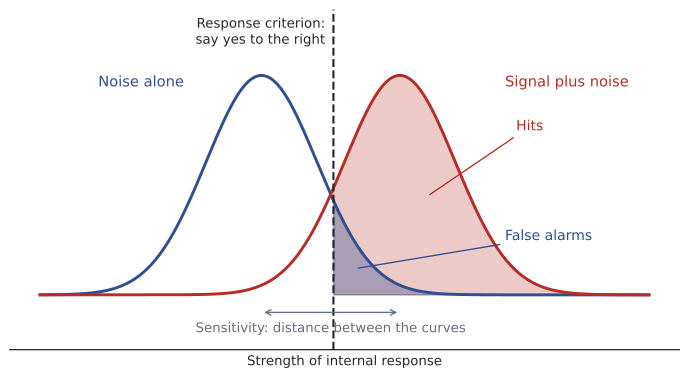
The key reasoning step is to keep sensitivity and bias apart. If an intervention raises both hits and false alarms, the observer has probably shifted criterion, not become more sensitive. If hits rise while false alarms fall, sensitivity has improved. Questions built on medical screening use exactly this logic: a test threshold set lower catches more true cases but flags more healthy people.
Sensory adaptation and habituation
Sensory adaptation is a decrease in receptor responsiveness during constant stimulation. You stop feeling your watch on your wrist because the touch receptors adapt. Adaptation happens at the level of receptors and early neural processing, so it is a sensory event. Habituation, covered in lesson 4, is a decrease in a behavioural response to a repeated stimulus and is a simple form of learning. The two are easy to confuse. If the passage describes receptors or neurons firing less, think adaptation; if it describes a person or animal responding less while the sense organ still works, think habituation.
Vision
Light enters the eye through the cornea, passes through the pupil (whose size is set by the iris) and is focused by the lens onto the retina. The retina contains two kinds of photoreceptors.
| Feature | Rods | Cones |
|---|---|---|
| Number | About 120 million per eye | About 6 million per eye |
| Location | Mostly peripheral retina | Concentrated in the fovea |
| Light sensitivity | High; work in dim light | Lower; need brighter light |
| Colour vision | No | Yes; three types (short, medium and long wavelength) |
| Acuity | Low | High |
Photoreceptors pass signals to bipolar cells and then to ganglion cells, whose axons form the optic nerve. Where the optic nerve leaves the eye there are no receptors, creating a blind spot that the brain fills in. At the optic chiasm, fibres from the nasal half of each retina cross to the opposite side, so that information from the left visual field of both eyes goes to the right hemisphere and the reverse. Most fibres continue to the lateral geniculate nucleus of the thalamus and then to primary visual cortex in the occipital lobe.
Passages about lesions use this wiring. Damage to one optic nerve causes blindness in that eye. Damage to the middle of the optic chiasm, as from a pituitary tumour pressing upward, cuts the crossing nasal fibres and produces loss of both outer (temporal) visual fields. Damage to the optic tract or visual cortex on one side causes loss of the opposite visual field in both eyes.
Two theories of colour vision are both correct at different levels. Trichromatic theory (Young-Helmholtz) states that colour depends on the relative activity of three cone types; it explains colour mixing and most colour blindness. Opponent-process theory (Hering) states that later processing works in opposing pairs: red versus green, blue versus yellow and black versus white. It explains afterimages: stare at a green square and then at a white wall, and you see a red square, because the green channel has fatigued.
Visual cortex processes features in parallel. Hubel and Wiesel found neurons tuned to lines of particular orientations, called feature detectors. Information then flows along two broad streams: a ventral stream to the temporal lobe that identifies what an object is, and a dorsal stream to the parietal lobe that handles where it is and how to act on it. Parallel processing means that colour, motion, form and depth are analysed at the same time by different populations of neurons. Damage to one area can therefore remove one ability, such as recognizing faces (prosopagnosia) or perceiving motion, while leaving others intact.
Hearing and balance
Sound waves are funnelled by the outer ear to the tympanic membrane, which vibrates the three ossicles of the middle ear (malleus, incus and stapes). The stapes pushes on the oval window of the fluid-filled cochlea in the inner ear. Waves in the cochlear fluid move the basilar membrane, and hair cells on it bend against the tectorial membrane, opening mechanically gated ion channels. That is transduction for hearing. The auditory nerve carries signals through the brainstem and the medial geniculate nucleus of the thalamus to auditory cortex in the temporal lobe.
Pitch is encoded in two ways. Place theory holds that different frequencies cause peak vibration at different places along the basilar membrane: high frequencies near the base, by the oval window, and low frequencies near the apex. Frequency theory, also called temporal theory, holds that for low frequencies, neurons fire in time with the sound wave. Both mechanisms operate. Loudness is encoded by the number of hair cells activated and their firing rate.
Hearing loss comes in two main types. Conductive loss involves the outer or middle ear (wax, fluid, damaged ossicles) and often responds to medical treatment or amplification. Sensorineural loss involves hair cells or the auditory nerve; loud noise and aging destroy hair cells, typically high-frequency ones near the base first. Cochlear implants bypass damaged hair cells by stimulating the auditory nerve directly.
The vestibular system, also in the inner ear, senses balance and head movement. The semicircular canals detect rotational acceleration, and the utricle and saccule (the otolith organs) detect linear acceleration and head tilt. Mismatch between vestibular and visual signals is the usual explanation offered for motion sickness.
The other senses
- Taste (gustation): taste receptor cells in taste buds detect sweet, sour, salty, bitter and umami. Much of what we call flavour depends on smell.
- Smell (olfaction): olfactory receptor neurons in the nasal epithelium bind odorant molecules. Olfaction is unusual because its signals reach the olfactory bulb and cortex without first passing through the thalamus, and it has close links to the amygdala and hippocampus, which may explain why smells evoke vivid memories.
- Pheromones: chemical signals that affect behaviour within a species. Their role in humans is debated.
- Somatosensation: receptors in the skin detect pressure, vibration, temperature and pain. Pain receptors, called nociceptors, respond to potentially damaging stimuli.
- Gate control theory of pain: signals from large touch fibres can close a "gate" in the spinal cord and reduce pain signals carried by small fibres, which is one reason rubbing an injury helps.
- Kinesthesia and proprioception: receptors in muscles, tendons and joints report body position and movement.
Ezequiel recognized gate control at once. 'When we splinted a broken wrist, patients always wanted to rub the arm above it,' he said. 'I thought it was just nerves.' Thandiwe told him that was exactly the right instinct: 'Nerves, specifically large fibres competing with small ones at the spinal cord. Now say it in the passage vocabulary.'
Perceptual organization: Gestalt principles
Gestalt psychologists argued that the whole is perceived as more than the sum of its parts, and that the brain groups elements according to consistent rules.
| Principle | What it says | Everyday example |
|---|---|---|
| Proximity | Elements close together are grouped | Rows of dots seen as columns when spaced closer vertically |
| Similarity | Similar elements are grouped | Seeing a pattern of light and dark squares as stripes |
| Continuity | Smooth continuous lines are preferred over abrupt changes | Two crossing curves seen as two lines, not four pieces |
| Closure | Gaps are filled to form complete shapes | A circle with a small gap still looks like a circle |
| Figure-ground | Scenes are split into an object and a background | The face-vase illusion flips between two figures |
| Common fate | Elements moving together are grouped | A flock of birds seen as one shape |
Gestalt principles are a form of top-down organization built into perception. The Law of Pragnanz, sometimes called the law of simplicity, summarizes them: people tend to perceive the simplest, most stable interpretation available.
Depth, constancy and motion
Depth perception uses binocular cues, which need both eyes, and monocular cues, which work with one. Binocular cues are retinal disparity (each eye sees a slightly different image, and the difference grows as objects come closer) and convergence (the eyes turn inward more for near objects). Monocular cues include relative size, interposition (a nearer object blocks a farther one), relative height, linear perspective, texture gradient, shading and motion parallax (near objects seem to move faster than far ones as you move).
Perceptual constancy is the perception of objects as stable even as the sensory input changes. A door seen at an angle still looks rectangular (shape constancy); a friend walking away does not seem to shrink (size constancy); a white shirt looks white in dim light (lightness or brightness constancy); a red apple looks red under different lighting (colour constancy). Constancies are top-down corrections based on experience, and illusions often arise when those corrections misfire. The Müller-Lyer illusion on Thandiwe's opening slide is commonly explained by depth cues: the arrowheads resemble the corners of a room or a building, and the brain adjusts perceived size for apparent distance. That explanation is debated, and cross-cultural studies have found differences in susceptibility, which is a reminder that experience shapes perception.
A passage-style example
Thandiwe gave the group a short invented study to practise signal detection reasoning.
Worked problem
A screening study
Researchers trained 40 nurses to detect a subtle sign of infection in wound photographs. Half the photographs showed the sign. Before training, nurses had a hit rate of 60 percent and a false alarm rate of 20 percent. After a training session on the sign's appearance, hit rates rose to 80 percent and false alarm rates fell to 10 percent. A second group was not trained but was told that infections were 'very common this month'; their hit rate rose to 80 percent and their false alarm rate rose to 40 percent. (Data invented for this course.) What changed in each group?
Show solution
- Compare hits and false alarms together, not hits alone.
- In the trained group, hits rose and false alarms fell: the nurses became better at separating signal from noise. That is an increase in sensitivity.
- In the told group, hits and false alarms both rose: the nurses became more willing to say yes without becoming more accurate. That is a more liberal criterion.
- Check the design: the told group received no training, so their change is attributable to expectation, a top-down influence.
Answer: Training increased sensitivity; the warning shifted the response criterion toward saying yes (a liberal bias) without improving sensitivity.
Notice that the passage gave you both rates for both groups. A question that offers 'the told group became more sensitive' is a trap built for students who look only at hit rates.
How 6A shows up on the test
Elliot, a neuroscience major, found the anatomy easy and the definitions slippery. In his diagnostic he had confused absolute threshold with JND and transduction with perception. Thandiwe asked him to write a one-line definition of each term in his own words and to add an example the next time he missed one. 'Psych/Soc is a vocabulary test wearing a science costume,' she said. 'The passages are readable. The answers turn on one precise word.' Devika added two items to her error log under the label 'name the level': whether a process happens in the receptor, in early neural pathways or in interpretation.
When you read a 6A passage, ask three questions. What stimulus is being detected and by which receptor? Is the reported effect about detection (sensation, thresholds, adaptation) or interpretation (perception, organization, constancy, expectation)? And in an experiment, which variable was manipulated and what would the results look like if a different process were responsible? Those three questions sort most answer choices quickly.
Common mistakes
MistakeWeber's law says the JND is a fixed amount for each sense.
InsteadThe JND is a constant proportion of the original stimulus, so it grows as the stimulus grows.
MistakeAn observer whose hits and false alarms both rose has become more sensitive.
InsteadThat pattern shows a shift to a more liberal criterion; sensitivity rises when hits rise and false alarms fall.
MistakeSensory adaptation and habituation are the same thing.
InsteadAdaptation is reduced receptor responsiveness; habituation is a learned decrease in a behavioural response.
MistakeRods provide colour vision in dim light.
InsteadRods are colour-blind and work in dim light; cones provide colour and acuity and need brighter light.
MistakePlace theory and frequency theory are rival theories, and only one is correct.
InsteadBoth operate: place coding for higher frequencies and timing for lower ones.
Summary and key terms
- Sensation is detection and transduction of physical energy; perception is organization and interpretation.
- Bottom-up processing builds from features; top-down processing uses knowledge, expectation and context.
- Absolute thresholds, JNDs and Weber's law describe the limits of detection; signal detection theory separates sensitivity from response bias.
- In vision, nasal fibres cross at the optic chiasm; trichromatic and opponent-process theories explain colour at different stages; feature detection and parallel processing occur in visual cortex.
- Hearing transduction happens in cochlear hair cells; pitch is coded by place and timing; the vestibular system senses balance.
- Gestalt principles, depth cues and perceptual constancies show how the brain organizes sensory input.
- Transduction
- Conversion of a physical stimulus into a neural signal by a sensory receptor.
- Absolute threshold
- The minimum intensity of a stimulus detected 50 percent of the time.
- Just noticeable difference
- The smallest change in a stimulus detected 50 percent of the time.
- Weber's law
- The principle that the just noticeable difference is a constant proportion of the original stimulus.
- Signal detection theory
- A model of detection as a decision under uncertainty, separating sensitivity from response bias.
- Top-down processing
- Perception guided by knowledge, expectation and context.
- Perceptual constancy
- Perceiving an object as unchanged in size, shape, lightness or colour despite changing sensory input.
- Retinal disparity
- The difference between the images seen by the two eyes, used as a binocular depth cue.
Practice problems
Work each problem on paper first, then reveal the answer to check.
A person can just detect the addition of 1 candle to a room lit by 50 candles. About how many candles must be added to a room lit by 200 candles to be just noticeable?
Show answer
About 4, because the JND is a constant proportion (1/50, or 2 percent) of the starting intensity.
A tumour presses on the middle of the optic chiasm. Which visual fields are most likely lost?
Show answer
Both temporal (outer) fields, because the crossing nasal fibres carry information from the temporal fields.
After staring at a yellow image, a person sees a blue afterimage on a white wall. Which theory explains this best?
Show answer
Opponent-process theory, which pairs blue with yellow in opposing channels.
Why does rubbing a bumped elbow reduce pain?
Show answer
Gate control theory: activity in large touch fibres reduces the transmission of pain signals in the spinal cord.
A new screening rule increases hits from 70 to 90 percent and false alarms from 10 to 30 percent. What changed?
Show answer
Mainly the criterion became more liberal; there is no evidence of improved sensitivity.
Lesson quiz · 5 questions
Score 60% or more to complete this lesson.
Create a free account to save your progress, take quizzes and earn a certificate.