
MCAT-130 · Lesson 8 of 12 · 21 min
Social behaviour: social thinking, attitudes and influence
▶ Video coming soon A video version of this lesson is on the way.
Thandiwe opened with a scenario. 'A patient arrives forty minutes late for an appointment. What is your first thought about why?' Elliot said, 'He is disorganized.' Devika said, 'Maybe the bus was late. Mine was this morning.' Ezequiel said, 'Could be either. In my experience, it is usually the bus.' Thandiwe smiled. 'Three answers, and the difference between them is the fundamental attribution error. Elliot explained the behaviour with a trait. Devika used a situation, because she had just been in it. Today we study how people explain and influence each other.'
This lesson covers content category 8B, "Social thinking", including attribution, prejudice, bias and stereotypes, and the parts of 7B that describe how the presence of others changes behaviour, including conformity and obedience. Social psychology passages are often built around classic experiments, so know each study's design and finding well enough to predict what a variation would show.
Attribution
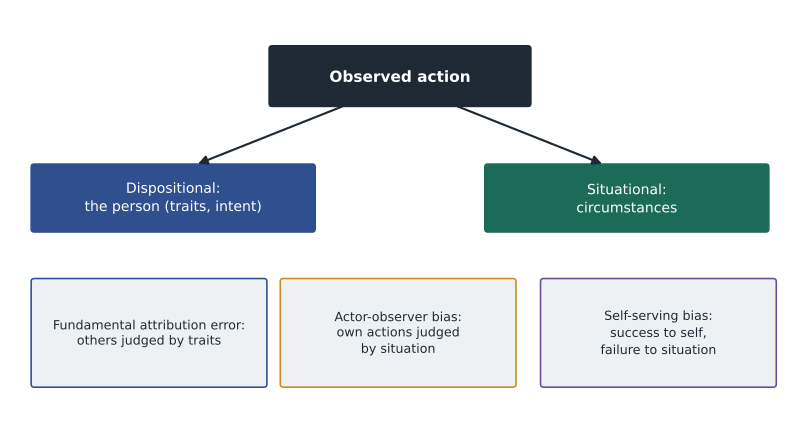
Attribution theory, developed by Fritz Heider, describes how people explain behaviour. A dispositional (internal) attribution explains behaviour by a person's traits or intentions: she failed the test because she did not study. A situational (external) attribution explains behaviour by circumstances: she failed because the test was unfair or she was ill. Harold Kelley's covariation model proposes that people use three kinds of information. Consistency asks whether the person behaves the same way in this situation over time. Distinctiveness asks whether the person behaves this way in other situations. Consensus asks whether other people behave the same way in this situation. High consensus, high distinctiveness and high consistency favour a situational attribution; low consensus, low distinctiveness and high consistency favour a dispositional one.
Several biases distort attributions.
- The fundamental attribution error is the tendency to overemphasize dispositional explanations and underestimate situational ones when explaining others' behaviour. It is weaker in many collectivist cultures, which tend to give more weight to context.
- The actor-observer bias is the tendency to explain one's own behaviour situationally and others' behaviour dispositionally.
- The self-serving bias is the tendency to attribute one's successes to internal factors and failures to external factors.
- The just-world hypothesis is the belief that people get what they deserve, which can lead to blaming victims.
- Optimism bias is the belief that bad events are more likely to happen to others than to oneself.
Prejudice, stereotypes and discrimination
These three terms map onto the ABC model of attitudes from lesson 4. A stereotype is a cognitive generalization about members of a group (the cognitive component). Prejudice is a negative attitude or feeling toward a group and its members (the affective component). Discrimination is unjustified negative behaviour toward members of a group (the behavioural component). Prejudice does not always produce discrimination, and discrimination can occur without individual prejudice, as in institutional discrimination built into policies and practices, discussed in lesson 11.
Several processes produce and maintain stereotypes. Categorization simplifies the social world but encourages overgeneralization. The out-group homogeneity effect is the perception that members of other groups are more alike than members of one's own group. In-group favouritism is preferring and giving more resources to one's own group. Illusory correlations are perceived relationships between variables that are not actually related, often formed when distinctive groups and distinctive behaviours are paired in memory. Confirmation bias helps stereotypes persist, as people notice and remember information that fits them.
Self-fulfilling prophecies occur when expectations cause behaviour that confirms them. In Robert Rosenthal and Lenore Jacobson's 1968 study, teachers were told that some randomly chosen students were likely to show unusual intellectual growth; those students later showed some gains on tests, which was attributed to teachers treating them differently. The size and reliability of the effect have been debated, but expectation effects in classrooms and clinics are well documented. Stereotype threat is the concern about confirming a negative stereotype about one's group, which can impair performance; Claude Steele and Joshua Aronson reported that Black students performed worse on a difficult verbal test when it was described as a measure of intellectual ability. Replication results for stereotype threat have been mixed, and effects appear smaller and more variable than early studies suggested.
Implicit biases are attitudes or stereotypes that operate without conscious awareness and may differ from a person's stated beliefs. They are often measured with reaction-time tasks such as the Implicit Association Test. How well such measures predict individual behaviour is debated, but research on implicit bias has influenced training in medicine and other fields. Prejudice can be reduced by contact between groups under supportive conditions, described by Gordon Allport's contact hypothesis: equal status, common goals, cooperation and support from authorities. The 'jigsaw classroom', in which students depend on each other to complete a task, and Muzafer Sherif's Robbers Cave study, in which hostile groups of boys cooperated when given shared goals, are commonly cited examples.
Ethnocentrism is judging other cultures by the standards of one's own and seeing one's own as superior. Cultural relativism is understanding other cultures on their own terms. Both concepts appear in sociology questions about culture, covered in lesson 10.
The presence of others
Social facilitation is the tendency to perform simple or well-learned tasks better, and complex or new tasks worse, in the presence of others. Robert Zajonc explained this as an effect of arousal: the presence of others increases arousal, which strengthens the dominant response. This fits the Yerkes-Dodson curve from lesson 5. Social loafing is the tendency to exert less effort in a group when individual contributions are not identifiable, as when people pull less hard on a rope as part of a team. Deindividuation is the loss of self-awareness and personal responsibility in groups, especially under anonymity and high arousal, and can lead to behaviour people would not show alone.
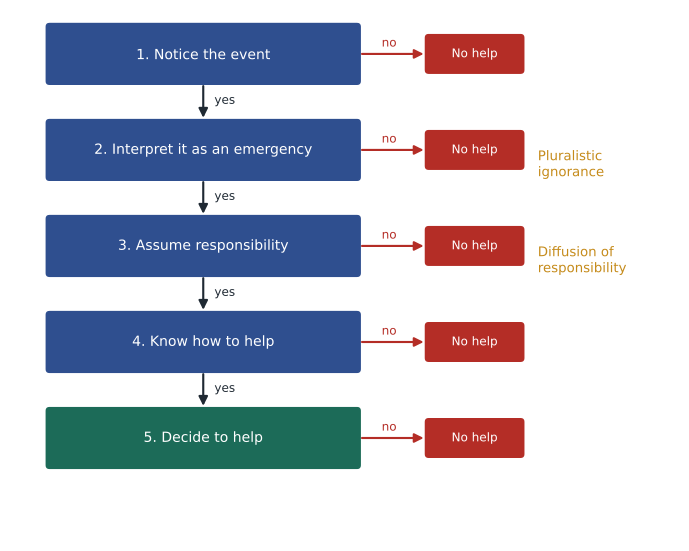
The bystander effect is the tendency for individuals to be less likely to help in an emergency when others are present. Bibb Latané and John Darley studied this after the 1964 murder of Kitty Genovese in New York, which was reported at the time as having been witnessed by 38 people who did nothing; later investigations found that this account was greatly exaggerated, but the research it inspired is well established. Latané and Darley proposed that bystanders must notice the event, interpret it as an emergency, assume responsibility, know how to help and decide to help. The presence of others can interfere at several steps, especially through diffusion of responsibility and pluralistic ignorance (assuming that because others are not reacting, there is no emergency).
Ezequiel said that his EMT training had included the counter to the bystander effect. 'When you need help at a scene, you point at one person and say, you in the red jacket, call 911,' he said. 'It kills the diffusion of responsibility.' Thandiwe noted that in Canada the number is the same.
Conformity
Conformity is adjusting behaviour or thinking to match a group standard. In Solomon Asch's 1950s line-judgment studies, participants judged which of three lines matched a standard line after hearing several confederates give the same wrong answer. Participants conformed on roughly a third of critical trials, and about three quarters conformed at least once. Conformity dropped sharply when a single other person gave the correct answer, and when responses were written privately.
Two types of social influence underlie conformity. Normative social influence is conforming to be liked or accepted; informational social influence is conforming because one believes others have accurate information. Muzafer Sherif's autokinetic effect studies, in which participants estimated how far a stationary point of light in a dark room seemed to move, showed informational influence: estimates converged on a group norm, especially when the situation was ambiguous. Conformity increases with group size up to a point, with group unanimity, cohesion and status, when responses are public and when people feel insecure. It varies across cultures and has been reported to be somewhat higher in collectivist societies.
| Type of influence | Motive | Typical situation | Example study |
|---|---|---|---|
| Normative | To be accepted and avoid rejection | Public responses, clear answers | Asch line judgments |
| Informational | To be correct | Ambiguous situations | Sherif autokinetic effect |
Obedience
Obedience is following the orders of an authority. In Stanley Milgram's studies in the early 1960s, participants were told they were in a study of learning and were instructed to give increasingly strong electric shocks to a 'learner' (a confederate who was not actually shocked) for each wrong answer. In the best-known version, about 65 percent of participants continued to the maximum shock of 450 volts, despite the learner's protests. Obedience decreased when the experimenter gave orders by telephone, when the learner was in the same room, when the participant had to place the learner's hand on a shock plate, and when other 'teachers' refused to continue. It increased when the authority was close and legitimate and the victim was distant.
Milgram's studies raised serious ethical concerns about deception and distress, and they helped prompt the development of modern research ethics rules, including informed consent and the right to withdraw. The Stanford prison study, mentioned in lesson 4, is also cited in discussions of the power of roles and situations, but its methods have been criticized more heavily.
Compliance techniques
Compliance is agreeing to a request without an explicit command. Several techniques are well documented.
- Foot-in-the-door: first making a small request, then a larger one.
- Door-in-the-face: first making a large request that is likely to be refused, then a smaller one, which then seems reasonable.
- Lowball: getting agreement to a deal and then adding costs.
- That's-not-all: adding extras to an offer before the person decides.
- Reciprocity: giving something first to create a feeling of obligation.
- Social proof and scarcity: indicating that many others agree, or that an offer is limited.
Devika recognized door-in-the-face from her pharmacy shifts. 'A customer asks us to hold an expensive brand for a month, we say no, and then she asks if we can just order one box. We always say yes.'
Group decision making
Group polarization is the tendency for group discussion to strengthen the initial leaning of group members, making the group's decision more extreme than the average of individual views. Groupthink, described by Irving Janis, occurs when a cohesive group's desire for agreement overrides realistic evaluation of alternatives. Symptoms include illusions of invulnerability and unanimity, self-censorship, pressure on dissenters and 'mindguards' who protect the group from contrary information. Groupthink is more likely with a directive leader, isolation from outside views and high stress. Remedies include encouraging dissent, assigning a devil's advocate and seeking outside opinions. Medical teams use structured approaches such as checklists and debriefs partly to counter these effects.
Worked problem
Analysing a conformity variation
Researchers repeated a line-judgment task with 60 participants in groups of seven, in which six confederates gave the same wrong answer on 12 critical trials. In condition 1, participants answered aloud; in condition 2, they wrote answers privately after hearing the confederates. Conformity occurred on 34 percent of critical trials in condition 1 and 12 percent in condition 2. (Data invented for this course.) What type of influence does the difference suggest?
Show solution
- Identify the manipulation: public versus private responding.
- Conformity dropped when answers were private, so much of the public conformity was about how others would react.
- Fear of disapproval reflects normative social influence; informational influence would persist in private, because the participant would genuinely believe the group.
- The remaining private conformity suggests some informational influence or genuine doubt.
Answer: Mostly normative social influence, with a smaller informational component.
Common mistakes
MistakeThe fundamental attribution error is explaining one's own failures by the situation.
InsteadThat is part of the self-serving and actor-observer biases; the fundamental attribution error is overusing dispositions to explain others' behaviour.
MistakePrejudice and discrimination mean the same thing.
InsteadPrejudice is an attitude; discrimination is behaviour.
MistakeSocial facilitation means people always perform better in front of others.
InsteadPerformance improves for simple or practised tasks but worsens for complex or new ones.
MistakeConformity in Asch's study reflected informational influence.
InsteadThe answer was obvious, so conformity mainly reflected normative influence; Sherif's ambiguous task shows informational influence.
MistakeGroup polarization means groups become more moderate after discussion.
InsteadDiscussion tends to push groups further in the direction members already leaned.
Summary and key terms
- People make dispositional or situational attributions using consistency, distinctiveness and consensus; the fundamental attribution error, actor-observer bias and self-serving bias distort them.
- Stereotypes, prejudice and discrimination correspond to the cognitive, affective and behavioural components of attitudes.
- Self-fulfilling prophecies, stereotype threat and implicit bias show how expectations shape behaviour; intergroup contact under supportive conditions can reduce prejudice.
- Social facilitation, social loafing, deindividuation and the bystander effect describe how the presence of others changes behaviour.
- Conformity reflects normative and informational influence (Asch, Sherif); obedience to authority was demonstrated by Milgram.
- Compliance techniques and group processes such as polarization and groupthink affect decisions.
- Fundamental attribution error
- The tendency to overemphasize dispositional explanations for others' behaviour.
- Self-serving bias
- Attributing successes to oneself and failures to circumstances.
- Stereotype threat
- Anxiety about confirming a negative stereotype that can impair performance.
- Social facilitation
- Improved performance on simple tasks and impaired performance on complex tasks in the presence of others.
- Diffusion of responsibility
- Reduced personal responsibility to act when others are present.
- Normative social influence
- Conforming to gain acceptance or avoid rejection.
- Groupthink
- Faulty decision making in cohesive groups that prioritize agreement over critical evaluation.
- Door-in-the-face technique
- Making a large request that is refused, followed by a smaller request that is more likely to be accepted.
Practice problems
Work each problem on paper first, then reveal the answer to check.
A student who aced a test credits her intelligence; when she fails the next one, she blames the noisy room. Which bias is this?
Show answer
The self-serving bias.
A group of people sees smoke coming under a door, but nobody reacts, so each assumes it is nothing. Which concept explains this?
Show answer
Pluralistic ignorance, a contributor to the bystander effect.
A skilled pianist plays better in front of an audience, while a beginner plays worse. What explains this?
Show answer
Social facilitation: arousal strengthens the dominant response, which is correct for experts and error-prone for beginners.
In Milgram's studies, what happened to obedience when the experimenter gave instructions by telephone?
Show answer
It decreased substantially.
Members of a committee who lean slightly toward approving a risky project leave discussion strongly in favour. What is this called?
Show answer
Group polarization.
Lesson quiz · 5 questions
Score 60% or more to complete this lesson.
Create a free account to save your progress, take quizzes and earn a certificate.