
MCAT-130 · Lesson 10 of 12 · 22 min
Social structure: theories, institutions, culture and demographics
▶ Video coming soon A video version of this lesson is on the way.
Thandiwe opened the sociology block with a question that sounded simple. 'Why does a hospital exist?' Elliot said, 'To treat sick people.' Ezequiel said, 'To make money, depending on who owns it.' Devika said, 'Because people agree that sick people should be cared for in a certain way.' 'Three answers, three sociological theories,' Thandiwe said. 'Functionalism, conflict theory and symbolic interactionism. On the MCAT, you will often be asked which theory a statement reflects. Today you learn to hear the difference.'
This lesson covers content categories 9A, "Understanding social structure", and 9B, "Demographic characteristics and processes". Sociology makes up roughly 30 percent of the Psych/Soc section. Questions tend to give a short scenario or a passage describing a social study and ask you to apply a theoretical perspective, identify an institution or interpret demographic data. The vocabulary is the content.
Theoretical approaches
The macro-level perspectives look at society as a whole; the micro-level perspectives look at everyday interaction.
| Theory | Level | Core idea | Applied to health care |
|---|---|---|---|
| Functionalism | Macro | Society is a system of interdependent parts that work together to maintain stability | Medicine restores people to their social roles; the sick role is functional |
| Conflict theory | Macro | Society is shaped by competition for scarce resources and power; inequality benefits dominant groups | Access to care reflects class and power; profit shapes treatment |
| Symbolic interactionism | Micro | People create and interpret meanings through interaction | Diagnoses and labels shape how patients see themselves |
| Social constructionism | Micro to macro | Many social realities are created and sustained by shared agreements | What counts as illness changes over time and across cultures |
| Rational choice and exchange theory | Micro | People act to maximize rewards and minimize costs | Patients weigh the costs and benefits of seeking care |
| Feminist theory | Macro and micro | Gender inequality shapes social life and knowledge | Women's symptoms historically understudied or dismissed |
Functionalism, associated with Émile Durkheim, Talcott Parsons and Robert Merton, asks what each part of society does to maintain the whole. Merton distinguished manifest functions, intended and recognized consequences (schools teach skills), from latent functions, unintended consequences (schools also provide childcare and a marriage market). Dysfunctions are consequences that disrupt stability. Durkheim's study of suicide showed that even an apparently individual act varies with social integration and regulation: rates differed systematically between groups, such as married and unmarried people, which he explained using concepts such as anomie, a state of normlessness.
Conflict theory, rooted in the work of Karl Marx, emphasizes struggles between groups with unequal power. Marx focused on the conflict between the bourgeoisie, who own the means of production, and the proletariat, who sell their labour, and argued that workers could develop class consciousness or be held back by false consciousness. Later conflict theorists extended the approach to race, gender and other forms of inequality. Max Weber added that power and inequality have several dimensions, including class (economic position), status (prestige) and party (political power).
Symbolic interactionism, discussed in lesson 9, focuses on how meanings are created in interaction. Social constructionism argues that concepts such as race, gender, childhood and even some illnesses are not simply natural facts but are shaped by social processes; this does not mean they are unreal, but that their meanings and boundaries are socially defined and can change. Rational choice and social exchange theories model interactions as exchanges of costs and rewards. Feminist theory examines how gender inequality is produced and maintained. Questions often test whether you can tell a macro statement (about society's structure) from a micro one (about individual interaction).
Social institutions
Social institutions are relatively stable structures of norms, roles and organizations that meet basic social needs. The MCAT outline lists education, family, religion, government and the economy, and health and medicine.
Education transmits knowledge and skills, socializes young people and sorts them into future positions. The hidden curriculum teaches norms such as punctuality and obedience. Teacher expectancy effects, discussed in lesson 8, can influence achievement. Educational segregation and stratification occur when resources and quality differ across schools, often by neighbourhood income, which reproduces inequality.
The family takes many forms: nuclear families, extended families, single-parent families, blended families and others. Kinship can be based on descent, marriage or choice. Marriage patterns include monogamy and polygamy. Family structure has changed in North America over recent decades, with later marriage, more cohabitation and more diverse family forms. Violence within families, including child abuse, intimate partner violence and elder abuse, is a public health concern.
Religion is a system of beliefs and practices related to the sacred. Durkheim emphasized religion's role in social cohesion; Marx described it as a tool that could reinforce existing inequality, the 'opium of the people'; Weber's The Protestant Ethic and the Spirit of Capitalism argued that religious values contributed to the rise of capitalism. Secularization is the declining influence of religion in public life; fundamentalism is a strict adherence to traditional doctrine, sometimes as a reaction to social change. Religious groups range from churches (large, established) to sects (breakaway groups) and new religious movements.
Government and the economy are closely linked institutions. Weber described three types of authority: traditional (based on custom, such as hereditary monarchy), charismatic (based on a leader's personal qualities) and rational-legal (based on laws and procedures). Political systems include democracies, monarchies, authoritarian regimes and totalitarian states. Economic systems range from capitalism, with private ownership and markets, to socialism, with collective or state ownership, with mixed economies in between. The division of labour, described by Durkheim, increases with industrialization; he distinguished mechanical solidarity, based on similarity in small traditional societies, from organic solidarity, based on interdependence in complex societies.
Health and medicine form an institution with its own norms, roles and organizations. Medicalization is the process by which conditions previously considered normal or moral issues come to be defined and treated as medical problems; examples often cited include childbirth, aging and some behaviours. The social epidemiology of health asks how disease and health vary across social groups and why; it connects to lesson 11. Delivery of care varies across countries: Canada has a publicly funded single-payer system for medically necessary hospital and physician services administered by the provinces and territories under the Canada Health Act, while the United States relies on a mix of private insurance, public programs such as Medicare and Medicaid, and out-of-pocket payment.
Culture
Culture is the shared beliefs, values, norms, language, practices and objects of a group. Material culture includes physical objects, such as tools, buildings and clothing; symbolic (nonmaterial) culture includes ideas, values, language and norms. Values are shared ideas about what is good and desirable; beliefs are ideas about what is true. Language and symbols allow culture to be transmitted, and rituals mark important transitions and reinforce shared meanings.
Culture changes over time. Cultural lag is the gap that arises when material culture changes faster than nonmaterial culture, such as technologies for life support developing faster than shared norms about end-of-life decisions. Cultural diffusion is the spread of cultural elements between societies; cultural transmission is the passing of culture across generations. Culture shock is the disorientation experienced in an unfamiliar culture. Subcultures share distinct values and practices within a larger culture; countercultures reject major elements of the dominant culture. Assimilation is the process by which a minority group adopts the culture of the majority, and multiculturalism, a stated policy in Canada since 1971, values the coexistence of many cultures. Mass media and the internet speed diffusion and create shared popular culture, but can also deepen divides.
Ethnocentrism and cultural relativism, introduced in lesson 8, are attitudes toward other cultures. Evolutionary perspectives on culture examine how cultural practices may persist because they helped groups adapt, and gene-culture coevolution describes how cultural practices, such as dairy farming, can shape genetic selection, for example on lactase persistence.
Demographic structure
Demography is the study of the size, structure and changes of human populations. The MCAT outline names several demographic variables that shape identity and inequality.
- Age: aging populations and cohort differences affect health care demand, labour markets and family structures. Ageism is prejudice or discrimination based on age.
- Gender: social roles and identities associated with gender, distinct from biological sex.
- Race and ethnicity: race refers to socially constructed categories based on perceived physical characteristics; ethnicity refers to shared cultural heritage, language, ancestry or religion. Racialization is the process by which groups come to be defined in racial terms.
- Immigration status: the movement of people between countries and their legal status affect access to resources and health care. Patterns of immigrant integration include assimilation, integration (keeping one's culture while participating in the wider society), separation and marginalization.
- Sexual orientation: patterns of romantic and sexual attraction.
Demographic processes
Population change depends on fertility, mortality and migration. The crude birth rate is the number of live births per 1,000 people per year; the total fertility rate is the average number of children a woman would have over her lifetime at current rates. Replacement-level fertility in high-income countries is about 2.1 children per woman. The crude death rate is the number of deaths per 1,000 people per year, and life expectancy is the average number of years a newborn is expected to live under current conditions. Infant mortality rate, deaths in the first year per 1,000 live births, is a sensitive indicator of a population's health. Migration includes immigration, emigration and internal movement; push factors (poverty, conflict) drive people out, and pull factors (jobs, safety, family) draw them in.
The demographic transition model describes how countries tend to move from high birth and death rates to low birth and death rates as they industrialize.
| Stage | Birth rate | Death rate | Population growth |
|---|---|---|---|
| 1: Pre-industrial | High | High | Stable and low |
| 2: Early industrial | High | Falling quickly | Rapid growth |
| 3: Late industrial | Falling | Low | Growth slows |
| 4: Post-industrial | Low | Low | Stable |
| 5 (proposed) | Very low | Low or rising as populations age | Possible decline |
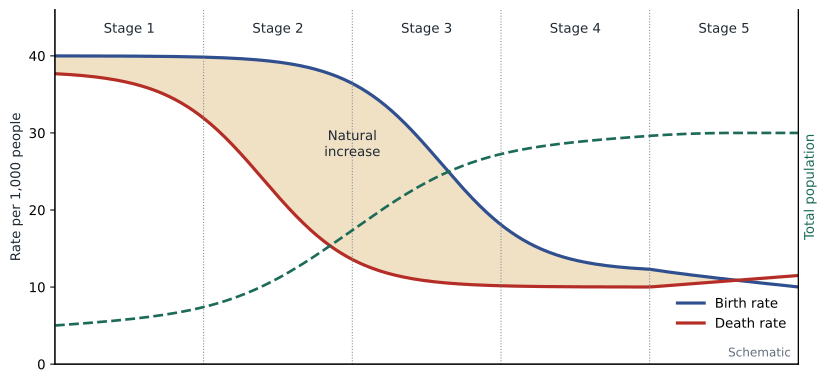
Death rates usually fall first, because of better nutrition, sanitation and medicine, while birth rates fall later, as urbanization, education (especially of women), access to contraception and the changing economic value of children reduce desired family size. Population pyramids show the age and sex structure of a population: a wide base indicates high fertility and rapid growth, a more rectangular shape indicates stable or slow growth, and a narrowing base indicates declining fertility and an aging population. Malthusian theory, from Thomas Malthus in 1798, predicted that population would outgrow food supply; technological change has so far prevented the outcomes he predicted on a global scale, though resource pressures remain.
Ezequiel thought of his grandparents' generation. 'My grandmother was one of nine,' he said. 'My mother was one of four. I have one brother.' Thandiwe said that his family story traced stage 3 of the transition in three generations.
Social change and urbanization
Social movements are organized efforts to promote or resist social change. They are often classified by the scope and type of change they seek: reform movements seek limited change, revolutionary movements seek fundamental change, and resistance movements oppose change. Relative deprivation theory proposes that movements arise when people feel deprived compared with others or with their expectations; resource mobilization theory emphasizes the organization, money and networks movements need. Globalization is the increasing integration of economies, cultures and societies across national borders, driven by trade, migration, communication and technology; it can spread wealth and innovation while also widening some inequalities and spreading disease quickly.
Urbanization is the growth of cities and the movement of populations from rural to urban areas. More than half of the world's population now lives in urban areas. Urbanization brings economic opportunities and services but also crowding, pollution and concentrated poverty. Suburbanization is the movement of people from cities to surrounding areas; gentrification is the movement of higher-income residents into lower-income urban neighbourhoods, which often raises property values and can displace long-time residents. Urban renewal policies and residential segregation shape the spatial inequality discussed in lesson 11.
Worked problem
Identifying a theoretical perspective
A sociologist argues that hospitals in wealthy neighbourhoods receive more donations and attract more specialists, that this pattern benefits residents with political influence, and that it persists because those residents shape funding decisions. (Scenario invented for this course.) Which perspective does this reflect?
Show solution
- Look for the level of analysis: the argument concerns institutions and resource distribution, a macro view.
- Look for the mechanism: unequal power and competition for scarce resources maintain the pattern.
- Functionalism would ask what function the pattern serves for society as a whole; symbolic interactionism would focus on meanings in interaction.
- The emphasis on power and inequality identifies conflict theory.
Answer: Conflict theory.
Common mistakes
MistakeLatent functions are functions that have disappeared.
InsteadLatent functions are unintended, often unrecognized consequences; manifest functions are intended.
MistakeSocial constructionism says that race and gender are not real.
InsteadIt says their meanings and boundaries are socially created; they have real consequences.
MistakeIn the demographic transition, birth rates fall before death rates.
InsteadDeath rates usually fall first, producing rapid growth until birth rates decline.
MistakeThe crude birth rate and the total fertility rate measure the same thing.
InsteadThe crude birth rate counts births per 1,000 people per year; total fertility is average lifetime births per woman.
MistakeCultural lag is the delay in spreading culture between countries.
InsteadCultural lag is the gap between faster-changing material culture and slower-changing norms and values.
Summary and key terms
- Functionalism, conflict theory, symbolic interactionism, social constructionism, rational choice and feminist theory offer different explanations of social life.
- Social institutions include education, family, religion, government and the economy, and health and medicine; medicalization redefines conditions as medical problems.
- Culture includes material and symbolic elements; it changes through diffusion and transmission, and cultural lag can arise.
- Demographic variables such as age, gender, race, ethnicity, immigration status and sexual orientation shape social experiences.
- Fertility, mortality and migration drive population change; the demographic transition describes falling death rates followed by falling birth rates.
- Social movements, globalization and urbanization are major sources of social change.
- Functionalism
- A macro theory viewing society as interdependent parts that maintain stability.
- Conflict theory
- A macro theory emphasizing competition for scarce resources and unequal power.
- Latent function
- An unintended consequence of a social structure or institution.
- Medicalization
- Defining and treating a condition as a medical problem.
- Cultural lag
- The delay between changes in material culture and changes in norms and values.
- Total fertility rate
- The average number of children a woman would have in her lifetime at current rates.
- Demographic transition
- The shift from high birth and death rates to low birth and death rates with industrialization.
- Gentrification
- The arrival of higher-income residents in lower-income neighbourhoods, often displacing earlier residents.
Practice problems
Work each problem on paper first, then reveal the answer to check.
A researcher says that schools teach students to obey schedules and authority, preparing them for the workforce. Which type of function is this, and which perspective?
Show answer
A latent function (part of the hidden curriculum), analysed from a functionalist perspective; a conflict theorist would add that it reproduces class inequality.
A country's population pyramid has a narrow base and a wide top. What does it suggest?
Show answer
Low fertility and an aging population, typical of late stages of the demographic transition.
Which type of authority does a constitutional government official hold?
Show answer
Rational-legal authority.
A culture's medical technology can keep patients alive indefinitely, but there is no shared agreement on when to withdraw treatment. Which concept is illustrated?
Show answer
Cultural lag.
Which demographic measure is a sensitive indicator of a population's overall health?
Show answer
The infant mortality rate.
Lesson quiz · 5 questions
Score 60% or more to complete this lesson.
Create a free account to save your progress, take quizzes and earn a certificate.