
MBA-511 · Lesson 12 of 12 · 22 min
Capstone: valuing Cedarline Outdoor and a financing decision
The final weekend returns to Cedarline Outdoor, the Toronto-based outdoor apparel company the cohort diagnosed at the end of MBA-501. Then, the question was whether Cedarline was healthy enough to take on management's plan to open 18 stores and build a second distribution centre for about 95 million dollars. The answer was no, not as proposed: revenue had grown from 312 to 468 million dollars in four years, but inventory had more than doubled to 128 million, cash from operations had fallen from 30.2 to 12.4 million, free cash flow had turned negative, and return on invested capital had fallen to 8 per cent, below the 9 per cent cost of capital. The cohort recommended a staged plan: first release about 50 million dollars from inventory and receivables, then open stores in tranches of six, each conditional on the last meeting its targets and on leverage staying below 3.0 times EBITDA. Cedarline's board accepted the recommendation in principle and has now asked two further questions. What is the company worth under the revised plan compared with carrying on as before? And how should the expansion be financed?
Dr. Varga divides the cohort into the same teams and sets out the work in four parts: build the valuation model, value the operating plans, value the expansion as a staged decision, and recommend the financing. Each part draws on earlier lessons, and the teams must present the result to the board in twenty minutes.
Part 1: the starting point
The teams begin with the figures for the year ended 31 March 2026. Revenue was 468 million dollars and operating profit 39.8 million, a margin of 8.5 per cent. Depreciation and amortization, including the amortization of store right-of-use assets, were about 16.5 million, so EBITDA was about 56 million. Capital spending was 21 million, about 4.5 per cent of revenue. Net working capital, mostly inventory and wholesale receivables less payables, was about 165 million, or 35 per cent of revenue, reflecting a cash conversion cycle of 177 days. Net debt including lease liabilities was about 191 million dollars, 3.4 times EBITDA, against a limit of 3.75 times in the bond indenture.
| Input | Value | Source |
|---|---|---|
| Revenue, FY2026 | 468 million | MBA-501 statements |
| Operating margin | 8.5 per cent | MBA-501 statements |
| Net working capital | 165 million, 35 per cent of revenue | Balance sheet |
| Net debt including leases | 191 million, 3.4 times EBITDA | MBA-501 leverage analysis |
| WACC | about 9 per cent | Lesson 8 |
| Terminal growth | 2.5 per cent | Long-run nominal growth for apparel |
| Tax rate | 26.5 per cent | Combined federal and Ontario |
Dr. Varga reminds the teams of three rules from lesson 11. Build the forecast from drivers. Make terminal growth consistent with reinvestment: in steady state, the share of operating profit that must be reinvested equals growth divided by the return on new capital. And treat leases consistently: because lease liabilities are counted as debt, lease payments are excluded from operating costs and their amortization and interest are treated like depreciation and interest.
Part 2: two operating plans
The status quo plan extrapolates recent trends, slowed slightly to reflect management's own forecast: revenue grows 7 per cent a year, the operating margin keeps sliding from 8.3 to 7.5 per cent as discounting continues to clear excess stock, working capital creeps up from 36 to 40 per cent of revenue, and new capital in the long run earns 8 per cent, the current ROIC. The working capital plan reflects the MBA-501 recommendation: growth slows to 4 per cent while stores are tested, inventory discipline lifts the margin to 9 per cent as markdowns fall, working capital drops to 25 per cent of revenue within two years, releasing about 50 million dollars, and new capital earns 11 per cent, closer to the 12 per cent Cedarline earned before its expansion.
# Cedarline Outdoor: value under two operating plans (millions)
tax, wacc, g = 0.265, 0.09, 0.025
net_debt = 191.0                     # including lease liabilities
def value(growth, margins, nwc_pct, capex_pct, ret, da_pct=0.035, rev0=468.0, nwc0=165.0):
    rev, nwc, pv, flows = rev0, nwc0, 0.0, []
    for t in range(1, 6):
        rev *= 1 + growth
        new_nwc = rev * nwc_pct[t - 1]
        f = rev * margins[t - 1] * (1 - tax) + (da_pct - capex_pct) * rev - (new_nwc - nwc)
        nwc = new_nwc
        flows.append(f)
        pv += f / (1 + wacc) ** t
    nopat = rev * (1 + g) * margins[-1] * (1 - tax)
    tv = nopat * (1 - g / ret) / (wacc - g)   # reinvestment consistent with growth at return ret
    return pv + tv / (1 + wacc) ** 5, flows

plans = {
    "status quo": (0.07, [0.083, 0.080, 0.078, 0.076, 0.075], [0.36, 0.37, 0.38, 0.39, 0.40], 0.045, 0.08),
    "working capital plan": (0.04, [0.086, 0.088, 0.090, 0.090, 0.090], [0.30, 0.25, 0.25, 0.25, 0.25], 0.040, 0.11),
}
for name, args in plans.items():
    ev, flows = value(*args)
    print(f"{name:21s} FCFF {[round(f, 1) for f in flows]}")
print(f"{'':21s} EV {ev:5.0f}, equity {ev - net_debt:5.0f}")status quo FCFF [10.3, 8.2, 7.5, 6.7, 6.3]
EV 286, equity 95
working capital plan FCFF [47.3, 49.7, 27.1, 28.2, 29.3]
EV 444, equity 253The difference is striking. Under the status quo, Cedarline's operations are worth about 286 million dollars, leaving equity of about 95 million after net debt. Under the working capital plan, they are worth about 444 million and equity about 253 million. Roughly 50 million of the gain is the cash released from inventory and receivables in the first two years. The rest, about 110 million, comes from higher margins and, above all, from changing the economics of future growth. When new capital earns 8 per cent against a 9 per cent cost of capital, every dollar of growth destroys value, and the faster the company grows the worse it gets. When new capital earns 11 per cent, growth adds value. This is the point Dr. Varga has made since the first session: growth is not the goal; returns above the cost of capital are.
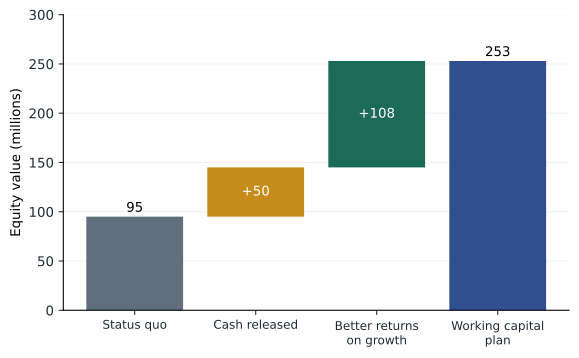
The private equity investor bought its stake two years ago at a valuation that put Cedarline's equity at about 300 million dollars, the figure used for the WACC weights in lesson 8. Under the status quo, much of that value has gone. The teams note that this explains the investor's unease better than any ratio: the status quo has been quietly transferring value away from the owners.
Part 3: the expansion as a staged decision
Management's original plan treated the 18 stores as a single commitment. The cohort's staged plan treats them as three tranches of six, each costing about 28 million dollars including fit-out and opening inventory. Store-level analysis suggests two outcomes for each tranche. If Cedarline's new store format works, which the teams estimate has a 60 per cent probability, a tranche produces after-tax cash flow of about 3.0 million dollars a year, growing 2 per cent, worth about 42.9 million at the 9 per cent cost of capital, for an NPV of about plus 14.9 million. If it does not, the tranche produces about 0.9 million a year, worth 12.9 million, for an NPV of about minus 15.1 million. The first tranche will reveal which outcome applies.
This is a real option. A firm that can wait and learn before committing more capital holds something like a call option on the later investments: it will exercise only if the news is good. Standard NPV analysis, which assumes all decisions are made today, misses that value. Options to expand, to delay, to abandon and to switch inputs or outputs are common in business, and they are most valuable when uncertainty is high and decisions can be reversed or postponed cheaply.
# Valuing the store expansion: commit to all 18 stores now, or stage it (millions)
wacc, cost, p_good = 0.09, 28.0, 0.60
pv_good = 3.0 / (wacc - 0.02)          # growing perpetuity of after-tax cash flow
pv_bad = 0.9 / (wacc - 0.02)
npv_good, npv_bad = pv_good - cost, pv_bad - cost
e_npv = p_good * npv_good + (1 - p_good) * npv_bad
print(f"one tranche: NPV {npv_good:+.1f} if good, {npv_bad:+.1f} if bad, expected {e_npv:+.1f}")

all_now = 3 * e_npv
staged = e_npv + p_good * 2 * npv_good / (1 + wacc)   # tranches 2-3 a year later, only if good
print(f"commit to all three now: {all_now:5.1f}")
print(f"stage the expansion:     {staged:5.1f}")
print(f"value of the option to wait and learn: {staged - all_now:5.1f}")one tranche: NPV +14.9 if good, -15.1 if bad, expected +2.9 commit to all three now: 8.6 stage the expansion: 19.2 value of the option to wait and learn: 10.6
Committing to all three tranches now has an expected NPV of about 8.6 million dollars. Staging them, so that tranches two and three go ahead a year later only if the first succeeds, has an expected NPV of about 19.2 million. The difference, about 10.6 million, is the value of the option to learn before committing. Staging costs something, since stores open later if the format works, but here the information is worth far more than the delay. The second distribution centre, which management wanted to build at once, is a similar case: it is needed only if the stores succeed, so the teams recommend deferring it and using a third-party warehouse in the meantime.
Part 4: the financing decision
The board's second question is how to pay for the expansion. The teams consider three sources, guided by lessons 9 and 10. Internal funds come first: the working capital plan releases about 50 million dollars over two years, enough to pay for the first tranche of stores and reduce debt. New debt is next: a term loan of about 56 million could fund tranches two and three if they go ahead. New equity from the private equity investor or the founding family is the last resort; at a time when the company's value is depressed and its prospects uncertain, issuing equity would be expensive and, as the pecking order suggests, would signal weakness to lenders and suppliers.
# Cedarline leverage path under the staged plan (millions)
ebitda = [56.3, 59.0, 62.5, 68.0, 72.0]       # FY2026 actual, then plan years 1-4
net_debt = 191.0
moves = [0.0, -25.0 + 14.0, -25.0 + 14.0 - 6.0, +56.0 - 18.0, -20.0]
# year 1-2: working capital release less tranche 1 spending and interest; year 3: term loan for
# tranches 2-3 less free cash flow; year 4: repayment from free cash flow
covenant, target = 3.75, 3.0
for year, (e, m) in enumerate(zip(ebitda, moves)):
    net_debt += m
    ratio = net_debt / e
    flag = "within target" if ratio <= target else "above target"
print(f"year {year}: net debt {net_debt:6.1f}, EBITDA {e:5.1f}, ratio {ratio:4.2f}x {flag}")year 0: net debt 191.0, EBITDA 56.3, ratio 3.39x above target year 1: net debt 180.0, EBITDA 59.0, ratio 3.05x above target year 2: net debt 163.0, EBITDA 62.5, ratio 2.61x within target year 3: net debt 201.0, EBITDA 68.0, ratio 2.96x within target year 4: net debt 181.0, EBITDA 72.0, ratio 2.51x within target
The leverage path shows that the staged plan brings net debt down from 3.4 to about 2.6 times EBITDA within two years, as released working capital repays debt, then rises to just under 3.0 times in the year the term loan is drawn and falls after. The original plan, funding all 95 million with debt before any store had opened, would have taken leverage above 4 times, beyond the 3.75 times limit in the bond indenture. Lesson 9 explains why the teams also recommend against using the extra borrowing capacity for any distribution to the owners until the stores have proved themselves: Cedarline's value depends on its brand, its designs and its relationships with wholesale customers, exactly the kind of intangible value that is lost in financial distress.
The tax shield on the term loan is modest. At an interest rate of about 7 per cent, interest on 56 million dollars is about 3.9 million a year, saving about 1 million in tax, and the loan is to be repaid over five years. The main argument for debt here is not tax but the pecking order and flexibility: it avoids issuing equity at a depressed value and leaves ownership unchanged, while the conditions on each tranche limit the risk that the debt is spent on stores that do not work. The teams propose that the loan agreement mirror the board's conditions, with draws for tranches two and three allowed only if the first tranche meets its sales and contribution targets and leverage is below 3.0 times.
The recommendation
Hana and Grace's team presents the recommendation in the format Dr. Achterberg taught in MBA-501: the answer first, then the evidence, the options and the conditions. Approve the staged plan. Release working capital first; on the base case it raises the value of Cedarline's equity from about 100 million to about 255 million dollars, mainly by restoring returns on growth above the cost of capital. Open stores in three tranches; staging is worth about 10 million dollars more than committing now. Defer the second distribution centre. Fund the first tranche from released cash and the later tranches with a term loan drawn only if conditions are met. Pay no special distributions and issue no equity until leverage is below 2.5 times and the new stores have been open for a full season. And tie management's bonus to ROIC and cash conversion rather than revenue growth, the incentive that created the problem.
Dr. Varga's closing feedback ties the course together. Every question the board asked was, in the end, a question about value: whether the cash flows a decision produces, adjusted for time and risk, are worth more than it costs. Time value and discounting from lessons 2 to 4, project analysis from lessons 5 and 6, risk and the cost of capital from lessons 7 and 8, financing and payout from lessons 9 and 10, and valuation from lesson 11 are not separate techniques but parts of one way of thinking. The numbers in a model are only as good as the judgment behind them, and the most valuable skill a manager can bring to a finance discussion is to ask what has to be true for the answer to be right.
Worked problem
Testing the recommendation
A director asks what happens if the working capital plan releases only 30 million dollars instead of 50 million, and new capital earns 10 per cent rather than 11. Without rerunning the full model, roughly how much value is at stake, and does the recommendation change?
Show solution
- Cash released: 20 million dollars less, received in the first two years, worth about 17 million today.
- Return on new capital: lowering it from 11 to 10 per cent raises the reinvestment needed for 2.5 per cent growth from about 23 to 25 per cent of operating profit, reducing the terminal value by roughly 3 per cent, about 9 million dollars in present value.
- Total: about 26 million dollars less equity value, leaving roughly 225 to 235 million, still far above the status quo.
- Leverage: with 20 million less cash, net debt peaks at roughly 3.2 times EBITDA, above the 3.0 times target, so the term loan for the later tranches should be smaller or delayed.
Answer: The value case for the staged plan survives a weaker outcome comfortably, but the financing plan is more sensitive: if less cash is released, Cedarline should delay the second and third tranches until leverage is back under 3.0 times. This is exactly why the board's conditions link each tranche to both performance and leverage.
Common mistakes
MistakeA company that grows quickly is creating value.
InsteadGrowth creates value only when new capital earns more than its cost; Cedarline's growth destroyed value.
MistakeNPV analysis captures the value of flexibility.
InsteadStandard NPV assumes all decisions are made now; staged decisions carry option value.
MistakeThe cheapest-looking source of finance is always best.
InsteadConsider flexibility, signalling, distress costs and covenants as well as cost.
MistakeA valuation model gives the answer.
InsteadIt shows what has to be true for an answer; judgment about the assumptions matters most.
Summary and key terms
- Cedarline's status quo destroys value because new capital earns less than the cost of capital.
- Releasing working capital and restoring returns above 9 per cent raises equity value by roughly 160 million dollars on the base case.
- Staging the store expansion adds option value by allowing the company to learn before committing more capital.
- Fund the expansion from released cash first, then conditional debt, keeping leverage below 3.0 times EBITDA; avoid issuing equity at a depressed value.
- Tie management incentives to returns and cash conversion, and present the recommendation with conditions the board can monitor.
- Real option
- The right, but not the obligation, to take a business action in future, such as expanding, delaying or abandoning a project.
- Staged investment
- Committing capital in steps, each conditional on the results of the last.
- Option to abandon
- The ability to stop a project and recover some value if it performs badly.
- Cash conversion
- The extent to which a company's profits turn into operating cash flow.
- Leverage path
- The projected ratio of debt to earnings over the life of a plan.
Practice problems
Work each problem on paper first, then reveal the answer to check.
Why does Cedarline's value rise so much under the working capital plan, even though revenue grows more slowly?
Show answer
Because the plan releases cash tied up in inventory and, more importantly, raises the return on new capital from below to above the cost of capital, so future growth adds rather than destroys value.
Under what conditions is the option to stage an investment most valuable?
Show answer
When uncertainty about the outcome is high, when early stages reveal useful information, and when delaying later stages is cheap.
Why might the private equity investor prefer the term loan to injecting more equity now?
Show answer
Equity would be issued at a depressed value, diluting existing owners; debt within the leverage target is cheaper and keeps ownership unchanged.
A director proposes building the distribution centre now because construction costs may rise. How should the team respond?
Show answer
Compare the expected cost increase with the value of waiting to learn whether the stores succeed; if the centre is needed only in the success case, the option to defer is likely worth more than the cost saving.
Lesson quiz · 5 questions
Score 60% or more to complete this lesson.
Create a free account to save your progress, take quizzes and earn a certificate.