
MBA-511 · Lesson 11 of 12 · 19 min
Valuation of a company: DCF and multiples
Fairway Grocers has been approached by the owners of Harvest Lane Markets, a privately held chain of 22 grocery stores in a neighbouring region, who are ready to sell. Their adviser has suggested a price of 330 million dollars for the whole business, debt included, describing it as about nine times last year's EBITDA, in line with recent deals in the sector. Grace has been asked to lead Fairway's valuation. Dr. Varga uses the deal to bring together everything the course has covered so far: free cash flow from lesson 4, project cash flows from lesson 6, the cost of capital from lesson 8 and the effect of financing from lesson 9. The aim is not a single right number but a defensible range and a clear view of what has to be true for the price to make sense.
Two families of methods
Company valuation uses two broad approaches. Intrinsic valuation, usually a discounted cash flow model, estimates value from the company's own expected cash flows and risk. Relative valuation estimates value from the prices paid for comparable companies or deals, expressed as multiples of earnings, EBITDA or revenue. The two answer slightly different questions. A DCF asks what the business is worth given its cash flows; a multiple asks what the market is paying for similar businesses. A good valuation uses both and investigates any large gap between them.
Building the DCF
A DCF of a whole company has five steps. First, forecast free cash flow to the firm for an explicit period, long enough for the business to reach a steady state, typically five to ten years. Second, estimate a terminal value for the cash flows beyond that period. Third, discount both at the WACC to get enterprise value. Fourth, subtract net debt and other claims, such as lease liabilities, pension deficits and minority interests, to get equity value. Fifth, test the result against alternative assumptions.
The forecast should be built from drivers rather than extrapolated from past cash flows: revenue growth from store count and sales per store, margins from gross margin and operating costs, capital spending from new stores and maintenance, and working capital from days of inventory, receivables and payables. MBA-501 showed how ratios describe a business's economics; in a DCF those ratios become forecast assumptions. Harvest Lane had revenue of 640 million dollars last year, EBITDA of about 36.5 million, and capital spending of about 14 million. Grace's base case assumes revenue growth of 4 per cent a year, a slow rise in the EBITDA margin from 5.7 to 6.2 per cent as Fairway's purchasing terms apply, and capital spending rising to about 2.6 per cent of revenue as older stores are refurbished.
The terminal value
The terminal value usually accounts for 60 to 80 per cent of a DCF valuation, so its assumptions deserve the most scrutiny. Two methods are common. The perpetuity growth method applies the growing perpetuity formula to the first year after the forecast. The exit multiple method applies a multiple, such as enterprise value to EBITDA, to the final year's figure.
The perpetuity method forces the analyst to state a long-run growth rate, which should be no higher than long-run nominal economic growth and is often set near expected inflation for mature businesses. A useful consistency check comes from lesson 4: growth requires reinvestment, and sustainable growth equals the reinvestment rate times the return on new capital. If the terminal growth rate is 2.5 per cent and the return on new capital equals the WACC, the business must reinvest a share of its after-tax operating profit equal to growth divided by the return. Assuming high growth with no reinvestment is one of the most common errors in valuation and inflates the result. The exit multiple method is quick and anchored in market prices, but it imports whatever the market believes today into a value that is supposed to be independent of it. Analysts often compute both and compare the implied multiple from the perpetuity method with current market multiples.
From enterprise value to equity value
Enterprise value is the value of the operating business to all capital providers. To reach equity value, subtract all claims that rank ahead of common shareholders: debt, lease liabilities, preferred shares, unfunded pension obligations and the share of subsidiaries owned by others. Add non-operating assets, such as excess cash and investments, that are not reflected in the cash flows. In an acquisition, the buyer usually pays enterprise value: it takes on or repays the debt and pays the sellers the rest. Harvest Lane's adviser quoted 330 million dollars on that basis.
# DCF of Harvest Lane Markets (millions) with a sensitivity table
rev0, growth, tax = 640.0, 0.04, 0.25
margins = [0.058, 0.059, 0.060, 0.061, 0.062]   # EBITDA margin, years 1-5
da_pct, capex_pct, nwc_pct = 0.020, 0.026, 0.010  # of revenue; NWC as % of revenue change
def dcf(wacc, g, show=False):
    rev, pv, fcff = rev0, 0.0, []
    for t, m in enumerate(margins, start=1):
        prev, rev = rev, rev * (1 + growth)
        ebitda = rev * m
        ebit = ebitda - da_pct * rev
        f = ebit * (1 - tax) + da_pct * rev - capex_pct * rev - nwc_pct * (rev - prev)
        fcff.append(f)
        pv += f / (1 + wacc) ** t
    tv = fcff[-1] * (1 + g) / (wacc - g)
    pv_tv = tv / (1 + wacc) ** len(margins)
    if show:
        print("FCFF:", [round(x, 1) for x in fcff])
        print(f"PV forecast {pv:.1f}, PV terminal {pv_tv:.1f} ({pv_tv / (pv + pv_tv):.0%} of value)")
        print(f"implied exit multiple of year-5 EBITDA: {tv / (rev * margins[-1]):.1f}x")
    return pv + pv_tv
ev = dcf(0.075, 0.025, show=True)
print(f"base enterprise value {ev:.0f}")
print("WACC  g:  " + "".join(f"{g:>8.1%}" for g in (0.015, 0.020, 0.025, 0.030)))
for w in (0.070, 0.075, 0.080, 0.085):
print(f"{w:8.1%} " + "".join(f"{dcf(w, g):8.0f}" for g in (0.015, 0.020, 0.025, 0.030)))FCFF: [14.7, 15.8, 17.0, 18.2, 19.6]
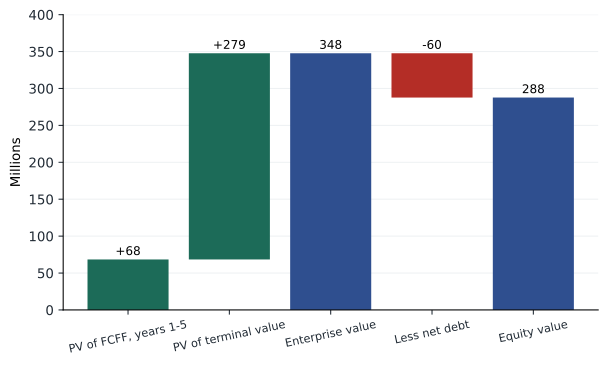
PV forecast 68.4, PV terminal 279.3 (80% of value)
implied exit multiple of year-5 EBITDA: 8.3x
base enterprise value 348
WACC g: 1.5% 2.0% 2.5% 3.0%
7.0% 327 354 387 428
7.5% 299 321 348 380
8.0% 275 294 315 342
8.5% 255 271 289 310At a WACC of 7.5 per cent, appropriate for a grocer with stable demand, and terminal growth of 2.5 per cent, the base case gives an enterprise value of roughly 350 million dollars, a little above the adviser's price, with the terminal value contributing about 80 per cent. But the sensitivity table shows how fragile that is. Half a point higher on the WACC takes the value down to about 315 million, and half a point higher combined with a point lower on growth takes it below 280 million; the reverse moves take it well above 380 million. The analysis does not say the price is right or wrong; it says the price is defensible only if Grace is comfortable with the base-case margins and a cost of capital of 7.5 per cent or less.
Relative valuation with multiples
A multiple divides a measure of value by a measure of performance. Enterprise multiples, such as EV to EBITDA, EV to EBIT and EV to sales, compare enterprise value with measures available to all capital providers, so they are not distorted by differences in leverage. Equity multiples, such as the price-to-earnings ratio and price to book, compare equity value with measures that belong to shareholders. Mixing the two, for example dividing enterprise value by net income, is a common and serious error.
The method has three steps: choose comparable companies or transactions, compute their multiples, and apply a representative value, often the median, to the target's figure. The art is in choosing comparables, which should share the target's growth, risk and return on capital, not just its industry label. Multiples from acquisitions include a control premium and synergies, so they usually exceed multiples of listed shares. Grace collects four listed grocers and three recent acquisitions of regional chains.
| Comparable | EV / EBITDA | P / E | Revenue growth |
|---|---|---|---|
| Listed grocer A | 8.1 | 16.5 | 3.5 per cent |
| Listed grocer B | 7.4 | 14.8 | 2.8 per cent |
| Listed grocer C | 9.0 | 18.2 | 5.1 per cent |
| Listed grocer D | 7.8 | 15.6 | 3.9 per cent |
| Acquisition 1 (regional chain) | 9.4 | not used | 4.2 per cent |
| Acquisition 2 (regional chain) | 8.8 | not used | 3.6 per cent |
| Acquisition 3 (regional chain) | 10.1 | not used | 6.0 per cent |
# Relative valuation of Harvest Lane from comparables (millions)
import statistics as st
ebitda, net_debt = 36.5, 60.0
listed = [8.1, 7.4, 9.0, 7.8]
deals = [9.4, 8.8, 10.1]
for name, mult in [("listed peers", listed), ("transactions", deals)]:
    m = st.median(mult)
    ev = m * ebitda
    print(f"{name:12s} median {m:4.2f}x -> EV {ev:5.0f}, equity {ev - net_debt:5.0f}"
          f"   (range {min(mult) * ebitda:.0f} to {max(mult) * ebitda:.0f})")
print(f"asking price 330 is {330 / ebitda:.1f}x EBITDA")listed peers median 7.95x -> EV 290, equity 230 (range 270 to 328) transactions median 9.40x -> EV 343, equity 283 (range 321 to 369) asking price 330 is 9.0x EBITDA
The listed peers imply an enterprise value of about 290 million dollars and the transactions about 345 million. The adviser's price of 330 million, about 9.0 times EBITDA, sits between them, close to what acquirers have recently paid. Comparing the multiples with the DCF is instructive: the perpetuity-growth terminal value implies an exit multiple of about 8.3 times year-five EBITDA, between the listed-peer and transaction medians. The two methods tell a coherent story.
The football field and synergies
Valuation results are often summarized in a chart known as a football field, showing the range from each method side by side, with the proposed price marked. It shows at a glance whether the price sits at the bottom, middle or top of the evidence. For Harvest Lane, the price sits in the middle of the DCF range and the transaction range and above the listed-peer range.
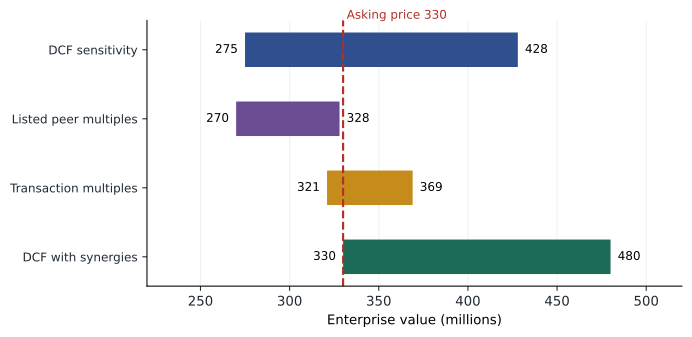
The final question in any acquisition is how much of the value of synergies to pay away. Fairway expects better purchasing terms and lower distribution costs worth perhaps 6 million dollars a year before tax once integrated, with one-time integration costs of about 12 million. After tax and allowing for the integration costs and a two-year ramp-up, those synergies are worth something like 60 to 75 million dollars in present value. If Fairway pays a price equal to Harvest Lane's standalone value plus all the synergies, it creates no value for its own shareholders; the sellers capture it all. Studies of acquisitions consistently find that, on average, target shareholders gain substantially while acquirer shareholders gain little or lose, largely because buyers overpay. Dr. Varga's rule is to decide in advance the walk-away price and to treat the synergies as the buyer's to keep unless competition forces otherwise.
Worked problem
What must be true at 330 million?
Using the DCF model, at a WACC of 7.5 per cent, what terminal growth rate is needed for Harvest Lane's standalone enterprise value to equal the asking price of 330 million dollars, and how should Grace use the answer?
Show solution
- Run the model across growth rates: the base case of 2.5 per cent gives about 348 million.
- Lowering growth to about 2.2 per cent brings the value down to about 331 million.
- Compare the requirement with evidence: long-run nominal growth for a regional grocer of 2 to 3 per cent is plausible given inflation and modest population growth.
Answer: The price is consistent with standalone value if Harvest Lane can grow at about 2.2 per cent a year in the long run with base-case margins, an achievable but not conservative assumption. Because the price leaves the synergies largely with Fairway, Grace can recommend proceeding at up to about 330 million dollars, with a walk-away price not far above it.
Common mistakes
MistakeA DCF gives a precise value.
InsteadSmall changes in the WACC and terminal growth move the value a lot; present a range.
MistakeTerminal growth can be set high without changing reinvestment.
InsteadGrowth requires reinvestment; check the implied reinvestment rate and exit multiple.
MistakeDividing enterprise value by net income gives a useful multiple.
InsteadMatch enterprise values with enterprise measures and equity values with equity measures.
MistakeA buyer should pay up to standalone value plus all synergies.
InsteadPaying away all synergies creates no value for the buyer's shareholders.
Summary and key terms
- Value companies with both a DCF and multiples, and investigate any gap.
- Build DCF forecasts from operating drivers, discount FCFF at the WACC and subtract net debt and other claims for equity value.
- The terminal value dominates; keep growth below long-run economic growth and consistent with reinvestment.
- Use enterprise multiples for enterprise value and equity multiples for equity value, with carefully chosen comparables.
- Summarize results in a football field and decide in advance how much of the synergies to pay.
- Intrinsic valuation
- Valuation based on a company's own expected cash flows and risk.
- Terminal value
- The value at the end of the forecast period of all cash flows beyond it.
- Exit multiple
- A multiple applied to a final-year measure, such as EBITDA, to estimate terminal value.
- EV/EBITDA
- Enterprise value divided by earnings before interest, taxes, depreciation and amortization.
- Football field
- A chart showing the ranges of value from different methods side by side.
- Synergies
- Gains in value from combining two businesses, such as cost savings or extra revenue.
Practice problems
Work each problem on paper first, then reveal the answer to check.
A company's final forecast-year FCFF is 50 million dollars, the WACC is 9 per cent and terminal growth is 3 per cent. What is the terminal value at the end of that year?
Show answer
50 times 1.03 / 0.06 = about 858 million dollars.
A target has EBITDA of 40 million dollars and net debt of 100 million. Comparable deals trade at 8.5 times EBITDA. What equity value do they imply?
Show answer
EV = 340 million; equity = 340 minus 100 = 240 million dollars.
Why are transaction multiples usually higher than trading multiples of listed peers?
Show answer
Acquirers pay a control premium and often expect synergies, so deal prices exceed the value of minority stakes traded in the market.
A DCF terminal value implies an exit multiple of 16 times EBITDA, while peers trade at 8 times. What should the analyst do?
Show answer
Revisit the assumptions, especially terminal growth, the WACC and reinvestment, since the DCF implies a valuation far above the market for similar firms.
Lesson quiz · 5 questions
Score 60% or more to complete this lesson.
Create a free account to save your progress, take quizzes and earn a certificate.