
MBA-503 · Lesson 9 of 12 · 19 min
Conflict and negotiation
Eight months after the merger that created his finance team, Daniel Osei is refereeing the same argument every month. The four people who came from the acquired company close the books with a detailed checklist and a sign-off by each preparer; the five from the parent company use a faster, exception-based review. Each side thinks the other's method is either reckless or bureaucratic. Month-end has become tense, two people have stopped speaking to each other except by email, and the controller has asked Daniel to sort it out before the year-end audit. Dr. Sato uses his case to examine conflict and negotiation, two skills that most leaders learn by trial and error and that research can make far more systematic.
Kinds of conflict and their effects
Conflict is a process in which one party perceives that its interests are opposed or negatively affected by another party. Karen Jehn's research distinguished task conflict, disagreement about the content of work such as ideas, methods or priorities, from relationship conflict, interpersonal friction involving tension, annoyance and dislike. Later researchers added process conflict, disagreement about how work is organized, such as who does what and when. The distinction matters because the types have different effects and need different responses.
Early theorizing suggested that task conflict was good for teams, because debate improves decisions, while relationship conflict was harmful. The evidence is more nuanced. A meta-analysis by Carsten De Dreu and Laurie Weingart in 2003 found that both task and relationship conflict were negatively related to team performance and member satisfaction on average. A later and larger meta-analysis by Frank de Wit, Lindred Greer and Jehn in 2012 found that task conflict was not consistently harmful and was positively related to performance in some conditions, particularly in top management teams and when task conflict was not accompanied by relationship conflict. Relationship conflict and process conflict were consistently negative. The practical lesson is that disagreement about ideas can be valuable, but only if it stays about ideas. Once task conflict turns personal, its benefits disappear.
Daniel's team began with process conflict, about how to close the books, which is often the most damaging kind because it touches every day's work and implies judgments about competence. It has now spread into relationship conflict. Psychological safety, discussed in the session on teams, helps keep task conflict from becoming personal, because people who trust that others mean well interpret disagreement as information rather than attack.
Five ways of handling conflict
Kenneth Thomas and Ralph Kilmann, building on earlier work by Robert Blake and Jane Mouton, described five ways of handling conflict arranged on two dimensions: assertiveness, the degree to which a person tries to satisfy their own concerns, and cooperativeness, the degree to which they try to satisfy the other party's concerns. Competing is assertive and uncooperative: pursuing your own position at the other's expense. Accommodating is the reverse: yielding to the other. Avoiding is neither assertive nor cooperative: sidestepping or postponing the issue. Collaborating is both: working to find a solution that fully satisfies both parties' concerns. Compromising sits in the middle: each side gives up something to reach a mutually acceptable middle ground.
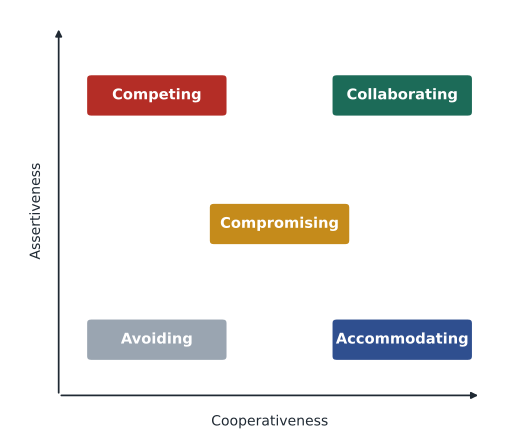
No mode is best in every situation. Competing is appropriate in emergencies or when an unpopular decision is necessary. Accommodating makes sense when the issue matters much more to the other person or when you are wrong. Avoiding can be wise for trivial issues or when people need time to cool down. Compromising is useful when the parties have equal power and a quick, workable solution is needed. Collaborating is most valuable when both sets of concerns are too important to be traded off and there is time to work through them, but it is time-consuming and can be overused. The research suggests that collaborative, problem-solving approaches are associated with better outcomes and relationships overall, while avoiding and competing are often associated with escalation. Most people, however, have a habitual preference that they use even when it does not fit.
# Scoring a short conflict-mode self-assessment (original items, 1-5 scale)
items = {   # item number -> mode it reflects
    1: "competing", 2: "collaborating", 3: "compromising", 4: "avoiding", 5: "accommodating",
    6: "competing", 7: "collaborating", 8: "compromising", 9: "avoiding", 10: "accommodating",
    11: "competing", 12: "collaborating", 13: "compromising", 14: "avoiding", 15: "accommodating",
}
# Daniel's answers to statements such as "I push to get my way" (item 1)
answers = {1: 2, 2: 4, 3: 4, 4: 5, 5: 4, 6: 1, 7: 3, 8: 4,
           9: 5, 10: 4, 11: 2, 12: 3, 13: 5, 14: 4, 15: 3}
cohort_mean = {"competing": 9.1, "collaborating": 11.2, "compromising": 10.4,
               "avoiding": 8.3, "accommodating": 9.0}

scores = {m: 0 for m in cohort_mean}
for item, mode in items.items():
    scores[mode] += answers[item]
for mode, s in sorted(scores.items(), key=lambda kv: -kv[1]):
    diff = s - cohort_mean[mode]
    flag = "  much higher than cohort" if diff >= 3 else ("  much lower than cohort" if diff <= -3 else "")
print(f"{mode:<14} {s:>2} (cohort {cohort_mean[mode]:.1f}, {diff:+.1f}){flag}")avoiding 14 (cohort 8.3, +5.7) much higher than cohort compromising 13 (cohort 10.4, +2.6) accommodating 11 (cohort 9.0, +2.0) collaborating 10 (cohort 11.2, -1.2) competing 5 (cohort 9.1, -4.1) much lower than cohort
The items are a simple teaching instrument written for the course, not a validated commercial assessment, and self-reports of this kind say more about how people see themselves than about how they behave. Even so, Daniel's profile is revealing. His avoiding score is far above the cohort average, compromising is somewhat above it, and competing is much lower. That fits the history: for eight months he has hoped the conflict would settle itself, and when pressed he has proposed splitting the difference, with each sub-team keeping its own method for different accounts. That compromise has made things worse, because it institutionalized the divide.
Principled negotiation
Negotiation is a process in which two or more parties with different preferences try to reach agreement. Roger Fisher and William Ury's book Getting to Yes, first published in 1981 from the Harvard Negotiation Project, set out an approach called principled negotiation, built on four ideas. Separate the people from the problem, so that relationships and substance are dealt with separately. Focus on interests, not positions: a position is what someone says they want, while an interest is why they want it. Invent options for mutual gain before deciding. Insist on using objective criteria, such as market value, precedent or professional standards, rather than a contest of wills.
Several concepts are essential for negotiators. A party's BATNA, the best alternative to a negotiated agreement, is what they will do if no deal is reached; it determines their bargaining power more than anything said at the table. The reservation point is the worst deal a party will accept, derived from the BATNA. The zone of possible agreement, or ZOPA, is the range between the parties' reservation points; if the seller's lowest acceptable price is below the buyer's highest acceptable price, a deal is possible somewhere in between. Negotiations are distributive when parties divide a fixed amount, such as the price of a used car, and integrative when there are several issues that the parties value differently, which allows trades that make both better off.
Research on negotiation has produced several robust findings. First offers act as anchors: studies by Adam Galinsky and Thomas Mussweiler found that the party who made the first offer in a distributive negotiation tended to obtain a better outcome, unless the other side focused on its own alternatives and the first mover's weaknesses. Packaging issues together and making multiple equivalent offers simultaneously helps reveal the other party's priorities. Asking questions about interests, and sharing some information about your own priorities, tends to increase joint gains. Research on gender and negotiation by Hannah Riley Bowles, Linda Babcock and colleagues found that women who negotiate assertively for higher pay can face social backlash in some settings, which is a constraint created by evaluators' expectations rather than a deficiency in women's skills; framing requests in terms of shared organizational interests reduced the penalty in their experiments.
| Concept | Meaning | Daniel's case |
|---|---|---|
| Position | What a party says it wants | Keep our checklist; keep our exception review |
| Interest | Why it wants it | Audit defensibility; speed to close by working day 4 |
| BATNA | Best alternative if no agreement | The controller imposes one method, likely the stricter one |
| Objective criteria | Standards independent of either side | Audit findings, error rates and close times from the last eight months |
| Integrative option | A solution that serves both interests | Risk-based review: full checklist for high-risk accounts, exception review for the rest |
Having the difficult conversation
Many workplace conflicts persist because the people involved avoid the conversation that would resolve them. Douglas Stone, Bruce Patton and Sheila Heen, also from the Harvard Negotiation Project, observed that every difficult conversation contains three conversations: the what happened conversation, about facts, intentions and blame; the feelings conversation; and the identity conversation, about what the situation says about who we are. People typically argue about facts while the real difficulty lies in feelings or identity. The accountant who insists on the full checklist may be defending her professional identity as someone who never lets an error through. Separating intent from impact, and shifting from blame to contribution, meaning what each person did that contributed to the problem, makes it possible to talk productively.
When a leader acts as a third party in a conflict between others, research on third-party intervention distinguishes several roles. Managers acting as arbitrators listen and then decide, which is fast but may leave the losing side resentful. Managers acting as mediators help the parties reach their own agreement, which takes longer but tends to produce more commitment. Managers often default to arbitration because it feels efficient. For conflicts where the parties must continue to work together, mediation, followed by the manager deciding only if the parties cannot agree, is usually better.
Culture shapes how conflict and negotiation are expressed. Research on cross-cultural negotiation, such as work by Jeanne Brett and colleagues, finds that negotiators from some cultures share information directly by stating priorities and asking questions, while others share it indirectly through patterns of offers and counteroffers, and both can reach high joint gains if the parties understand each other's approach. Cultures also differ in how openly disagreement is expressed; in some, direct confrontation with a senior person is a serious breach of respect, so concerns are raised privately or through intermediaries. In multicultural teams, a leader cannot assume that silence means agreement. Asking for written input before meetings, or meeting people individually, gives those less comfortable with open disagreement a way to contribute.
Emotions matter in negotiation too. Research by Gerben van Kleef and colleagues found that displays of anger can extract concessions from counterparts who have weak alternatives and are paying close attention, but they damage relationships and can provoke retaliation, particularly when the anger seems inappropriate or the other party has power. In internal negotiations, where relationships continue, the costs of strategic anger usually outweigh its benefits. Calm firmness about interests, combined with warmth toward the person, is a better default.
Worked problem
Resolving Daniel's month-end conflict
Daniel's team must agree on a single close process before the audit in ten weeks. The current compromise of two methods has entrenched the divide.
Show solution
- Meet each person individually first to understand their interests: the acquired team wants audit defensibility; the parent team wants to close by working day 4 without overtime.
- Bring the team together, state the shared goal, and agree on objective criteria: audit adjustments, error rates and close time, using data from the last eight months.
- Generate options together before evaluating them, with a rule that every option must address both interests.
- Converge on a risk-based review: a full checklist and sign-off for the twelve accounts with material balances or past errors, and exception-based review for the rest, piloted for two months.
- Separately, meet the two colleagues who stopped speaking and mediate a conversation about impact rather than intent, before the new process starts.
Answer: A mediated, interest-based agreement on a single risk-based process, judged against shared criteria, plus direct work on the relationship conflict.
Common mistakes
MistakeAll conflict is bad for teams.
InsteadTask conflict can improve decisions when it stays about ideas and relationships are sound; relationship and process conflict are consistently harmful.
MistakeCompromise is always the fair solution.
InsteadSplitting the difference can leave both sides worse off and entrench divisions; integrative options often serve both interests better.
MistakeBargaining power comes from being tough at the table.
InsteadPower comes mainly from the quality of your BATNA; improving alternatives before negotiating matters more than tactics.
Summary and key terms
- Task, relationship and process conflict have different effects; task conflict helps only when it stays impersonal.
- Competing, accommodating, avoiding, collaborating and compromising each fit some situations; most people overuse a habitual mode.
- Principled negotiation separates people from the problem, focuses on interests, invents options and uses objective criteria.
- BATNA, reservation points and the zone of possible agreement determine whether and where a deal is possible.
- Difficult conversations involve facts, feelings and identity; managers often achieve more lasting resolutions as mediators than as arbitrators.
- Task conflict
- Disagreement about the content of work, such as ideas or methods.
- Relationship conflict
- Interpersonal friction involving tension, annoyance and dislike.
- BATNA
- Best alternative to a negotiated agreement.
- Reservation point
- The least favourable deal a party will accept.
- ZOPA
- The zone of possible agreement between the parties' reservation points.
- Integrative negotiation
- Negotiation over several issues valued differently, allowing trades that create joint value.
Practice problems
Work each problem on paper first, then reveal the answer to check.
A supplier will not go below 82,000 dollars for a contract; your highest acceptable price is 90,000 dollars. Is there a ZOPA, and how wide is it?
Show answer
Yes. The ZOPA runs from 82,000 to 90,000 dollars, a width of 8,000 dollars.
Two project managers both want the same analyst full time next quarter. One needs her for a regulatory deadline in March; the other needs her skills to train his team. Suggest an integrative solution.
Show answer
Focus on interests: the first needs her intensively before the March deadline, the second needs knowledge transfer. She could work full time on the regulatory project until March, then spend part of her time training the second team, or record training sessions the second team can use.
When might avoiding be the most appropriate way to handle a conflict?
Show answer
When the issue is trivial, when the potential damage of confronting it outweighs the benefits, when others can resolve it more effectively, or when people need time to calm down before a productive conversation.
Lesson quiz · 5 questions
Score 60% or more to complete this lesson.
Create a free account to save your progress, take quizzes and earn a certificate.