
MBA-503 · Lesson 2 of 12 · 19 min
Leadership theories: traits, behaviours, situations and transformations
In the second session Dr. Sato hands out a one-page list of leadership theories, from the trait studies of the early twentieth century to the authentic, servant and shared leadership models popular today. Owen counts nineteen of them and asks, half seriously, which one is right. Her answer frames the whole session. Each theory captured something real about how leaders influence groups, each was oversold in its time, and the useful question for a manager is not which theory is true but what each one tells you to pay attention to. A theory is a lens. The trait lens points at who you are, the behavioural lens at what you do, the situational lens at when and with whom, and the transformational lens at what you ask people to become.
She also warns the cohort about a problem that runs through the whole field. Much leadership research measures leadership by asking followers to rate their leader on questionnaires, and then correlates those ratings with other questionnaire answers from the same followers, such as satisfaction or commitment. Because the same people answer both, part of the relationship reflects their general feelings about the leader rather than any causal effect. The most credible studies use objective outcomes such as sales, turnover or safety incidents, field experiments in which leaders are randomly assigned to training, or ratings from different sources. Throughout the session she notes which kind of evidence supports each claim.
Traits: who leaders are
The earliest research looked for the traits that distinguish leaders from followers. A famous 1948 review by Ralph Stogdill concluded that no trait reliably did so across situations, and for several decades trait research fell out of favour. It returned with better measures and meta-analysis. A widely cited 2002 meta-analysis by Timothy Judge and colleagues found that the Big Five personality traits together had a multiple correlation of about 0.48 with leadership emergence and effectiveness. Extraversion was the most consistent predictor, followed by conscientiousness and openness to experience, while emotional stability showed smaller positive relationships and agreeableness was the weakest predictor overall.
General intelligence also predicts leadership, though less strongly than many people assume; a meta-analysis by Judge, Colbert and Ilies found a corrected correlation of about 0.27, with some evidence that very large gaps between a leader's intelligence and the group's can reduce the leader's influence. Traits matter most for who is chosen as a leader and somewhat less for how well the group then performs. The practical lesson is that personality is a starting point rather than a destiny. An introverted manager like Daniel cannot become an extravert, but he can learn the behaviours, such as speaking up early, structuring meetings and following up, that extraverts tend to display naturally.
| Big Five trait | Relationship with leadership (meta-analytic, corrected) | What it suggests for practice |
|---|---|---|
| Extraversion | Strongest, about 0.31 | Visibility and energy help people emerge as leaders |
| Conscientiousness | About 0.28 | Reliability and follow-through build trust |
| Openness to experience | About 0.24 | Curiosity supports adapting to change |
| Emotional stability | About 0.24 | Composure under pressure reassures followers |
| Agreeableness | Weak, about 0.08 | Warmth helps relationships but is not enough on its own |
Behaviours: what leaders do
From the late 1940s, researchers at Ohio State University and the University of Michigan shifted the focus from traits to behaviours. The Ohio State studies identified two broad dimensions. Consideration is the extent to which a leader shows concern and respect for followers, looks out for their welfare and expresses appreciation. Initiating structure is the extent to which a leader defines roles, organizes work and sets clear goals and standards. The Michigan studies found a similar pair, which they called employee-oriented and production-oriented behaviour. Blake and Mouton later popularized the idea as a managerial grid, arguing that the best leaders score high on both concern for people and concern for results.
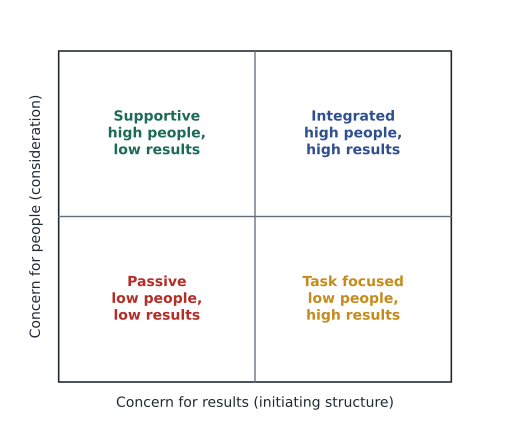
A 2004 meta-analysis by Judge, Piccolo and Ilies revived these two dimensions with impressive results. Consideration had a corrected correlation of about 0.48 with overall leadership outcomes and was particularly strongly related to follower satisfaction and motivation. Initiating structure had a correlation of about 0.29 and was more strongly related to leader job performance and group performance. Both mattered, for different things. This is good news for managers because both sets of behaviour are concrete and learnable. Consideration looks like regular one-on-one conversations, remembering what matters to people and giving credit. Structure looks like clear priorities, defined roles and well-run meetings.
Situations: when and with whom
Behavioural theories left an obvious question: does the same style work everywhere? Contingency theories answered no. Fred Fiedler's contingency model proposed that a leader's style, measured with the least preferred co-worker scale, is relatively fixed, so the situation should be matched to the leader. Robert House's path-goal theory proposed that leaders should choose behaviours that clear the path to goals: directive leadership when tasks are ambiguous, supportive leadership when tasks are stressful or tedious, participative leadership when followers have expertise, and achievement-oriented leadership when followers want challenge. Paul Hersey and Ken Blanchard's situational leadership model, widely used in corporate training, prescribes more direction for less ready followers and more delegation as they gain competence and commitment.
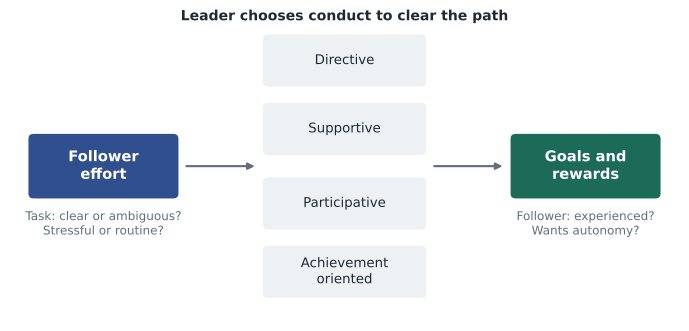
The evidence for contingency theories is mixed. Path-goal theory has received partial support, especially for the idea that structure helps more when tasks are ambiguous and support helps more when tasks are stressful. Situational leadership is intuitive and popular but has weak research support for its specific prescriptions. Yet the core contingency insight has held up well: the effect of a leader's behaviour depends on the task, the followers and the setting. A newer approach, leader-member exchange theory, adds that leaders develop different relationships with different followers. High-quality exchanges, built on trust and mutual obligation, are consistently associated with better performance, citizenship behaviour and lower turnover, which raises the fairness question of who gets the leader's best attention.
Transformations: what leaders ask people to become
In 1978 the political historian James MacGregor Burns distinguished transactional leaders, who exchange rewards for performance, from transforming leaders, who raise followers' motivation and moral aspirations. Bernard Bass turned the idea into a measurable model. Transformational leadership has four components: idealized influence, in which the leader acts as a role model; inspirational motivation, in which the leader articulates an appealing vision; intellectual stimulation, in which the leader challenges assumptions and encourages new ideas; and individualized consideration, in which the leader attends to each follower's needs and development. Transactional leadership includes contingent reward and management by exception, and laissez-faire leadership is the absence of leadership.
Meta-analyses find that transformational leadership is positively associated with follower satisfaction, motivation and performance, and contingent reward is often nearly as effective, while laissez-faire leadership is consistently harmful. Field experiments are especially persuasive. In a well-known study, Israeli military platoon leaders randomly assigned to transformational leadership training led recruits who later scored higher on performance tests than recruits under untrained leaders. Critics note that the questionnaire measures blend the components together and include outcomes in the definition, so a leader rated as inspiring may simply be one whose team is doing well. Dr. Sato's summary is that the behaviours behind the model, a clear and meaningful purpose, a high bar paired with belief in people's ability to reach it, and genuine interest in individuals, are worth learning, whatever label is attached to them.
Newer models such as authentic, servant, ethical and humble leadership emphasize the leader's integrity and service to others. They capture real concerns about leaders who are charismatic but self-serving. However, a 2018 meta-analysis by Banks and colleagues found that measures of authentic leadership overlap so heavily with transformational leadership that they add little predictive power, and servant leadership showed somewhat more distinctiveness. For practice, the common thread is that followers judge leaders on whether they act in the group's interest, keep promises and treat people fairly.
# Scoring a short leader conduct survey and linking it to team outcomes
from statistics import mean, correlation   # Python 3.10+
teams = {   # team: ([consideration items], [structure items], turnover %, on-time %)
    "Costing":    ([4.2, 4.0, 4.4], [3.1, 3.4, 3.0], 9.0, 88),
    "Payables":   ([3.0, 2.8, 3.2], [4.3, 4.1, 4.4], 18.0, 95),
    "Payroll":    ([4.5, 4.6, 4.3], [4.2, 4.0, 4.4], 6.0, 97),
    "Reporting":  ([2.6, 2.9, 2.5], [2.8, 3.0, 2.7], 24.0, 81),
    "Treasury":   ([3.8, 3.9, 4.0], [3.6, 3.8, 3.5], 11.0, 92),
    "Plant cost": ([3.3, 3.5, 3.1], [3.9, 4.0, 3.7], 14.0, 90),
}
cons = [mean(v[0]) for v in teams.values()]
stru = [mean(v[1]) for v in teams.values()]
turn = [v[2] for v in teams.values()]
time = [v[3] for v in teams.values()]
for name, c, s in zip(teams, cons, stru):
    print(f"{name:<11} consideration {c:.2f}  structure {s:.2f}")
print(f"r(consideration, turnover) = {correlation(cons, turn):+.2f}")
print(f"r(structure, on-time close) = {correlation(stru, time):+.2f}")
print("Small sample: treat as a prompt for conversation, not proof.")Costing consideration 4.20 structure 3.17 Payables consideration 3.00 structure 4.27 Payroll consideration 4.47 structure 4.20 Reporting consideration 2.67 structure 2.83 Treasury consideration 3.90 structure 3.63 Plant cost consideration 3.30 structure 3.87 r(consideration, turnover) = -0.97 r(structure, on-time close) = +0.94 Small sample: treat as a prompt for conversation, not proof.
Daniel built this toy analysis from a pulse survey across six finance teams in Northfield's parent group. Consideration is strongly and negatively related to turnover, and structure is strongly related to closing the books on time, which echoes the meta-analytic pattern. With only six teams and survey ratings from the same people, it proves nothing on its own, but it gives him a structured way to talk with his supervisors about what each team needs: the Reporting team appears short of both.
Who emerges as leader, and who is effective
Research distinguishes leader emergence, meaning who is seen as a leader by a group, from leader effectiveness, meaning whether the group performs well under that person. The two are related but not the same. People carry implicit theories, or prototypes, of what a leader looks like, and individuals who match the prototype tend to emerge as leaders even when they are no more effective. Narcissism is a striking example. A meta-analysis by Emily Grijalva and colleagues in 2015 found that narcissism is positively related to leader emergence, largely because narcissists appear confident and extraverted, but it is essentially unrelated to effectiveness overall, with some evidence that moderate levels are associated with the best ratings and very high levels with worse ones. Selection processes that reward confident self-presentation in a short interview can therefore choose people who look like leaders more reliably than people who lead well.
Gender and leadership has been studied extensively. Meta-analyses by Alice Eagly and colleagues found that women and men in comparable leadership roles differ only modestly in style, with women on average slightly more participative and slightly more likely to use transformational behaviours and contingent reward. Women leaders are rated as effective as men overall, but evaluations depend on context: women are often judged more harshly when they lead in a directive way or in roles stereotyped as masculine. Eagly's role congruity theory explains this as a clash between expectations of leaders and expectations of women, rather than a difference in competence. For managers who make promotion decisions, the lesson is to define what effective leadership looks like in behavioural terms before assessing candidates, so that a prototype does not substitute for evidence.
Worked problem
Matching behaviour to the situation
Hana has two charge nurses. Priyanka leads an experienced night team facing a stressful but well-understood routine. Marc leads a newly formed team piloting a new triage protocol that nobody yet fully understands.
Show solution
- Path-goal theory suggests supportive behaviour where tasks are stressful but clear, so Priyanka should focus on recognition, workload balance and protecting breaks.
- Where tasks are ambiguous, directive behaviour and structure help, so Marc should define roles, write a short protocol checklist and hold daily huddles.
- Both should keep some consideration and some structure, because the meta-analytic evidence shows both matter; the mix differs, not the presence.
- As Marc's team gains experience, he should shift toward participative behaviour and invite them to improve the protocol.
Answer: Priyanka emphasizes support, Marc emphasizes structure for now, and both review the mix as the situation changes.
Common mistakes
MistakeThere is one best leadership style for all situations.
InsteadThe effects of leader behaviour depend on the task, the followers and the setting, though consideration and structure help in most settings.
MistakeTransformational leadership has made transactional leadership obsolete.
InsteadContingent reward is often nearly as effective; good leaders combine clear exchanges with an inspiring purpose.
MistakeHigh follower ratings prove a leadership style works.
InsteadRatings from the same people who report outcomes are biased; look for objective outcomes and field experiments.
Summary and key terms
- Trait research finds that extraversion, conscientiousness, openness and intelligence modestly predict who emerges as a leader; traits are a starting point, not destiny.
- Consideration and initiating structure are two learnable families of behaviour; both predict leadership outcomes, with consideration tied to satisfaction and structure to performance.
- Contingency theories such as path-goal theory hold that the right behaviour depends on the task and followers; leader-member exchange shows relationship quality matters.
- Transformational leadership, supported by field experiments, combines purpose, challenge, intellectual stimulation and individual attention; laissez-faire leadership is consistently harmful.
- Consideration
- Leader behaviour showing concern, respect and support for followers.
- Initiating structure
- Leader behaviour that defines roles, organizes work and sets goals.
- Path-goal theory
- A contingency theory in which leaders choose behaviours that help followers reach goals given the task and follower characteristics.
- Leader-member exchange
- The quality of the relationship between a leader and each follower.
- Transformational leadership
- Leadership that motivates through role modelling, vision, intellectual stimulation and individual consideration.
- Laissez-faire leadership
- Avoidance of leadership responsibilities and decisions.
Practice problems
Work each problem on paper first, then reveal the answer to check.
Leo's engineering managers score high on consideration but low on structure, and projects miss deadlines. What would you recommend?
Show answer
Keep the supportive behaviour but add structure: clear priorities, defined owners for each deliverable, agreed definitions of done and a regular review rhythm. The evidence links structure to performance, so the gap is likely the cause of missed deadlines.
Why are field experiments, such as the platoon leader study, more convincing than surveys showing that transformational leaders have satisfied followers?
Show answer
Random assignment of leaders to training means differences in follower performance can be attributed to the training, and the outcome was measured objectively. Surveys rely on the same people rating both the leader and their own satisfaction, so general feelings can inflate the relationship and causality cannot be determined.
Grace notices that she spends far more time with the five store managers who like her ideas than with the others. Which theory describes this, and what is the risk?
Show answer
Leader-member exchange theory. The risk is that the out-group managers receive less information, support and influence, which can reduce their commitment and performance and create perceptions of unfairness. She should deliberately build higher-quality exchanges with all forty.
Lesson quiz · 5 questions
Score 60% or more to complete this lesson.
Create a free account to save your progress, take quizzes and earn a certificate.