
MBA-503 · Lesson 11 of 12 · 19 min
Culture, diversity and inclusion
Hana Kowalski's emergency department has a poster in the staff room that says Safety First: Speak Up. In the same department, a newly graduated nurse who questioned a physician's medication order last month was told in front of a patient to do her job, and nobody said anything. Two weeks later, the nurse requested a transfer. Hana knows that the poster describes what the hospital says it values and the incident describes what it actually does. This session examines organizational culture, how it forms and how leaders shape it, and then turns to diversity and inclusion, where the gap between stated values and daily practice is often widest.
What culture is
Edgar Schein, whose work defined the field, described organizational culture as a pattern of shared basic assumptions that a group has learned as it solved its problems of external adaptation and internal integration, that has worked well enough to be considered valid and is therefore taught to new members as the correct way to perceive, think and feel. He distinguished three levels. Artifacts are the visible structures and behaviours, such as office layout, dress, language, rituals and stories; they are easy to see but hard to interpret. Espoused values are the stated strategies, goals and philosophies, such as the values on the website or the poster in the staff room. Basic underlying assumptions are the taken-for-granted beliefs that actually guide behaviour, often unconsciously. When espoused values and basic assumptions conflict, the assumptions win.
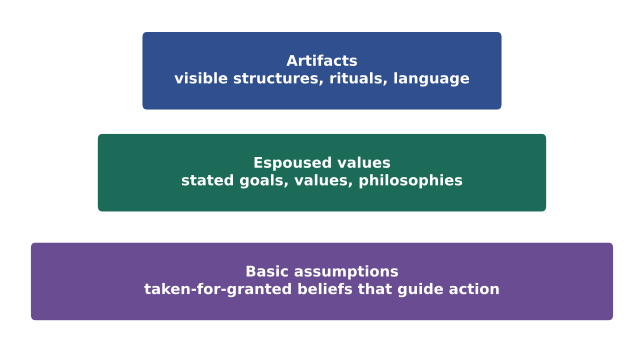
In Hana's department, the basic assumption appears to be that physicians' authority should not be questioned in public and that raising concerns is risky for junior staff. That assumption formed for understandable reasons, perhaps from times when challenges slowed care or provoked conflict, and it has been reinforced each time someone spoke up and was punished or ignored. Changing it requires changing what happens when people speak up, not adding more posters.
Schein also identified what leaders do that most powerfully shapes culture. His primary embedding mechanisms include what leaders pay attention to, measure and control on a regular basis; how they react to critical incidents and crises; how they allocate resources, rewards and status; deliberate role modelling, teaching and coaching; and the criteria they use to recruit, select, promote and remove people. Secondary mechanisms include structures, systems, rituals, physical spaces, stories and formal statements of philosophy. The secondary mechanisms work only when they are consistent with the primary ones. A values statement contradicted by who gets promoted teaches people that the values statement is not to be taken seriously.
Types of culture and performance
Researchers have proposed many ways of classifying cultures. One widely used framework is the competing values framework developed by Robert Quinn, Kim Cameron and colleagues. It arranges cultures along two dimensions, flexibility versus stability and internal versus external focus, giving four types: clan cultures, which emphasize collaboration, development and loyalty; adhocracy cultures, which emphasize innovation and risk-taking; market cultures, which emphasize competition, results and customers; and hierarchy cultures, which emphasize control, efficiency and procedures. Most organizations combine elements of all four. A meta-analysis by Chad Hartnell, Amy Yi Ou and Angelo Kinicki in 2011 found that each culture type was related to different outcomes, with clan cultures most strongly linked to employee attitudes and market cultures to some financial measures, but that the relationships were not as distinct as the framework implies.
Culture strength, meaning how widely and intensely values are shared, also matters. Strong cultures coordinate behaviour without detailed rules and can be a source of performance, but they can also resist change when the environment shifts. Jennifer Chatman and Charles O'Reilly have argued that what matters is not strength alone but whether a strong culture is aligned with strategy and includes norms that value adaptability. A strong culture of operational excellence in a business that suddenly needs innovation can be a liability.
In healthcare and other high-risk settings, an important cultural concept is just culture, developed from the work of James Reason and David Marx. A just culture distinguishes between human error, which is inadvertent and should be handled by consoling the person and improving the system; at-risk behaviour, where people drift into unsafe shortcuts because the risk is not recognized, which calls for coaching and removing incentives for shortcuts; and reckless behaviour, a conscious disregard of substantial risk, which warrants discipline. Most errors in complex systems fall into the first two categories. Organizations that punish all errors drive reporting underground, which is why, as Edmondson's early research found, better units often report more errors.
Diversity: what the evidence shows
Diversity refers to differences among members of a group on any attribute. Researchers distinguish surface-level diversity in visible or demographic characteristics such as gender, age and ethnicity from deep-level diversity in values, personality and knowledge, and job-related diversity in function, education and expertise from less job-related forms. A common way to measure diversity on a categorical attribute is the Blau index, which is one minus the sum of the squared proportions in each category. It equals zero when everyone is in one category and approaches one minus one over k when members are spread evenly across k categories.
The research on whether diversity improves team performance is more nuanced than either advocates or sceptics often suggest. Meta-analyses, such as one by Hans van Dijk, Marloes van Engen and Daan van Knippenberg in 2012, find that job-related diversity has small positive effects on outcomes such as innovation and decision quality, while the average effect of demographic diversity on performance is close to zero. Averages hide large variation. The categorization-elaboration model proposed by van Knippenberg and colleagues explains why: diversity can improve performance when members elaborate on their different information and perspectives, but it can hurt when it triggers us-versus-them categorization. Which happens depends on conditions such as task complexity, psychological safety, shared goals and leadership. Diversity is therefore a resource that leaders must manage, not an outcome that happens automatically.
One mechanism that turns diversity into conflict is the faultline, a concept introduced by Dora Lau and Keith Murnighan. A faultline exists when several attributes align to split a group into subgroups, for example when all the engineers are older men from the parent company and all the analysts are younger women from the acquired one. Strong faultlines are associated with more conflict and lower performance, especially when they line up with differences in information or status. Daniel's finance team, discussed in the previous session, had a faultline along the merger boundary that was reinforced by different methods and different managers.
# Blau index for categorical attributes in two project teams
from collections import Counter

def blau(values):
    n = len(values)
    return 1 - sum((c / n) ** 2 for c in Counter(values).values())

teams = {
    "Pod A": {"discipline": ["process", "process", "civil", "structural", "civil", "process", "geotech"],
              "origin":     ["firm", "firm", "firm", "firm", "client", "firm", "firm"]},
    "Pod B": {"discipline": ["electrical", "controls", "controls", "electrical", "controls", "electrical", "electrical"],
              "origin":     ["firm", "firm", "acquired", "firm", "acquired", "firm", "acquired"]},
}
for team, attrs in teams.items():
    parts = []
    for attr, vals in attrs.items():
        k = len(set(vals))
        parts.append(f"{attr} Blau={blau(vals):.2f} (max {1 - 1 / k:.2f} for {k} groups)")
    print(team + ": " + "; ".join(parts))

# A simple faultline check: does origin line up with discipline in Pod B?
pairs = Counter(zip(teams["Pod B"]["discipline"], teams["Pod B"]["origin"]))
print("Pod B discipline by origin:", dict(pairs))Pod A: discipline Blau=0.69 (max 0.75 for 4 groups); origin Blau=0.24 (max 0.50 for 2 groups)
Pod B: discipline Blau=0.49 (max 0.50 for 2 groups); origin Blau=0.49 (max 0.50 for 2 groups)
Pod B discipline by origin: {('electrical', 'firm'): 3, ('controls', 'firm'): 1, ('controls', 'acquired'): 2, ('electrical', 'acquired'): 1}Pod A is diverse in discipline, which is the kind of job-related diversity linked to better problem solving on complex engineering work. Pod B has only two disciplines and is split almost evenly by origin, since three members joined when Prairie Ridge acquired a smaller controls firm. The cross-tabulation shows that two of the three acquired members are controls specialists, while three of the four firm members are electrical engineers, so origin and discipline partly align. Owen decides to pair an acquired controls specialist with a firm electrical engineer on each work package, so that collaboration crosses the potential faultline.
Inclusion and what works
Inclusion is the degree to which people experience being treated as valued members of a group. Lynn Shore and colleagues proposed that inclusion combines two needs: belongingness, being accepted as an insider, and uniqueness, being valued for one's distinctive characteristics rather than having to suppress them. Assimilation provides belonging without uniqueness; differentiation provides uniqueness without belonging. Inclusive leaders create both, for example by actively inviting contributions from quieter members, attributing ideas accurately and making sure that informal opportunities, such as stretch assignments and access to senior leaders, are distributed fairly.
Evidence on what diversity programs achieve is sobering in places. Frank Dobbin and Alexandra Kalev, analysing three decades of data from more than 800 US firms, found that mandatory diversity training and grievance systems were often followed by no increase, and in some cases decreases, in the share of managers from underrepresented groups, perhaps because people resist being told what to think. Programs that engaged managers in solving the problem, such as voluntary training, structured mentoring, recruitment initiatives with targeted outreach, task forces and clear accountability for results, were associated with increases. A large field experiment by Edward Chang and colleagues found that a one-hour online diversity training changed some attitudes but produced limited behavioural change. Structural changes, such as structured interviews and clear promotion criteria, discussed in the session on decisions, reduce bias more reliably than awareness alone.
In Canada, the federal Employment Equity Act requires federally regulated employers to identify and remove barriers for designated groups and to report on their workforce, and the federal government has been reviewing the Act to modernize its designated groups. Provincial human rights codes, such as Ontario's, prohibit discrimination in employment on a range of grounds and require accommodation to the point of undue hardship. These laws set the floor; inclusion is about what leaders do above it.
Bringing new people into the culture
Organizational socialization is the process through which newcomers learn the knowledge, behaviours and attitudes needed to participate as members. It is one of the most powerful channels through which culture is transmitted, for better or worse. A meta-analysis by Talya Bauer and colleagues in 2007 found that newcomer adjustment, measured by role clarity, self-efficacy and social acceptance, was linked to higher performance, satisfaction and commitment and to lower turnover intentions. Organizational tactics that provide structured, sequential and supportive onboarding, including access to experienced insiders, tend to improve adjustment.
For Hana's department the implication is direct. The new graduate nurse who transferred out learned the department's real assumptions within weeks, from what happened when she spoke up. A deliberate onboarding plan that pairs each new nurse with an experienced mentor, explains how to raise concerns and includes an early conversation with the physician lead would teach a different lesson. First impressions of culture are hard to undo, so the first ninety days are when leaders have the most influence over how newcomers understand the organization.
Worked problem
Changing the speak-up culture in Hana's department
After the incident with the new graduate nurse, Hana wants to make it genuinely safe to question orders without undermining physicians.
Show solution
- Name the gap: share the incident anonymously with nursing and physician leaders as an example of espoused values conflicting with practice.
- Agree on a shared phrase, such as I need a moment to clarify this order, that any staff member can use, and which physicians commit to pausing for.
- Change primary embedding mechanisms: the physician lead and Hana publicly thank people who raise concerns, and speaking up becomes a criterion in performance reviews for all clinical staff.
- Adopt just-culture principles in incident review, distinguishing error, at-risk behaviour and reckless behaviour.
- Measure progress with a short quarterly pulse question on whether people feel safe to speak up, and track the number of near-miss reports, expecting them to rise at first.
Answer: Culture change through leader behaviour, a shared speak-up phrase, just-culture review and rewards, measured over time.
Common mistakes
MistakeCulture is what the values statement says.
InsteadCulture lies mostly in basic assumptions revealed by what leaders pay attention to, reward and tolerate.
MistakeDiverse teams automatically perform better.
InsteadAverage effects of demographic diversity on performance are near zero; benefits depend on elaboration, safety and leadership.
MistakeMandatory diversity training reliably increases representation.
InsteadEvidence suggests mandatory training alone often has little effect; engagement, mentoring, accountability and structural changes work better.
Summary and key terms
- Schein's culture has three levels: artifacts, espoused values and basic assumptions; assumptions guide behaviour when they conflict with stated values.
- Leaders shape culture most through what they attend to, how they react to crises, how they allocate rewards and whom they promote.
- A just culture distinguishes error, at-risk behaviour and reckless behaviour, encouraging reporting and learning.
- Job-related diversity has small positive effects; demographic diversity effects average near zero and depend on whether differences are elaborated or trigger faultlines.
- Inclusion combines belonging and uniqueness; structural practices and manager engagement outperform mandatory training alone.
- Basic assumptions
- Taken-for-granted beliefs that guide behaviour in a culture.
- Embedding mechanism
- A leader action that shapes culture, such as what is rewarded or measured.
- Just culture
- An approach that distinguishes error, at-risk and reckless behaviour in responding to incidents.
- Blau index
- One minus the sum of squared category proportions, measuring categorical diversity.
- Faultline
- Alignment of several attributes that splits a group into subgroups.
- Inclusion
- Being treated as a valued insider while being valued for distinctive characteristics.
Practice problems
Work each problem on paper first, then reveal the answer to check.
A team of 10 has 5 engineers, 3 analysts and 2 designers. What is its Blau index for function?
Show answer
1 - (0.5 squared + 0.3 squared + 0.2 squared) = 1 - (0.25 + 0.09 + 0.04) = 0.62.
A company's values statement emphasizes innovation, but the managers promoted last year all came from the operations group known for avoiding risk. What will employees most likely conclude?
Show answer
That risk avoidance is what is really rewarded. Promotion decisions are a primary embedding mechanism and override espoused values.
A nurse takes a shortcut that skips a double check because it is common practice on busy shifts. In a just culture, how should this be classified and handled?
Show answer
As at-risk behaviour: the risk was not recognized because the shortcut had become normal. The response is coaching, plus removing the pressures and incentives that make the shortcut common, rather than punishment.
Lesson quiz · 5 questions
Score 60% or more to complete this lesson.
Create a free account to save your progress, take quizzes and earn a certificate.