
MBA-503 · Lesson 3 of 12 · 19 min
Leading yourself: self-awareness, values and emotional intelligence
Before the third session each student receives a confidential report from a 360-degree feedback survey. Over the previous three weeks their managers, peers and direct reports answered forty questions about how they behave at work, and each student rated themselves on the same items. Dr. Sato starts the session by asking the cohort to guess which group's ratings of them would differ most from their own. Most guess their manager. In the data, as in most organizations, the biggest gaps are usually with direct reports, the people who see a manager's behaviour most often and have the least power to say what they see.
The session rests on a simple premise. A manager cannot change behaviour they cannot see, and research suggests that most people see themselves less accurately than they think. Tasha Eurich, who studied self-awareness across thousands of professionals, estimated that while most people believe they are self-aware, only about 10 to 15 per cent meet the criteria in her studies. She distinguishes internal self-awareness, a clear view of one's own values, passions and reactions, from external self-awareness, an accurate understanding of how others see you. The two are only weakly related, and leaders need both.
Why self-assessments are often wrong
Meta-analyses comparing self-ratings with ratings from others and with objective performance find only modest agreement. People tend to rate themselves above average on desirable traits, a pattern psychologists call the better-than-average effect. Kruger and Dunning's well-known studies found that people who performed worst on tests of logic, grammar and humour overestimated their performance most; later work has debated how much of this pattern reflects statistical artefacts such as regression to the mean, but the finding that low performers often lack the knowledge needed to judge their own performance has held up in many settings. Power appears to make the problem worse. Senior people receive less candid feedback and, in several studies, became less accurate at reading others' perspectives when made to feel powerful.
Experience alone does not fix the problem. Eurich's research found that more experienced managers were, if anything, more likely to overrate their own capability, partly because they receive less critical feedback as they rise. Introspection can also mislead. Asking yourself why you feel a certain way often produces plausible but inaccurate stories; asking what you are feeling and what you might do next tends to be more useful. The reliable route to external self-awareness is structured feedback from people who see your work, gathered in a way that makes candour safe.
The 360-degree feedback process
A 360-degree review collects ratings and comments from a manager's supervisor, peers, direct reports and sometimes customers, alongside a self-rating. It is valuable for development because different groups see different behaviour. Research reviews suggest it works best under specific conditions: when it is used for development rather than tied directly to pay or promotion, when raters are anonymous and there are at least three or four in each group, when the items describe observable behaviours rather than traits, and when the recipient discusses the results with a coach and commits to a small number of specific changes. A meta-analysis by Smither, London and Reilly found that, on average, improvement after multisource feedback is small, but it is larger for people who set goals, discuss feedback with raters and believe change is possible.
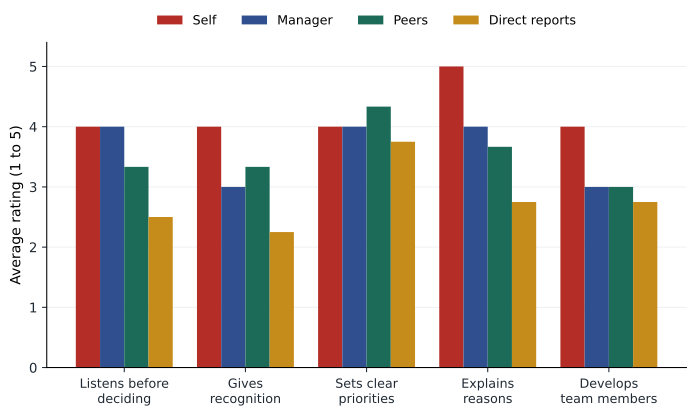
The most useful patterns in a report are gaps and themes rather than individual scores. A blind spot is a behaviour you rate much higher than others do. A hidden strength is one others rate higher than you do, which can be just as important, because people tend to stop doing things they undervalue. Written comments often carry more information than numbers, especially when several raters describe the same incident in different words. Dr. Sato asks each student to choose no more than two behaviours to work on, to tell their team which two they chose, and to ask for a short check-in at the end of the term. Telling people what you are working on makes the change visible and invites further feedback.
# 360-degree feedback: averages by rater group and self-other gaps
from statistics import mean
items = ["Listens before deciding", "Gives recognition", "Sets clear priorities",
         "Explains the reasons for decisions", "Develops team members"]
ratings = {   # rater group: list of ratings per item (1 = never, 5 = always)
    "self":    [[4], [4], [4], [5], [4]],
    "manager": [[4], [3], [4], [4], [3]],
    "peers":   [[3, 4, 3], [3, 3, 4], [4, 4, 5], [4, 3, 4], [3, 3, 3]],
    "reports": [[2, 3, 2, 3], [2, 2, 3, 2], [4, 4, 3, 4], [3, 3, 2, 3], [3, 2, 3, 3]],
}
print(f"{'Practice':<36}{'self':>6}{'mgr':>6}{'peer':>6}{'rept':>6}{'gap':>6}")
for i, item in enumerate(items):
    s = mean(ratings["self"][i])
    others = [mean(ratings[g][i]) for g in ("manager", "peers", "reports")]
    gap = s - mean(others)
    flag = "  blind spot" if gap >= 1.0 else ("  hidden strength" if gap <= -0.5 else "")
print(f"{item:<36}{s:6.1f}" + "".join(f"{o:6.1f}" for o in others) + f"{gap:6.1f}{flag}")Practice self mgr peer rept gap Listens before deciding 4.0 4.0 3.3 2.5 0.7 Gives recognition 4.0 3.0 3.3 2.2 1.1 blind spot Sets clear priorities 4.0 4.0 4.3 3.8 -0.0 Explains the reasons for decisions 5.0 4.0 3.7 2.8 1.5 blind spot Develops team members 4.0 3.0 3.0 2.8 1.1 blind spot
Values and character
Self-awareness is not only about how others see your behaviour; it is also about knowing what you care about and why. Values are relatively stable beliefs about what is important, such as fairness, achievement, security or helping others. Shalom Schwartz's research across dozens of countries identified a consistent structure of basic human values arranged in a circle, in which some values, such as achievement and benevolence, tend to pull in different directions. Leaders who are clear about their values make more consistent decisions and are more trusted, because followers can predict how they will act when the rules run out.
Dr. Sato uses a simple exercise. Each student writes a page about a time at work when they felt proud of how they handled a hard situation, and another about a time they felt they compromised. The cohort then names the values that were honoured or breached. Owen realizes that his frustration with the engineering team at Prairie Ridge comes partly from a clash between his value of financial discipline and their value of technical excellence; both are legitimate, and seeing them as values rather than stubbornness changes how he frames budget conversations. Values clarification is not a one-time event. Leaders revisit it when they take on new roles or face decisions that test them.
Emotional intelligence: what it is and what it predicts
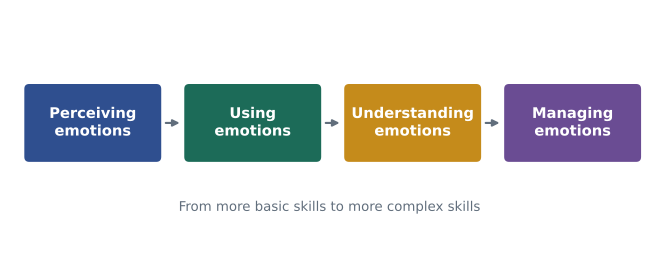
Emotional intelligence became famous through Daniel Goleman's 1995 bestseller, but the scientific concept came from psychologists Peter Salovey and John Mayer, who defined it in 1990 as the ability to perceive, use, understand and manage emotions in oneself and others. The popular version expanded the idea into a broad set of competencies that overlap heavily with personality, and claims that emotional intelligence matters more than intelligence for success went well beyond the evidence. Researchers distinguish ability measures, which test emotional skills with right and wrong answers, from self-report and mixed models, which ask people to rate themselves.
The evidence is more modest than the popular claims but real. A meta-analysis by Joseph and Newman found that ability emotional intelligence predicts job performance mainly in jobs with high emotional labour, such as nursing, sales and customer service, and that much of the predictive power of mixed self-report measures comes from their overlap with personality and self-efficacy. A later meta-analysis found that emotional intelligence adds a small amount of prediction of performance beyond cognitive ability and the Big Five. For leaders, the most practically useful parts are the skills of recognizing emotions accurately in others and regulating your own reactions under pressure, both of which can be improved with practice.
Emotion regulation research offers concrete techniques. James Gross's process model distinguishes strategies that act before an emotion fully forms, such as choosing or changing the situation and reappraising what it means, from strategies that act afterward, such as suppressing the expression. Reappraisal, for example interpreting a sharp email as a sign of the sender's stress rather than an attack, is generally associated with better outcomes than suppression, which tends to increase physiological stress and reduce the quality of interactions. Hana teaches her charge nurses a short routine for tense moments: name the emotion, pause before replying and ask one question to understand the other person's view.
Mindsets, resilience and claims that did not replicate
Several popular self-improvement findings have weakened under replication, and Dr. Sato wants the cohort to know which ones. The claim that adopting an expansive 'power pose' for two minutes raises testosterone and lowers cortisol did not replicate in larger studies, although some later work finds small effects on how powerful people report feeling. The idea of ego depletion, that self-control draws on a limited resource that runs down with use, failed in a large multi-laboratory replication in 2016. Growth mindset interventions, which teach that abilities can be developed, show small average effects on school achievement in large trials, concentrated among lower-achieving students. The lesson is to treat striking single studies with caution and to prefer practices backed by many studies.
What does hold up is that leaders' own wellbeing affects their teams. Studies of emotional contagion show that a leader's mood spreads to the group, and research on sleep finds that sleep-deprived leaders are rated as less charismatic and make more unethical decisions. Leo's 360 comments include several references to late-night messages that leave his team anxious. He decides to schedule messages for the morning and to say explicitly when something is not urgent. Leading yourself, Dr. Sato says, is the part of leadership nobody else can do for you.
When feedback helps and when it hurts
It is tempting to assume that more feedback always helps. A landmark meta-analysis by Avraham Kluger and Angelo DeNisi in 1996, covering more than 600 effect sizes, found that feedback interventions improved performance on average by a moderate amount, but that in over a third of cases performance actually got worse after feedback. The key variable was where the feedback directed attention. Feedback that focused attention on the task and on how to improve it tended to help. Feedback that focused attention on the self, such as praise or criticism of the person, comparisons with others or threats to self-esteem, tended to hurt, because people spent effort managing their feelings and image rather than improving the work.
For self-awareness this has two implications. When you ask for feedback, ask about specific behaviours and situations, for example how you handled the budget meeting on Tuesday, rather than for a general verdict on your leadership. When you receive feedback that stings, separate the emotional reaction from the information: note the reaction, wait a day if needed, and then ask what specific evidence lies behind the comment and what one change would make the biggest difference. Daniel adopts a simple routine after the 360 results. At the end of each team meeting he asks one person a single question: what is one thing I could do differently next time? Over eight weeks, the answers become more specific and more candid, which is itself a sign that the team is starting to trust that feedback will not be punished.
Worked problem
Reading a 360 report
Daniel's results show a self-rating of 4.0 on 'Gives recognition' against an average of 3.0 from his manager, peers and reports, with direct reports averaging 2.25. Comments include 'Daniel notices errors immediately but rarely mentions good work' and 'I found out my analysis went to the plant manager from someone else'.
Show solution
- The self-other gap of 1.0 meets his threshold for a blind spot, and the gap with direct reports is 1.75.
- The comments describe specific behaviour, so they suggest a concrete change rather than a personality issue.
- He chooses one behaviour: when work is good, tell the person within a day and say what was good about it, and credit analysts by name when their work goes upward.
- He tells his team about the change and asks for a quick check-in in eight weeks.
Answer: A specific, visible behaviour change targeted at the largest gap, with a planned check-in, gives Daniel the best chance of measurable improvement.
Common mistakes
MistakeExperienced managers know themselves well.
InsteadSelf-awareness often declines with seniority because candid feedback becomes scarce; structured feedback is needed.
MistakeEmotional intelligence matters more than intelligence for success.
InsteadAbility emotional intelligence adds modest prediction, mainly in emotionally demanding jobs; cognitive ability remains a strong predictor.
MistakeA power pose before a meeting will raise your hormones and confidence.
InsteadThe hormonal effects did not replicate; preparation and practice are more reliable sources of confidence.
Summary and key terms
- Most people overestimate their self-awareness; internal and external self-awareness are distinct and both matter.
- 360-degree feedback helps development when it is anonymous, behavioural, separated from pay and followed by goals and conversations.
- Clarity about values makes leaders more consistent and trustworthy, and helps reframe conflicts as differences in legitimate values.
- Ability emotional intelligence predicts performance modestly, especially in emotional jobs; reappraisal is a more effective regulation strategy than suppression.
- Several popular findings, including power posing and ego depletion, did not replicate; prefer practices supported by many studies.
- Internal self-awareness
- A clear understanding of your own values, emotions and reactions.
- External self-awareness
- An accurate understanding of how others see you.
- 360-degree feedback
- Ratings and comments from supervisors, peers, direct reports and self on the same behaviours.
- Blind spot
- A behaviour you rate much higher than others do.
- Emotional intelligence
- The ability to perceive, use, understand and manage emotions.
- Reappraisal
- Changing how you interpret a situation to change its emotional impact.
Practice problems
Work each problem on paper first, then reveal the answer to check.
Why should 360-degree feedback used for development usually be kept separate from pay decisions?
Show answer
When ratings affect pay, raters may inflate or deflate scores for strategic reasons, recipients become defensive, and candour falls. Keeping it developmental encourages honest feedback and openness to change.
Owen's report shows peers rate him 4.6 on 'Analyses problems thoroughly' while he rates himself 3.5. What is this, and why does it matter?
Show answer
It is a hidden strength. It matters because people tend to underuse strengths they undervalue; recognizing it can help Owen contribute more confidently in engineering discussions.
A colleague cites a single famous study as proof that a two-minute technique transforms performance. How should a manager respond?
Show answer
Ask whether the finding has been replicated in larger, independent studies and meta-analyses. Single striking results are often inflated; several, such as power posing and ego depletion, failed to replicate.
Lesson quiz · 5 questions
Score 60% or more to complete this lesson.
Create a free account to save your progress, take quizzes and earn a certificate.