
MBA-503 · Lesson 4 of 12 · 19 min
Motivation: needs, goals and self-determination
Hana arrives at the fourth session with a problem that has been keeping her up at night. Lakeview Health's emergency department has lost eleven experienced nurses in a year, and exit interviews mention workload, schedules and a feeling that nobody listens. The hospital's response so far has been a retention bonus of 5,000 dollars paid after two more years of service. Turnover has not changed. Dr. Sato uses the case to open the session on motivation, because it illustrates a mistake organizations make constantly: assuming that people are motivated mainly by money, and that if money does not work, nothing will.
Motivation is the set of forces that start, direct and sustain effort. Psychologists describe three features of any motivated behaviour: direction, meaning what a person chooses to do; intensity, meaning how hard they try; and persistence, meaning how long they keep going in the face of difficulty. Theories of work motivation fall into two broad groups. Content theories ask what people need or want. Process theories ask how people decide where to put their effort. A manager needs both, because knowing what people value is useless without understanding how effort gets translated into outcomes.
Needs theories and what survived
Abraham Maslow's hierarchy of needs, published in 1943, proposed that people satisfy physiological and safety needs before social needs, esteem and finally self-actualization. The pyramid is probably the most recognized image in management education, yet research has found little support for a strict hierarchy; people pursue several needs at once and the order varies across individuals and cultures. Frederick Herzberg's two-factor theory proposed that hygiene factors such as pay, working conditions and supervision prevent dissatisfaction, while motivators such as achievement, recognition and the work itself create satisfaction. The specific split has not held up well in later studies, which find that pay and conditions can also motivate. What survived from both is a useful idea: people want more from work than a paycheque, and conditions that prevent misery are not the same as conditions that inspire effort.
David McClelland's research on needs for achievement, affiliation and power remains influential. People with a high need for achievement prefer moderately difficult tasks with clear feedback and personal responsibility, which makes them strong individual contributors and entrepreneurs but not always good managers. McClelland's studies of managers found that the most effective ones often had a high need for power directed at building the organization, combined with self-control, rather than a high need for affiliation, which can lead to avoiding hard decisions in order to be liked.
Self-determination theory
The most strongly supported modern theory of what people need from work is self-determination theory, developed by Edward Deci and Richard Ryan. It proposes three basic psychological needs: autonomy, the sense of acting by choice rather than under pressure; competence, the sense of being effective and growing; and relatedness, the sense of connection and belonging. When work satisfies these needs, people show more autonomous motivation, meaning they act because the work is interesting or because they genuinely value its purpose. When work thwarts them, people show controlled motivation, acting only to gain rewards or avoid punishment or guilt. Meta-analyses across many countries link satisfaction of the three needs to engagement, performance, wellbeing and lower turnover intentions.
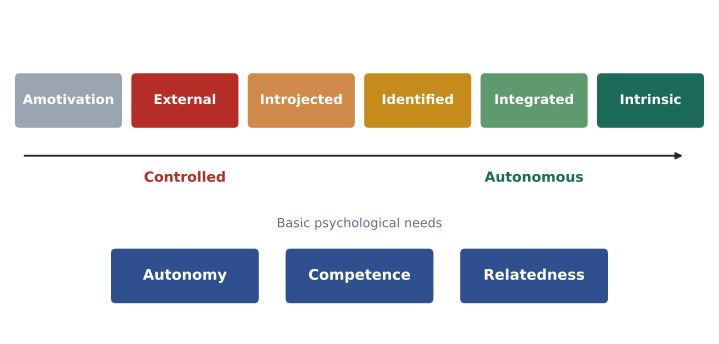
Self-determination theory also explains why rewards sometimes backfire. In a 1999 meta-analysis of 128 experiments, Deci, Koestner and Ryan found that tangible rewards given for doing an interesting task tended to reduce later free-choice interest in it, especially when the rewards were expected and contingent on doing the task. Other researchers dispute how large and general this effect is, and the effect is weaker or absent for dull tasks or for rewards that convey information about competence. For managers the practical point is that how rewards are framed matters. A bonus experienced as control can crowd out the sense of choice; recognition experienced as information about good work can support competence.
Hana applies the theory to her nurses. Autonomy is undermined by rigid schedules set without consultation. Competence is undermined by chronic understaffing that prevents them doing the job well. Relatedness is undermined by rotating staff who never form stable teams. A retention bonus addresses none of these. She proposes self-scheduling within staffing rules, a protected weekly hour for skills practice, and stable pods of nurses who work the same shifts. Each change costs less than the bonus program.
Process theories: expectancy, equity and goals
Victor Vroom's expectancy theory, published in 1964, proposes that people direct effort toward actions they believe will lead to outcomes they value. Motivation depends on three beliefs. Expectancy is the belief that effort will lead to performance. Instrumentality is the belief that performance will lead to outcomes. Valence is the value placed on those outcomes. Because the three combine multiplicatively, motivation collapses if any one is near zero. A salesperson who doubts that more calls will produce sales, or that sales will lead to a bonus, or who does not care about the bonus, will not work harder. Meta-analyses find modest support for the components, and the theory remains one of the most useful diagnostic tools for managers.
J. Stacy Adams's equity theory proposes that people compare the ratio of their outcomes to their inputs with the ratios of others. Perceived under-reward leads to reduced effort, demands for change or leaving. Later research broadened the idea into organizational justice, which has three main parts: distributive justice, the fairness of outcomes; procedural justice, the fairness of the processes that decide outcomes; and interactional justice, the respect and honesty with which people are treated. A meta-analysis by Colquitt and colleagues found that procedural justice is often as important as distributive justice for commitment and trust. People accept disappointing outcomes far more readily when they believe the process was fair and they were treated with respect.
Goal-setting theory, developed over decades by Edwin Locke and Gary Latham, is among the best supported theories in all of organizational psychology. Specific, difficult goals lead to higher performance than easy goals or vague instructions to do your best, provided the person is committed to the goal, has the ability to reach it and receives feedback. Goals work by directing attention, mobilizing effort, increasing persistence and encouraging people to find strategies. There are important limits. For complex tasks that require learning, specific performance goals can narrow attention too early; learning goals, such as finding three ways to reduce errors, work better. Goals can also encourage cheating and neglect of unmeasured work when they are imposed, extremely difficult and tied to large rewards.
| Theory | Core idea | Question a manager can ask |
|---|---|---|
| Self-determination | Autonomy, competence and relatedness fuel autonomous motivation | Does this job let people choose, grow and belong? |
| Expectancy | Effort depends on expectancy, instrumentality and valence | Do people believe effort pays off in outcomes they value? |
| Equity and justice | People compare outcomes and judge processes and treatment | Would the process feel fair to the people affected? |
| Goal setting | Specific, difficult, accepted goals with feedback raise performance | Is the goal clear, challenging and owned, with feedback? |
Pay, transparency and motivation
Money matters for motivation, even if it is not the only thing that does. Field studies of piece-rate pay, such as Edward Lazear's study of a windshield installation company in which productivity rose about 44 per cent after a move from hourly wages to piece rates, show that well-designed incentives can raise output substantially, partly by attracting more productive workers. Pay also signals fairness and status, which is why perceived pay inequity is such a strong driver of turnover. Transparency about pay is spreading. Since 1 January 2026, Ontario employers with 25 or more employees must include the expected pay or a pay range of no more than 50,000 dollars in publicly advertised job postings, except for jobs paying more than 200,000 dollars a year, and must disclose whether artificial intelligence is used to screen applicants and whether the posting is for an existing vacancy.
For the US cohort, Dr. Sato notes that pay transparency has spread state by state. Illinois began requiring pay scales and a general description of benefits in job postings for employers with 15 or more employees on 1 January 2025, joining states such as Colorado, California, Washington, New York and Maryland, and several more have followed. Research on pay transparency suggests that it narrows unexplained pay gaps and can reduce the pay of top earners relative to others, while making the fairness of pay processes far more visible. For managers this means that procedural justice in pay decisions is no longer private: they need to be able to explain how pay is set.
# Expectancy theory: diagnosing why a bonus is not motivating
def force(E, outcomes):
    """E: effort-to-performance belief (0-1); outcomes: list of (name, I, V)."""
    return E * sum(I * V for _, I, V in outcomes)

nurse_now = (0.35, [  # understaffed: effort often does not produce good care
    ("retention bonus", 0.9, 0.4),     # likely paid, but modest value
    ("recognition", 0.2, 0.8),         # rarely given
    ("better schedule", 0.1, 0.9),     # not linked to performance
])
nurse_plan = (0.70, [  # stable pods and skills hour raise expectancy
    ("retention bonus", 0.9, 0.4),
    ("recognition", 0.7, 0.8),
    ("better schedule", 0.8, 0.9),     # self-scheduling within rules
])
for label, (E, outs) in [("current", nurse_now), ("proposed", nurse_plan)]:
    print(f"{label:<9} force = {force(E, outs):.2f}")
    for name, I, V in outs:
print(f" {name:<16} I={I:.1f} V={V:.1f} I*V={I * V:.2f}")current force = 0.21
retention bonus I=0.9 V=0.4 I*V=0.36
recognition I=0.2 V=0.8 I*V=0.16
better schedule I=0.1 V=0.9 I*V=0.09
proposed force = 1.15
retention bonus I=0.9 V=0.4 I*V=0.36
recognition I=0.7 V=0.8 I*V=0.56
better schedule I=0.8 V=0.9 I*V=0.72The numbers are subjective estimates from Hana's conversations with nurses, but the structure of the calculation exposes the problem. The bonus has high instrumentality and modest value, while the outcomes nurses value most, a better schedule and recognition, are barely connected to performance, and understaffing keeps expectancy low. The proposed changes roughly quadruple the motivational force without increasing the bonus at all.
Designing work that motivates
Motivation depends not only on rewards and goals but on the design of the job itself. J. Richard Hackman and Greg Oldham's job characteristics model, published in 1976, proposed five core features of motivating work: skill variety, task identity, meaning completing a whole and identifiable piece of work, task significance, autonomy and feedback from the job itself. A large meta-analysis by Stephen Humphrey, Jennifer Nahrgang and Frederick Morgeson in 2007 confirmed that these characteristics are related to satisfaction, motivation and performance, and added that social characteristics, such as interdependence and support from colleagues, matter as well.
Task significance can be strengthened in surprisingly simple ways. In field experiments with university fundraising callers, Adam Grant and colleagues found that callers who briefly met a student whose scholarship had been funded by their calls went on to spend much more time on the phone and raise much more money in the following month than callers in comparison groups. The effect is not magic; it works when the contact is genuine and the work really does help someone. Hana applies the idea by inviting a former patient and family to speak briefly at a staff meeting about the care they received, and by sharing thank-you letters with the specific nurses named in them rather than posting them anonymously in a break room.
Worked problem
Setting a goal that helps rather than hurts
Grace wants store managers to reduce produce waste. Last year waste averaged 9.2 per cent of produce sales. Her first draft goal is 'Do your best to reduce waste'.
Show solution
- A vague do-your-best goal tends to produce less improvement than a specific, difficult one.
- A specific goal: reduce produce waste to 7.5 per cent of sales by the end of the second quarter, measured weekly from shrink reports.
- Because stores face different conditions, she asks each manager to propose a store target between 7 and 8 per cent, which increases commitment.
- For the first month she adds a learning goal: each store identifies three causes of its waste, because the task requires discovering new strategies.
- She checks for gaming risks, such as under-ordering that causes empty shelves, and adds an on-shelf availability measure.
Answer: A specific, challenging, participatively set target with weekly feedback, an initial learning goal and a guard metric against gaming.
Common mistakes
MistakePeople are motivated mainly by money.
InsteadPay matters, but autonomy, competence, relatedness, fairness and clear goals are powerful drivers that money cannot substitute for.
MistakeA difficult goal always improves performance.
InsteadDifficult goals help when people are committed, able and receive feedback; for complex learning tasks, learning goals work better, and extreme goals can encourage cheating.
MistakeIf the outcome is fair, the process does not matter.
InsteadProcedural and interactional justice strongly affect trust and commitment, often as much as the outcome itself.
Summary and key terms
- Motivation has direction, intensity and persistence; content theories ask what people need and process theories ask how effort is allocated.
- Self-determination theory identifies autonomy, competence and relatedness as basic needs; satisfying them produces autonomous motivation linked to performance and wellbeing.
- Expectancy theory shows motivation collapses if any of expectancy, instrumentality or valence is low.
- People judge fairness through outcomes, processes and treatment; procedural justice matters as much as distributive justice.
- Specific, difficult, accepted goals with feedback raise performance; learning goals suit complex tasks and guard metrics reduce gaming.
- Autonomous motivation
- Acting out of interest or genuine endorsement of the activity's value.
- Controlled motivation
- Acting to obtain rewards, avoid punishment or avoid guilt.
- Expectancy
- The belief that effort will lead to performance.
- Instrumentality
- The belief that performance will lead to particular outcomes.
- Valence
- The value a person places on an outcome.
- Procedural justice
- The perceived fairness of the process used to make decisions.
Practice problems
Work each problem on paper first, then reveal the answer to check.
Kestrel offers engineers a bonus for shipping features on time, but managers often change priorities mid-sprint. Which part of expectancy theory is weakened?
Show answer
Expectancy and instrumentality. Engineers cannot be confident that effort will produce on-time delivery when priorities change, and on-time delivery may not reliably lead to the bonus if targets move. Stable priorities would strengthen the link.
Two analysts receive the same raise. One was consulted and given the reasons; the other learned of it from a payroll notice. Which justice dimension explains why their reactions differ?
Show answer
Procedural and interactional justice. The outcome is the same, but the consulted analyst experienced a fair process and respectful explanation, which raises acceptance and trust.
Why might paying children to read books reduce their reading later, according to self-determination theory?
Show answer
If children already find reading interesting, an expected, contingent reward can be experienced as control, shifting the reason for reading from interest to the reward and reducing free-choice reading once the reward stops.
Lesson quiz · 5 questions
Score 60% or more to complete this lesson.
Create a free account to save your progress, take quizzes and earn a certificate.