
MBA-503 · Lesson 1 of 12 · 19 min
What leaders actually do
Leading People and Organizations is the third course in the weekend executive MBA at the Lakeshore School of Business in Toronto. It is taught by Dr. Ingrid Sato, an organizational psychologist who spent eleven years running leadership development for a national bank and a provincial health authority before she returned to research and teaching. She opens the first Friday session without slides. She asks each of the five managers in the room to write down the last decision they made at work that involved another person, and then to write down what happened next. Within ten minutes the whiteboard is full, and almost none of it looks like the leadership described in airport books.
The cohort is the same group that worked through accounting in MBA-501 and economics in MBA-502. Daniel Osei, the plant controller at Northfield Components, has just been asked to lead a merged finance and costing team of nine people, three of whom applied for his job. Hana Kowalski, director of operations at Lakeview Health, is trying to stop experienced nurses leaving the emergency department. Leo Brandt, co-founder and chief financial officer of Kestrel Analytics, watched the company grow from 40 to 120 people in eighteen months and now spends his days in meetings he did not schedule. Grace Mwangi, a category manager at Fairway Grocers, has to change what forty store managers stock without being their boss. Owen Tremblay, finance manager at Prairie Ridge Energy, sits on a project team of engineers who do not think finance has anything to teach them.
Dr. Sato says the course has three promises. It will separate the evidence on leading people from folklore, including some famous findings that did not survive replication. It will treat leadership as a set of behaviours that can be practised, measured and improved, rather than a personality that some people have and others lack. And it will finish with a capstone in which the cohort diagnoses a real-feeling team in trouble at Cedarline Outdoor, the apparel company they analysed in the first two courses, and designs an intervention that a busy executive could actually carry out. Students who took BUS-130 Organizational Behaviour as undergraduates will recognize many names; the difference here is that every idea is tested against data and against the cohort's own jobs.
Management and leadership: a useful distinction, not two jobs
John Kotter's well-known distinction holds that management is about coping with complexity, through planning, budgeting, organizing, staffing, controlling and problem solving, while leadership is about coping with change, through setting direction, aligning people and motivating and inspiring them. The distinction is useful because it reminds managers that a perfectly run budget process will not move a team toward a new strategy. It becomes harmful when it is read as two kinds of people, with visionary leaders above and administrative managers below. In practice every manager does both, and the mix shifts with the situation. Daniel needs management to close the books on time and leadership to persuade three disappointed colleagues to commit to a team he leads.
A simpler working definition, used throughout this course, is that leadership is the process of influencing a group toward shared goals. Three things follow from it. Leadership is a process, so it happens through repeated interactions rather than a single speech. It is about influence, so it can be exercised by people without formal authority, as Grace must do with store managers. And it is about shared goals, so getting people to comply with orders they do not accept is control rather than leadership. Formal authority helps, but research on emergent leadership shows that groups quickly recognize people who contribute ideas, coordinate work and care about others, whatever their title.
What managers really do with their time
In the late 1960s Henry Mintzberg followed five chief executives for a week each and recorded every activity. His findings overturned the textbook picture of managers as calm planners. The executives worked at an unrelenting pace, their activities were brief and fragmented, most lasting under nine minutes, they preferred live conversation to documents, and they spent much of their time with people outside their own chain of command. Later studies of managers at many levels, including diary and sensor studies of thousands of executives, have found the same pattern: most of the week is spent in meetings and conversations, and the hours for focused work are scarce and easily lost.
Mintzberg grouped what he saw into ten roles in three families. Interpersonal roles are figurehead, leader and liaison. Informational roles are monitor, disseminator and spokesperson. Decisional roles are entrepreneur, disturbance handler, resource allocator and negotiator. The value of the list for a working manager is diagnostic. Leo realizes that as Kestrel grew he slid from entrepreneur and resource allocator into disturbance handler, spending his days resolving escalations that a clearer structure would prevent. A role audit does not tell a manager what to do, but it shows where the time is going and which roles are being neglected.
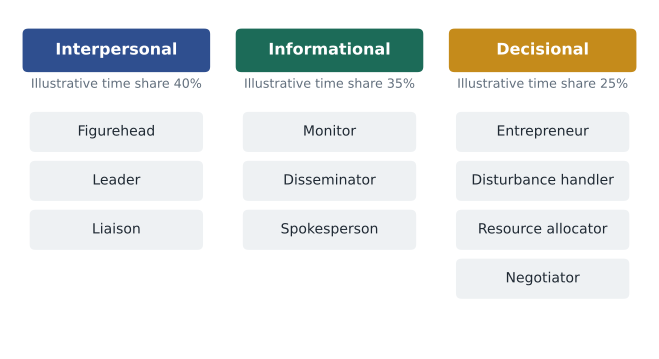
Research by Michael Porter and Nitin Nohria, who tracked how 27 chief executives spent about 60,000 hours, found that the leaders spent roughly 72 per cent of their working time in meetings and about 61 per cent of their working time face to face. They argued that the scarcest resource a leader controls is personal time and attention, and that the agenda of a leader's calendar is the clearest signal of what the organization really values. Smaller studies of first-line supervisors show the same squeeze at lower levels: the time that should go to coaching and developing people is the first to be crowded out by urgent operational work.
Does leadership matter? The evidence
It is reasonable to ask whether leaders matter as much as their pay and press coverage suggest. Studies that separate leader effects from industry and company effects find that chief executives explain a meaningful but not dominant share of the variation in company performance, typically estimated in the range of a few per cent to perhaps a fifth depending on the industry and method. At the level that affects most employees, the evidence is stronger. Gallup's long-running workplace research estimates that managers account for about 70 per cent of the variance in team engagement, and large field studies at technology companies, including Google's Project Oxygen, found that teams with managers who coached, communicated and showed interest in their people had lower turnover and higher performance.
There is also a dark side to the evidence. Surveys over decades find that a bad boss is one of the most common reasons people give for leaving a job, and research on abusive supervision links hostile behaviour by managers to lower performance, more counterproductive work behaviour and poorer mental health among employees. The lesson for the cohort is not that leaders are heroes, but that the quality of everyday leadership behaviour is one of the few levers that is both important and within a manager's control.
| Common belief | What the evidence says |
|---|---|
| Leaders are born, not made | Personality matters modestly; leadership behaviours can be trained, with meta-analyses showing moderate positive effects of well-designed development programs |
| Good leaders are charismatic | Charisma predicts follower ratings, but structure, fairness and coaching predict team results at least as well |
| Leadership is only at the top | First-line managers have the largest effect on employee engagement and retention |
| The leader should have all the answers | Teams perform better when leaders ask, listen and share decisions where expertise is spread out |
How this course works
Each session pairs a body of research with a practical tool and an assignment back at work. Lesson 2 surveys the main leadership theories. Lesson 3 turns inward to self-awareness and emotional intelligence. Lessons 4 and 5 cover motivation, goals, performance conversations and coaching. Lesson 6 examines decision making and the biases that distort it. Lessons 7 and 8 are about teams, psychological safety and conflict. Lesson 9 covers power and organizational politics. Lesson 10 turns to culture, diversity and inclusion, and Lesson 11 to organizational design, including hybrid work. Lesson 12 brings everything together on the Cedarline case.
Dr. Sato asks each manager to keep a leadership log for the term: one entry a week describing a situation, what they did, what happened and what the evidence from class suggests they might try. She points out that the strongest predictor of learning from experience is not the experience itself but the habit of reflecting on it. Her first assignment is a time audit. For one week, each student records how their working hours split across Mintzberg's role families and estimates what those hours cost the organization.
# One-week time audit: role families and the cost of meetings
week = [  # (activity, role family, hours, people in the room)
    ("Monthly close review", "informational", 3.0, 6),
    ("One-on-ones with direct reports", "interpersonal", 4.5, 2),
    ("Budget variance meeting", "decisional", 2.0, 8),
    ("Escalations and disputes", "decisional", 5.0, 3),
    ("Plant leadership meeting", "informational", 3.5, 12),
    ("Supplier negotiation", "decisional", 1.5, 4),
    ("Focused analysis (alone)", "individual", 6.0, 1),
    ("Email and messages", "informational", 9.0, 1),
    ("Coaching new analyst", "interpersonal", 1.0, 2),
]
loaded_rate = 78.0   # average fully loaded cost per person-hour, dollars
total = sum(h for _, _, h, _ in week)
by_family = {}
for _, fam, h, _ in week:
    by_family[fam] = by_family.get(fam, 0) + h
print(f"Total hours: {total:.1f}")
for fam, h in sorted(by_family.items(), key=lambda x: -x[1]):
    print(f"  {fam:<14}{h:5.1f} h  {h / total:6.1%}")
meetings = [(a, h, n) for a, _, h, n in week if n > 2]
cost = sum(h * n * loaded_rate for _, h, n in meetings)
print(f"Meetings with 3+ people: {len(meetings)}, cost {cost:,.0f} dollars")
worst = max(meetings, key=lambda m: m[1] * m[2])
print(f"Most expensive: {worst[0]} ({worst[1] * worst[2] * loaded_rate:,.0f} dollars)")Total hours: 35.5 informational 15.5 h 43.7% decisional 8.5 h 23.9% individual 6.0 h 16.9% interpersonal 5.5 h 15.5% Meetings with 3+ people: 5, cost 7,566 dollars Most expensive: Plant leadership meeting (3,276 dollars)
Daniel's week, shown above, is typical. Only six of his 35.5 hours went to focused work, about one hour went to coaching a new analyst, and the plant leadership meeting alone consumed more than 3,000 dollars of loaded salary. None of this means meetings are bad; many are where coordination and influence happen. The audit simply makes a hidden allocation visible so that it can be chosen deliberately. Daniel decides to move his coaching time to a fixed slot each week and to propose a shorter, smaller format for the plant meeting.
One practical consequence of all this research is that a leader's calendar is a strategy document. If a manager says that developing people is the top priority but spends no scheduled time on one-to-one conversations, coaching or reviewing work with team members, the calendar tells the truer story. Dr. Sato asks each participant to colour-code two typical weeks into four categories: work with their own team, work with peers and other units, work upward with senior leaders, and solitary work. Most discover that peer and upward work, often in meetings they did not call, has quietly squeezed out time with their own people. Small, protected routines, such as a fortnightly one-to-one with each direct report, are one of the few interventions that consistently appear in studies of effective managers.
Worked problem
Pricing a standing meeting
Kestrel Analytics holds a weekly product sync of 75 minutes attended on average by 14 people with a loaded cost of 95 dollars per hour. Leo wonders whether to cut it to 45 minutes with 8 required attendees and a written update for everyone else.
Show solution
- Current cost per week: 1.25 h × 14 people × 95 dollars = 1,662.50 dollars.
- Proposed cost: 0.75 h × 8 × 95 = 570 dollars, plus about 15 minutes for six others to read the update: 0.25 × 6 × 95 = 142.50 dollars.
- Weekly saving: 1,662.50 − 712.50 = 950 dollars; over 48 working weeks about 45,600 dollars.
- The saving is real only if the shorter meeting still makes the decisions the longer one made, so Leo writes down the three decisions the meeting exists to take.
Answer: About 45,600 dollars of loaded time a year, plus focus time returned to engineers, provided the meeting is redesigned around its decisions rather than simply shortened.
Common mistakes
MistakeLeadership is a personality trait you either have or lack.
InsteadLeadership is mostly a repertoire of behaviours that can be learned, practised and improved with feedback.
MistakeOnly senior executives exercise leadership.
InsteadAnyone who influences a group toward shared goals is leading, and first-line managers have the largest effect on most employees.
MistakeA busy calendar shows a manager is working hard on the right things.
InsteadA time audit often shows that coaching and focused work are being crowded out by escalations and information meetings.
Summary and key terms
- Leadership is the process of influencing a group toward shared goals; management and leadership are complementary, not separate jobs.
- Mintzberg's studies show managerial work is fast, fragmented and mostly spent in conversation; his ten roles help diagnose where time goes.
- Chief executives explain a moderate share of company performance, but everyday managers strongly shape engagement, retention and team results.
- A time audit and a leadership log turn experience into learning by making choices about time and behaviour visible.
- Leadership
- The process of influencing a group toward shared goals.
- Management
- Planning, organizing, staffing and controlling work to deliver results reliably.
- Managerial roles
- Mintzberg's ten roles grouped as interpersonal, informational and decisional.
- Emergent leader
- A group member recognized as a leader without holding formal authority.
- Abusive supervision
- Sustained hostile verbal and non-verbal behaviour by a manager toward subordinates.
Practice problems
Work each problem on paper first, then reveal the answer to check.
Grace has no formal authority over store managers. Using the definition of leadership in this lesson, explain why she can still lead them.
Show answer
Leadership is influence toward shared goals, not authority. Grace can influence through expertise in category data, through relationships, by framing changes in terms of the store managers' own goals such as sales and waste, and by involving them in decisions. Authority would let her demand compliance, but commitment requires the influence processes of leadership.
Hana's audit shows 14 hours a week in disturbance handling and none in the entrepreneur role. What does this suggest, and what might she do?
Show answer
It suggests she is absorbed by recurring problems and is not working on improvements that would remove them. She could look for the root causes behind the escalations, delegate or create clear decision rights for routine issues, and protect a fixed block each week for improvement projects such as the nurse retention plan.
A study finds that chief executives explain about 15 per cent of the variation in company profitability. Does that mean leadership is unimportant?
Show answer
No. Fifteen per cent is a large effect for one person, and the estimate concerns only the top role. Leadership effects at lower levels, on engagement, turnover and team performance, are also substantial and add to the total influence of leadership in the organization.
Lesson quiz · 5 questions
Score 60% or more to complete this lesson.
Create a free account to save your progress, take quizzes and earn a certificate.