
MBA-502 · Lesson 9 of 12 · 23 min
Information, incentives and contracts
The models in earlier lessons assumed that everyone knew the relevant prices, costs and qualities. Real markets and organizations are full of asymmetric information: one party knows something the other does not. A seller knows more about a used machine than a buyer; an employee knows more about her own effort than her manager; a borrower knows more about his project than the bank; a patient knows more about his health habits than his insurer. George Akerlof, Michael Spence and Joseph Stiglitz shared the 2001 Nobel prize for showing how such asymmetries can cause markets to unravel and how institutions arise to cope with them. Oliver Hart and Bengt Holmström shared the 2016 prize for contract theory, which studies how to design agreements when information is imperfect. This lesson brings their insights to managerial problems: pricing quality, hiring, paying salespeople and executives, and writing supplier contracts.
Adverse selection: hidden information before the deal
Adverse selection arises when one side knows its own type before a transaction and the other side cannot tell types apart. Akerlof's 1970 paper on the market for lemons used used cars as the example. Suppose half of the used cars of a model are good, worth 12,000 dollars to buyers, and half are lemons, worth 6,000 dollars. Sellers know which they have; buyers do not. If buyers offer the average of 9,000 dollars, owners of good cars who value them at, say, 10,000 dollars withdraw them from the market. The remaining cars are mostly lemons, buyers lower their offers, and the market can shrink to lemons only. Information asymmetry destroys trades that would benefit both sides.
Adverse selection appears wherever quality is hidden. Insurance attracts those who expect to claim most, which is why Lakeview Health's employee benefits team cannot offer a voluntary rich plan at an average premium without seeing costs rise as healthier employees choose cheaper plans. Lenders attract riskier borrowers when they raise interest rates, because safer borrowers drop out, which is one reason banks ration credit rather than simply raising rates. Firms offering generous voluntary severance packages often find that their best employees, who have good outside options, are the first to accept.
# The market for lemons: does the market unravel?
import random
random.seed(7)
# each seller's car has a quality q in dollars to buyers; sellers value their car at 85 % of q
qualities = [random.uniform(4000, 14000) for _ in range(10000)]
def trade(price):
    offered = [q for q in qualities if 0.85 * q <= price]
    return offered

price = sum(qualities) / len(qualities)       # buyers start by offering average quality
for rnd in range(1, 9):
    offered = trade(price)
    avg = sum(offered) / len(offered)
    print(f"Round {rnd}: offer {price:8,.0f}   cars offered {len(offered):5d}   average quality {avg:8,.0f}")
    if abs(avg - price) < 1:
        break
price = avg # buyers pay what the offered cars are worth on averageRound 1: offer 8,985 cars offered 6568 average quality 7,258 Round 2: offer 7,258 cars offered 4583 average quality 6,268 Round 3: offer 6,268 cars offered 3394 average quality 5,680 Round 4: offer 5,680 cars offered 2740 average quality 5,357 Round 5: offer 5,357 cars offered 2317 average quality 5,148 Round 6: offer 5,148 cars offered 2070 average quality 5,025 Round 7: offer 5,025 cars offered 1927 average quality 4,953 Round 8: offer 4,953 cars offered 1842 average quality 4,911
In the simulation, buyers first offer the average quality of all cars, about 9,000 dollars. Only sellers whose cars are worth less than about 10,600 dollars to buyers accept, so the average quality of the cars actually offered is lower than the offer. Buyers revise their offer down, more good cars leave, and after several rounds the market settles at a small fraction of its potential, with only the lowest-quality cars trading. The details depend on the numbers, but the direction is general: when the uninformed side cannot distinguish quality, the market favours low quality.
Signalling and screening
Markets respond to adverse selection in two main ways. In signalling, the informed party takes a costly action that low-quality types would find too expensive to imitate. Spence's model of education as a signal suggested that degrees can signal ability even if they added nothing to productivity, because able people find study less costly. Warranties signal product quality, because a manufacturer of unreliable products would lose money offering a long warranty. Northfield signals reliability to new automotive customers by accepting penalty clauses for late delivery that a less reliable supplier could not afford. Kestrel signals confidence by offering a money-back guarantee if its forecasts do not beat the customer's existing method.
In screening, the uninformed party designs a menu of options that leads informed parties to reveal themselves through their choices. Insurers offer policies with different deductibles; customers who expect few claims choose high deductibles. Employers offer pay packages with different mixes of salary and commission; confident salespeople choose more commission. Airlines offer fares with different restrictions, which screen leisure from business travellers, as Lesson 3 showed. For a screen to work, each type must prefer the option designed for it.
Moral hazard: hidden action after the deal
Moral hazard arises when one party's actions after a contract is signed cannot be observed fully by the other and affect the other's payoff. An insured driver may drive less carefully; a salaried employee may work less hard; a manager may pursue empire-building acquisitions that benefit her prestige more than shareholders; a contractor paid by the hour may take longer. The problem is not that people are dishonest, though some are, but that incentives diverge and effort is costly to monitor.
This is the principal–agent problem. The principal, such as an owner, employer or customer, wants the agent, such as a manager, employee or supplier, to act in the principal's interest. Solutions include monitoring, which is often expensive; incentive pay, which ties the agent's reward to outcomes the principal cares about; and selection and culture, which bring in agents whose interests are aligned. Each has costs, and the art of organizational design lies in combining them.
Designing incentive contracts
Incentive pay faces a fundamental trade-off between incentives and risk. Outcomes depend on effort but also on luck: a salesperson's revenue depends on her work and on the economy. Tying pay strongly to outcomes motivates effort but exposes the agent to risk she did not control, and risk-averse agents must be paid more on average to accept it. Holmström and Paul Milgrom's linear contract model shows that the optimal share of output paid to the agent falls as the outcome becomes noisier, as the agent becomes more risk-averse and as effort becomes more costly.
In this formula, b* is the optimal commission rate as a share of the value the agent creates, r is the agent's coefficient of risk aversion, c measures how costly effort is, and σ² is the variance of the noise in the measured outcome. When the measure is precise, σ² is small and b* approaches 1, meaning the agent is paid nearly the full value of her effort. When the measure is noisy, the commission should be lower and more of the pay should be fixed.
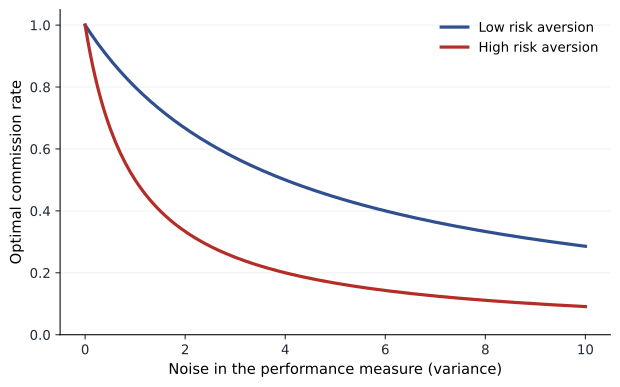
# The optimal linear incentive contract (Holmstrom-Milgrom)
def contract(r, c, var):
    b = 1 / (1 + r * c * var)
    effort = b / c                      # agent chooses effort where b = c * e
    value = effort                      # each unit of effort adds one unit of expected output
    effort_cost = 0.5 * c * effort ** 2
    risk_premium = 0.5 * r * b ** 2 * var
    surplus = value - effort_cost - risk_premium
    return b, effort, surplus

print(f"{'measure':28s}{'commission':>11s}{'effort':>8s}{'surplus':>9s}")
for label, var in [('precise (unit sales)', 0.5), ('moderate (territory revenue)', 2.0), ('noisy (regional profit)', 8.0)]:
    b, e, s = contract(r=1.0, c=0.5, var=var)
    print(f"{label:28s}{b:11.2f}{e:8.2f}{s:9.3f}")

# Better measurement raises surplus: compare a noisy measure with one adjusted for regional demand
_, _, s_noisy = contract(1.0, 0.5, 8.0)
_, _, s_adjusted = contract(1.0, 0.5, 2.0)
print(f"Value of removing regional demand noise: {s_adjusted - s_noisy:.3f} per salesperson (in units of output)")measure commission effort surplus precise (unit sales) 0.80 1.60 0.800 moderate (territory revenue) 0.50 1.00 0.500 noisy (regional profit) 0.20 0.40 0.200 Value of removing regional demand noise: 0.300 per salesperson (in units of output)
The code shows how the optimal commission falls from 0.80 for a precise measure to 0.20 for a noisy one, and how total surplus, the value created minus the cost of effort and the cost of bearing risk, falls with it. The last line makes a practical point: filtering noise out of the measure, for example by comparing a salesperson's results with those of others facing the same regional economy, raises the value of the contract. This is the logic of relative performance evaluation, and it is why many firms judge regional managers against peers rather than against fixed targets.
Pitfalls of incentive pay
Incentive pay can go wrong in predictable ways. Multitasking is the most important: when agents perform several tasks and only some are measured, strong incentives on the measured tasks draw effort away from the others. Paying call-centre staff only for calls handled per hour neglects problem resolution; paying teachers only on test scores neglects other learning; paying physicians only for volume can neglect coordination. Holmström and Milgrom showed that when important tasks cannot be measured, weak incentives on all tasks may be best.
Other pitfalls include gaming, where agents manipulate the measure rather than improve the outcome, as when quarterly sales targets lead to channel stuffing; ratchet effects, where agents hold back effort because good performance raises next year's target; and crowding out, where extrinsic rewards displace intrinsic motivation for work people find meaningful. Grace saw gaming when Fairway's store managers were paid on shrink, the loss of inventory to spoilage and theft: some stores cut fresh produce orders to reduce spoilage and lost sales as a result. The solution was a balanced measure that combined shrink with sales and customer satisfaction.
| Problem | Example | Remedy |
|---|---|---|
| Noisy measure | Sales depend on regional economy | Relative performance evaluation, longer measurement periods |
| Multitasking | Volume measured, quality not | Balanced measures, weaker incentives, job design |
| Gaming | Pulling sales into the quarter | Audits, clawbacks, multi-period measures |
| Ratchet effect | Targets rise after a good year | Commit to targets for several years |
| Short-termism | Executive cuts research to meet earnings | Deferred equity, long vesting periods |
| Crowding out | Paying for work people value intrinsically | Recognition, autonomy, mission |
Executive pay and corporate governance
Shareholders are principals and senior executives are agents. Stock options and restricted shares tie executive wealth to share value, but they also create risk and can reward market-wide moves the executive did not cause. Options in particular reward volatility, since their value rises with risk, and can encourage short-term manipulation of the share price. Modern pay designs use performance shares that vest only if returns beat a peer group, long vesting periods, holding requirements and clawback provisions that recover pay if results are restated. Shareholders in both Canada and the United States now vote on executive pay plans in advisory say-on-pay votes, and boards' compensation committees rely on these principles.
Incomplete contracts and the boundaries of the firm
Not everything can be written into a contract. Future contingencies are too many to list, and some qualities are observable to both parties but cannot be verified by a court. When contracts are incomplete, parties who make specific investments, investments worth much more inside a relationship than outside it, are vulnerable to hold-up: once the investment is sunk, the other party can renegotiate for a better price. Fear of hold-up leads to underinvestment. Oliver Williamson and Ronald Coase argued that this is why firms exist: integrating a supplier into the firm replaces haggling with authority. Hart and colleagues added that ownership matters because it determines who controls assets when contracts are silent.
Daniel faced a hold-up concern when a customer asked Northfield to install a dedicated stamping line for one product. The line would be worth little for any other use, so once it was built the customer could press for lower prices. Northfield negotiated a contract with a minimum volume commitment, a cost-sharing arrangement for the tooling and a clause transferring ownership of the tooling to the customer if volumes fell short. Each element reduced Northfield's exposure to hold-up and made the investment worthwhile for both sides.
Worked problem
Designing a sales commission at Kestrel
Kestrel pays its account executives a base salary and a commission on new annual contract value. Annual sales per executive have a standard deviation driven by luck that is high: in the formula's units, σ² = 4. Leo estimates r = 0.5 and c = 1. What commission rate does the model suggest, and what happens if Kestrel adjusts each executive's results for the average of the team, cutting the noise to σ² = 1?
Show solution
- With σ² = 4, b* = 1 / (1 + 0.5 × 1 × 4) = 1 / 3, or about 0.33.
- With σ² = 1, b* = 1 / (1 + 0.5 × 1 × 1) = 2 / 3, or about 0.67.
- Cutting the noise to a quarter allows Kestrel to double the strength of incentives without imposing more risk.
- Effort rises in proportion to b*, so executives would work harder under the adjusted scheme.
Answer: Relative performance adjustment doubles the optimal commission rate and raises effort and total surplus. Leo should also watch for multitasking: if executives neglect renewals and customer success, the commission should include renewal revenue.
Common mistakes
MistakeAsymmetric information only matters for used goods.
InsteadIt affects insurance, credit, labour markets, procurement and executive pay.
MistakeStronger incentives are always better.
InsteadWhen measures are noisy or tasks are hard to measure, strong incentives impose risk and distort effort.
MistakeA signal must be productive to be useful.
InsteadA signal works if it is cheaper for high-quality types than for low-quality ones.
MistakeContracts can cover every contingency.
InsteadContracts are incomplete, which creates hold-up risk around specific investments.
MistakeMoral hazard means people are dishonest.
InsteadIt means incentives diverge and actions are costly to observe.
Summary and key terms
- Asymmetric information arises when one party knows more than another about quality, type or actions.
- Adverse selection, hidden information before a deal, can unravel markets; signalling and screening help.
- Moral hazard, hidden action after a deal, is the core of the principal–agent problem.
- Optimal incentive pay balances incentives against risk; the commission rate falls as measures become noisier.
- Relative performance evaluation filters common noise and allows stronger incentives.
- Multitasking, gaming, ratchet effects and crowding out are common pitfalls of incentive pay.
- Incomplete contracts create hold-up risk, which shapes vertical integration and contract design.
- Asymmetric information
- A situation in which one party to a transaction knows more than the other.
- Adverse selection
- The tendency for hidden information to attract the worst types to a transaction.
- Signalling
- A costly action by an informed party that reveals its type.
- Screening
- A menu of options offered by an uninformed party that induces types to reveal themselves.
- Moral hazard
- The tendency of a party whose actions are hidden to act against the other party's interest.
- Principal–agent problem
- The challenge of motivating an agent to act in the principal's interest.
- Relative performance evaluation
- Judging an agent's results against those of peers facing similar conditions.
- Hold-up
- Renegotiation by one party after the other has made a specific, sunk investment.
Practice problems
Work each problem on paper first, then reveal the answer to check.
Why might a bank refuse to lend at any interest rate to some applicants rather than charge them more?
Show answer
Higher rates attract riskier borrowers and encourage riskier projects, so expected repayments can fall as rates rise.
Give an example of screening in a market you know.
Show answer
Insurance deductible menus, airline fare restrictions, or salary versus commission choices.
With r = 2, c = 1 and σ² = 1, what is the optimal commission rate?
Show answer
1 / 3.
Why can strong incentives on measured tasks harm unmeasured ones?
Show answer
Agents shift effort toward what is rewarded; this is the multitasking problem.
How does a minimum volume commitment protect a supplier making a specific investment?
Show answer
It limits the buyer's ability to hold up the supplier by threatening to withdraw volume.
Portfolio task: analyze one incentive scheme in your organization for noise, multitasking and gaming, and propose an improvement.
Show answer
Answers vary.
Lesson quiz · 5 questions
Score 60% or more to complete this lesson.
Create a free account to save your progress, take quizzes and earn a certificate.