
MBA-502 · Lesson 8 of 12 · 22 min
Sequential games, commitment and credible threats
Many strategic situations unfold over time. An incumbent decides how much capacity to build, an entrant watches and decides whether to enter, and the incumbent then decides whether to fight or accommodate. A buyer makes an offer, the seller accepts or counters. A union and an employer exchange proposals before a strike deadline. In these sequential games, the order of moves matters, later movers can respond to what earlier movers did, and earlier movers can shape what later movers will want to do. This lesson shows how to analyze such games with game trees and backward induction, and why the ability to commit, to limit one's own future options, can be one of the most valuable strategic assets a firm has.
Game trees and backward induction
A sequential game is drawn as a game tree. Each node is a point at which a player makes a decision, each branch is an action, and each terminal node at the end of a path shows the payoffs to all players. The tree makes explicit who moves when and what each player knows at each point.
The solution method is backward induction. Start at the last decisions in the tree and ask what the player moving there would choose, given the payoffs. Replace each of those decision nodes by the payoffs that result from the chosen action. Then move one step back and repeat, until you reach the first move. The result is a subgame perfect equilibrium, in which every player's strategy is optimal not only along the path actually played but at every point in the game, including points that are never reached. Reinhard Selten introduced this refinement in the 1960s and later shared the 1994 Nobel prize with Nash and John Harsanyi.
Credible and non-credible threats
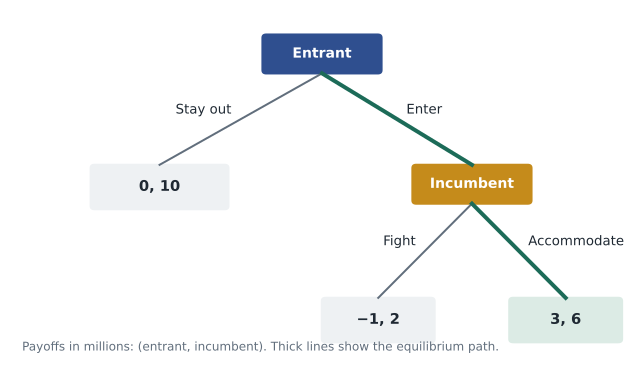
Dr. Varga's first example is an entry game. A discount grocery chain is deciding whether to open a store in one of Fairway Grocers' strongest towns. If it stays out, Fairway keeps earning 10 million dollars a year in that market and the entrant earns nothing. If it enters, Fairway can fight with a deep price war, in which case both lose money, Fairway earning 2 million and the entrant losing 1 million, or Fairway can accommodate by competing normally, in which case Fairway earns 6 million and the entrant 3 million.
Fairway would like the entrant to believe that it will fight. If the entrant believed that, it would stay out, and Fairway would keep 10 million. But the threat is not credible. Once the entrant has opened its store, Fairway earns 6 million by accommodating and only 2 million by fighting, so a rational Fairway accommodates. Anticipating this, the entrant enters. Backward induction eliminates the non-credible threat: the subgame perfect equilibrium is entry followed by accommodation. Announcements, however loud, do not change this logic unless they change the payoffs.
The same reasoning applies to promises. A supplier who promises to hold prices after Northfield commits to a long-term design using its parts may not keep the promise once Northfield is locked in. A promise is credible only if, when the time comes, keeping it is in the promiser's interest, which is why contracts, reputations and hostages, such as deposits or specific investments by the promiser, matter so much.
Commitment: the value of limiting your options
The striking insight of sequential games is that a player can gain by reducing its own flexibility. Thomas Schelling, who shared the 2005 Nobel prize for his work on conflict and cooperation, gave the classic examples: the general who burns the bridges behind his army so that retreat is impossible, and the negotiator who publicly commits to a position that would be too costly to abandon. A commitment works if it is visible to the other player, if it is irreversible or costly to undo, and if it changes what the committed player will want to do later.
In the entry game, Fairway could make fighting credible by changing its own payoffs before the entrant decides. Suppose Fairway invests in a large distribution centre and long-term supply contracts that lower its marginal cost in the region, so that a price war would be much cheaper for it to sustain; or suppose it signs leases on the few suitable retail sites. Such investments are sunk; once made, they cannot be undone. If they make fighting more profitable than accommodating after entry, the threat becomes credible and the entrant stays out. The investment may be worth making even if it would not pay on its own, because its strategic value is the entry it deters.
# Backward induction on a small game tree
# A node is either ('leaf', payoffs) or (player, {action: child_node})
def solve(node, path=()):
    if node[0] == 'leaf':
        return node[1], path
    player, moves = node
    best = None
    for action, child in moves.items():
        payoffs, p = solve(child, path + ((player, action),))
        if best is None or payoffs[player] > best[0][player]:
            best = (payoffs, p)
    return best

E, I = 0, 1      # index of entrant and incumbent payoffs
def entry_game(fight_payoff_incumbent, stay_out_incumbent):
    return (E, {
        'stay out': ('leaf', (0, stay_out_incumbent)),
        'enter': (I, {
            'fight': ('leaf', (-1, fight_payoff_incumbent)),
            'accommodate': ('leaf', (3, 6)),
        }),
    })

for label, fight, stay in [('no commitment', 2, 10), ('after cost-reducing investment', 7, 9.5)]:
    payoffs, path = solve(entry_game(fight, stay))
    moves = ', '.join(f"{'Entrant' if p == E else 'Incumbent'}: {a}" for p, a in path)
    print(f"{label:32s} -> {moves}; payoffs (entrant, incumbent) = {payoffs}")

# Is the investment worth it? It costs 2.5 million dollars and reduces the stay-out payoff by 0.5 million
gain = (10 - 0.5) - 6 - 2.5
print(f"Net value of the deterrence investment: {gain:.1f} million dollars")no commitment -> Entrant: enter, Incumbent: accommodate; payoffs (entrant, incumbent) = (3, 6) after cost-reducing investment -> Entrant: stay out; payoffs (entrant, incumbent) = (0, 9.5) Net value of the deterrence investment: 1.0 million dollars
The code solves the game before and after the investment. Without commitment, the entrant enters and Fairway accommodates. After the investment, fighting would earn Fairway 7 million rather than 6, so fighting becomes the best response to entry; the entrant, anticipating this, stays out. The investment costs 2.5 million and slightly reduces Fairway's profit even without entry, but it raises Fairway's outcome from 6 million to 9.5 million, so it is worth 1.0 million net. Competition authorities scrutinize such strategies when a dominant firm uses them to exclude equally efficient rivals, which is one reason the analysis of predation and exclusion in Lesson 10 matters to managers.
First-mover and second-mover advantages
Moving first is valuable when it allows a player to commit to a position that rivals must accept. In the Stackelberg model of quantity competition, named after Heinrich von Stackelberg, a leader that commits to its output before the follower earns more than in the simultaneous Cournot game, because the follower responds by producing less. Owen has seen this in natural gas processing: the company that builds the first large plant in a new producing area often captures the anchor contracts, and later entrants size their plants to what is left. First movers can also benefit from learning curves, from locking up scarce resources such as sites, spectrum or talent, and from switching costs that keep early customers.
But moving first is not always better. Followers can learn from the leader's mistakes, free-ride on its investments in educating the market, and adopt better technology. In games where flexibility is valuable, such as price competition with differentiated products, it is often better to move second, because the second mover can undercut or position itself against a known price. Leo has noticed that in enterprise software, the first company to define a category often spends heavily to educate buyers, while a well-funded follower captures the market once demand is proven. The lesson is not that moving first or second is always better but that managers should ask which the structure of the game rewards.
| Situation | Who tends to benefit | Why |
|---|---|---|
| Capacity in a market that supports few plants | First mover | Sunk capacity commits the leader and shrinks the follower's best response |
| Scarce sites, licences or contracts | First mover | Pre-emption denies resources to later entrants |
| Network effects and switching costs | First mover | Early users attract more users and are costly to win away |
| Uncertain technology or demand | Second mover | The follower learns from the leader and avoids its mistakes |
| Price competition with differentiated products | Second mover | The follower can position against a known price |
| Market education is costly and cannot be protected | Second mover | The follower free-rides on the leader's spending |
Bargaining
Bargaining is a sequential game in which players exchange offers until one is accepted. Ariel Rubinstein showed in 1982 that when players alternate offers and both are impatient, the equilibrium is reached immediately and the more patient player gets a larger share. In practice, bargaining power depends on each side's best alternative to a negotiated agreement, often abbreviated BATNA, on the costs of delay, on information and on commitment. A party with a strong alternative, low costs of waiting and the ability to commit credibly to a position tends to do well.
Hana applied this to Lakeview Health's negotiation with a regional laboratory company. Lakeview's alternative was to build an in-house laboratory, which would take eighteen months; the laboratory's alternative was to lose its largest client. By commissioning a credible feasibility study and publicly announcing a timeline for the in-house option, Lakeview improved its alternative and its credibility, and the laboratory agreed to a lower price schedule before the study was complete. The lesson is that bargaining power is often created before the negotiation begins.
Commitment devices in business
Firms use many devices to make commitments credible. Long-term contracts with penalties, such as Owen's take-or-pay contracts for pipeline capacity, commit buyers and allow producers to invest. Most-favoured-customer clauses commit a seller not to offer lower prices to others, which can protect buyers but also reduce the seller's incentive to cut prices. Public announcements of capacity expansions commit management by putting reputation at stake. Warranties commit a manufacturer to quality. Specialized investments commit a supplier to a relationship. Corporate culture and values can serve as commitments to employees and customers, as when a firm known for never laying off staff earns loyalty during good times.
Commitments are not free. A firm that commits loses the option to respond to new information, and if the commitment is mistaken, the cost can be large. Real options analysis, which values flexibility, and game theory, which values commitment, must therefore be balanced. Daniel captured the trade-off when Northfield considered signing a five-year exclusive supply agreement with a battery-enclosure customer: exclusivity would win the contract, but it would also prevent Northfield from serving a fast-growing rival of that customer. The answer depended on the probability that the rival would overtake the customer, which Daniel estimated from market data before recommending a three-year agreement with an option to renew.
Worked problem
Should Prairie Ridge build ahead of demand?
Owen is evaluating a gas processing plant for a new field. If Prairie Ridge builds a large plant first, a rival will build a small plant: Prairie Ridge earns 120 million dollars in present value and the rival 30 million. If Prairie Ridge builds a small plant first, the rival builds a large one: Prairie Ridge earns 70 million and the rival 60 million. If Prairie Ridge waits a year to learn more, it avoids a 25 % chance of a weak field, which would cut the large-first payoff to 40 million and the small-first payoff to 50 million, but the rival moves first and Prairie Ridge earns 55 million in expected value. What should Prairie Ridge do?
Show solution
- Building large first has an expected value of 0.75 × 120 + 0.25 × 40 = 100 million dollars.
- Building small first has an expected value of 0.75 × 70 + 0.25 × 50 = 65 million dollars.
- Waiting yields 55 million dollars because the rival takes the first-mover position.
- The large plant is the best choice by 35 million over building small and 45 million over waiting.
Answer: Prairie Ridge should build the large plant first. The commitment value of moving first outweighs the option value of waiting here, though a higher probability of a weak field or a smaller first-mover advantage could reverse the conclusion.
Common mistakes
MistakeThreats always deter rivals.
InsteadOnly credible threats, those that would be carried out when the time comes, change rivals' behaviour.
MistakeMore options are always better.
InsteadLimiting one's own options can be valuable when it changes what rivals expect.
MistakeMoving first is always an advantage.
InsteadFollowers can benefit from learning, free-riding and flexibility.
MistakeBargaining power comes from toughness at the table.
InsteadIt comes mainly from alternatives, patience, information and commitments made before the negotiation.
MistakeA sunk investment is irrelevant to strategy.
InsteadSunk costs are irrelevant to the investor's own marginal decision, but a sunk investment can change rivals' expectations and therefore the outcome.
Summary and key terms
- Sequential games are drawn as game trees and solved by backward induction.
- A subgame perfect equilibrium is optimal at every decision point, eliminating non-credible threats and promises.
- Commitment, a visible and irreversible limit on one's own options, can change rivals' behaviour in one's favour.
- First movers gain from commitment, pre-emption and network effects; second movers from learning and flexibility.
- Bargaining outcomes depend on alternatives, patience, information and credible commitments.
- Commitment sacrifices flexibility, so its strategic value must be weighed against the option value of waiting.
- Sequential game
- A game in which players move in turn and later players observe earlier moves.
- Game tree
- A diagram showing the order of moves, the actions available and the payoffs at each end.
- Backward induction
- Solving a sequential game by starting at the last decisions and working back.
- Subgame perfect equilibrium
- An equilibrium in which strategies are optimal at every decision point.
- Credible threat
- A threat that the threatening player would want to carry out when the time comes.
- Commitment
- A visible and costly-to-reverse action that limits one's own future options.
- Stackelberg leader
- A firm that commits to its output before its rival chooses.
- BATNA
- Best alternative to a negotiated agreement.
Practice problems
Work each problem on paper first, then reveal the answer to check.
In the entry game without commitment, what would happen if Fairway's fighting payoff were 6.5 million dollars?
Show answer
Fighting would beat accommodating (6.5 against 6), so the threat would be credible and the entrant would stay out.
Why is a public announcement of a price war often not enough to deter entry?
Show answer
It does not change the incumbent's payoffs after entry, so it is not credible.
Give one example in which moving second is better than moving first.
Show answer
Entering a market after a leader has paid to educate customers, or pricing against a known rival price.
How can a buyer improve its bargaining position before negotiations begin?
Show answer
By developing credible alternatives, such as a second supplier or in-house capability.
What is the main cost of commitment?
Show answer
Loss of flexibility to respond to new information.
Portfolio task: identify a threat or promise in your industry and assess whether it is credible using backward induction.
Show answer
Answers vary.
Lesson quiz · 5 questions
Score 60% or more to complete this lesson.
Create a free account to save your progress, take quizzes and earn a certificate.