
MBA-502 · Lesson 10 of 12 · 24 min
Competition policy and regulation in Canada
Lessons 5 to 9 showed that market power raises prices above marginal cost, that a few firms can sometimes sustain high prices without explicit agreement, and that incumbents can make threats and commitments that deter entry. Societies respond with competition law, which prohibits the most harmful conduct and reviews mergers that would reduce competition, and with economic regulation, which sets prices or terms of service in industries where competition cannot work well. Managers need to understand both. Competition law shapes which acquisitions are possible, how pricing and distribution agreements can be written, what can be said to competitors and how dominant firms may behave. Getting it wrong can mean criminal charges, large penalties, damages claims and blocked deals. This lesson covers the Canadian framework, which changed substantially between 2022 and 2025, and how its economics compare with those used elsewhere.
The Competition Act and the Competition Bureau
The Competition Act is the federal statute governing competition in Canada. It is enforced by the Competition Bureau, an independent law enforcement agency headed by the Commissioner of Competition. Criminal matters, such as cartels, are prosecuted by the Public Prosecution Service of Canada in the courts. Civil matters, including mergers, abuse of dominance and certain restrictive trade practices, are decided by the Competition Tribunal, a specialized body of judges and lay members with expertise in economics and business. The Act's purpose clause sets out several goals: to promote the efficiency and adaptability of the Canadian economy, to expand opportunities for Canadian participation in world markets, to ensure that small and medium-sized enterprises have an equitable opportunity to participate, and to provide consumers with competitive prices and product choices.
Recent amendments have made the Act considerably stronger. In 2022, wage-fixing and no-poaching agreements between unrelated employers became criminal offences, effective June 2023. In 2023, the efficiencies defence for mergers was repealed, so a merger that harms competition can no longer be saved simply because cost savings outweigh the harm, though efficiencies remain a factor in the analysis. In 2024, Bill C-59 introduced structural presumptions for mergers, extended the period in which the Bureau can challenge mergers that were not notified to three years, expanded private access to the Tribunal and added provisions on environmental claims. Labour markets are now expressly part of merger review.
Cartels and agreements between competitors
Section 45 of the Competition Act makes it a criminal offence for competitors to agree to fix prices, allocate customers or markets, or restrict output. Penalties include fines with no upper limit set by the court and imprisonment of up to 14 years. Section 47 prohibits bid rigging, which matters to every company that bids on public or private tenders. The Bureau runs an immunity and leniency program that gives the first cartel member to come forward immunity from prosecution, and the program has uncovered many cartels. The bread price-fixing case discussed in Lesson 6 is a reminder that these provisions are enforced against familiar consumer markets.
For managers, the practical rules are clear. Never discuss prices, margins, bids, customers, territories, capacity plans or wages with competitors, including at trade association meetings and social events. If a competitor raises these topics, leave the conversation and report it to counsel. Be careful with benchmarking exercises and information exchanges, which are legitimate only when data are aggregated, historical and managed by a third party. Joint ventures and strategic alliances between competitors can be lawful and efficient, for example in research, purchasing or shared infrastructure, but they need legal review and clear limits on the information shared. Pricing algorithms add a new dimension: firms are responsible for the outcomes of the algorithms they use, and sharing a common pricing tool with competitors can raise the same concerns as direct communication.
Merger review
Mergers can create value through economies of scale and scope, complementary capabilities and better management, but horizontal mergers between competitors can also create or strengthen market power. Competition authorities review mergers to prevent those likely to substantially lessen or prevent competition. The analysis follows a common economic structure in most jurisdictions: define the relevant market, measure concentration, assess whether the merger would allow the combined firm to raise prices unilaterally or would make coordination among the remaining firms easier, and consider entry, buyer power and efficiencies.
Market definition uses the hypothetical monopolist test: the relevant market is the smallest group of products and geographic area in which a hypothetical sole supplier could profitably impose a small but significant and non-transitory increase in price, typically 5 %. If customers would switch to products outside the group in large enough numbers to make the increase unprofitable, the group is too narrow. The critical loss analysis from Lesson 3's elasticity concepts makes this concrete: a 5 % price increase is profitable if the fraction of sales lost is below the critical loss, which equals the price increase divided by the sum of the increase and the margin.
Concentration is measured by the Herfindahl–Hirschman Index, the sum of the squared market shares of all firms, with shares in percentage points. A market with one firm has an index of 10,000; a market with ten equal firms has an index of 1,000. The increase in the index caused by a merger of firms A and B equals twice the product of their shares.
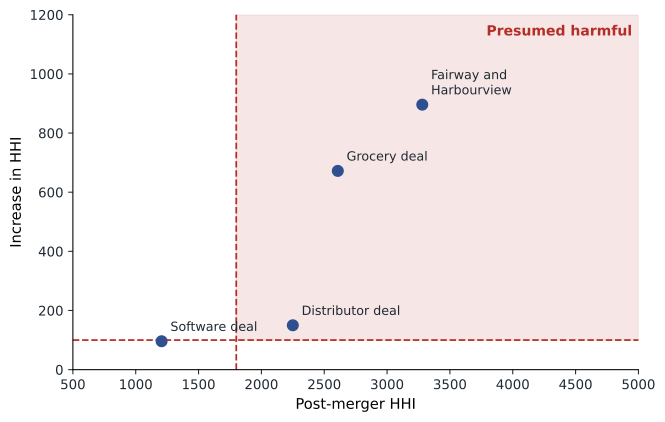
Bill C-59 introduced structural presumptions that mirror those used in the United States. A merger is presumed likely to prevent or lessen competition substantially if it increases the index by more than 100 and either results in an index above 1,800 or gives the merged firm a market share above 30 %. The merging parties can rebut the presumption with evidence, but it shifts the burden. Mergers that exceed the size thresholds in Part IX of the Act must be notified to the Bureau before closing, with a waiting period during which the Bureau can request more information.
# Merger screen: concentration index and the structural presumption
def hhi(shares):
    return sum(s ** 2 for s in shares)

def screen(shares, a, b):
    pre = hhi(shares)
    merged = [s for i, s in enumerate(shares) if i not in (a, b)] + [shares[a] + shares[b]]
    post = hhi(merged)
    delta = post - pre
    combined = shares[a] + shares[b]
    presumed = delta > 100 and (post > 1800 or combined > 30)
    return pre, post, delta, combined, presumed

markets = {
    'Regional grocery (Fairway buys #4)':     ([28, 22, 18, 12, 10, 10], 0, 3),
    'Steel coil distribution (#3 buys #6)':   ([30, 25, 15, 15, 10, 5], 2, 5),
    'Forecasting software (Kestrel buys #6)': ([20, 15, 12, 10, 8, 6, 5, 5, 5, 5, 5, 4], 5, 4),
}
for name, (shares, a, b) in markets.items():
    pre, post, delta, comb, pres = screen(shares, a, b)
    print(f"{name:40s} pre {pre:5d}  post {post:5d}  change {delta:4d}  share {comb:3d} %  presumed: {'yes' if pres else 'no'}")

# Critical loss for a 5 % price increase at different margins
for margin in (0.2, 0.4, 0.6):
print(f"Margin {margin:.0%}: critical loss = {0.05 / (0.05 + margin):.1%} of sales")Regional grocery (Fairway buys #4) pre 1936 post 2608 change 672 share 40 % presumed: yes Steel coil distribution (#3 buys #6) pre 2100 post 2250 change 150 share 20 % presumed: yes Forecasting software (Kestrel buys #6) pre 1110 post 1206 change 96 share 14 % presumed: no Margin 20%: critical loss = 20.0% of sales Margin 40%: critical loss = 11.1% of sales Margin 60%: critical loss = 7.7% of sales
The code screens three hypothetical deals. Fairway's purchase of the fourth-largest regional grocer raises the index by 672 to well above 1,800 and gives a combined share of 40 %, so it is presumed harmful; Fairway would need to show that the market is broader than assumed, for example because discount and online grocers constrain prices, or offer to divest stores where overlap is greatest. The distributor deal raises the index by 150 and creates a 20 % share, but the post-merger index of 2,250 exceeds 1,800, so the presumption applies. Kestrel's small acquisition in fragmented software raises the index by 96 and falls below the threshold. The critical loss lines show that high-margin businesses need to lose only a small share of sales for a price increase to fail, which is why market definition in high-margin industries is often contested.
Recent Canadian merger cases show the analysis at work. In the Rogers–Shaw merger, the Bureau challenged the deal but the Tribunal concluded in December 2022 that the proposed sale of Shaw's wireless business, Freedom Mobile, to Vidéotron resolved the competitive concerns, and the merger closed in 2023 after the divestiture. The Bureau has also challenged acquisitions in sectors including energy and waste management, and its enforcement since the 2024 amendments has paid closer attention to labour markets, to serial acquisitions of small competitors and to non-compete clauses that accompany deals.
Abuse of dominance
Section 79 of the Act prohibits abuse of dominance: conduct by a dominant firm that is intended to have a negative effect on a competitor, or that has the effect of substantially preventing or lessening competition. Anti-competitive acts include predatory pricing below an appropriate measure of cost, margin squeezes in which a vertically integrated firm sets input and retail prices so that rivals cannot compete, exclusive dealing that forecloses rivals, and the use of scarce inputs or intellectual property to exclude. The Tribunal can order the firm to stop, take corrective action and pay administrative monetary penalties of up to the greater of 10 million dollars for a first order, three times the benefit derived, or 3 % of worldwide gross revenue. In November 2024, the Bureau applied to the Tribunal alleging that Google abused its dominance in online advertising technology, illustrating the application of section 79 to digital markets.
Game theory explains why authorities are cautious about predatory pricing claims. Lesson 8 showed that a threat to fight entry is often not credible, because fighting is costly for the incumbent. Low prices are usually good for customers, and a firm that cuts prices in response to entry is usually competing, not predating. Predation becomes plausible when the incumbent can recoup its losses later, for example because barriers to re-entry are high, and when the price is below a measure of avoidable or marginal cost. The analysis therefore combines cost tests from Lesson 4 with an assessment of market structure from Lessons 5 and 6.
Vertical restraints and distribution
Many agreements between firms at different levels of the supply chain, such as exclusive dealing, tied selling, market restriction and refusals to deal, are reviewable civil matters under sections 75, 76 and 77 of the Act. Price maintenance, in which a supplier attempts to influence upward the price at which a customer resells, or refuses to supply a customer because of its low pricing, is reviewable under section 76. These practices are often efficient, for example to encourage retailers to invest in service or to prevent free-riding, and they are prohibited only when they have an adverse effect on competition. Daniel was advised that Northfield could recommend resale prices to its aftermarket distributors as long as it made clear that distributors were free to set their own prices and did not penalize those who priced lower.
Economic regulation
Where competition cannot work, because a market is a natural monopoly or because firms control essential facilities such as pipelines, transmission lines or local networks, governments regulate prices and service terms directly. Lesson 5 introduced the two main approaches. Under cost-of-service or rate-of-return regulation, the regulator sets prices to cover operating costs plus a fair return on the rate base, the depreciated value of invested capital. This assures investors and encourages investment but weakens incentives to cut costs, and it can encourage over-investment in capital, a tendency analyzed by Harvey Averch and Leland Johnson in 1962. Under price-cap or incentive regulation, the regulator sets a price path, often inflation minus a productivity factor, and the firm keeps the savings if it beats it. This strengthens cost discipline but risks quality cuts, so regulators add service quality standards.
| Approach | How prices are set | Strengths | Weaknesses |
|---|---|---|---|
| Cost of service | Operating costs plus allowed return on rate base | Stable returns, supports investment | Weak cost discipline, over-capitalization |
| Price cap | Inflation minus productivity factor, reset every few years | Strong cost discipline | Risk of quality cuts, hard to set factor |
| Performance-based | Rewards and penalties tied to outcomes | Targets what customers value | Measurement and gaming |
| Yardstick competition | Prices based on costs of comparable firms | Uses information from peers | Needs comparable firms |
In Canada, provincial utility regulators such as the Ontario Energy Board and the Alberta Utilities Commission set electricity and natural gas distribution rates, the Canada Energy Regulator oversees interprovincial pipelines and transmission lines, and the Canadian Radio-television and Telecommunications Commission regulates telecommunications and broadcasting. The Ontario Energy Board's incentive rate-setting for electricity distributors, which adjusts rates by inflation less a productivity factor and benchmarks distributors' costs, is an example of the price-cap and yardstick approaches working together. Owen deals with the Canada Energy Regulator on Prairie Ridge's pipeline tolls and with the Alberta Utilities Commission on electricity costs.
Regulation also extends beyond prices. Health and safety, environmental and financial regulation correct externalities and information problems discussed in Lessons 1 and 9. Hana's work at Lakeview involves rules on clinical standards, privacy of health information and reimbursement rates. Managers can use economics to engage constructively with regulators: estimating the costs and benefits of proposed rules, proposing alternatives that achieve the regulator's goals at lower cost, and understanding how regulators trade off affordability, reliability and investment.
Worked problem
A merger screen for Fairway
Fairway is considering buying Harbourview Foods, a regional chain. In the towns where both operate, shares are Fairway 32 %, a national chain 30 %, Harbourview 14 %, a discount chain 16 % and independents 8 % in total, treated as eight stores with 1 % each. Grace has been asked whether the deal is likely to face a presumption under the Competition Act and what Fairway could do.
Show solution
- Pre-merger index: 32² + 30² + 14² + 16² + 8 × 1² = 1,024 + 900 + 196 + 256 + 8 = 2,384.
- Increase from the merger: 2 × 32 × 14 = 896, giving a post-merger index of 3,280.
- The increase exceeds 100, the post-merger index exceeds 1,800 and the combined share of 46 % exceeds 30 %, so the presumption applies on every test.
- Fairway could argue for a broader market including online grocers and warehouse clubs, or propose divesting stores in the towns with the greatest overlap.
Answer: The deal is presumed to lessen competition substantially in the overlap towns. With the efficiencies defence repealed, Fairway cannot rely on cost savings alone; it should prepare evidence on market definition and a divestiture remedy before announcing the deal.
Common mistakes
MistakeTalking about prices with competitors is fine if no agreement is signed.
InsteadAn informal understanding can be an illegal agreement; avoid such discussions entirely.
MistakeBeing dominant is illegal.
InsteadDominance is lawful; excluding rivals by means other than competition on the merits is not.
MistakeSmall acquisitions are never reviewed.
InsteadNon-notifiable mergers can still be challenged, and serial acquisitions receive growing scrutiny.
MistakeLow prices in response to entry are predatory.
InsteadPrice cuts are usually competition; predation requires below-cost pricing and a prospect of recoupment.
MistakeRegulated firms have no incentive to cut costs.
InsteadUnder price caps and performance-based regulation, they keep part of the savings.
Summary and key terms
- The Competition Act, enforced by the Competition Bureau and the Competition Tribunal, governs cartels, mergers, abuse of dominance and restrictive practices.
- Price fixing, market allocation, bid rigging and wage-fixing among competitors are criminal; managers must never discuss these subjects with rivals.
- Merger review defines the market with the hypothetical monopolist test, measures concentration with the HHI and assesses unilateral and coordinated effects.
- A merger that raises the HHI by more than 100 to above 1,800, or that creates a share above 30 %, is presumed harmful.
- Abuse of dominance covers exclusionary conduct by dominant firms, with penalties that can reach three times the benefit or 3 % of worldwide revenue.
- Vertical restraints are judged by their effect on competition and are often efficient.
- Economic regulation of natural monopolies uses cost-of-service, price-cap, performance-based and yardstick methods.
- Competition law
- Law that prohibits cartels and abuse of dominance and reviews mergers.
- Per se offence
- Conduct that is illegal regardless of its effects or justification.
- Hypothetical monopolist test
- A method of defining markets by asking whether a sole supplier could profitably raise price by about 5 %.
- Herfindahl–Hirschman Index
- The sum of squared market shares, used to measure concentration.
- Structural presumption
- A rule that mergers above concentration thresholds are presumed harmful unless shown otherwise.
- Critical loss
- The share of sales a firm can lose before a price increase becomes unprofitable.
- Predatory pricing
- Pricing below cost to exclude rivals, with the prospect of recouping losses later.
- Price-cap regulation
- Regulation that sets a price path, often inflation minus a productivity factor.
- Rate base
- The depreciated value of a regulated firm's invested capital on which it earns an allowed return.
Practice problems
Work each problem on paper first, then reveal the answer to check.
Compute the HHI for a market with shares 40, 30, 20 and 10.
Show answer
1,600 + 900 + 400 + 100 = 3,000.
Two firms with shares of 6 % and 5 % merge in a market with a post-merger index of 2,100. Is the presumption triggered?
Show answer
No: the increase is 2 × 6 × 5 = 60, below 100, and the combined share is 11 %.
A firm has a 30 % margin. What is the critical loss for a 5 % price increase?
Show answer
0.05 / 0.35 ≈ 14.3 % of sales.
Why are information exchanges among competitors risky even without an agreement on prices?
Show answer
Exchanging current or future pricing information can facilitate coordination and be treated as evidence of an agreement.
What is the main incentive weakness of cost-of-service regulation?
Show answer
Costs are passed through to customers, so the firm has little incentive to reduce them, and it may over-invest in capital.
Portfolio task: identify one practice in your organization that touches competition law, such as trade association meetings, distribution agreements or acquisitions, and outline the safeguards you would put in place.
Show answer
Answers vary.
Lesson quiz · 5 questions
Score 60% or more to complete this lesson.
Create a free account to save your progress, take quizzes and earn a certificate.