
MBA-502 · Lesson 3 of 12 · 22 min
Pricing: markups, price discrimination and dynamic pricing
Price is the one element of the marketing mix that produces revenue rather than cost, and small changes in price have large effects on profit. A frequently quoted analysis of large companies found that a 1 % improvement in realized price, holding volume constant, raised operating profit by roughly 10 %, more than an equal improvement in variable cost, fixed cost or volume. Whatever the exact figure for a particular business, the arithmetic is simple: a price increase drops straight to profit, while a volume increase brings its own variable costs. This lesson develops the economics of setting prices: the profit-maximizing rule, the markup formula that links price to elasticity, the many forms of price discrimination, and the dynamic pricing that software now makes possible.
The profit-maximizing price
A firm with some control over its price faces a downward-sloping demand curve. To sell more it must lower the price, and in general it must lower the price on all units, not just the extra one. Marginal revenue, the extra revenue from one more unit, is therefore less than the price. Profit is maximized where marginal revenue equals marginal cost: producing one more unit beyond that point adds more to cost than to revenue, and producing one fewer gives up units that would have added to profit.
The expression for marginal revenue shows why a profit-maximizing firm never prices in the inelastic part of demand: if the elasticity is between −1 and 0, marginal revenue is negative, so raising the price would increase revenue and reduce cost at the same time. Setting marginal revenue equal to marginal cost and rearranging gives the Lerner condition, which relates the optimal percentage markup over marginal cost to the elasticity of demand.
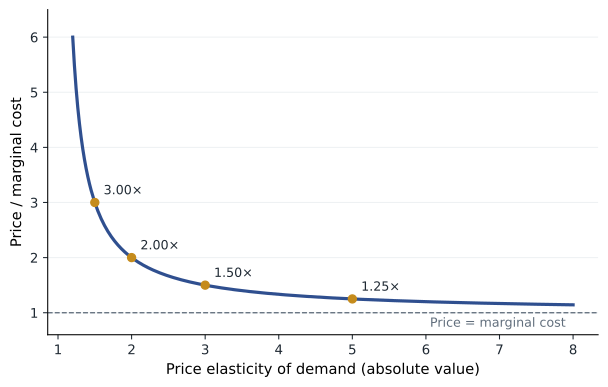
If demand has an elasticity of −2, the optimal price is twice marginal cost; with an elasticity of −4, it is a third above marginal cost; with an elasticity of −11, about a tenth above. The rule explains why markups are high on fashion items, branded drugs and airport food, where buyers have few alternatives, and low on commodity groceries and gasoline, where buyers switch easily. It also explains why marginal cost, not average cost, is the right basis for pricing: fixed costs determine whether a business should exist, but not where its price should be.
# Profit-maximizing price for a linear demand curve and the Lerner check
# Kestrel's mid-market plan: monthly subscriptions Q = 2600 - 4 * P (P in dollars per month)
a, b = 2600, 4.0
mc = 95.0            # marginal cost per subscriber per month: hosting, support, payment fees
fixed = 98_000.0     # monthly fixed costs allocated to this plan
p_star = (a / b + mc) / 2          # from MR = MC with linear demand
q_star = a - b * p_star
profit = (p_star - mc) * q_star - fixed
elasticity = -b * p_star / q_star
print(f"Optimal price {p_star:.2f}, subscribers {q_star:.0f}, monthly profit {profit:,.0f}")
print(f"Elasticity at the optimum {elasticity:.2f}; Lerner markup {(p_star - mc) / p_star:.3f} = -1/e {-1 / elasticity:.3f}")
for p in (300, 325, 350, 375, 400):
    q = a - b * p
print(f" price {p}: subscribers {q:5.0f} profit {(p - mc) * q - fixed:9,.0f}")Optimal price 372.50, subscribers 1110, monthly profit 210,025 Elasticity at the optimum -1.34; Lerner markup 0.745 = -1/e 0.745 price 300: subscribers 1400 profit 189,000 price 325: subscribers 1300 profit 201,000 price 350: subscribers 1200 profit 208,000 price 375: subscribers 1100 profit 210,000 price 400: subscribers 1000 profit 207,000
Leo tested several prices for Kestrel's mid-market plan and found that subscriptions fell by about four for every dollar of monthly price. With a marginal cost of 95 dollars per customer per month, the profit-maximizing price is about 373 dollars, and at that price demand has an elasticity of about −1.34, exactly the value at which the Lerner markup equals the actual markup. The table of nearby prices shows that profit is quite flat near the optimum, which is common and useful: managers do not need to know the exact optimal price, but they do need to avoid being far from it.
Cost-plus pricing and why it persists
Many firms set prices by adding a standard percentage markup to average cost. Northfield quotes most new parts this way, and so do many construction contractors, law firms and grocery retailers. Economists criticize cost-plus pricing because it ignores demand and uses average rather than marginal cost, which can lead to a vicious circle: when volume falls, average cost rises, the formula raises the price, and volume falls further. Yet cost-plus survives for good reasons. It is simple, it is easy to explain to customers, it limits disputes in long-term contracts and, if managers adjust the markup by product and market, it can approximate the Lerner rule. The lesson is not to abandon cost-based pricing but to choose the markup with demand in mind and to base it on the costs that actually change with the decision.
Price discrimination
Price discrimination means charging different prices to different customers, or for different units, when the differences are not explained by differences in cost. It increases profit by capturing more of the value that customers place on the product, and it can also increase output and benefit customers who would not buy at a single higher price. Three conditions are needed: the firm must have some market power, it must be able to identify or sort customers with different willingness to pay, and it must be able to prevent resale from low-price to high-price buyers.
Economists distinguish three types. First-degree, or perfect, price discrimination charges each customer his or her maximum willingness to pay; it is rare in pure form but is approached in negotiated business-to-business pricing, car sales and some auctions. Second-degree price discrimination offers a menu, such as quantity discounts, versions or bundles, and lets customers sort themselves; Kestrel's basic, professional and enterprise plans are an example. Third-degree price discrimination charges different prices to identifiable groups, such as students, seniors, business and leisure travellers, or customers in different countries.
# Third-degree price discrimination: Lakeview Health's fitness and rehabilitation pool
# Two groups with separate linear demand for monthly memberships (Q = a - b * P); marginal cost 18 dollars
mc = 18.0
groups = {"working adults": (1400, 20.0), "seniors and students": (1500, 40.0)}
total_profit = 0.0
for name, (a, b) in groups.items():
    p = (a / b + mc) / 2
    q = a - b * p
    e = -b * p / q
    total_profit += (p - mc) * q
    print(f"{name:21}: price {p:5.2f}, members {q:4.0f}, elasticity {e:5.2f}")
# single price for both groups combined
A, B = sum(a for a, b in groups.values()), sum(b for a, b in groups.values())
p1 = (A / B + mc) / 2
q_single = sum(max(a - b * p1, 0) for a, b in groups.values())
print(f"Discriminating profit {total_profit:,.0f}; single price {p1:.2f} gives profit {(p1 - mc) * q_single:,.0f}")working adults : price 44.00, members 520, elasticity -1.69 seniors and students : price 27.75, members 390, elasticity -2.85 Discriminating profit 17,322; single price 33.17 gives profit 13,802
The more elastic group, seniors and students, gets the lower price, exactly as the formula predicts. Separate prices raise the contribution from the pool, and for a not-for-profit like Lakeview the extra contribution helps fund the rehabilitation program, while the lower price makes the pool affordable to people who would otherwise not join. This is why price discrimination is often welcomed rather than resented when it takes the form of discounts for groups with lower incomes.
Two-part tariffs, bundling and versioning
A two-part tariff charges a fixed fee for the right to buy plus a price per unit: a club membership plus court fees, a cellphone plan with a monthly charge and per-gigabyte overage, a warehouse club membership plus product prices, an electricity bill with a fixed customer charge and an energy charge. For identical customers, the profit-maximizing two-part tariff sets the unit price equal to marginal cost, so that customers buy the efficient quantity, and captures their entire consumer surplus in the fixed fee. With customers who differ, the firm must balance a higher fee, which loses small customers, against a higher unit price, which captures more from heavy users.
Bundling sells two or more products together for one price. It raises profit when customers' valuations of the components are negatively correlated, because the bundle price can be set close to the sum of most customers' valuations even though their valuations of each item differ. Software suites, cable television packages, restaurant set menus and Fairway's meal kits are bundles. Versioning offers different quality levels at different prices, such as economy and business seats, standard and express shipping, or Kestrel's plans with different forecast horizons; it works by designing the lower version so that high-value customers prefer to pay for the better one.
Dynamic pricing and revenue management
Airlines, hotels, sports teams, ride-hailing services, electricity markets and online retailers change prices frequently in response to demand, remaining capacity and time to the deadline. Revenue management, developed by airlines after deregulation in the United States in the late 1970s and 1980s, allocates limited perishable capacity among customer segments with different willingness to pay and different booking patterns. The basic rule protects a seat for a late-booking, high-fare passenger as long as the probability of selling it at the high fare times that fare exceeds the low fare; this is known as Littlewood's rule.
Grace has seen dynamic pricing arrive in groceries in a modest form: electronic shelf labels let Fairway mark down prepared foods and produce late in the day, reducing waste. Owen sees it in electricity markets, where wholesale prices change every five minutes or hourly depending on the market, and where some time-of-use retail rates are higher in peak hours. Dynamic pricing raises questions of fairness and trust: customers accept higher prices for peak travel but often resent surge pricing for necessities, and regulators in several jurisdictions have examined algorithmic pricing that may facilitate coordination among competitors or exploit personal data. A sound policy explains the logic to customers, limits increases during emergencies and avoids pricing based on personal characteristics that customers would consider unfair.
Behavioural pricing
Real buyers do not always behave as the standard model assumes. Prices ending in 99 cents appear lower than prices just above them. Customers judge prices relative to a reference price, so a discount from a higher list price can be more attractive than the same price without the comparison. A decoy option, priced so that nobody should choose it, can steer buyers towards the option next to it. Customers dislike losses more than they value equal gains, which makes surcharges less acceptable than equivalent discounts. Managers should use these insights with care: tactics that customers later see as manipulative can damage trust, and consumer protection laws restrict misleading reference prices and drip pricing, in which mandatory fees are revealed only at the end of the purchase.
Worked problem
Pricing a contract renewal
Northfield supplies a welded subassembly to an equipment maker at 46.00 dollars per unit. Its marginal cost is 33.80 dollars. The customer has one other qualified supplier, and Daniel estimates that the elasticity of the customer's demand facing Northfield is about −3.5. What price does the Lerner rule suggest, and how should Daniel use it?
Show solution
- The Lerner condition gives P = MC / (1 + 1/ε) = 33.80 / (1 − 1/3.5).
- 1 − 0.2857 = 0.7143, so P = 33.80 / 0.7143 ≈ 47.32 dollars.
- The current price of 46.00 dollars is about 3 % below that level.
- Daniel should treat the result as a guide: the elasticity is uncertain, and the relationship with the customer has value beyond this contract.
Answer: The rule suggests a modest increase of about 1.30 dollars per unit is supportable. Daniel proposes an increase of 1.00 dollar tied to a two-year volume commitment, which reduces the risk that the customer moves the work to the rival supplier.
Common mistakes
MistakePrices should be based on average cost plus a fixed markup.
InsteadProfit-maximizing prices depend on marginal cost and demand elasticity; average cost includes fixed costs that do not change with price.
MistakeA firm should price where demand is inelastic to maximize revenue.
InsteadProfit-maximizing prices lie in the elastic range; in the inelastic range, raising price increases revenue and lowers cost.
MistakePrice discrimination always harms customers.
InsteadIt can expand output and make products available to lower-income buyers who would not buy at a single price.
MistakeBundling works whenever products are sold together.
InsteadIt raises profit mainly when customers' valuations of the items are negatively correlated.
MistakeDynamic pricing is purely a technical question.
InsteadIt raises fairness, trust and legal issues that must be managed.
Summary and key terms
- Profit is maximized where marginal revenue equals marginal cost.
- The Lerner rule sets the percentage markup over marginal cost equal to minus one over the elasticity.
- Cost-plus pricing persists but should use relevant costs and markups that reflect demand.
- Price discrimination requires market power, sorting and prevention of resale; it takes first-, second- and third-degree forms.
- Two-part tariffs, bundling and versioning capture more consumer surplus.
- Dynamic pricing and revenue management allocate perishable capacity; they raise fairness and legal questions.
- Behavioural effects such as reference prices and loss aversion influence how customers respond to prices.
- Marginal revenue
- The additional revenue from selling one more unit.
- Lerner index
- The markup over marginal cost as a fraction of price, (P − MC)/P.
- Cost-plus pricing
- Setting price by adding a markup to average cost.
- Price discrimination
- Charging different prices for the same product when the differences are not explained by cost.
- Two-part tariff
- A pricing scheme with a fixed fee plus a price per unit.
- Bundling
- Selling two or more products together for a single price.
- Versioning
- Offering a product in different quality levels at different prices.
- Revenue management
- Allocating perishable capacity among segments with different willingness to pay.
- Reference price
- The price a buyer uses as a benchmark when judging an offer.
Practice problems
Work each problem on paper first, then reveal the answer to check.
Marginal cost is 30 dollars and the elasticity of demand is −3. What price maximizes profit?
Show answer
45 dollars: 30 / (1 − 1/3).
Demand is Q = 1,000 − 10P and marginal cost is 20. What are the profit-maximizing price and quantity?
Show answer
P = 60, Q = 400.
A firm sells to two groups with elasticities −2 and −5 and constant marginal cost of 10. What prices should it charge?
Show answer
20 to the first group and 12.50 to the second.
Why should the unit price in a two-part tariff for identical customers equal marginal cost?
Show answer
It makes customers buy the efficient quantity, maximizing the surplus that the fixed fee can capture.
Explain why a cinema can profit from selling movie tickets and popcorn separately at high popcorn prices.
Show answer
Popcorn price sorts customers by intensity of demand: heavy buyers pay more, a form of second-degree discrimination.
Portfolio task: identify one product in your organization priced on a cost-plus basis and estimate whether the Lerner rule would suggest a higher or lower price.
Show answer
Answers vary.
Lesson quiz · 5 questions
Score 60% or more to complete this lesson.
Create a free account to save your progress, take quizzes and earn a certificate.