
MBA-502 · Lesson 6 of 12 · 21 min
Oligopoly and monopolistic competition
Most of the markets that MBA students will manage in are neither perfectly competitive nor monopolies. Some have a few large firms whose decisions affect one another: wireless carriers, airlines, banks, grocery chains in a region, aircraft manufacturers, cloud providers. Others have many firms selling differentiated products with some local market power: restaurants, clothing brands, dental practices, craft breweries. Economists call the first oligopoly and the second monopolistic competition. This lesson analyses both, using the classic models of Cournot and Bertrand for oligopoly, the conditions that make collusion more or less likely, and the long-run logic of differentiated markets.
Oligopoly: the importance of rivals
An oligopoly is a market dominated by a few firms, protected by barriers to entry such as economies of scale, network infrastructure, regulation or brand. The defining feature is interdependence: each firm's best price, output or investment depends on what its rivals do, and each firm knows this. When Fairway Grocers considers cutting prices on a basket of staples, Grace Mwangi must predict whether the two other major chains in the region will match. If they do, Fairway gains little volume and all three lose margin; if they do not, Fairway may take share. The outcome depends on beliefs about rivals, which is why game theory, introduced formally in Lesson 7, is the natural language of oligopoly.
Economists use several models, each suited to different industries. In the Cournot model, firms choose quantities or capacities and the market price adjusts to clear the market; it fits industries where capacity is chosen first and is hard to change, such as cement, steel, potash or gas processing. In the Bertrand model, firms choose prices and supply whatever is demanded; it fits industries where capacity is ample and prices are easy to change. In the Stackelberg model, one firm commits to its output first and the others follow, which captures industries with a recognized leader. These models give different predictions, and choosing the right one for a market is part of the analysis.
The Cournot model
Consider two firms producing an identical product, each choosing its output while taking the other's output as given. Each firm's best response, or reaction function, gives the output that maximizes its profit for each level of its rival's output. If the rival produces more, the price falls and the firm's best response is to produce less. The Cournot equilibrium is the pair of outputs at which each firm is producing its best response to the other, so neither wants to change.
With identical costs, each Cournot firm produces a third of the competitive quantity, so together they produce two thirds of it, more than a monopolist but less than a competitive industry. The price lies between the monopoly and competitive prices, and as the number of firms grows, the Cournot outcome approaches the competitive one. This prediction matches a broad pattern in the data: markups tend to fall as the number of competitors rises, but the first few entrants reduce prices the most.
# Cournot and Bertrand duopoly with linear demand P = a - b(q1 + q2)
a, b = 200.0, 1.0           # market demand: price falls one dollar per unit of total output
c1, c2 = 40.0, 50.0         # marginal costs of firm 1 and firm 2
q1 = (a - 2 * c1 + c2) / (3 * b)
q2 = (a - 2 * c2 + c1) / (3 * b)
p = a - b * (q1 + q2)
print(f"Cournot: q1 {q1:.1f}, q2 {q2:.1f}, price {p:.1f}, profits {(p - c1) * q1:,.0f} and {(p - c2) * q2:,.0f}")
qm = (a - c1) / (2 * b); pm = a - b * qm
print(f"Monopoly by the low-cost firm: quantity {qm:.0f}, price {pm:.0f}")
# Bertrand with identical products: the low-cost firm prices just below the rival's cost
p_bert = c2 - 0.01
q_bert = (a - p_bert) / b
print(f"Bertrand: price {p_bert:.2f}, low-cost firm sells {q_bert:.0f}, profit {(p_bert - c1) * q_bert:,.0f}")
# Cournot with n identical firms (cost 40): price falls toward marginal cost as n grows
for n in (1, 2, 3, 5, 10, 20):
    q_each = (a - c1) / ((n + 1) * b)
print(f" n = {n:2d}: price {a - b * n * q_each:6.1f}")Cournot: q1 56.7, q2 46.7, price 96.7, profits 3,211 and 2,178 Monopoly by the low-cost firm: quantity 80, price 120 Bertrand: price 49.99, low-cost firm sells 150, profit 1,499 n = 1: price 120.0 n = 2: price 93.3 n = 3: price 80.0 n = 5: price 66.7 n = 10: price 54.5 n = 20: price 47.6
The output shows the classic pattern. With costs of 40 and 50 dollars, the low-cost firm produces more and earns more in the Cournot equilibrium, and the price of about 97 dollars is far above marginal cost. With price competition in an identical product, the Bertrand outcome is very different: the low-cost firm undercuts its rival to just below 50 dollars and takes the whole market. With twenty identical Cournot firms, the price falls to about 48 dollars, close to the marginal cost of 40.
The Bertrand model and the paradox of price competition
The Bertrand model, with identical products and no capacity limits, predicts that two firms are enough to drive price down to marginal cost, because each can take the whole market by slightly undercutting the other. This Bertrand paradox seems at odds with experience: duopolies often earn healthy profits. The paradox is resolved by relaxing its assumptions. Products are rarely identical, so a small price difference does not move all customers. Capacity is limited, so a firm cannot serve the whole market. Firms interact repeatedly, so a price cut today invites retaliation tomorrow. Each of these softens price competition, and managers who understand them can avoid the destructive price wars that the simple model predicts.
Product differentiation is the most important of these. When products are differentiated, each firm faces a downward-sloping demand curve whose elasticity depends partly on rivals' prices, and the equilibrium involves prices above marginal cost even with price competition. The more differentiated the products, the higher the equilibrium markups. Much of marketing strategy can be understood as an effort to reduce the cross elasticity between one's own product and rivals', so that price competition is softened.
Collusion and cartels
Firms in an oligopoly would collectively earn more by acting like a monopolist, restricting output and raising price. But each firm has an incentive to cheat on any agreement, by producing a little more or offering a quiet discount, because it gains while the others bear most of the cost of the lower price. This tension between joint and individual interest is the prisoners' dilemma of Lesson 7. Explicit agreements to fix prices, divide markets or rig bids are criminal offences in Canada and the United States, and penalties include large fines and prison sentences for individuals.
Canadian examples are well known. In 2017 and 2018 several grocers and a bakery company disclosed participation in an arrangement to fix the price of packaged bread over more than a decade, and the Competition Bureau's investigation led to a guilty plea by the bakery company in 2023, a record criminal fine of 50 million dollars and large class action settlements. Grace remembers the reputational damage across the industry, and Fairway's compliance training now uses the case as its main example.
Even without explicit agreements, oligopolists may reach high prices through tacit coordination: each firm understands that aggressive pricing will be matched and refrains from it. Tacit coordination is easier when there are few firms, products are similar, prices are transparent, demand is stable, interactions are frequent and the firms have similar costs. It is harder when there is a maverick firm with an incentive to compete aggressively, when large lumpy contracts reward cheating, or when demand is volatile. These factors are exactly the ones competition authorities examine when assessing whether a merger makes coordination more likely, as Lesson 10 explains. Tacit coordination is not itself illegal, but practices that facilitate it, such as exchanging detailed future price information with competitors, can be.
Price leadership, capacity and commitment
In some oligopolies a dominant firm sets prices and smaller firms follow, a pattern called price leadership. Airlines often signal fare changes and wait to see if rivals match before finalizing them; steel and cement producers announce price increases weeks in advance. Capacity also shapes competition: a firm with large spare capacity has an incentive to cut prices to fill it, while a firm that is capacity constrained has little reason to do so. Investing in capacity can be a way of committing to aggressive behaviour, a theme Lesson 8 develops.
Monopolistic competition
In monopolistic competition, many firms sell differentiated products and entry is easy. Each firm has some market power because customers prefer its product, location or service, so it faces a downward-sloping demand curve and sets price above marginal cost. But because entry is free, economic profits attract new firms whose products take some customers away and make each firm's demand curve more elastic. In long-run equilibrium, price equals average cost, so economic profit is zero, but price still exceeds marginal cost and firms operate below their minimum efficient scale. The result is more variety than perfect competition would provide, at somewhat higher cost.
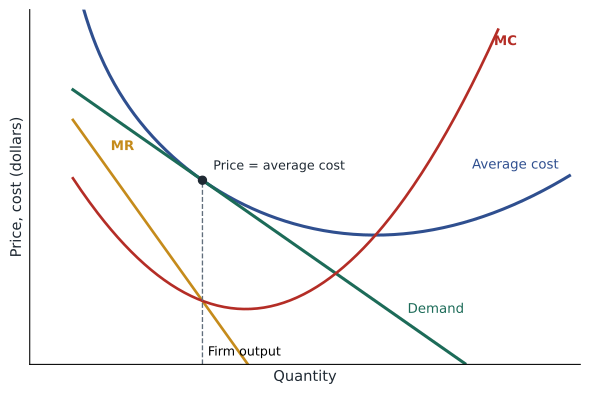
Hana Kowalski sees monopolistic competition among private physiotherapy clinics near Lakeview's sites: each clinic has loyal patients and a slightly different mix of services and hours, but new clinics open whenever existing ones are busy, and profits per clinic are modest. Grace sees it in Fairway's prepared-food counters competing with dozens of nearby restaurants and meal-kit services. For managers in such markets, the main levers are differentiation that customers value and that is hard to copy, and cost efficiency, because prices are constrained by many near-substitutes.
Reading the structure of your market
Managers can diagnose market structure with a few questions. How many firms have a meaningful share, and how concentrated is the market? How differentiated are the products, and how easily do customers switch? How easy is entry, and how long does it take? Are capacities and costs similar across firms? How transparent are prices? Is there a maverick? How often do firms interact, and how large are individual contracts? The answers indicate which model is relevant and therefore what kind of competitive response to expect. Daniel Osei did this exercise for Northfield's main product markets and concluded that standard brackets behave close to Bertrand competition among many qualified suppliers, while complex welded assemblies behave more like a differentiated oligopoly with three or four credible suppliers.
Worked problem
A Cournot capacity decision
Two gas processors serve a region where the processing fee depends on total throughput: fee = 1.20 − 0.004 Q dollars per gigajoule, with Q in million gigajoules a year. Prairie Ridge has a marginal cost of 0.30 dollars per gigajoule and its rival 0.36 dollars. What throughputs and fee does the Cournot model predict?
Show solution
- Here a = 1.20, b = 0.004, c1 = 0.30 and c2 = 0.36.
- Prairie Ridge: q1 = (1.20 − 0.60 + 0.36) / 0.012 = 80 million gigajoules.
- Rival: q2 = (1.20 − 0.72 + 0.30) / 0.012 = 65 million gigajoules.
- Fee = 1.20 − 0.004 × 145 = 0.62 dollars per gigajoule.
Answer: The Cournot model predicts a fee of 0.62 dollars, with Prairie Ridge processing about 80 million gigajoules. Owen uses the model to show that adding capacity beyond 80 million would depress the fee by more than the gain in volume unless the rival cuts back.
Common mistakes
MistakeTwo firms are always enough to make a market competitive.
InsteadWith differentiated products, capacity limits or repeated interaction, duopolies often price well above marginal cost.
MistakeA rival's price cut should always be matched.
InsteadIt depends on capacity, differentiation and the rival's motives; matching every cut can start a price war.
MistakeTacit coordination is the same as illegal collusion.
InsteadIndependent decisions that anticipate rivals' responses are legal; agreements and some information exchanges are not.
MistakeMonopolistic competitors earn monopoly profits.
InsteadEntry drives their long-run economic profit to zero, although price exceeds marginal cost.
MistakeMarket structure is fixed.
InsteadEntry, exit, mergers, technology and regulation change it over time.
Summary and key terms
- Oligopolies are markets with a few interdependent firms protected by entry barriers.
- In Cournot competition, firms choose quantities; price lies between monopoly and competitive levels and falls as firms are added.
- In Bertrand competition with identical products, price falls to marginal cost; differentiation, capacity limits and repeated interaction soften it.
- Collusion raises joint profits but each firm has an incentive to cheat; explicit price fixing is a crime.
- Tacit coordination is easier with few similar firms, transparent prices and stable demand.
- Monopolistic competition combines product differentiation with free entry, giving zero long-run economic profit with prices above marginal cost.
- Diagnosing market structure helps managers predict rivals' responses.
- Oligopoly
- A market dominated by a few interdependent firms.
- Cournot model
- An oligopoly model in which firms choose quantities simultaneously.
- Bertrand model
- An oligopoly model in which firms choose prices simultaneously.
- Reaction function
- A firm's best output or price for each choice of its rival.
- Cartel
- A group of firms that agree to restrict output or fix prices.
- Tacit coordination
- Parallel behaviour that raises prices without an explicit agreement.
- Maverick
- A firm with an incentive to disrupt coordination by competing aggressively.
- Price leadership
- A pattern in which one firm sets prices that rivals follow.
- Monopolistic competition
- A market with many firms selling differentiated products and free entry.
Practice problems
Work each problem on paper first, then reveal the answer to check.
Demand is P = 120 − Q and both duopolists have marginal cost 30. Find the Cournot outputs and price.
Show answer
Each produces 30; price is 60.
In the same market, what are the monopoly and competitive outputs?
Show answer
Monopoly 45; competition 90.
Why does a firm in a cartel have an incentive to cheat?
Show answer
Producing more or discounting raises its own profit at the cartel price while the cost of the lower price is shared.
Name three market features that make tacit coordination easier.
Show answer
Few firms, transparent prices, stable demand (also similar costs, frequent interaction).
Why do firms in monopolistic competition operate below minimum efficient scale in the long run?
Show answer
Their demand curve is tangent to average cost where it is still falling.
Portfolio task: classify your organization's main market using the diagnostic questions in this lesson and state which model best predicts rivals' responses.
Show answer
Answers vary.
Lesson quiz · 5 questions
Score 60% or more to complete this lesson.
Create a free account to save your progress, take quizzes and earn a certificate.