
MBA-502 · Lesson 5 of 12 · 21 min
Perfect competition and monopoly
Market structure describes how many firms compete, how similar their products are and how easily new firms can enter. It shapes prices, profits, innovation and the strategic choices open to managers. Economists analyse a spectrum of structures, from perfect competition with many small firms selling identical products to monopoly with a single seller. Real markets fall between these poles, but the two extremes are the reference points against which all others are understood, and they explain two of the most important facts in business: competition drives economic profit towards zero, and market power lets firms earn profits that persist only if entry is blocked.
The competitive benchmark
A perfectly competitive market has many buyers and sellers, each too small to affect the price; an identical product; free entry and exit; and buyers and sellers who are well informed. Each firm is a price taker: it can sell as much as it wants at the market price and nothing at a higher price, so the demand curve facing the individual firm is horizontal even though the market demand curve slopes downwards. Wheat, canola and corn, crude oil at a trading hub, foreign exchange, and many commodity metals come close, as do many local service markets with low entry barriers.
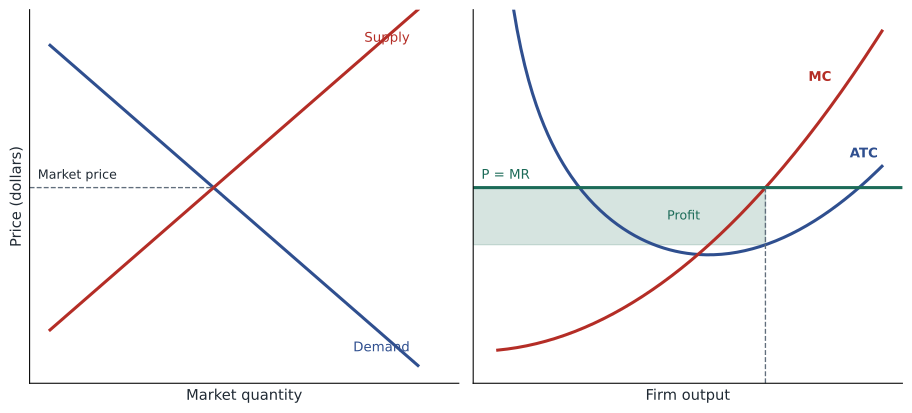
For a price taker, marginal revenue equals the price, so the profit-maximizing rule MR = MC becomes P = MC: produce up to the point where the marginal cost of the last unit equals the market price. Because marginal cost rises in the short run, the firm's marginal cost curve above its average variable cost is its short-run supply curve. Adding up the supply curves of all firms gives the market supply curve, and the market price is set where market supply meets market demand.
Short-run decisions: produce or shut down
In the short run, a competitive firm that is losing money must decide whether to keep operating or to shut down temporarily. Because fixed costs must be paid either way, the firm should keep producing as long as the price covers average variable cost, since each unit then makes some contribution towards fixed costs. If price falls below average variable cost, producing adds to losses and the firm should shut down until prices recover. Owen Tremblay sees this rule in action at Prairie Ridge Energy: when spot prices for natural gas fall below the variable cost of processing at the company's oldest plant, the plant is idled even though its fixed costs continue, and gas is routed to the more efficient main plant.
Long-run equilibrium and zero economic profit
In the long run, entry and exit change the number of firms. If firms earn economic profit, meaning returns above the opportunity cost of their capital, new firms enter, market supply increases and the price falls. If firms make economic losses, some leave, supply falls and the price rises. Entry and exit continue until the price equals the minimum of long-run average cost, where economic profit is zero. Zero economic profit does not mean firms earn nothing: they earn exactly the normal return that keeps their capital in the industry.
This is one of the most important lessons in economics for managers. In a competitive industry, any advantage based on something rivals can copy, such as a new process, a popular product feature or a good location, will be competed away. Fairway's experience with ready-to-eat meals illustrates the point: when the chain introduced them, margins were high; within three years every competitor offered similar meals, and the margin fell close to the category average. Sustained economic profit requires something that rivals cannot readily imitate or a barrier that prevents entry, which is the subject of MBA-514 Business Strategy.
Efficiency and surplus
Consumer surplus is the difference between what buyers are willing to pay and what they actually pay, summed over all units bought; producer surplus is the difference between the price and the marginal cost of each unit. In a competitive market, the equilibrium quantity maximizes total surplus, because every unit for which a buyer's value exceeds the marginal cost of producing it is produced, and no unit is produced whose cost exceeds its value. This is the formal sense in which economists say competitive markets are efficient. It assumes that prices reflect all costs and benefits, which fails when there are externalities such as pollution, and it says nothing about whether the resulting distribution of income is fair.
Monopoly
A monopoly is the only seller of a product with no close substitutes. Monopolies exist because of barriers to entry: control of an essential resource, patents and copyrights, government licences or franchises, network effects that make the largest network most valuable, or economies of scale so large that one firm can serve the market at lower cost than two. The last case is called a natural monopoly and includes local electricity distribution, water and gas pipelines, and rail infrastructure. Prairie Ridge's local gas distribution affiliate is a regulated natural monopoly; its gas processing and renewable generation businesses are not.
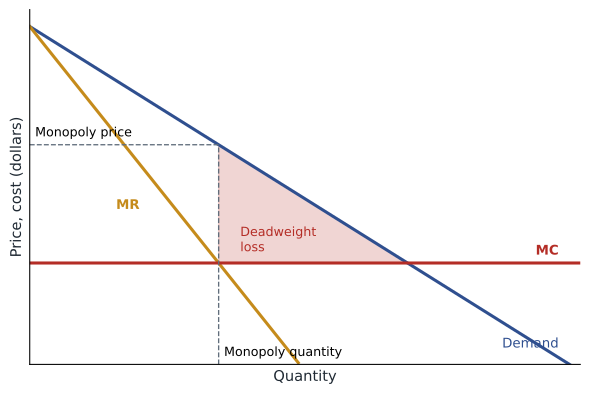
A monopolist faces the market demand curve, so to sell more it must lower its price. It maximizes profit where marginal revenue equals marginal cost and charges the price that buyers will pay for that quantity, which is above marginal cost. The result, compared with competition, is a higher price, lower output and a transfer of surplus from consumers to the producer. Some surplus is lost altogether, because units that buyers value above their marginal cost are not produced. This lost surplus is called the deadweight loss of monopoly, and it is the economic justification for competition policy and for regulating natural monopolies.
# Monopoly versus competition with linear demand P = a - b Q and constant marginal cost c
a, b, c = 120.0, 0.5, 40.0      # demand intercept (dollars), slope, marginal cost
q_c = (a - c) / b                # competition: P = MC
p_c = c
q_m = (a - c) / (2 * b)          # monopoly: MR = a - 2bQ = c
p_m = a - b * q_m
cs = lambda p, q: 0.5 * (a - p) * q
print(f"Competition: price {p_c:.0f}, quantity {q_c:.0f}, consumer surplus {cs(p_c, q_c):,.0f}")
print(f"Monopoly:    price {p_m:.0f}, quantity {q_m:.0f}, consumer surplus {cs(p_m, q_m):,.0f}, profit {(p_m - c) * q_m:,.0f}")
dwl = 0.5 * (p_m - p_c) * (q_c - q_m)
print(f"Deadweight loss {dwl:,.0f}; Lerner index {(p_m - c) / p_m:.2f}")Competition: price 40, quantity 160, consumer surplus 6,400 Monopoly: price 80, quantity 80, consumer surplus 1,600, profit 3,200 Deadweight loss 1,600; Lerner index 0.50
In this example the monopolist charges 80 dollars instead of 40, sells 80 units instead of 160, and earns a profit of 3,200 dollars, all of it taken from consumer surplus, which falls from 6,400 to 1,600. A further 1,600 dollars of surplus disappears entirely. The Lerner index of 0.5 measures the degree of market power: the share of the price that is a markup over marginal cost.
Regulating natural monopolies
Where a single firm can serve the market most cheaply, breaking it up would raise costs, so governments usually regulate it instead. Traditional cost-of-service or rate-of-return regulation sets prices to cover operating costs, depreciation and a fair return on the regulated asset base. Its weakness is that it gives the firm little incentive to cut costs and may encourage it to over-invest, because a larger asset base earns more return. Price-cap or performance-based regulation sets a maximum price that rises with inflation minus an efficiency factor, letting the firm keep savings it achieves. Many regulators now use hybrids with performance incentives.
In Canada, gas and electricity distribution are regulated by provincial bodies such as the Ontario Energy Board, the Alberta Utilities Commission and the Régie de l'énergie in Québec, while interprovincial pipelines fall under the Canada Energy Regulator. Owen's colleagues at the distribution affiliate spend months each year preparing rate applications that justify capital spending and propose returns on equity, and the board sets the rates after public hearings.
Market power in practice
Pure monopoly is rare, but market power is common. Any firm with a differentiated product, a strong brand, a patent, a loyal customer base or a location advantage faces a downward-sloping demand curve and some ability to price above marginal cost. The question for managers is how much market power they have and how long it will last. Patents expire; drug prices typically fall sharply after generic versions enter. Network effects can lock in market leadership, but technology shifts can dissolve them. Brands erode if quality slips. Leo Brandt describes Kestrel's position this way: the company has modest market power with existing customers, because switching forecasting systems is costly, but almost none with new customers, who compare it with several rivals.
Market power can also be measured. The Lerner index is one measure. Concentration ratios, which add up the market shares of the largest firms, and the Herfindahl-Hirschman index, which adds up the squares of all firms' shares, are others; Lesson 10 shows how competition authorities use them to screen mergers. None of these is perfect, because each depends on how the market is defined, which is often the most contested question in competition cases.
Worked problem
Should the plant keep running?
Prairie Ridge's older processing plant has fixed costs of 9 million dollars a year. Its variable cost is 0.42 dollars per gigajoule at its normal throughput of 20 million gigajoules a year, and the processing fee it can earn has fallen to 0.38 dollars per gigajoule because new capacity has entered the region. Should it keep running this year? What should Prairie Ridge consider for the long run?
Show solution
- Revenue at 0.38 dollars per gigajoule is 7.6 million dollars; variable cost is 8.4 million dollars.
- Operating loses 0.8 million dollars of contribution on top of the 9 million of fixed cost.
- Shutting down temporarily loses only the fixed costs that cannot be avoided, so it is better to idle the plant while the fee is below average variable cost.
- For the long run, the question is whether expected fees will exceed average total cost of (9 + 8.4) / 20 = 0.87 dollars per gigajoule; if not, the plant should eventually be retired.
Answer: Shut down temporarily and route gas to the main plant. A competitive market with new entrants is likely to keep fees low, so a long-run exit plan, including selling equipment and settling site obligations, should be prepared.
Common mistakes
MistakeA competitive firm should set its own price.
InsteadA price taker accepts the market price and chooses only its output.
MistakeFirms in competitive industries earn no profit at all.
InsteadIn long-run equilibrium they earn zero economic profit, which includes a normal return on capital.
MistakeA firm making a loss should shut down immediately.
InsteadIn the short run it should keep operating while price covers average variable cost.
MistakeA monopolist charges the highest possible price.
InsteadIt charges the price that maximizes profit, where marginal revenue equals marginal cost; higher prices would lose too many sales.
MistakeNatural monopolies should always be broken up.
InsteadWhere one firm serves the market most cheaply, regulation is usually better than break-up.
Summary and key terms
- Perfectly competitive firms are price takers that produce where price equals marginal cost.
- In the short run, firms keep operating while price covers average variable cost.
- Entry and exit drive long-run economic profit to zero in competitive markets.
- Competitive equilibrium maximizes total surplus when prices reflect all costs and benefits.
- Monopolies arise from barriers to entry and set MR = MC, charging prices above marginal cost.
- Monopoly causes a deadweight loss; natural monopolies are usually regulated.
- Market power is common and can be measured by the Lerner index and concentration measures.
- Perfect competition
- A market with many firms selling identical products, with free entry and exit.
- Price taker
- A firm that cannot influence the market price.
- Shutdown point
- The price below which a firm should stop producing in the short run, equal to minimum average variable cost.
- Economic profit
- Profit above the normal return on capital.
- Consumer surplus
- The difference between buyers' willingness to pay and the price they pay.
- Producer surplus
- The difference between the price and sellers' marginal cost.
- Monopoly
- A market with a single seller of a product with no close substitutes.
- Deadweight loss
- Surplus lost because output is below the efficient level.
- Natural monopoly
- A market in which one firm can supply total demand at lower cost than two or more.
Practice problems
Work each problem on paper first, then reveal the answer to check.
A competitive firm has marginal cost MC = 10 + 2q and the price is 50. How much should it produce?
Show answer
20 units.
Price is 30, average variable cost 32 and average total cost 40. Should the firm produce in the short run?
Show answer
No; price is below average variable cost.
Demand is P = 100 − Q and marginal cost is 20. Find monopoly price and quantity and the deadweight loss.
Show answer
Q = 40, P = 60; competitive Q = 80; deadweight loss 0.5 × 40 × 40 = 800.
Why do economic profits in a competitive industry disappear in the long run?
Show answer
Entry increases supply and lowers the price until economic profit is zero.
Explain one advantage and one disadvantage of price-cap regulation compared with rate-of-return regulation.
Show answer
It rewards cost cutting, but it may encourage quality cuts unless quality is also regulated.
Portfolio task: assess how much market power your organization has in its main market, and what could erode it over five years.
Show answer
Answers vary.
Lesson quiz · 5 questions
Score 60% or more to complete this lesson.
Create a free account to save your progress, take quizzes and earn a certificate.