
MBA-501 · Lesson 5 of 12 · 22 min
IFRS, ASPE and Canadian reporting
Managers do not need to know every paragraph of the accounting standards, but they do need to know which rules their own company and its competitors follow, where those rules leave room for judgement, and where to find the information that matters in a public filing. This lesson maps the Canadian reporting landscape: IFRS for publicly accountable enterprises, ASPE for private companies, the standards for not-for-profit organizations, and the continuous disclosure system run by the provincial securities regulators. It then compares IFRS with US GAAP, because many Canadian companies compete with, borrow from or sell to American firms.
Who uses which framework
The CPA Canada Handbook sets out the frameworks. Part I is IFRS, required for publicly accountable enterprises: entities with debt or equity traded in a public market, and those that hold assets in a fiduciary capacity for outsiders, such as banks, insurers and investment dealers. Part II is ASPE, available to private enterprises, which most Canadian private companies use because it is simpler and cheaper to apply. Part III covers not-for-profit organizations, and Part IV covers pension plans. Public sector entities follow separate public sector standards. Private companies may choose IFRS instead of ASPE, for example because they plan to go public or a foreign parent requires it.
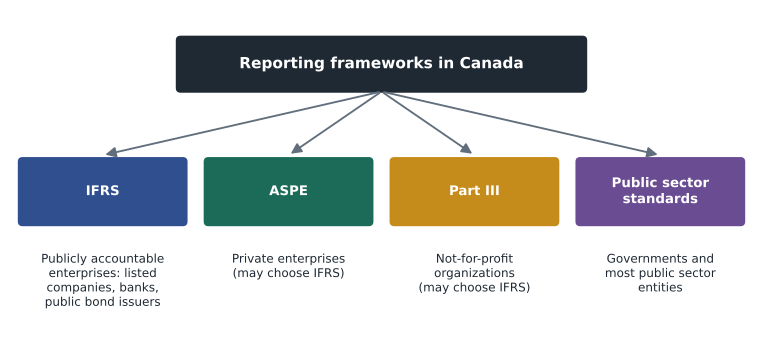
Northfield Components is private and uses ASPE. Prairie Ridge Energy has shares listed on the Toronto Stock Exchange and reports under IFRS. Fairway Grocers is owned by a pension fund and a family holding company; it chose IFRS because its bonds are held by public investors. Lakeview Health follows the not-for-profit standards in Part III. Kestrel Analytics, a venture-funded start-up, uses ASPE for now but is preparing IFRS comparatives in case of a future listing or sale to a public company.
ASPE and IFRS compared
ASPE is shorter and less demanding than IFRS. Under ASPE, a company may choose to account for income taxes using the simpler taxes payable method rather than recording deferred taxes; leases are classified as capital or operating under rules similar to the pre-2019 standard, so many leases stay off the balance sheet; there is no requirement to report earnings per share or segments; financial instruments are mostly carried at cost; and goodwill is tested for impairment only when events suggest it may be impaired. The section on revenue under ASPE was updated in recent years, but it remains less detailed than IFRS 15.
For a manager, the practical effect is that ASPE statements can look stronger or weaker than IFRS statements of a similar company for reasons that have nothing to do with performance. A retailer under ASPE may show far fewer liabilities than one under IFRS because store leases stay off the balance sheet. When Fairway compared itself with a competitor that uses ASPE, Grace's team had to add back estimated lease obligations before the debt ratios meant anything.
Continuous disclosure for Canadian public companies
Canadian securities regulation is provincial, coordinated through the Canadian Securities Administrators (CSA), and filings are made on SEDAR+. Under National Instrument 51-102, a reporting issuer files annual audited financial statements and management's discussion and analysis (MD&A) within 90 days of year-end, or 120 days for venture issuers, and interim statements and MD&A within 45 days of each quarter-end (60 days for venture issuers). It also files an annual information form if it is not a venture issuer, a management information circular before shareholder meetings, and material change reports when significant events occur. Executive certifications under National Instrument 52-109 accompany the annual and interim filings.
| Document | What managers should read it for |
|---|---|
| Audited annual statements and notes | Performance, financial position, accounting policies, segments, commitments |
| MD&A | Management's explanation of results, liquidity, capital resources, risks and non-GAAP measures |
| Annual information form | Business description, risk factors, capital structure, major contracts |
| Management information circular | Executive pay, board composition, governance |
| Material change reports and press releases | Significant events between reports |
Experienced readers rarely start with the income statement. They start with the MD&A, which explains what management thinks drove results and how it plans to fund the business, then read the notes on revenue, segments, debt and commitments, and only then study the statements themselves. The auditor's report is also worth reading: since the late 2010s, audit reports for listed companies have included key or critical audit matters, describing the areas the auditor found most difficult or judgemental, which point directly to where the risks of misstatement lie.
IFRS and US GAAP: the main differences
IFRS and US GAAP have converged substantially since the early 2000s, with near-identical standards on revenue and similar ones on leases and business combinations, but differences remain. Some matter mainly to specialists; a few make a large difference to reported numbers.
| Topic | IFRS | US GAAP |
|---|---|---|
| Inventory cost flow | FIFO or weighted average; LIFO prohibited | FIFO, weighted average or LIFO permitted |
| Inventory write-downs | Reversed if value recovers | Not reversed |
| Development costs | Capitalized when strict criteria are met | Generally expensed (software has special rules) |
| Property, plant and equipment | Cost or revaluation model | Cost only |
| Impairment reversals | Allowed for most assets except goodwill | Not allowed for assets held for use |
| Lessee leases | Single model: depreciation and interest | Finance and operating leases; operating lease cost straight-line |
| Income statement subtotals | IFRS 18 requires operating profit from 2027 | Few required subtotals; disaggregation notes from ASU 2024-03 |
| Interest in cash flows | Choice, narrowed by IFRS 18 | Operating |
LIFO, last in, first out, is the most visible difference. A US company using LIFO in a period of rising prices charges the latest, higher costs to cost of goods sold, lowering profit and taxes and leaving older, lower costs in inventory. US companies using LIFO must disclose a LIFO reserve, the difference between LIFO and FIFO inventory, which allows analysts to restate to FIFO for comparison.
# Restating a LIFO company to FIFO for comparison (millions of dollars)
lifo_inventory = 410.0
lifo_reserve_start, lifo_reserve_end = 95.0, 118.0
cogs_lifo = 2860.0
tax_rate = 0.25
fifo_inventory = lifo_inventory + lifo_reserve_end
cogs_fifo = cogs_lifo - (lifo_reserve_end - lifo_reserve_start)
extra_pretax = cogs_lifo - cogs_fifo
print("Inventory restated to FIFO:", fifo_inventory)
print("Cost of goods sold restated to FIFO:", cogs_fifo)
print("Pre-tax profit would be higher by", extra_pretax, "and after tax by", round(extra_pretax * (1 - tax_rate), 2))Inventory restated to FIFO: 528.0 Cost of goods sold restated to FIFO: 2837.0 Pre-tax profit would be higher by 23.0 and after tax by 17.25
An increase in the LIFO reserve of 23 million dollars means FIFO cost of goods sold would have been 23 million lower. Restating to FIFO makes the company comparable with a competitor reporting under IFRS, which cannot use LIFO.
Standards keep changing
Standard setters revise rules continually, and managers should know what is coming because changes can shift reported numbers, loan covenants and bonus targets. Recent and upcoming changes include IFRS 18, which reshapes the income statement from 2027; IFRS 19, which lets subsidiaries without public accountability use reduced disclosures; the FASB's expanded income tax disclosures under ASU 2023-09, which public business entities apply for annual periods beginning after 15 December 2024; and expense disaggregation under ASU 2024-03, which applies to annual periods beginning after 15 December 2026. Sustainability reporting is also developing quickly, through the International Sustainability Standards Board and national adaptations, a subject MBA-612 covers in depth.
Owen raised a practical question: when a standard changes the reported numbers, do loan covenants change too? Usually not automatically. Many loan agreements freeze the accounting rules at the date of signing or require the parties to negotiate in good faith, which is why finance teams review their covenants whenever a major standard is issued.
Non-GAAP and non-IFRS measures
Canadian issuers that use non-GAAP measures such as adjusted EBITDA, free cash flow or same-store sales in their MD&A and press releases must follow National Instrument 52-112, which requires them to present the most directly comparable measure from the financial statements with no less prominence, explain why the measure is useful, and reconcile it. IFRS 18 will go further for management-defined performance measures that relate to income and expenses, requiring them to be disclosed and reconciled in a single note of the audited statements.
The auditor and the audit report
Financial statements are prepared by management, not by the auditor. The auditor's job is to obtain reasonable assurance that the statements are free of material misstatement and to express an opinion. In Canada, audits follow the Canadian Auditing Standards, which are based on the international standards, and the Canadian Public Accountability Board oversees the firms that audit reporting issuers. For private companies, owners and lenders choose the level of assurance they need: a full audit, a review engagement, which gives limited assurance based mainly on inquiry and analysis, or a compilation, which gives no assurance at all.
An unmodified opinion says that the statements present fairly, in all material respects, the financial position and performance of the company in accordance with the applicable framework. A qualified opinion means there is a material problem confined to a specific area. An adverse opinion means the statements as a whole are misleading, and a disclaimer means the auditor could not obtain enough evidence to form an opinion. Managers should read beyond the opinion paragraph. A paragraph on material uncertainty related to going concern is a serious warning that the company may not be able to meet its obligations over the next year.
For listed entities, the report also describes key audit matters: the areas the auditor judged most significant, such as revenue recognition on long contracts, impairment of goodwill or the valuation of complex financial instruments. These paragraphs are a useful guide to where the judgement in the statements is concentrated, and therefore where an analyst should look first.
Leo Brandt learned the practical side of this when Kestrel Analytics raised its first venture round. The lead investor had accepted reviewed statements at the seed stage but required audited statements for the larger round, and the first audit found that several multi-year contracts had been recognized too quickly. The restatement was small, but it delayed the closing by a month and taught the founders that revenue policies chosen casually in the early days are expensive to unwind later.
Worked problem
Comparing two competitors
Owen is comparing Prairie Ridge (IFRS) with a US competitor that reports under US GAAP and uses LIFO for its inventory of natural gas liquids. What adjustments should he consider before comparing margins and returns?
Show solution
- Restate the LIFO company's inventory and cost of goods sold to FIFO using the LIFO reserve.
- Check lease accounting: operating lease cost under US GAAP sits above EBITDA, while under IFRS it is split into depreciation and interest, so EBITDA is not comparable without adjustment.
- Check whether the IFRS company uses the revaluation model or has reversed impairments, which can raise asset values.
- Check where interest paid is classified in the cash flow statement before comparing operating cash flow.
- Read each company's non-GAAP reconciliations to see what is excluded from adjusted earnings.
Answer: Comparisons across frameworks need a short list of standard adjustments: inventory method, leases, revaluations and impairments, cash flow classification and non-GAAP definitions.
Common mistakes
MistakeAll Canadian companies must use IFRS.
InsteadOnly publicly accountable enterprises must; private companies may use ASPE and not-for-profits have their own standards.
MistakeUS private companies follow completely different rules from public companies.
InsteadThey follow US GAAP, with some optional simplifications approved by the Private Company Council.
MistakeIFRS and US GAAP are now identical.
InsteadThey are close on revenue and business combinations but differ on LIFO, development costs, revaluation, impairment reversals and lease presentation.
MistakeThe MD&A is marketing material and can be skipped.
InsteadIt contains management's explanation of results, liquidity and critical estimates, and is subject to securities law.
MistakeA new accounting standard automatically changes loan covenants.
InsteadMany agreements freeze the rules at signing; finance teams must review the terms.
Summary and key terms
- Canadian publicly accountable enterprises use IFRS; private enterprises may use ASPE; not-for-profits use Part III.
- Public companies file annual and interim statements, MD&A and other documents on SEDAR+ under NI 51-102.
- Experienced readers start with management's discussion, then read the notes and the auditor's key or critical audit matters.
- IFRS and US GAAP differ on LIFO, development costs, revaluation, impairment reversals and lease presentation.
- A LIFO reserve allows restatement to FIFO for comparison.
- Standards keep changing, including IFRS 18 from 2027 and new US disclosure requirements on taxes and expenses.
- Non-GAAP measures must be reconciled to the nearest statement measure and examined critically.
- IFRS
- International Financial Reporting Standards, issued by the IASB.
- US GAAP
- Generally accepted accounting principles in the United States, codified by the FASB.
- ASPE
- Accounting Standards for Private Enterprises, Part II of the CPA Canada Handbook.
- MD&A
- Management's discussion and analysis of results, financial condition and risks.
- Form 10-K
- The annual report US public companies file with the SEC.
- SEDAR+
- The Canadian system for filing and viewing public company documents.
- LIFO reserve
- The difference between inventory at FIFO and at LIFO.
- Key audit matter
- An area the auditor judged most significant in the audit, described in the auditor's report.
- Non-GAAP measure
- A financial measure not defined by the accounting framework, such as adjusted EBITDA.
- IFRS 18
- The standard on presentation and disclosure that replaces IAS 1 from 2027.
Practice problems
Work each problem on paper first, then reveal the answer to check.
A private Canadian manufacturer wants simpler reporting. Which framework will it probably use?
Show answer
ASPE, unless it plans to list or a parent requires IFRS.
A US company's LIFO reserve rose from 40 to 52 million. How much lower would FIFO cost of goods sold be?
Show answer
12 million dollars.
Name two items that IFRS permits and US GAAP does not.
Show answer
Revaluation of property, plant and equipment; reversal of inventory and most asset impairments; capitalized development costs.
Where in a public filing would you find management's explanation of liquidity?
Show answer
In the MD&A.
Why might EBITDA differ between an IFRS and a US GAAP retailer with identical leases?
Show answer
IFRS puts lease costs in depreciation and interest, below EBITDA; US GAAP operating lease cost is an operating expense above EBITDA.
Portfolio task: find the key or critical audit matters in a public company's latest audit report and explain why each was judged difficult.
Show answer
Answers vary.
Lesson quiz · 5 questions
Score 60% or more to complete this lesson.
Create a free account to save your progress, take quizzes and earn a certificate.