
MBA-501 · Lesson 3 of 12 · 21 min
The income statement, revenue recognition and earnings quality
The income statement reports performance over a period: the revenue earned, the expenses incurred to earn it, and the profit or loss that remains. It is the statement investors watch most closely, the one bonuses are tied to and the one that moves share prices on results day. Because so much depends on it, it is also the statement most exposed to optimistic judgement. This lesson explains how the income statement is built, how revenue is recognized, how to read the main subtotals, and how to judge whether reported earnings are of high quality.
Building the income statement
A typical income statement starts with revenue, deducts the cost of goods sold to give gross profit, deducts operating expenses such as selling, general and administrative costs and research and development to give operating profit, then adds or deducts finance income and costs, and finally deducts income tax to reach net income. Companies may present expenses by function (cost of sales, selling, administration) or, under IFRS, by nature (materials, employee costs, depreciation). Each presentation answers different questions: by function shows where the money goes in the business; by nature shows what it is spent on.
IFRS 18, Presentation and Disclosure in Financial Statements, replaces IAS 1 for annual periods beginning on or after 1 January 2027, with comparative figures restated. It requires income and expenses to be classified into operating, investing and financing categories, adds two required subtotals, operating profit and profit before financing and income taxes, and requires companies to explain and reconcile any management-defined performance measures they use in public communications, such as adjusted operating profit. For Canadian public companies reporting under IFRS, this will make income statements more comparable and will bring some non-GAAP measures inside the audited notes.
| Line | Northfield (manufacturer) | Kestrel (software) | Fairway (grocer) |
|---|---|---|---|
| Revenue | 100.0 % | 100.0 % | 100.0 % |
| Cost of goods sold | 81.0 % | 24.0 % | 73.5 % |
| Gross margin | 19.0 % | 76.0 % | 26.5 % |
| Selling, general and administration | 12.0 % | 58.0 % | 21.0 % |
| Research and development | 1.5 % | 31.0 % | 0.0 % |
| Operating margin | 5.5 % | -13.0 % | 5.5 % |
Revenue recognition: the five steps
Revenue from customers is governed by IFRS 15, which is converged in substance with the US standard, ASC 606. Both use a five-step model: identify the contract with a customer; identify the separate performance obligations, meaning the distinct goods or services promised; determine the transaction price, including estimates of variable amounts such as rebates and penalties; allocate the price to each performance obligation in proportion to its stand-alone selling price; and recognize revenue when, or as, each obligation is satisfied by transferring control to the customer.
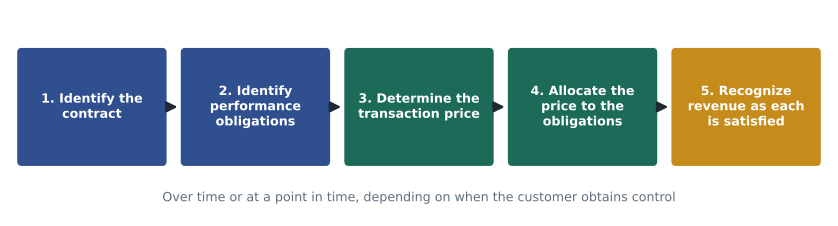
The model forces careful thinking about what the customer is actually buying. When Kestrel sells a three-year subscription with an implementation service and training, it must decide whether these are separate obligations. If implementation is a distinct service the customer could buy from others, part of the price is recognized as implementation revenue when that work is done, and the rest over the subscription term. If implementation is so customized that the software cannot be used without it, it may be combined with the subscription.
Revenue is recognized over time when the customer receives the benefit as the work is performed, when the work creates an asset the customer controls, or when the asset has no alternative use and the seller has a right to payment for work done to date. Otherwise it is recognized at a point in time, usually delivery. Northfield's stamping contracts are normally recognized when parts ship. A specialized tooling contract for a single customer, with no alternative use and a right to payment as work progresses, may be recognized over time based on costs incurred.
# Allocating a bundled price to performance obligations (thousands of dollars)
contract_price = 900                     # 3-year subscription plus implementation plus training
standalone = {"subscription (3 years)": 780, "implementation": 150, "training": 70}
total_ssp = sum(standalone.values())
for item, ssp in standalone.items():
    share = contract_price * ssp / total_ssp
    print(f"{item:<24} stand-alone {ssp:>4}   allocated {share:7.1f}")
sub = contract_price * standalone["subscription (3 years)"] / total_ssp
print("Subscription revenue per year:", round(sub / 3, 1))subscription (3 years) stand-alone 780 allocated 702.0 implementation stand-alone 150 allocated 135.0 training stand-alone 70 allocated 63.0 Subscription revenue per year: 234.0
The customer received a discount of 100 thousand dollars from the total stand-alone prices of 1,000 thousand. The standard spreads that discount across all three items in proportion to their stand-alone prices, unless there is evidence that it relates to one item only. The result determines how much revenue Kestrel reports this year and how much in later years.
Gross margin, operating profit and EBITDA
Gross margin shows how much each sale contributes before overhead. It depends on pricing power, input costs and the product mix. Operating profit, sometimes called EBIT (earnings before interest and taxes), shows what the business earns from its operations before financing choices. EBITDA adds back depreciation and amortization, giving a rough measure of operating cash generation that is popular in lending agreements and valuations. Dr. Achterberg is wary of EBITDA because it treats the cost of replacing worn-out equipment as if it did not exist. For Prairie Ridge, with billions of dollars of long-lived plant, depreciation is a real economic cost; for Kestrel it is small.
Below operating profit come finance costs, the share of results from associates and joint ventures, and income tax. Some companies also report discontinued operations separately, net of tax. Basic earnings per share divides net income attributable to ordinary shareholders by the weighted average number of shares outstanding; diluted earnings per share adds the potential shares from options, convertible debt and similar instruments.
Non-recurring items and adjusted earnings
Most companies report items they describe as unusual: restructuring costs, impairment charges, gains or losses on selling businesses, acquisition costs and litigation settlements. Investors often adjust them out to see underlying, or normalized, earnings. That is reasonable when the items are genuinely rare. It is misleading when a company has restructuring charges every year, or when it adjusts out the costs but keeps the gains. A useful habit is to list the adjustments a company has made over five years and ask whether the same categories keep coming back.
Stock-based compensation is a frequent adjustment, especially at technology companies. Kestrel's investors see adjusted EBITDA excluding share-based pay. Leo Brandt argued in class that it is a non-cash cost; Owen Tremblay replied that issuing shares to employees dilutes existing owners as surely as paying them cash. The class agreed that excluding it can be useful for comparing cash flows, but not for judging profitability.
Earnings quality
High-quality earnings are persistent (likely to recur), backed by cash, and based on conservative, consistently applied estimates. Low-quality earnings depend on one-time gains, aggressive estimates or a growing gap between profit and cash. No single measure captures quality, but several screens help. The accruals ratio compares net income with cash from operations: if profit consistently exceeds operating cash flow, accruals are building up on the balance sheet as receivables, inventory or capitalized costs, and future earnings may disappoint. Comparing the growth of receivables and inventory with the growth of sales is another early warning.
| Red flag | Why it matters | Where to look |
|---|---|---|
| Net income persistently above cash from operations | Profit is not turning into cash | Cash flow statement |
| Receivables growing faster than sales | Possible looser credit, extended terms or premature revenue | Balance sheet, revenue note |
| Inventory growing faster than cost of sales | Possible obsolete stock or overproduction | Balance sheet, inventory note |
| Falling allowance for credit losses as a share of receivables | Possible under-reserving | Receivables note |
| Longer useful lives or more capitalized costs | Lower expenses today, higher later | Accounting policy notes |
| Recurring "one-time" charges | Underlying costs presented as unusual | Several years of results |
# Earnings-quality screen: accruals ratio and growth gaps (millions of dollars)
years = ["2024", "2025", "2026"]
net_income = [14.0, 16.2, 19.5]
cfo = [15.1, 13.4, 11.0]            # cash from operations
avg_assets = [180.0, 196.0, 214.0]
sales = [240.0, 262.0, 288.0]
receivables = [38.0, 46.0, 58.0]
for i, y in enumerate(years):
    accruals = (net_income[i] - cfo[i]) / avg_assets[i]
    line = f"{y}: accruals ratio {accruals:6.1%}"
    if i:
        g_sales = sales[i] / sales[i - 1] - 1
        g_rec = receivables[i] / receivables[i - 1] - 1
        line += f"   sales growth {g_sales:5.1%}  receivables growth {g_rec:5.1%}"
        if g_rec > g_sales + 0.10:
            line += "  <- check"
print(line)2024: accruals ratio -0.6% 2025: accruals ratio 1.4% sales growth 9.2% receivables growth 21.1% <- check 2026: accruals ratio 4.0% sales growth 9.9% receivables growth 26.1% <- check
In this example, profit rises every year while operating cash flow falls, so the accruals ratio climbs from negative to almost 4 % of assets, and receivables grow two or three times as fast as sales. None of this proves anything improper. The company might have extended terms to win a big customer. But it is exactly the pattern an analyst or lender would ask management to explain.
Comprehensive income
Some gains and losses go not to profit but to other comprehensive income (OCI), which is reported in a separate statement or a section below net income. Examples include certain currency translation differences on foreign subsidiaries, remeasurements of defined benefit pension plans, and some changes in the fair value of investments and hedges. Total comprehensive income is net income plus OCI. Managers should know that OCI exists because large unrealized losses can sit there, reducing equity without ever touching the earnings everyone watches.
Reading the income statement as a manager
Dr. Achterberg asks the cohort to read an income statement in a fixed order. Start with revenue growth and ask where it came from: volume, price, mix, acquisitions or currency. Then look at gross margin, because a falling gross margin usually means either pricing pressure or rising input costs, and the notes or the management discussion should say which. Next, compare the growth of operating expenses with the growth of revenue; expenses that grow faster than sales erode operating leverage, while expenses that grow more slowly are a sign of scale economies. Only then move below operating profit to interest, tax and any unusual items.
Grace Mwangi applied this sequence to Fairway Grocers. Revenue grew 4 %, but nearly all of the growth came from three new stores; same-store sales were flat. Gross margin slipped by half a point because of promotional pricing, and store labour grew faster than sales. The headline profit was steady only because a property sale produced a one-time gain. Read in order, the statement told a very different story from the press release, which led with record revenue.
Worked problem
Is this revenue?
Late in the year, Northfield ships a large order of brackets to a customer's warehouse under an arrangement that lets the customer return any unused parts for full credit for the next six months. The sales team wants the full amount counted as revenue this year. What should Daniel consider?
Show solution
- Control may have transferred at shipment, but the right of return creates variable consideration.
- Northfield should estimate the expected returns and recognize revenue only for the amount it is highly probable will not reverse, recording a refund liability for the rest.
- If the parts are really held on consignment, with the customer paying only when it uses them, control has not transferred and no revenue should be recognized yet.
- Year-end shipments with unusual terms are a classic channel-stuffing pattern; auditors will examine them closely.
Answer: Revenue should reflect the amount Northfield expects to keep. Shipping goods with generous return rights to hit a target pulls revenue forward and lowers earnings quality.
Common mistakes
MistakeRevenue is recognized when the customer pays.
InsteadRevenue is recognized when control of goods or services passes to the customer, which may be before or after payment.
MistakeEBITDA is the same as cash flow.
InsteadEBITDA ignores working capital, capital spending, interest and taxes.
MistakeAdjusted earnings are always more accurate than reported earnings.
InsteadAdjustments can remove recurring costs; examine what is excluded and why.
MistakeHigher net income means higher earnings quality.
InsteadQuality depends on persistence and cash backing, not on the level of profit.
MistakeA discount in a bundled sale belongs to whichever item has the highest margin.
InsteadDiscounts are allocated across obligations in proportion to stand-alone prices unless evidence shows otherwise.
Summary and key terms
- The income statement reports revenue, expenses and profit for a period, with subtotals such as gross and operating profit.
- Revenue follows a five-step model: contract, obligations, price, allocation and recognition as control transfers.
- Revenue is recognized over time or at a point in time depending on how the customer receives the benefit.
- EBITDA is a rough operating measure that ignores the cost of replacing assets.
- Adjusted and non-GAAP measures can be useful but must be reconciled and examined for recurring items.
- Earnings quality depends on persistence, cash backing and conservative estimates; accrual and growth screens help detect problems.
- Other comprehensive income captures some gains and losses that bypass net income.
- Gross profit
- Revenue minus cost of goods sold.
- Operating profit
- Profit from operations before finance costs and income tax.
- EBITDA
- Earnings before interest, taxes, depreciation and amortization.
- Performance obligation
- A promise to transfer a distinct good or service to a customer.
- Transaction price
- The consideration a seller expects to receive, including estimates of variable amounts.
- Stand-alone selling price
- The price at which a good or service would be sold separately.
- Variable consideration
- Price elements that depend on future events, such as rebates, returns or bonuses.
- Earnings quality
- The extent to which reported earnings are persistent and backed by cash.
- Accruals ratio
- Net income minus operating cash flow, divided by average assets.
- Other comprehensive income
- Gains and losses recognized in equity rather than profit.
Practice problems
Work each problem on paper first, then reveal the answer to check.
Revenue 50, cost of goods sold 32, operating expenses 11 (millions). What are gross margin and operating margin?
Show answer
Gross margin 36 %; operating margin 14 %.
A 120 thousand dollar contract includes products with stand-alone prices of 90 and 60. How is the price allocated?
Show answer
72 and 48 thousand dollars.
Net income 12, operating cash flow 7, average assets 125 (millions). What is the accruals ratio?
Show answer
(12 − 7) / 125 = 4 %.
Name two items commonly excluded from adjusted earnings and one risk of excluding them.
Show answer
Restructuring and stock-based pay; they may recur and represent real costs.
When is revenue recognized over time?
Show answer
When the customer benefits as work is performed, controls the asset as it is created, or the asset has no alternative use and the seller has a right to payment for work to date.
Portfolio task: list the adjustments a public company made to reach adjusted earnings over three years.
Show answer
Answers vary.
Lesson quiz · 5 questions
Score 60% or more to complete this lesson.
Create a free account to save your progress, take quizzes and earn a certificate.