
MBA-501 · Lesson 1 of 12 · 22 min
Accounting as the language of business
Every serious business conversation eventually turns into numbers. A plant manager asking for a new press, a hospital deciding whether to open a weekend clinic, a founder pitching investors and a retailer negotiating with a landlord all end up talking about revenue, cost, margin, cash and return. Accounting is the system that produces those numbers, and managers who cannot read it are at the mercy of people who can. This course is the first in the MBA program at the Lakeshore School of Business in Toronto. It is not a bookkeeping course: you will not post journal entries for their own sake. Instead you will learn to read financial statements critically, to use cost information to make decisions, and to ask the questions that reveal what the numbers hide.
The cohort and the cases
The weekend executive MBA cohort meets on alternate Fridays and Saturdays. Its accounting professor, Dr. Miriam Achterberg, spent twelve years as an auditor and then as chief financial officer of a mid-sized manufacturer before she started teaching. She opens the course with a warning she repeats often: "Accounting numbers are not facts about the world. They are the result of rules and judgements applied to facts. Your job is to understand the rules well enough to see the judgements."
Five members of the cohort will appear throughout this course and the rest of the MBA, each bringing a company from their own working life. Daniel Osei is plant controller at Northfield Components, a manufacturer of metal stampings and welded assemblies for vehicle and equipment makers. Hana Kowalski is director of operations at Lakeview Health, a not-for-profit network of clinics and a community hospital. Leo Brandt is co-founder and chief financial officer of Kestrel Analytics, a young software company that sells inventory-forecasting tools by subscription. Grace Mwangi is a category manager at Fairway Grocers, a regional supermarket chain. Owen Tremblay is a finance manager at Prairie Ridge Energy, which runs natural gas processing plants and a growing portfolio of wind and solar farms. The companies are invented, but their problems are typical of real firms in their industries.
The five businesses are useful because they look so different in the statements. Northfield owns heavy equipment and carries inventory. Lakeview has no shareholders and measures success partly by patients served. Kestrel spends heavily on staff and software development before revenue arrives. Fairway turns its inventory over quickly on thin margins. Prairie Ridge has huge long-lived assets and earnings that move with commodity prices. By the end of the course you should be able to look at a set of statements and guess which kind of business produced them.
Financial and managerial accounting
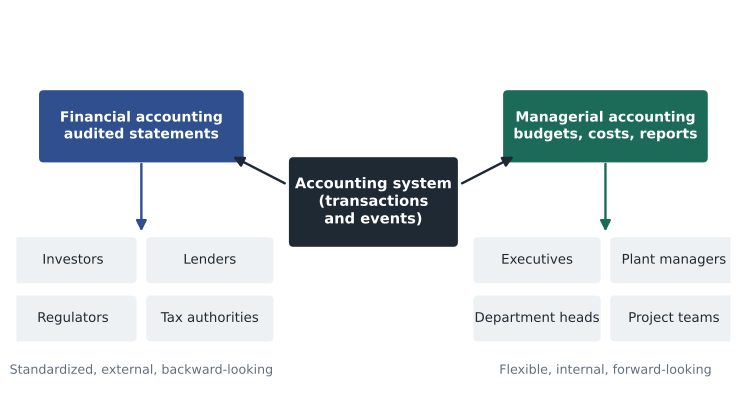
Accounting has two branches that share data but serve different users. Financial accounting produces general-purpose reports for people outside the organization: shareholders, lenders, suppliers, regulators, tax authorities and the public. Because outsiders cannot ask for whatever data they want, financial reports follow standards that make them comparable and auditable. Managerial accounting produces information for people inside the organization, such as cost per unit, budgets, variance reports, profitability by customer and the cost of a new product. It follows no external rules; it is judged by whether it helps managers decide well.
| Feature | Financial accounting | Managerial accounting |
|---|---|---|
| Main users | Investors, lenders, regulators, the public | Managers and employees |
| Rules | Accounting standards and securities law | Whatever is useful; internal policy |
| Time focus | Past periods, reported on a fixed schedule | Past, present and forecasts, as often as needed |
| Level of detail | Whole company, with segments | Products, customers, plants, projects, shifts |
| Assurance | Usually audited or reviewed | Not audited; tested by usefulness |
| Typical outputs | Balance sheet, income statement, cash flows, notes | Budgets, costing, variances, dashboards |
The branches overlap more than the table suggests. Lenders often ask for managerial information, such as monthly cash forecasts, and managers care intensely about the reported earnings on which their bonuses and share prices depend. The first half of this course concentrates on financial statements; the second half turns to cost behaviour, costing, budgets and decisions.
The accounting equation
All financial accounting rests on one identity. What a business controls, its assets, must have been financed by someone: either creditors, whose claims are liabilities, or owners, whose residual claim is equity.
Every transaction keeps the equation in balance. When Kestrel raises 2 million dollars from investors, cash (an asset) and share capital (equity) both rise. When Northfield borrows to buy a press, equipment rises and so does debt. When Fairway sells groceries for more than they cost, the profit increases equity through retained earnings. Double-entry bookkeeping, invented by Italian merchants and described by Luca Pacioli in 1494, is simply a disciplined way of recording both sides of every change.
For managers the equation has a practical message: profit is a change in equity, not a pile of cash. A business can report profits while its cash shrinks, because the profit is tied up in receivables, inventory or equipment. Equally, a business can have plenty of cash because it has borrowed, even while it loses money. Lesson 4 returns to this distinction, which is the source of more business failures than almost any other misunderstanding.
Accrual accounting
Financial statements are prepared on the accrual basis. Revenue is recognized when the business has done what it promised for the customer, not when cash arrives; expenses are recognized when they help earn revenue or are used up, not when they are paid. Accrual accounting gives a better picture of performance over a period than a cash count, because it matches effort with accomplishment. A software firm that collects a full year of subscription fees in January has not earned a year of revenue in January; it has an obligation to provide eleven more months of service.
Accruals require judgement. How much of the receivables will customers actually pay? How long will a machine last? How much will warranty claims cost? What is unsold inventory worth if prices fall? Each estimate moves profit from one period to another. Most estimates are made honestly, but the room they leave is the reason analysts look beyond reported earnings to cash flow and to the notes. Lesson 3 examines earnings quality in detail.
# Cash basis versus accrual basis for one quarter at Kestrel Analytics (thousands of dollars)
annual_contracts = [120, 240, 60]       # three customers sign and pay a year in advance this quarter
months_served = [3, 2, 1]               # months of service delivered by quarter end
cash_received = sum(annual_contracts)
revenue_earned = sum(c * m / 12 for c, m in zip(annual_contracts, months_served))
deferred = cash_received - revenue_earned
print("Cash received from customers:", cash_received)
print("Revenue earned (accrual):    ", round(revenue_earned, 1))
print("Unearned revenue liability: ", round(deferred, 1))Cash received from customers: 420 Revenue earned (accrual): 75.0 Unearned revenue liability: 345.0
Kestrel collects 420 thousand dollars but has earned only 75 thousand. The other 345 thousand is a liability, unearned or deferred revenue, because Kestrel owes the customers service. Leo Brandt found this frustrating at first: the bank balance looked healthy, but the income statement showed a loss. Dr. Achterberg pointed out that both views are true and both matter. The cash keeps the company alive; the accrual view tells investors whether each contract will eventually be profitable.
Who sets the rules
In Canada, accounting standards are part of the CPA Canada Handbook, overseen by the Accounting Standards Board. Publicly accountable enterprises, such as listed companies and banks, must use International Financial Reporting Standards (IFRS), issued by the International Accounting Standards Board in London. Private companies may instead use Accounting Standards for Private Enterprises (ASPE), a simpler made-in-Canada framework, and not-for-profit organizations such as Lakeview Health have their own Part III standards or may choose IFRS. Securities regulators coordinated by the Canadian Securities Administrators set the filing rules for public companies. Lesson 5 compares these frameworks.
Whatever the framework, the qualities the standard setters aim for are similar. Information should be relevant, meaning it can make a difference to decisions, and it should faithfully represent what it claims to show: complete, neutral and free from material error. Comparability, verifiability, timeliness and understandability enhance those qualities. Cost is a constraint, because producing information is not free. Managers who understand these goals find the detailed rules easier to follow, because most rules are attempts to balance relevance against reliability.
Auditors, controls and trust
Financial statements are prepared by management, not by auditors. The external auditor, an independent public accounting firm, examines the statements and the evidence behind them and gives an opinion on whether they are presented fairly in all material respects. An unmodified, or clean, opinion is the normal result; a qualified opinion, an adverse opinion or a disclaimer is a serious warning. Audits are designed to give reasonable, not absolute, assurance, and they test samples rather than every transaction.
Large public companies must also maintain internal control over financial reporting, the processes that make errors and fraud less likely, such as segregation of duties, approvals and reconciliations. In Canada, chief executives and chief financial officers of listed issuers certify their annual and interim filings and the design of these controls under National Instrument 52-109. Daniel Osei's monthly close at Northfield, with its bank reconciliations and inventory counts, is part of that control system, even though the company is private.
Trust in financial reporting has been shaken repeatedly, by frauds such as Enron and WorldCom in the early 2000s and by later cases in which revenue was invented or costs hidden. The lesson for managers is not cynicism but healthy scepticism: know what drives the numbers, look for consistency between profit and cash, and ask why when something looks too good.
How managers use accounting information
Managers use accounting in three broad ways. They use it to keep score, comparing results with plans and with competitors. They use it to direct attention, flagging problems such as rising scrap or slowing collections. And they use it to solve problems, estimating the effect of choices such as dropping a product, adding a shift or changing a price. Each use needs a different kind of number. Keeping score needs consistent definitions over time; directing attention needs timely exceptions; problem solving needs the costs and revenues that differ between the options, which may not appear in any standard report.
Hana Kowalski described the gap at Lakeview. The finance department produced detailed monthly statements, but clinic managers found them hard to use because costs were grouped by account rather than by service, and the reports arrived three weeks after month end. What managers wanted was the cost of a patient visit by clinic, available within days. Managerial accounting is the art of producing that kind of information without drowning people in detail.
Worked problem
Choosing the right number
Grace Mwangi's category team at Fairway is deciding whether to keep a slow-selling line of imported specialty cheeses. Which kinds of accounting information should she gather, and which reports would mislead her?
Show solution
- The financial statements show total company gross margin; they are too aggregated to answer the question.
- She needs the line's revenue, the cost of the cheese sold, spoilage, and any costs that would disappear if the line were dropped, such as a dedicated supplier fee.
- Shared store costs allocated to the line, such as rent and head-office salaries, will not change if the line is dropped, so including them would make the line look worse than it is.
- She should also consider effects outside the line: customers who come for the cheese may buy other items, and the shelf space could be used for something more profitable.
Answer: The relevant information is the change in revenue and cost caused by the decision, including effects on other products, not the line's share of total company costs. Lesson 11 develops this method.
Common mistakes
MistakeProfit means the business has more cash.
InsteadProfit is an increase in equity measured on the accrual basis; cash can move in the opposite direction.
MistakeAudited statements are guaranteed to be free of error.
InsteadAn audit gives reasonable assurance that statements are free of material misstatement, based on testing.
MistakeManagerial accounting must follow the same rules as financial reporting.
InsteadInternal reports can use whatever definitions help managers decide, as long as they are understood.
MistakeAccounting numbers are objective facts.
InsteadMany figures depend on estimates and policy choices; understanding those judgements is part of reading the numbers.
MistakeUnearned revenue is a sign of good profits.
InsteadIt is a liability: the business owes the customer goods or services already paid for.
Summary and key terms
- Accounting turns business activity into numbers that outsiders and managers use to make decisions.
- Financial accounting serves external users under standards; managerial accounting serves internal users and follows no external rules.
- Assets equal liabilities plus equity, and every transaction keeps the equation in balance.
- Accrual accounting recognizes revenue when it is earned and expenses when resources are used, which differs from cash timing.
- Canadian public companies use IFRS; private companies may use ASPE; not-for-profits have their own standards.
- Auditors give reasonable assurance; management is responsible for the statements and internal control.
- Managers use accounting to keep score, direct attention and solve problems, each needing different information.
- Financial accounting
- Reporting to external users under accounting standards.
- Managerial accounting
- Information prepared for decisions and control inside an organization.
- Accounting equation
- Assets equal liabilities plus equity.
- Accrual basis
- Recognizing revenue when earned and expenses when incurred, regardless of cash timing.
- Unearned revenue
- A liability for cash received before goods or services are delivered.
- Retained earnings
- Cumulative profits kept in the business rather than paid out as dividends.
- Audit opinion
- An independent accountant's conclusion on whether statements are fairly presented.
- Internal control
- Processes that give reasonable assurance of reliable reporting and safeguarding of assets.
- Materiality
- The size or nature of an item that could influence users' decisions.
- Faithful representation
- Information that is complete, neutral and free from material error.
Practice problems
Work each problem on paper first, then reveal the answer to check.
A company pays 60,000 dollars in December for twelve months of insurance starting 1 December. How much is an expense in December?
Show answer
5,000 dollars; the remaining 55,000 is a prepaid asset.
A firm borrows 1 million dollars. What happens to assets, liabilities and equity?
Show answer
Assets and liabilities both rise by 1 million; equity is unchanged.
Name two users of financial accounting and two of managerial accounting.
Show answer
For example, lenders and investors; plant managers and product managers.
Why might a profitable company run out of cash?
Show answer
Cash can be tied up in receivables, inventory and equipment, or used to repay debt, while profit is reported on the accrual basis.
What does a clean audit opinion tell you, and what does it not tell you?
Show answer
That the statements are fairly presented in all material respects; it does not say the business is healthy or that there is no fraud at all.
Portfolio task: list three numbers your own manager watches every month and say whether each is financial or managerial.
Show answer
Answers vary.
Lesson quiz · 5 questions
Score 60% or more to complete this lesson.
Create a free account to save your progress, take quizzes and earn a certificate.