
MBA-501 · Lesson 2 of 12 · 21 min
The balance sheet and what it tells managers
The balance sheet, called the statement of financial position under IFRS, is a snapshot of what a business controls and how it is financed at one moment, usually the last day of a reporting period. It is the oldest of the financial statements and, for many managers, the least read. That is a mistake. The balance sheet shows the resources a strategy depends on, the obligations that constrain it and the cushion that protects it when things go wrong. This lesson works through the main sections, explains how items are measured, and shows how to read a balance sheet the way a lender or an acquirer would.
Structure of the balance sheet
Assets are resources the entity controls as a result of past events that are expected to bring future economic benefits. Liabilities are present obligations to transfer resources as a result of past events. Equity is the residual: assets minus liabilities. Both assets and liabilities are split into current and non-current. Current assets are expected to be turned into cash, sold or used up within a year or the normal operating cycle; current liabilities are due within the same period. The split matters because it shows whether short-term obligations can be met from short-term resources.
| Section | Typical items | What it tells a manager |
|---|---|---|
| Current assets | Cash, receivables, inventory, prepaid expenses | Short-term resources and working capital needs |
| Non-current assets | Property, plant and equipment, right-of-use assets, intangible assets, goodwill, investments | The long-lived capacity the business runs on |
| Current liabilities | Payables, accrued wages, unearned revenue, current portion of debt and leases | Obligations due within a year |
| Non-current liabilities | Long-term debt, lease liabilities, pensions, deferred taxes, provisions | Long-term financing and commitments |
| Equity | Share capital, retained earnings, other reserves | The owners' cumulative investment and retained profits |
Under IFRS the order is not prescribed, and some European companies list non-current assets first and equity before liabilities. North American companies usually list current items first. Do not let the order distract you; the categories are the same.
Working capital
Working capital is current assets minus current liabilities. Operating working capital narrows the focus to the items generated by day-to-day business, mainly receivables plus inventory minus payables, and excludes cash and debt. Operating working capital is an investment the business must finance, just like a machine. Daniel Osei explained it at Northfield: every time the company wins a new contract, it buys steel weeks before shipping parts and waits up to two months to be paid. Growth therefore consumes cash even when each order is profitable. Lesson 4 measures this with the cash conversion cycle.
A large positive working capital balance is not always good. It may mean slow-moving inventory, customers who pay late, or cash that is earning little. Fairway Grocers actually runs with negative operating working capital: customers pay at the till, inventory turns over in weeks, and suppliers are paid in thirty to forty-five days. Suppliers effectively finance part of the store network. Grace Mwangi was surprised to learn that a grocer can grow partly on its suppliers' money, while a manufacturer like Northfield needs extra financing for every step up in sales.
Measuring assets: cost, fair value and impairment
Most operating assets are carried at historical cost less accumulated depreciation or amortization. A press that Northfield bought for 4 million dollars eight years ago appears at its cost minus eight years of depreciation, regardless of what a buyer would pay for it today. Historical cost is verifiable and resists manipulation, but it can be far from current value, especially for land bought decades ago or for assets made obsolete by new technology.
Some assets are measured at fair value, the price that would be received to sell an asset in an orderly transaction between market participants. Financial investments are the main example. IFRS also allows a revaluation model for property, plant and equipment and a fair value model for investment property, though most companies in Canada keep to cost. When the value of an asset falls below its carrying amount, an impairment test can force a write-down, and under IFRS an impairment of most assets other than goodwill can later be reversed if the value recovers.
Inventory is measured at the lower of cost and net realizable value (or market value under some US rules). Fairway's slow-selling seasonal goods must be written down if they can be sold only below cost. Receivables are reduced by an allowance for expected credit losses, management's estimate of the amount customers will not pay. Each of these measurements is a judgement that affects both the balance sheet and profit.
Intangible assets and goodwill
Many of the most valuable resources a business has never appear on its balance sheet. Kestrel Analytics' software, customer relationships and engineering team are its main assets, but because they were built internally, most of the cost was expensed as it was incurred. Accounting standards generally allow internally generated intangibles to be recorded only in narrow circumstances, such as development costs that meet strict criteria under IFRS or certain software development costs. By contrast, when one company buys another, it records the acquired brands, technology and customer lists at fair value, and any excess of the price over the fair value of identifiable net assets becomes goodwill.
Goodwill is not amortized by public companies under IFRS or US GAAP; instead it is tested for impairment at least annually. Large goodwill write-downs often signal that an acquirer overpaid. For managers comparing companies, the key point is that two businesses with the same economic assets can show very different balance sheets depending on whether they grew by building or by buying.
Liabilities, leases and provisions
Liabilities include more than loans. Accounts payable and accrued liabilities represent amounts owed to suppliers and employees. Unearned revenue, which Lesson 1 met at Kestrel, is an obligation to deliver. Provisions are liabilities of uncertain timing or amount, such as warranty obligations, restructuring costs, legal claims and environmental clean-up. Prairie Ridge Energy carries a large decommissioning provision for the cost of removing its gas plants and restoring the land at the end of their lives, discounted to present value and increased each year as the discount unwinds.
Since 2019, IFRS 16 has required lessees to put almost all leases on the balance sheet as a right-of-use asset and a lease liability, with exemptions for short-term and low-value leases. Fairway Grocers leases most of its stores, so the change added hundreds of millions of dollars to both its assets and its liabilities. Under IFRS 16 the lease cost appears as depreciation and interest, which raises EBITDA compared with the old treatment, a point to remember when comparing companies.
Some obligations stay off the balance sheet entirely. Purchase commitments, guarantees and contingent liabilities that are possible but not probable are disclosed in the notes rather than recognized. The notes are therefore part of the balance sheet in practice; reading only the face of the statement can miss commitments that matter.
Equity
Equity includes share capital contributed by owners, retained earnings accumulated from past profits less dividends, and other components such as accumulated other comprehensive income, which collects certain gains and losses that bypass profit, such as some currency translation effects. Share buybacks reduce equity; issuing shares to employees or investors increases it. A company with negative equity is not necessarily insolvent: some highly profitable firms have bought back so many shares that their book equity is below zero. Book equity measures the accounting residual, not what the business is worth.
For Lakeview Health, a not-for-profit, the equivalent of equity is net assets, sometimes split between amounts that donors have restricted to particular purposes and amounts the board may use freely. The analysis is similar: net assets show the cushion the organization has built up.
Common-size analysis
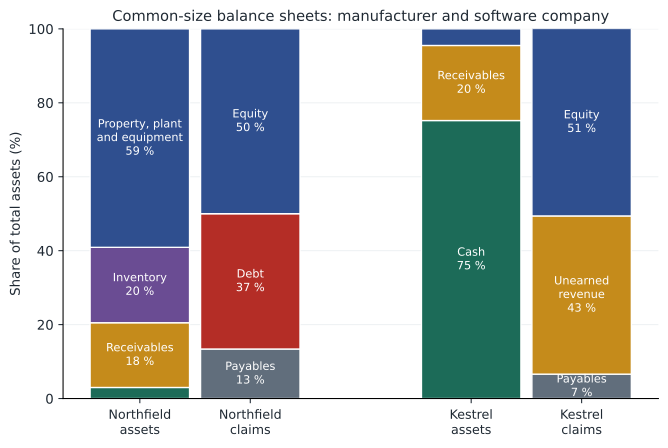
Comparing balance sheets of companies of different sizes is easier when each item is expressed as a percentage of total assets. This common-size view quickly shows what kind of business you are looking at. Daniel ran it for Northfield and Kestrel during the second weekend of the course.
# Common-size balance sheets (each item as a share of total assets); thousands of dollars
northfield = {"cash": 3200, "receivables": 18400, "inventory": 21500, "PP&E (net)": 62300,
              "payables": 14100, "unearned revenue": 0, "debt": 38600, "equity": 52700}
kestrel = {"cash": 21800, "receivables": 5900, "inventory": 0, "PP&E (net)": 1300,
           "payables": 1900, "unearned revenue": 12400, "debt": 0, "equity": 14700}
assets = ["cash", "receivables", "inventory", "PP&E (net)"]
claims = ["payables", "unearned revenue", "debt", "equity"]
for name, bs in (("Northfield", northfield), ("Kestrel", kestrel)):
    total = sum(bs[a] for a in assets)
    assert total == sum(bs[c] for c in claims), "balance sheet does not balance"
    print(name, "total assets", total)
    for k in assets + claims:
print(f" {k:<17}{100 * bs[k] / total:6.1f} %")Northfield total assets 105400 cash 3.0 % receivables 17.5 % inventory 20.4 % PP&E (net) 59.1 % payables 13.4 % unearned revenue 0.0 % debt 36.6 % equity 50.0 % Kestrel total assets 29000 cash 75.2 % receivables 20.3 % inventory 0.0 % PP&E (net) 4.5 % payables 6.6 % unearned revenue 42.8 % debt 0.0 % equity 50.7 %
Northfield's assets are 59 % plant and equipment and 20 % inventory, financed 37 % by debt. Kestrel's are 75 % cash, and its largest claim after equity is unearned revenue at 43 % of assets: customers have paid in advance for service. Neither is better; each fits its business. But each implies different risks. Northfield must keep its plant busy and its lenders comfortable; Kestrel must keep renewing subscriptions, because the cash in its bank account is largely an obligation to existing customers.
Reading a balance sheet like a lender
Lenders read balance sheets for evidence of repayment capacity and protection. They look at the amount and maturity of debt, the quality of collateral, the liquidity of current assets and the size of the equity cushion. They also adjust: they may add lease liabilities to debt, subtract cash to get net debt, and discount receivables from weak customers or inventory that is obsolete. Lesson 6 turns these into ratios such as the current ratio and debt to equity.
Acquirers read the balance sheet differently. They ask what assets they would really be buying, which liabilities are hidden or understated, and how much working capital the business needs to operate normally. A purchase price is usually agreed on a cash-free, debt-free basis with a normal level of working capital, so arguments about what normal means can be worth millions. Owen Tremblay saw this when Prairie Ridge bought a solar developer: the two sides spent weeks negotiating whether certain deposits counted as working capital.
Worked problem
Spotting a working capital problem
Northfield's sales grew 12 % last year, but its receivables grew 31 % and its inventory 22 %. Payables grew 4 %. What questions should Daniel ask before the next board meeting?
Show solution
- Receivables growing much faster than sales suggests customers are taking longer to pay, or that late-year sales were heavy. Check the ageing schedule and whether any large customer is in difficulty.
- Inventory growing faster than sales may mean slow-moving or obsolete parts, or deliberate stock-building ahead of a new contract. Check inventory by part and age.
- Payables growing slowly means the company is paying suppliers faster or buying less on credit. Check whether supplier terms have tightened.
- The combined effect is that working capital absorbed cash. Estimate how much, and whether the credit line can cover it if the trend continues.
Answer: Growth in receivables and inventory far ahead of sales, with payables lagging, is a classic warning sign that profit is not turning into cash.
Common mistakes
MistakeAssets on the balance sheet show what the company is worth.
InsteadMost operating assets are at historical cost less depreciation; many valuable intangibles are not recorded at all.
MistakeNegative equity always means a company is bankrupt.
InsteadIt can result from share buybacks or past losses; solvency depends on cash flows and debt service.
MistakeMore working capital is always safer.
InsteadExcess working capital can signal slow collections or obsolete stock, and it ties up cash.
MistakeLeases are just an expense, so they do not affect the balance sheet.
InsteadLessees now record right-of-use assets and lease liabilities for most leases.
MistakeThe notes are optional reading.
InsteadCommitments, contingencies, measurement policies and debt terms are often only in the notes.
Summary and key terms
- The balance sheet shows assets, liabilities and equity at a point in time.
- Current items are due or usable within a year; working capital measures short-term financing needs.
- Most operating assets are at historical cost less depreciation; some financial assets are at fair value.
- Internally developed intangibles are mostly expensed; acquired intangibles and goodwill are recorded in acquisitions.
- Liabilities include payables, unearned revenue, provisions, leases and debt; some commitments appear only in the notes.
- Common-size balance sheets reveal business models and make companies of different sizes comparable.
- Lenders and acquirers adjust the balance sheet for leases, cash, quality of assets and normal working capital.
- Statement of financial position
- The IFRS name for the balance sheet.
- Current asset
- An asset expected to be realized or used within a year or the operating cycle.
- Working capital
- Current assets minus current liabilities.
- Operating working capital
- Receivables plus inventory minus payables and other operating liabilities.
- Historical cost
- The original purchase price of an asset, less depreciation where applicable.
- Impairment
- A write-down when an asset's carrying amount exceeds its recoverable value.
- Goodwill
- The excess of an acquisition price over the fair value of identifiable net assets acquired.
- Provision
- A liability of uncertain timing or amount.
- Right-of-use asset
- A lessee's asset representing its right to use a leased item.
- Net debt
- Borrowings (often including leases) minus cash.
Practice problems
Work each problem on paper first, then reveal the answer to check.
Current assets are 48 million dollars and current liabilities 30 million. What is working capital?
Show answer
18 million dollars.
Receivables 20, inventory 15, payables 12 (millions). What is operating working capital?
Show answer
23 million dollars.
Why might two companies with identical businesses show different goodwill?
Show answer
One grew by acquisition and recorded goodwill; the other built its assets internally and expensed much of the cost.
Total assets 80 million, debt 30 million, cash 6 million. What is net debt and debt as a share of assets?
Show answer
Net debt 24 million; debt is 37.5 % of assets.
Give one reason a grocer can run with negative operating working capital.
Show answer
Customers pay immediately, inventory turns over quickly and suppliers give credit terms.
Portfolio task: download a public company's balance sheet and prepare a common-size version.
Show answer
Answers vary.
Lesson quiz · 5 questions
Score 60% or more to complete this lesson.
Create a free account to save your progress, take quizzes and earn a certificate.