
MATH-441 · Lesson 9 of 12 · 21 min
Modes of convergence and Egorov’s theorem
In MATH-341 a sequence of functions could converge pointwise or uniformly. Measure theory adds several more modes, each natural in some setting: almost everywhere convergence ignores null sets, convergence in measure asks that the set where \(f_n\) is far from \(f\) become small, convergence in \(L^1\) asks that the integral of \(|f_n - f|\) tend to zero, and almost uniform convergence asks for uniform convergence off a set of small measure. This lesson defines them, proves which imply which, and gives the counterexamples showing that no other implications hold. The central results are Egorov's theorem, Littlewood's third principle that almost everywhere convergence is nearly uniform, and the theorem of Frigyes Riesz that convergence in measure always has an almost everywhere convergent subsequence.
The definitions
Let \((X, \mathcal{A}, \mu)\) be a measure space and \(f_n, f\) measurable real-valued functions. We say that \(f_n \to f\): (a) almost everywhere if \(f_n(x) \to f(x)\) for all \(x\) outside a null set; (b) uniformly if \(\sup_X |f_n - f| \to 0\); (c) almost uniformly if for every \(\varepsilon > 0\) there is a set \(E\) with \(\mu(E) < \varepsilon\) such that \(f_n \to f\) uniformly on \(X \setminus E\); (d) in measure if for every \(\eta > 0\), \[\mu\big(\{x : |f_n(x) - f(x)| \ge \eta\}\big) \to 0;\] (e) in \(L^1\), or in mean, if \(\int |f_n - f| \, d\mu \to 0\). In probability, convergence in measure is called convergence in probability, and almost everywhere convergence is almost sure convergence.
Four counterexamples
The relations among these modes are best understood through four examples, all with Lebesgue measure.
Example A (concentration). On \([0, 1]\), \(f_n = n\mathbf{1}_{(0, 1/n)}\). Then \(f_n \to 0\) everywhere and in measure, since \(m(\{f_n \ge \eta\}) \le \frac{1}{n}\), but \(\int |f_n| = 1\), so not in \(L^1\).
Example B (escape to infinity). On \(\mathbb{R}\), \(f_n = \mathbf{1}_{[n, n+1]}\). Then \(f_n \to 0\) everywhere, but \(m(\{f_n \ge \frac{1}{2}\}) = 1\) for all \(n\), so not in measure and not in \(L^1\).
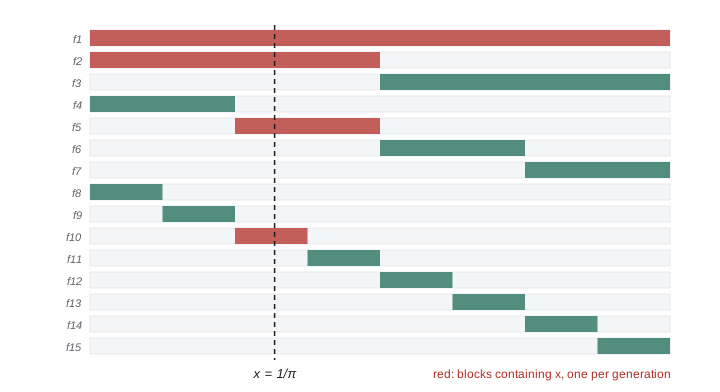
Example C (the typewriter sequence). On \([0, 1]\), list the dyadic intervals in order of generation: \([0, 1]\), then \([0, \frac{1}{2}], [\frac{1}{2}, 1]\), then the four quarters, and so on. Let \(f_n\) be the indicator of the \(n\)th interval in this list. If the \(n\)th interval has length \(2^{-k}\), then \(\int f_n = 2^{-k} \to 0\), so \(f_n \to 0\) in \(L^1\) and in measure. But every point lies in one interval of each generation, so \(f_n(x) = 1\) for infinitely many \(n\) and \(f_n(x) = 0\) for infinitely many \(n\): the sequence converges at no point at all.
Example D (flattening). On \(\mathbb{R}\), \(f_n = \frac{1}{n}\mathbf{1}_{[0, n]}\). Then \(f_n \to 0\) uniformly, but \(\int f_n = 1\), so not in \(L^1\). Uniform convergence controls heights, not total mass, on a space of infinite measure.
The implications
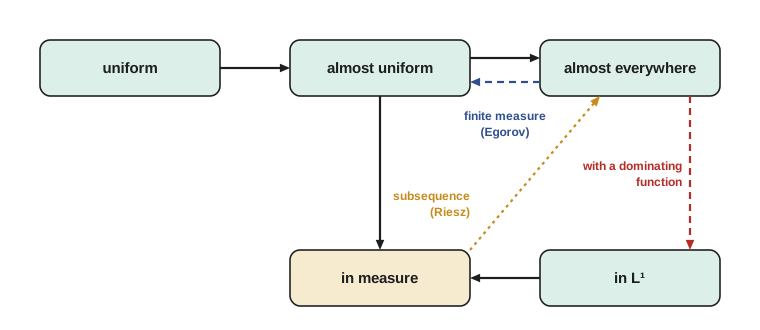
Theorem 9.1. (a) Uniform convergence implies almost uniform convergence, which implies almost everywhere convergence. (b) Convergence in \(L^1\) implies convergence in measure. (c) Almost uniform convergence implies convergence in measure. (d) If \(\mu(X) < \infty\), almost everywhere convergence implies almost uniform convergence (Egorov), and hence convergence in measure.
Proof of (a). The first implication is trivial. For the second, choose \(E_k\) with \(\mu(E_k) < \frac{1}{k}\) and uniform convergence off \(E_k\). Then \(f_n(x) \to f(x)\) for every \(x\) outside \(N = \bigcap_k E_k\), and \(\mu(N) \le \mu(E_k) < \frac{1}{k}\) for every \(k\), so \(N\) is null.
Proof of (b). By Markov's inequality, \(\mu(\{|f_n - f| \ge \eta\}) \le \frac{1}{\eta}\int |f_n - f| \to 0\).
Proof of (c). Given \(\eta, \varepsilon > 0\), choose \(E\) with \(\mu(E) < \varepsilon\) and uniform convergence off \(E\). For large \(n\), \(|f_n - f| < \eta\) off \(E\), so \(\mu(\{|f_n - f| \ge \eta\}) \le \mu(E) < \varepsilon\).
Part (d) is Egorov's theorem, proved next. Example B shows the finiteness hypothesis is needed. Example A shows that none of the other modes implies \(L^1\) convergence, Example C that \(L^1\) convergence and convergence in measure do not imply almost everywhere convergence, and Example D that uniform convergence does not imply \(L^1\) convergence when \(\mu(X) = \infty\). With domination, however, the gap closes: by the dominated convergence theorem, almost everywhere convergence with \(|f_n| \le g \in L^1\) implies \(L^1\) convergence, and the same holds for convergence in measure, by the subsequence theorem below.
Egorov's theorem
Theorem 9.2 (Egorov, 1911). Let \(\mu(X) < \infty\) and \(f_n \to f\) almost everywhere, with \(f\) finite a.e. Then for every \(\varepsilon > 0\) there is a measurable set \(E\) with \(\mu(E) < \varepsilon\) such that \(f_n \to f\) uniformly on \(X \setminus E\).
Proof. Discarding a null set, assume \(f_n(x) \to f(x)\) for every \(x\), with all values finite. For positive integers \(k\) and \(N\), let \[E_{k, N} = \bigcup_{n \ge N} \Big\{ x : |f_n(x) - f(x)| \ge \frac{1}{k} \Big\}.\] For fixed \(k\), the sets \(E_{k,N}\) decrease as \(N\) grows, and their intersection is empty, because at each \(x\) we have \(|f_n(x) - f(x)| < \frac{1}{k}\) for all large \(n\). Since \(\mu(X) < \infty\), continuity from above gives \(\mu(E_{k,N}) \to 0\) as \(N \to \infty\). Choose \(N_k\) with \(\mu(E_{k, N_k}) < \varepsilon 2^{-k}\) and let \(E = \bigcup_k E_{k, N_k}\), so \(\mu(E) < \varepsilon\). If \(x \notin E\), then for every \(k\) and every \(n \ge N_k\), \(|f_n(x) - f(x)| < \frac{1}{k}\). This is uniform convergence on \(X \setminus E\). \(\blacksquare\)
The only place finiteness entered was continuity from above, exactly the point where Example B fails. The proof is constructive in a useful sense: it shows how to remove a small exceptional set, generation by generation. For \(f_n(x) = x^n\) on \([0, 1]\), which converges to \(0\) on \([0, 1)\), the exceptional set can be taken to be \((1 - \varepsilon, 1]\), and on \([0, 1 - \varepsilon]\) the convergence is uniform since \(\sup x^n = (1 - \varepsilon)^n\).
Egorov's theorem is Littlewood's third principle. Together with regularity of sets and Lusin's theorem, it says that the measurable world is nearly the classical one: sets are nearly finite unions of intervals, functions nearly continuous, and convergence nearly uniform. Many proofs in the subject follow the same pattern: handle the nice part with classical methods and show the exceptional set contributes little.
# Egorov for x^n on [0, 1], and the typewriter sequence, which converges in L^1 but nowhere pointwise.
import math

eps = 0.01
for k in (10, 100, 1000):           # tolerance 1/k
    # on [0, 1 - eps] we need (1 - eps)^n < 1/k for all n >= N
    N = math.ceil(math.log(1 / k) / math.log(1 - eps))
    print(f"tolerance 1/{k}: uniform on [0, 0.99] from n = {N}")

def typewriter(n):
    """Return the n-th dyadic interval (n starts at 1): generation k, index j."""
    k = int(math.log2(n))
    j = n - 2 ** k
    return j / 2 ** k, (j + 1) / 2 ** k

x = 1 / math.pi
hits = [n for n in range(1, 2 ** 12) if typewriter(n)[0] <= x <= typewriter(n)[1]]
print("integral of f_n for n = 1, 10, 100, 1000:", [typewriter(n)[1] - typewriter(n)[0] for n in (1, 10, 100, 1000)])
print("x = 1/pi lies in the n-th interval for n =", hits[:12], "... one per generation:", len(hits), "hits in 12 generations")

# a subsequence converging at x: the leftmost interval of each generation, n_k = 2^k
sub = [2 ** k for k in range(12)]
print("subsequence f_(2^k) at x = 1/pi:", [int(typewriter(n)[0] <= x <= typewriter(n)[1]) for n in sub])tolerance 1/10: uniform on [0, 0.99] from n = 230 tolerance 1/100: uniform on [0, 0.99] from n = 459 tolerance 1/1000: uniform on [0, 0.99] from n = 688 integral of f_n for n = 1, 10, 100, 1000: [1.0, 0.125, 0.015625, 0.001953125] x = 1/pi lies in the n-th interval for n = [1, 2, 5, 10, 21, 42, 84, 168, 337, 674, 1349, 2699] ... one per generation: 12 hits in 12 generations subsequence f_(2^k) at x = 1/pi: [1, 1, 0, 0, 0, 0, 0, 0, 0, 0, 0, 0]
The Borel–Cantelli lemma and Riesz's theorem
Lemma 9.3 (Borel–Cantelli). If \(E_1, E_2, \ldots\) are measurable with \(\sum_k \mu(E_k) < \infty\), then almost every \(x\) lies in only finitely many \(E_k\).
Proof. The set of points lying in infinitely many \(E_k\) is \(\limsup_k E_k = \bigcap_{j=1}^{\infty} \bigcup_{k \ge j} E_k\). For each \(j\), it is contained in \(\bigcup_{k \ge j} E_k\), whose measure is at most \(\sum_{k \ge j} \mu(E_k)\), the tail of a convergent series. Letting \(j \to \infty\) shows the measure is zero. \(\blacksquare\) Equivalently, \(\int \sum_k \mathbf{1}_{E_k} = \sum_k \mu(E_k) < \infty\), so \(\sum_k \mathbf{1}_{E_k} < \infty\) almost everywhere by Corollary 6.6.
Theorem 9.4 (Riesz, 1909). If \(f_n \to f\) in measure, then some subsequence \(f_{n_k}\) converges to \(f\) almost everywhere.
Proof. Choose \(n_1 < n_2 < \cdots\) with \(\mu(E_k) < 2^{-k}\), where \(E_k = \{|f_{n_k} - f| \ge 2^{-k}\}\). By Borel–Cantelli, almost every \(x\) lies in only finitely many \(E_k\). For such \(x\) there is \(K\) with \(|f_{n_k}(x) - f(x)| < 2^{-k}\) for all \(k \ge K\), so \(f_{n_k}(x) \to f(x)\). \(\blacksquare\)
In the typewriter sequence, the subsequence of indicators of \([0, 2^{-k}]\) converges to \(0\) at every \(x > 0\), as the code above illustrates. Riesz's theorem has a striking corollary: a sequence converges in measure to \(f\) if and only if every subsequence has a further subsequence converging almost everywhere to \(f\), provided \(\mu(X) < \infty\). Convergence in any metric has this subsequence property. Almost everywhere convergence does not, as the typewriter sequence shows: every subsequence has a further subsequence converging a.e. to 0, yet the sequence itself converges nowhere. So a.e. convergence is not given by any metric, while on a finite measure space convergence in measure is, with distance \(\int \min(|f - g|, 1) \, d\mu\).
Corollary 9.5 (dominated convergence in measure). If \(f_n \to f\) in measure and \(|f_n| \le g \in L^1\), then \(\int |f_n - f| \to 0\). Proof: if not, some subsequence has \(\int |f_{n_k} - f| \ge \delta > 0\). A further subsequence converges almost everywhere, and dominated convergence applied to it gives a contradiction. \(\blacksquare\)
Worked problem
Diagnosing a sequence
On \([0, 1]\), let \(f_n(x) = n x^n (1 - x)\). Determine in which modes \(f_n \to 0\).
Show solution
- Pointwise: for \(x \in [0, 1)\), \(n x^n \to 0\) because \(x^n\) decays geometrically; at \(x = 1\), \(f_n(1) = 0\). So \(f_n \to 0\) everywhere.
- In \(L^1\): \(\int_0^1 n x^n(1 - x) \, dx = n\big(\frac{1}{n+1} - \frac{1}{n+2}\big) = \frac{n}{(n + 1)(n + 2)} \to 0\). So \(f_n \to 0\) in \(L^1\), and hence in measure.
- Uniformly: the maximum of \(x^n(1 - x)\) is at \(x = \frac{n}{n + 1}\), where it equals \(\frac{1}{n + 1}\big(\frac{n}{n + 1}\big)^n\). So \(\sup f_n = \frac{n}{n+1}\big(1 + \frac{1}{n}\big)^{-n} \to e^{-1}\). The convergence is not uniform.
- Almost uniformly: by Egorov, since \([0, 1]\) has finite measure; explicitly, on \([0, 1 - \varepsilon]\), \(\sup f_n \le n(1 - \varepsilon)^n \to 0\).
Answer: \(f_n \to 0\) everywhere, in \(L^1\), in measure and almost uniformly, but not uniformly: a bump of height near \(e^{-1}\) slides toward \(x = 1\) while its area shrinks.
The example is typical. The non-uniformity is caused by a bump of fixed height moving toward a point, and it is removed by cutting out a small neighbourhood of that point, exactly as Egorov predicts. The \(L^1\) convergence holds because the bump's width shrinks faster than its height stays constant.
Convergence in probability and almost surely
In probability, the distinction between modes is the distinction between the weak and strong laws of large numbers. If \(X_1, X_2, \ldots\) are independent with the same distribution and finite mean \(m\), the sample means \(\overline{X}_n = \frac{1}{n}\sum_{k \le n} X_k\) converge to \(m\) in probability (the weak law) and almost surely (the strong law, proved in this generality by Kolmogorov around 1930, after Émile Borel's 1909 theorem for coin tossing). The weak law follows from Markov's inequality applied to \((\overline{X}_n - m)^2\) when the variance is finite. The strong law is deeper, and a standard route goes through the Borel–Cantelli lemma along a subsequence, followed by a control of the gaps, much as in Riesz's theorem.
Common mistakes
MistakeAssuming convergence in L¹ implies pointwise convergence.
InsteadThe typewriter sequence converges in L¹ and in measure but at no point.
MistakeApplying Egorov’s theorem on a space of infinite measure.
Instead\(\mathbf{1}_{[n, n+1]}\) converges everywhere but not almost uniformly on \(\mathbb{R}\).
MistakeConfusing almost uniform convergence with uniform convergence almost everywhere.
InsteadAlmost uniform allows an exceptional set of small positive measure; uniform a.e. allows only a null set.
MistakeExpecting a sequence convergent in measure to converge a.e.
InsteadOnly a subsequence is guaranteed to, by Riesz’s theorem.
Summary and key terms
- The modes are uniform, almost uniform, almost everywhere, in measure and in L¹.
- Uniform implies almost uniform implies a.e.; almost uniform and L¹ convergence imply convergence in measure.
- Egorov: on a finite measure space, a.e. convergence is uniform off a set of arbitrarily small measure.
- Borel–Cantelli: if the measures are summable, almost every point lies in finitely many of the sets.
- Riesz: convergence in measure implies a.e. convergence of a subsequence.
- Counterexamples: concentration, escape to infinity, the typewriter sequence and flattening separate the modes.
- Convergence in measure
- \(\mu(|f_n - f| \ge \eta) \to 0\) for every \(\eta > 0\).
- Almost uniform convergence
- Uniform convergence off sets of arbitrarily small measure.
- Typewriter sequence
- Indicators of dyadic intervals listed generation by generation.
- Borel–Cantelli lemma
- \(\sum \mu(E_k) < \infty\) implies a.e. point lies in finitely many \(E_k\).
- Egorov’s theorem
- Almost everywhere convergence on a finite measure space is almost uniform.
Practice problems
Work each problem on paper first, then reveal the answer to check.
Does \(f_n = \mathbf{1}_{[0, 1/n]}\) converge to 0 a.e., in measure and in \(L^1\) on \([0, 1]\)?
Show answer
Yes in all three: it converges at every \(x > 0\), and \(\int f_n = \frac{1}{n} \to 0\). It does not converge at \(x = 0\), a null set.
On \(\mathbb{R}\), does \(f_n = \mathbf{1}_{[0, n]}/\sqrt{n}\) converge in measure? In \(L^1\)?
Show answer
In measure yes: for \(n > \frac{1}{\eta^2}\), \(\{f_n \ge \eta\}\) is empty. In \(L^1\) no: \(\int f_n = \sqrt{n} \to \infty\).
Find explicitly a set \(E\) of measure less than 0.1 off which \(x^n(1 + \sin(nx))\) converges uniformly on \([0, 1]\).
Show answer
\(E = (0.95, 1]\): off \(E\) the functions are at most \(2(0.95)^n \to 0\).
Show that if \(f_n \to f\) in measure and \(f_n \to g\) a.e., then \(f = g\) a.e.
Show answer
A subsequence converges to \(f\) a.e. by Riesz; it also converges to \(g\) a.e., so \(f = g\) a.e.
If \(\sum_n \mu(|f_n| > \frac{1}{n^2}) < \infty\), show \(\sum_n f_n\) converges absolutely a.e.
Show answer
By Borel–Cantelli, a.e. \(x\) has \(|f_n(x)| \le \frac{1}{n^2}\) for all large \(n\), and \(\sum \frac{1}{n^2}\) converges.
Lesson quiz · 5 questions
Score 60% or more to complete this lesson.
Create a free account to save your progress, take quizzes and earn a certificate.