
MATH-441 · Lesson 11 of 12 · 23 min
Lᵖ spaces: Hölder, Minkowski and completeness
The integral of \(|f - g|\) measures how far apart two functions are on average, and lesson 1 promised that, with the Lebesgue integral, this distance makes the space of integrable functions complete. This lesson delivers on that promise for a whole family of spaces. For \(1 \le p < \infty\), the space \(L^p\) consists of functions whose \(p\)th power is integrable, with norm \(\|f\|_p = \big(\int |f|^p\big)^{1/p}\); for \(p = \infty\) it consists of essentially bounded functions. We prove the inequalities of Hölder and Minkowski, which make \(\|\cdot\|_p\) a norm, and the Riesz–Fischer theorem, which says every \(L^p\) is complete. The case \(p = 2\) is a Hilbert space, the setting of Fourier analysis and quantum mechanics, and the \(L^p\) spaces are the basic objects of functional analysis in MATH-445. Throughout, \((X, \mathcal{A}, \mu)\) is a measure space.
Definitions
Definition 11.1. For \(1 \le p < \infty\) and measurable \(f\), let \[\|f\|_p = \Big( \int_X |f|^p \, d\mu \Big)^{1/p}.\] For \(p = \infty\), let \(\|f\|_\infty = \inf\{M \ge 0 : |f| \le M \text{ almost everywhere}\}\), the essential supremum of \(|f|\). The space \(L^p(\mu)\) is the set of measurable \(f\) with \(\|f\|_p < \infty\), where functions equal almost everywhere are identified.
The identification is needed because \(\|f\|_p = 0\) whenever \(f = 0\) a.e., by Corollary 6.6, and a norm must vanish only at zero. Strictly, an element of \(L^p\) is an equivalence class of functions; in practice we speak of functions and remember that values on null sets carry no meaning. In particular, it makes no sense to evaluate an element of \(L^p\) at a single point. The infimum in the definition of \(\|f\|_\infty\) is attained: \(|f| \le \|f\|_\infty\) a.e., because \(\{|f| > \|f\|_\infty\} = \bigcup_n \{|f| > \|f\|_\infty + \frac{1}{n}\}\) is a countable union of null sets.
Examples. With counting measure on \(\mathbb{N}\), \(L^p\) is the sequence space \(\ell^p\) of sequences with \(\sum |a_n|^p < \infty\), and \(\ell^\infty\) is the space of bounded sequences. On \((0, 1)\), \(x^{-a} \in L^p\) exactly when \(ap < 1\), since \(\int_0^1 x^{-ap} \, dx\) is finite exactly then. On \((1, \infty)\), \(x^{-a} \in L^p\) exactly when \(ap > 1\). So on \((0, 1)\), the singular function \(x^{-1/2}\) is in \(L^1\) but not \(L^2\), while on \((1, \infty)\) the slowly decaying function \(x^{-1}\) is in \(L^2\) but not \(L^1\). Neither of \(L^1(\mathbb{R})\) and \(L^2(\mathbb{R})\) contains the other: local singularities favour small \(p\), slow decay at infinity favours large \(p\).
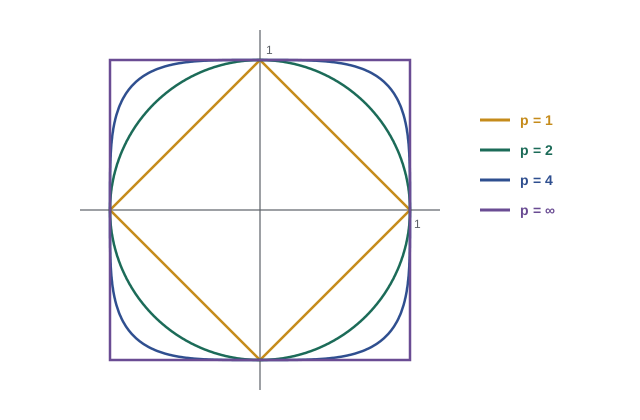
Young's and Hölder's inequalities
Two exponents \(p, q \in [1, \infty]\) are conjugate if \(\frac{1}{p} + \frac{1}{q} = 1\), with \(1\) and \(\infty\) conjugate to each other. For example, \(2\) is conjugate to itself and \(3\) to \(\frac{3}{2}\).
Lemma 11.2 (Young's inequality). For \(a, b \ge 0\) and conjugate \(1 < p, q < \infty\), \[ab \le \frac{a^p}{p} + \frac{b^q}{q},\] with equality exactly when \(a^p = b^q\). Proof: if \(a\) or \(b\) is zero the claim is trivial. Otherwise, since the logarithm is concave, \[\ln\Big(\frac{a^p}{p} + \frac{b^q}{q}\Big) \ge \frac{1}{p}\ln a^p + \frac{1}{q}\ln b^q = \ln(ab),\] with equality exactly when \(a^p = b^q\), by strict concavity. \(\blacksquare\)
Theorem 11.3 (Hölder's inequality). For conjugate \(p, q \in [1, \infty]\) and measurable \(f, g\), \[\int |fg| \, d\mu \le \|f\|_p \, \|g\|_q.\] In particular \(fg \in L^1\) when \(f \in L^p\) and \(g \in L^q\).
Proof. For \(p = 1\), \(q = \infty\): \(|fg| \le |f| \, \|g\|_\infty\) a.e., and integrate. Now let \(1 < p < \infty\). If \(\|f\|_p = 0\) then \(f = 0\) a.e. and both sides vanish; if either norm is infinite there is nothing to prove. Otherwise set \(F = \frac{|f|}{\|f\|_p}\) and \(G = \frac{|g|}{\|g\|_q}\), so \(\int F^p = \int G^q = 1\). By Young's inequality at each point, \[\int FG \le \frac{1}{p}\int F^p + \frac{1}{q}\int G^q = \frac{1}{p} + \frac{1}{q} = 1.\] Multiplying by \(\|f\|_p\|g\|_q\) gives the result. \(\blacksquare\)
Equality holds, for \(1 < p < \infty\), exactly when \(|f|^p\) and \(|g|^q\) are proportional almost everywhere. With \(p = q = 2\), Hölder's inequality is the Cauchy–Schwarz inequality \(\big|\int fg\big| \le \|f\|_2\|g\|_2\). Otto Hölder published the inequality in 1889, building on an 1888 version for sums by Leonard James Rogers.
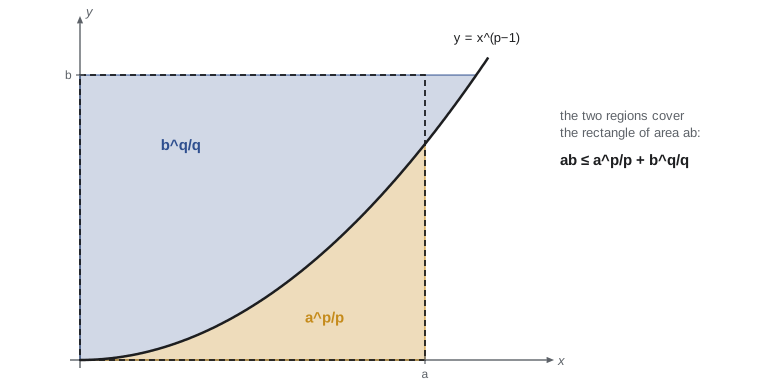
The figure gives a second proof of Young's inequality. The inverse of \(y = x^{p-1}\) is \(x = y^{q-1}\), because \((p - 1)(q - 1) = 1\) for conjugate exponents. The area under the curve from \(0\) to \(a\) is \(\frac{a^p}{p}\), the area to the left of it from \(0\) to \(b\) is \(\frac{b^q}{q}\), and together they cover the rectangle \([0, a] \times [0, b]\), with equality when the corner \((a, b)\) lies on the curve.
Minkowski's inequality
Theorem 11.4 (Minkowski's inequality). For \(1 \le p \le \infty\), \(\|f + g\|_p \le \|f\|_p + \|g\|_p\).
Proof. The cases \(p = 1\) and \(p = \infty\) follow from \(|f + g| \le |f| + |g|\). Let \(1 < p < \infty\) and assume the right side finite. Then \(f + g \in L^p\), because \(|f + g|^p \le (2\max(|f|, |g|))^p \le 2^p(|f|^p + |g|^p)\). Write \[|f + g|^p \le |f| \, |f + g|^{p-1} + |g| \, |f + g|^{p-1}.\] With \(q = \frac{p}{p-1}\), we have \(\big\| |f + g|^{p-1} \big\|_q = \big(\int |f + g|^p\big)^{1/q} = \|f + g\|_p^{p-1}\). Hölder's inequality applied to each term gives \[\|f + g\|_p^p \le \big(\|f\|_p + \|g\|_p\big) \|f + g\|_p^{p-1}.\] If \(\|f + g\|_p = 0\) the claim is trivial; otherwise divide by \(\|f + g\|_p^{p-1}\). \(\blacksquare\)
Minkowski's inequality is the triangle inequality for \(\|\cdot\|_p\). Together with \(\|cf\|_p = |c|\|f\|_p\) and \(\|f\|_p = 0\) only for \(f = 0\) a.e., it makes \(L^p\) a normed vector space. For \(0 < p < 1\) the triangle inequality fails: on \([0, 1]\) with \(f = \mathbf{1}_{[0, 1/2]}\) and \(g = \mathbf{1}_{(1/2, 1]}\), \(\|f + g\|_p = 1\) while \(\|f\|_p + \|g\|_p = 2 \cdot 2^{-1/p} < 1\). That is why the theory starts at \(p = 1\).
The Riesz–Fischer theorem
Theorem 11.5 (Riesz–Fischer, 1907). For \(1 \le p \le \infty\), \(L^p(\mu)\) is complete: every Cauchy sequence converges in \(L^p\). Moreover, every sequence converging in \(L^p\) has a subsequence converging almost everywhere.
Proof for \(1 \le p < \infty\). We use a criterion from MATH-341: a normed space is complete if every absolutely convergent series converges. Let \(\sum_k \|f_k\|_p = B < \infty\), and set \(G_n = \sum_{k=1}^{n} |f_k|\) and \(G = \sum_{k=1}^{\infty} |f_k|\). By Minkowski, \(\|G_n\|_p \le B\). Since \(G_n^p \uparrow G^p\), monotone convergence gives \(\int G^p \le B^p\), so \(G \in L^p\) and \(G < \infty\) almost everywhere. Hence \(\sum_k f_k(x)\) converges absolutely for almost every \(x\); call its sum \(F(x)\), and set \(F = 0\) on the null set where it diverges. Then \(|F - \sum_{k \le n} f_k|^p \le (2G)^p\), which is integrable, and the integrand tends to zero a.e., so by dominated convergence \(\|F - \sum_{k \le n} f_k\|_p \to 0\). The series converges in \(L^p\).
For the subsequence statement, let \(f_n\) be Cauchy in \(L^p\) and choose \(n_1 < n_2 < \cdots\) with \(\|f_{n_{k+1}} - f_{n_k}\|_p < 2^{-k}\). The telescoping series \(f_{n_1} + \sum_k (f_{n_{k+1}} - f_{n_k})\) is absolutely convergent, so by the argument above its partial sums \(f_{n_k}\) converge both almost everywhere and in \(L^p\) to some \(F\). A Cauchy sequence with a convergent subsequence converges to the same limit, so \(f_n \to F\) in \(L^p\).
Proof for \(p = \infty\). If \(f_n\) is Cauchy in \(L^\infty\), the sets \(\{|f_n - f_m| > \|f_n - f_m\|_\infty\}\) are null, and so is their countable union \(N\). Off \(N\) the sequence is uniformly Cauchy, hence uniformly convergent to a bounded function \(F\), and \(\|f_n - F\|_\infty \to 0\). \(\blacksquare\)
Frigyes Riesz and Ernst Fischer proved the theorem independently in 1907 for \(L^2\), in the form that a square-summable sequence of Fourier coefficients belongs to a square-integrable function. It was the first clear demonstration of the power of Lebesgue's integral. In MATH-341 we saw that the continuous functions on \([0, 1]\) with the \(L^1\) distance are not complete; Theorem 11.5 says that \(L^1([0, 1])\) is their completion, since continuous functions are dense in it, as we show next.
Density and inclusions
Theorem 11.6. For \(1 \le p < \infty\): (a) simple functions in \(L^p\) are dense in \(L^p(\mu)\); (b) for Lebesgue measure on \(\mathbb{R}\), step functions and continuous functions with compact support are dense in \(L^p\). Simple functions are also dense in \(L^\infty\), but continuous functions are not dense in \(L^\infty(\mathbb{R})\).
Proof. (a) For \(f \ge 0\) in \(L^p\), the simple functions \(\varphi_n \uparrow f\) of Theorem 5.6 satisfy \(|f - \varphi_n|^p \le f^p\), integrable, so \(\|f - \varphi_n\|_p \to 0\) by dominated convergence. For general \(f\) split into positive and negative parts. (b) By (a) it suffices to approximate \(\mathbf{1}_E\) for \(E\) of finite measure. By regularity (lesson 3) there is a finite union of intervals \(V\) with \(m(E \,\triangle\, V) < \varepsilon\), so \(\|\mathbf{1}_E - \mathbf{1}_V\|_p < \varepsilon^{1/p}\); and the indicator of an interval is approximated in \(L^p\) by a continuous trapezoid. For the last statement, a continuous function within \(\frac{1}{3}\) of \(\mathbf{1}_{[0, \infty)}\) in \(L^\infty\) would have to jump near \(0\), which a continuous function cannot do. \(\blacksquare\)
Proposition 11.7. If \(\mu(X) < \infty\) and \(1 \le p < q \le \infty\), then \(L^q \subseteq L^p\) with \(\|f\|_p \le \mu(X)^{\frac{1}{p} - \frac{1}{q}} \|f\|_q\). For counting measure the inclusion reverses: \(\ell^p \subseteq \ell^q\) with \(\|a\|_q \le \|a\|_p\). Proof of the first: apply Hölder to \(|f|^p \cdot 1\) with exponents \(\frac{q}{p}\) and its conjugate. For the second, normalize to \(\|a\|_p = 1\); then every \(|a_n| \le 1\), so \(|a_n|^q \le |a_n|^p\) and \(\sum |a_n|^q \le 1\). \(\blacksquare\) On a probability space, \(\|f\|_p\) is a nondecreasing function of \(p\), and \(\|f\|_p \to \|f\|_\infty\) as \(p \to \infty\).
# Norms of x^(-a) on (0, 1), a numerical check of Holder and Minkowski, and ||f||_p increasing in p.
import random, math

def norm_p(vals, p, w):
    """p-norm of a step function with values vals on cells of width w."""
    if p == math.inf:
        return max(abs(v) for v in vals)
    return (sum(abs(v) ** p for v in vals) * w) ** (1 / p)

# x^(-a) is in L^p(0, 1) exactly when a p < 1
for a in (0.25, 0.5):
    for p in (1, 2, 3, 4):
        print(f"x^-{a} in L^{p}(0, 1): {a * p < 1}", end="   ")
    print()

random.seed(441)
n = 1000; w = 1 / n
worst_holder, worst_mink = 0.0, 0.0
for trial in range(200):
    f = [random.uniform(-3, 3) for _ in range(n)]
    g = [random.expovariate(1) * random.choice((-1, 1)) for _ in range(n)]
    p = random.uniform(1.05, 6); q = p / (p - 1)
    lhs = sum(abs(x * y) for x, y in zip(f, g)) * w
    worst_holder = max(worst_holder, lhs / (norm_p(f, p, w) * norm_p(g, q, w)))
    s = [x + y for x, y in zip(f, g)]
    worst_mink = max(worst_mink, norm_p(s, p, w) / (norm_p(f, p, w) + norm_p(g, p, w)))
print(f"largest ratio in Holder over 200 trials:    {worst_holder:.4f} (must be <= 1)")
print(f"largest ratio in Minkowski over 200 trials: {worst_mink:.4f} (must be <= 1)")

f = [random.uniform(0, 2) ** 3 for _ in range(n)]       # on the probability space (0, 1)
print("||f||_p for p = 1, 2, 4, 8, 16, inf:", [round(norm_p(f, p, w), 3) for p in (1, 2, 4, 8, 16, math.inf)])x^-0.25 in L^1(0, 1): True x^-0.25 in L^2(0, 1): True x^-0.25 in L^3(0, 1): True x^-0.25 in L^4(0, 1): False x^-0.5 in L^1(0, 1): True x^-0.5 in L^2(0, 1): False x^-0.5 in L^3(0, 1): False x^-0.5 in L^4(0, 1): False largest ratio in Holder over 200 trials: 0.6870 (must be <= 1) largest ratio in Minkowski over 200 trials: 0.7475 (must be <= 1) ||f||_p for p = 1, 2, 4, 8, 16, inf: [2.072, 3.095, 4.272, 5.391, 6.292, 7.966]
The Hilbert space L²
For \(p = 2\) the norm comes from an inner product, \(\langle f, g \rangle = \int f \overline{g} \, d\mu\), with \(\|f\|_2^2 = \langle f, f \rangle\); Cauchy–Schwarz ensures it is finite. By Riesz–Fischer, \(L^2(\mu)\) is a complete inner product space, a Hilbert space. On \([-\pi, \pi]\) the functions \(\frac{1}{\sqrt{2\pi}} e^{inx}\) form an orthonormal basis, and the map from a function to its Fourier coefficients is an isometry of \(L^2\) onto \(\ell^2(\mathbb{Z})\): this is Parseval's identity together with the Riesz–Fischer theorem in its original form. Among the \(L^p\) spaces, \(L^2\) alone has this geometry of angles and orthogonal projections, which is why least squares, Fourier series and quantum states all live there.
Duality. For \(1 \le p < \infty\) and conjugate \(q\), each \(g \in L^q\) defines a bounded linear functional \(f \mapsto \int fg \, d\mu\) on \(L^p\), of norm \(\|g\|_q\) by Hölder and its equality case. The Riesz representation theorem for \(L^p\) says that, for \(1 < p < \infty\) or for \(p = 1\) with \(\mu\) σ-finite, every bounded linear functional arises this way. The proof uses the Radon–Nikodym theorem of lesson 12, and the result is developed in MATH-445.
Worked problem
A function in exactly a range of Lᵖ spaces
For which \(p \in [1, \infty]\) is \(f(x) = \frac{1}{\sqrt{x}(1 + |\ln x|)}\) in \(L^p((0, \infty))\)?
Show solution
- Near \(0\), substitute \(x = e^{-u}\): \(\int_0^1 x^{-p/2}(1 + |\ln x|)^{-p} dx = \int_0^\infty e^{u(p/2 - 1)}(1 + u)^{-p} \, du\). This is finite for \(p < 2\), infinite for \(p > 2\), and for \(p = 2\) it is \(\int_0^\infty (1 + u)^{-2} du = 1\).
- Near infinity, substitute \(x = e^{u}\): \(\int_1^\infty x^{-p/2}(1 + \ln x)^{-p} dx = \int_0^\infty e^{u(1 - p/2)}(1 + u)^{-p} du\). This is finite for \(p > 2\), infinite for \(p < 2\), and equal to 1 for \(p = 2\).
- For \(p = \infty\), \(f\) is unbounded near 0, so it is not in \(L^\infty\).
Answer: \(f \in L^p\) only for \(p = 2\), with \(\|f\|_2^2 = 2\). The logarithmic factor is exactly enough to make both ends converge for \(p = 2\) alone.
Common mistakes
MistakeEvaluating an element of Lᵖ at a point.
InsteadElements are equivalence classes modulo null sets; point values are not defined.
MistakeAssuming L¹(ℝ) and L²(ℝ) are nested.
Instead\(x^{-1/2}\mathbf{1}_{(0,1)}\) is in \(L^1\) only, \(\frac{1}{x}\mathbf{1}_{(1,\infty)}\) in \(L^2\) only.
MistakeUsing the essential supremum and the supremum interchangeably.
InsteadChanging a function on a null set changes \(\sup |f|\) but not \(\|f\|_\infty\).
MistakeApplying the Lᵖ norm triangle inequality for p < 1.
InsteadFor 0 < p < 1 Minkowski fails; the expression is not a norm.
Summary and key terms
- \(\|f\|_p = (\int |f|^p)^{1/p}\) for \(p < \infty\), and \(\|f\|_\infty\) is the essential supremum; Lᵖ identifies functions equal a.e.
- Young: \(ab \le \frac{a^p}{p} + \frac{b^q}{q}\); Hölder: \(\int |fg| \le \|f\|_p\|g\|_q\) for conjugate exponents.
- Minkowski’s inequality is the triangle inequality, making Lᵖ a normed space for p ≥ 1.
- Riesz–Fischer: every Lᵖ is complete, and Lᵖ convergence gives an a.e. convergent subsequence.
- Simple functions, step functions and continuous functions with compact support are dense in Lᵖ(ℝ) for p < ∞.
- On finite measure spaces Lᵖ shrinks as p grows; for sequences ℓᵖ grows with p; L² is a Hilbert space.
- Conjugate exponents
- \(p, q\) with \(\frac{1}{p} + \frac{1}{q} = 1\).
- Essential supremum
- The smallest \(M\) with \(|f| \le M\) almost everywhere.
- Hölder’s inequality
- \(\int |fg| \le \|f\|_p \|g\|_q\).
- Riesz–Fischer theorem
- Completeness of the Lᵖ spaces.
- Hilbert space
- A complete inner product space, such as L².
Practice problems
Work each problem on paper first, then reveal the answer to check.
Show that \(\|f\|_2^2 \le \|f\|_1 \|f\|_\infty\).
Show answer
Hölder with \(p = 1\), \(q = \infty\) applied to \(|f| \cdot |f|\).
Prove that if \(f \in L^1 \cap L^\infty\) then \(f \in L^p\) for all \(p \in [1, \infty]\).
Show answer
\(|f|^p \le \|f\|_\infty^{p-1}|f|\) a.e., so \(\int |f|^p \le \|f\|_\infty^{p-1}\|f\|_1\).
Find \(\|f\|_p\) for \(f = \mathbf{1}_E\) and deduce \(\|f\|_p \to \|f\|_\infty\) when \(0 < \mu(E) < \infty\).
Show answer
\(\|\mathbf{1}_E\|_p = \mu(E)^{1/p} \to 1 = \|\mathbf{1}_E\|_\infty\).
Use Hölder to show \(\big(\int_0^1 |f|\big)^2 \le \int_0^1 |f|^2\).
Show answer
Cauchy–Schwarz with \(g = 1\): \(\int |f| \cdot 1 \le \|f\|_2 \|1\|_2 = \|f\|_2\).
Show that \(\ell^1 \subsetneq \ell^2\).
Show answer
The inclusion is Proposition 11.7; the sequence \(\frac{1}{n}\) is in \(\ell^2\) but not \(\ell^1\).
Lesson quiz · 5 questions
Score 60% or more to complete this lesson.
Create a free account to save your progress, take quizzes and earn a certificate.