
LVT-340 · Lesson 9 of 12 · 21 min
Security, AV and life-safety interfaces review
BICSI's installer exams focus on cabling, but the Technician exam and most employers' assessments expect a technician to understand the systems that cabling serves, and especially the places where those systems touch life safety. Those places are where installer mistakes have the worst consequences: a door that will not open in a fire, a paging system that drowns out a fire alarm, a camera that records over evidence. This review covers LVT-230 and LVT-310 and the interfaces between them and the fire alarm system.
Intrusion alarm systems
LVT-230 lessons 2 to 4 covered intrusion systems. A panel monitors zones; each zone has one or more detectors and is supervised by an end-of-line resistor, so the panel can tell normal, alarm, and trouble from a cut or shorted wire. With a single end-of-line resistor on a normally closed loop, the panel sees the resistor value when normal, an open circuit in alarm or when the wire is cut, and a short when the wire is shorted; double end-of-line wiring adds a second resistor so that alarm and tamper or cut can be told apart. The resistor goes at the last device on the loop, never at the panel; a resistor at the panel supervises nothing but the panel terminals.
Detectors: magnetic contacts for doors and windows, passive infrared motion detectors that sense the movement of warm objects across their zones, glass-break detectors that listen for the sound pattern of breaking glass, and others. Passive infrared detectors are most sensitive to movement across their beams and least sensitive to movement straight toward them, which is why they are mounted to look across the likely path of an intruder. Monitoring stations receive signals over communicators, now mostly IP or cellular.
Access control and egress
LVT-230 lessons 5 to 7 covered access control. A reader sends credential data to a controller, which decides and releases the lock. Readers connect by Wiegand, an older one-way protocol, or by OSDP, a two-way, supervised protocol that can be encrypted; new installations increasingly specify OSDP.
Locks are fail-safe, unlocked when power is lost, or fail-secure, locked when power is lost but always openable from the egress side with the door hardware. The choice is a life safety and building code decision, not a security preference: stair doors and doors on exit paths have rules that the installer must not defeat.
Electromagnetic locks on egress doors are allowed only under specific conditions, which LVT-230 lesson 7 described. The usual conditions include release by a motion sensor on the egress side, release on loss of power, release when the fire alarm system activates, and a manual release device near the door that cuts power to the lock directly and keeps it released for a minimum time. In the US model codes, the manual device is mounted 40 to 48 in above the floor within 5 ft of the door and keeps the lock released for at least 30 seconds; Canadian codes set similar conditions. Delayed egress locks, which hold the door for a short delay while an alarm sounds, have their own conditions and are allowed only in some occupancies.
Exam trap: a request-to-exit motion sensor alone is not enough to release a magnetic lock on an egress door. The codes require the independent manual release as well, because a sensor can fail.
Video surveillance
LVT-230 lessons 8 and 9 covered cameras and recording. Image detail is described by pixel density on the target, often using the detection, observation, recognition and identification levels in IEC 62676-4: about 25, 62, 125 and 250 pixels per metre. A camera with 1,920 horizontal pixels covering a 7.7 m (25 ft) wide scene delivers about 250 pixels per metre, enough to identify a person. Recording storage equals the bit rate times the recording time, and the main traps are bits versus bytes and the recording schedule.
Worked problem
Sizing recording storage
A building has 48 cameras recording continuously at 4 Mb/s each, and the owner wants 30 days of retention. How much storage is needed, before RAID overhead?
Show solution
- Total bit rate: 48 × 4 = 192 Mb/s.
- Seconds in 30 days: 30 × 86,400 = 2,592,000 s.
- Bits: 192 × 2,592,000 = 497,664,000 Mb.
- Gigabytes: 497,664,000 ÷ 8 ÷ 1000 = 62,208 GB, about 62.2 TB.
Answer: About 62 TB before RAID and a growth margin. The trap is forgetting to divide by 8: bit rates are in bits, storage in bytes.
Audio-visual and paging
LVT-310 covered audio. Sound pressure level falls by about 6 dB each time the distance from a point source doubles. Constant-voltage distributed systems, at 70.7 V in North America and 100 V in some other places, connect many loudspeakers in parallel, each through a transformer tap set to a wattage; the amplifier must supply the sum of the taps plus headroom, commonly 20 to 25 percent. Low-impedance systems connect a few speakers directly, and the combined impedance must not fall below what the amplifier is rated for: two 8 ohm speakers in parallel make 4 ohm, in series 16 ohm.
Speech intelligibility is measured with the speech transmission index (STI), from 0 to 1. For emergency voice systems, the guidance in NFPA 72's annex is an average STI of at least 0.50 with nearly all points at least 0.45, and the Canadian standards for voice communication take a similar approach. Reverberant rooms such as gyms need treatment and careful speaker placement to get there, as in the LVT-310 capstone.
Assistive listening systems, such as hearing loops, infrared and RF systems, are required by accessibility rules in assembly spaces above a set size, with a set number of receivers, some of them hearing-aid compatible.
# Three short system calculations: recording storage, 70 V amplifier size and alarm loop states
def storage_tb(cameras, mbps, days):
    return cameras * mbps * days * 86400 / 8 / 1000 / 1000

print(f"Juniper Point: 48 cameras at 4 Mb/s for 30 days = {storage_tb(48, 4, 30):.1f} TB")
print(f"Riverside:     20 cameras at 2 Mb/s for 7 days  = {storage_tb(20, 2, 7):.1f} TB")

taps = [1, 1, 2, 2, 2, 2, 4, 4, 8, 8, 8, 8, 15, 15, 16]   # watts per speaker in one paging zone
total = sum(taps)
for headroom in (0.20, 0.25):
    print(f"Zone taps {total} W: amplifier at least {total * (1 + headroom):.0f} W with {headroom:.0%} headroom")

EOL = 2200.0   # ohm, single end-of-line resistor on a normally closed loop
def loop_state(ohm):
    if ohm < 100:
        return "TROUBLE (short)"
    if ohm > 50000:
        return "ALARM or cut wire (open)"
    if abs(ohm - EOL) / EOL < 0.2:
        return "NORMAL"
    return "TROUBLE (out of range)"

for reading in (2190, 15, 999999, 3400):
print(f"loop reads {reading:>6} ohm: {loop_state(reading)}")Juniper Point: 48 cameras at 4 Mb/s for 30 days = 62.2 TB Riverside: 20 cameras at 2 Mb/s for 7 days = 3.0 TB Zone taps 96 W: amplifier at least 115 W with 20% headroom Zone taps 96 W: amplifier at least 120 W with 25% headroom loop reads 2190 ohm: NORMAL loop reads 15 ohm: TROUBLE (short) loop reads 999999 ohm: ALARM or cut wire (open) loop reads 3400 ohm: TROUBLE (out of range)
The code collects three of the calculations from this review: storage for a camera system, the amplifier size for a 70 V paging zone, and the end-of-line states a panel sees. They are typical of the short calculations that appear on employer assessments and the Technician exam.
Where systems meet life safety
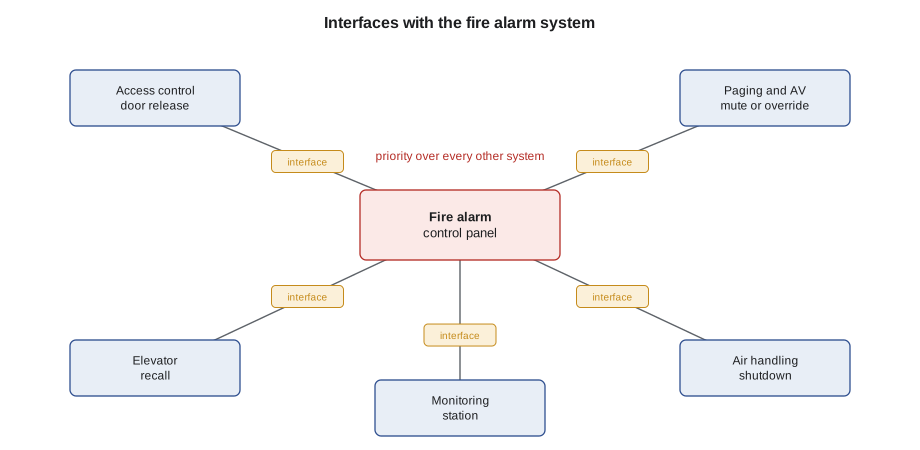
The fire alarm system has priority over every other system in the building, and the interfaces that give it that priority are among the most inspected parts of any job.
- Door release: on fire alarm, magnetic locks on egress doors and some electrified locks must release; the signal comes from a listed fire alarm relay or interface, wired and supervised to the fire alarm rules.
- Paging and background music: when the fire alarm or emergency voice system operates, other audio in the area must mute or be overridden, so it cannot mask alarm signals or voice instructions.
- Mass notification: a mass notification system can share speakers and displays with other systems, but its messages and their priority are set by the emergency plan and the standards, and the interface is designed and tested with the fire alarm contractor.
- Elevators and air handling: recall and shutdown signals come from the fire alarm system; low-voltage installers do not alter them.
Exam and job trap: never use spare conductors in a fire alarm cable, never connect to fire alarm terminals without the fire alarm contractor, and never bypass or delay a release to satisfy a security request. The installer's role is to provide the interface point the design calls for and to test it with the fire alarm contractor during commissioning.
Worked problem
A release that does not release
During the Juniper Point commissioning, the fire alarm contractor triggers an alarm, and every magnetic lock releases except the one on the parking garage stair door. What should Maya check, in order?
Show solution
- Confirm the lock is wired through the fire alarm release relay or the access panel's fire input, as the drawings show, and not directly to the lock supply.
- Check the relay or input for the signal during alarm, using the panel's status display or a meter.
- Check that the access panel's programming for that door follows the fire input.
- Check the manual release device, which should also release the lock independently.
Answer: The cause turned out to be a lock wired to a separate supply added during construction, bypassing the release circuit. It was rewired, retested with the fire alarm contractor and recorded on the commissioning sheet.
Commissioning and handover
Security and AV systems are not finished when they power up. LVT-230 lesson 12 and LVT-310 lesson 12 described commissioning, and the elements are the same across systems. Every device is tested and its result recorded: each zone in alarm, trouble and tamper; each door's lock, sensor, request-to-exit and release; each camera's view, focus, recording and retention; each speaker zone's level and intelligibility. Interfaces with the fire alarm system are tested with the fire alarm contractor present and recorded on both contractors' sheets. The owner's staff are trained on daily use, and the as-built drawings, device lists, programming backups, passwords handed over securely, warranty documents and maintenance instructions are delivered as a package. A system that works but has no records will be hard to maintain and may fail its first inspection.
Privacy and security of the systems themselves
Cameras and access control systems collect personal information, and installers handle it during setup. The owner sets the privacy policy, including what is recorded, where cameras may point, how long video is kept and who may see it, and the installer configures the system to match. Cameras are aimed away from places where people expect privacy, such as washrooms and neighbouring windows, and signage is installed where the owner's policy and the law require it. The systems are also network devices, so the defensive habits of LVT-220 lesson 11 apply: change default passwords, keep firmware current, put the devices on their own network segment and keep the configuration documents confidential. Exam questions in this area are about responsibility: the owner decides the policy, the installer implements it and documents what was done.
A short review of camera placement
Camera questions often ask for the best mounting position. A camera covering a door for identification is placed so that faces arrive toward it, at a height and angle that see faces rather than the tops of heads, and close enough that the required pixel density is met at the door. Backlight is the common problem: a camera looking at a glass entrance from inside sees silhouettes against daylight, so it needs wide dynamic range or a different angle. Infrared illumination helps at night but reflects off nearby surfaces and dome bubbles. Every placement is checked with a live view at commissioning, in daylight and after dark, because a drawing cannot show glare, trees or a sign that was installed after the design.
Common mistakes
MistakeInstalling the end-of-line resistor at the panel.
InsteadPut it at the last device so the whole loop is supervised.
MistakeRelying on a motion sensor alone to release a magnetic lock.
InsteadProvide the independent manual release and fire alarm release too.
MistakeForgetting to divide bits by 8 in storage calculations.
InsteadBit rates are in bits; storage in bytes.
MistakeLoading a 70 V amplifier to exactly its rating.
InsteadLeave 20 to 25 percent headroom.
MistakeLetting music play during a fire alarm.
InsteadProvide the mute or override interface the design requires.
MistakeConnecting to fire alarm terminals without the fire alarm contractor.
InsteadInterfaces are made by or with the fire alarm contractor.
Summary and key terms
- End-of-line resistors at the last device let the panel tell normal, alarm and trouble.
- Fail-safe and fail-secure locks are code decisions; magnetic locks on egress doors need sensor, power-loss, fire alarm and manual release.
- Pixel density levels near 25, 62, 125 and 250 px/m; storage is bit rate times time divided by 8.
- SPL falls about 6 dB per doubling of distance; 70 V amplifiers need the tap total plus headroom.
- Emergency voice systems aim for an STI of about 0.50 on average.
- The fire alarm system has priority; interfaces are listed, supervised and tested with the fire alarm contractor.
- End-of-line resistor
- A resistor at the far end of an alarm loop that lets the panel supervise the wiring.
- Fail-safe
- A lock that unlocks when power is removed.
- Fail-secure
- A lock that stays locked when power is removed, while still allowing free egress.
- OSDP
- Open Supervised Device Protocol, a two-way, supervised reader protocol that can be encrypted.
- STI
- Speech transmission index, a measure of speech intelligibility from 0 to 1.
Practice problems
Work each problem on paper first, then reveal the answer to check.
Where is an end-of-line resistor installed?
Show answer
At the last device on the loop.
What does a fail-safe lock do on loss of power?
Show answer
It unlocks.
Two 8 ohm speakers are wired in parallel. What is the load?
Show answer
4 ohm.
Why must background music mute during a fire alarm?
Show answer
So it cannot mask alarm signals or voice instructions.
Lesson quiz · 5 questions
Score 60% or more to complete this lesson.
Create a free account to save your progress, take quizzes and earn a certificate.