
LVT-340 · Lesson 10 of 12 · 21 min
Codes, bonding and firestopping review
Code questions are the ones candidates most often get wrong for a reason that has nothing to do with knowledge: they answer from habit instead of from the code. A crew that has always run riser cable in a ceiling space, because the inspector never checked, will answer a plenum question wrongly. This review covers LVT-330: how the electrical code applies to low-voltage work, cable ratings, spaces, separation, entrances, firestopping and bonding. It also covers the parts of the TIA-607 bonding standard that installer exams expect.
Exam note: BICSI's exams are international and refer mainly to the US NEC and to TIA standards, with the principle that the local code governs. A Canadian candidate needs to know both the CEC rules she works under and the NEC names that may appear on the exam. Where the two differ, this review gives the CEC rule first and the NEC name for exam purposes.
How the code applies
LVT-330 lessons 1 and 2 placed low-voltage work in the CEC. Section 16 covers Class 1 and Class 2 circuits; Section 60 covers communication circuits; Section 56 covers optical fibre cables; Section 32 covers fire alarm systems. In the NEC, the matching places are Chapter 7 (Articles 722, 724, 725 and 760 among others) and Chapter 8 (Article 800 general rules and Article 805 for communications), with Article 770 for optical fiber. The code is enforced by the authority having jurisdiction, in Ontario the Electrical Safety Authority for the electrical code and the municipality for the building code.
The standards, such as TIA-568 and TIA-607, are not law unless a code or a contract calls them up, but the specification almost always does. The building code governs fire separations and penetrations.
Cable ratings and substitution
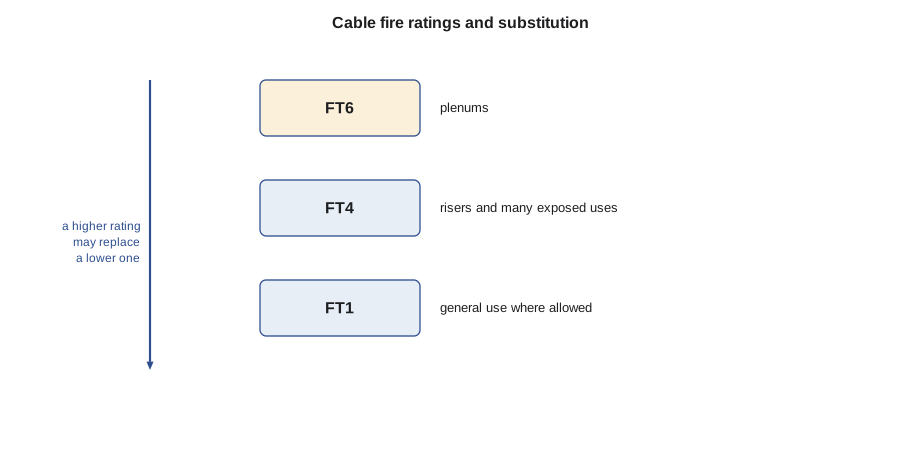
LVT-330 lesson 3 covered the CSA FT ratings, which the building code uses to say where a cable may go. FT6 passes the most severe test and is required in plenums; FT4 is required for exposed cable in buildings required to be of noncombustible construction and in vertical service spaces, with some exceptions for short lengths; FT1 is a lower rating for general use where the code allows. A cable may be used wherever a lower rating is required. Exam questions written to the NEC use the US listings: CMP for plenum, CMR for riser, CMG and CM for general use and CMX for limited use, with OFNP, OFNR and OFNG for nonconductive optical fiber.
Exam trap: a cable's category and its fire rating are separate. A Category 6A cable can be plenum-rated or riser-rated; the category says nothing about where it may go. And the rating needed for a run is set by the strictest space it passes through, so a run that passes through one plenum ceiling needs plenum cable for its whole length unless it changes type at a proper transition.
Spaces, separation and support
A plenum is a space used for environmental air, such as the space above a ceiling used as a return air path; a riser is a vertical shaft or a penetration through floors; everything else is general. LVT-330 lessons 4 and 5 covered the rules:
- Communication and Class 2 conductors are kept out of raceways and boxes with power conductors unless a barrier or a certified combination device separates them.
- Exposed communication conductors are kept apart from power conductors, commonly by 50 mm, unless raceway or metal sheath provides the separation.
- Cable is supported from the building structure, not from ceiling grid, grid wires, conduit or pipes; plenum ties and supports must be rated.
- Elevator hoistways are never used as cable pathways.
- Accessible abandoned cable is removed where the code or specification requires it; many specifications require it everywhere.
Entrances and protection
LVT-330 lesson 6 covered entrances. Copper communication conductors that enter a building from outside and could be exposed to lightning or power contact get a primary protector, installed as close as practicable to the point of entrance. The protector is bonded to the building's grounding electrode system with a short, straight bonding conductor, sized by the code with a minimum of 14 AWG copper. Outside cable that is not rated for inside use may enter only a limited distance, set by the code, before it ends at a transition to inside cable or is enclosed in raceway.
Exam trap: long, looping bonding conductors defeat the purpose. A surge rises quickly, and every metre of conductor and every bend adds impedance, so the voltage between the protector and ground during a surge rises. Short and straight is the rule.
Fire separations and firestopping
LVT-330 lessons 8 and 9 covered penetrations. A fire-rated wall or floor has an hourly rating, and every penetration through it must be sealed with a tested firestop system that restores that rating. A tested system is a specific combination of penetrant, opening size, annular space, fill and materials that has passed a fire test and is listed by a testing organization, such as UL or ULC. Two ratings describe it: the F rating, the time the system prevents flame passage, which must be at least the assembly's rating, and the T rating, the time before the unexposed side gets too hot, which the building code requires in some locations.
The installer chooses the system from the listing that matches the actual condition, installs it exactly as listed, and labels it with the system number, the date and the installer's name. Changing any variable, such as using a larger sleeve, more cables than the listed fill or a different sealant, takes the installation outside the listing. Reusable firestop devices and pathways, which let cables be added without breaking the seal, are the usual answer where cables change often.
Exam trap: a fire-rated wall needs the firestop at every penetration, including the ones hidden above the ceiling. Inspectors look above ceiling tiles first, because that is where the shortcuts are.
Bonding and TIA-607
LVT-330 lessons 10 and 11 covered bonding. Grounding connects a system to earth; bonding connects metal parts together so that they stay at the same potential. All the systems in a building, power, telecommunications, cable television and others, bond to the one grounding electrode system, so that a surge or fault cannot drive large voltages between them.
TIA-607 sets up a telecommunications bonding infrastructure. Its current names, from the D edition onward, are:
| Part | Current name | Older name | Role |
|---|---|---|---|
| Main busbar | PBB, primary bonding busbar | TMGB | Usually in the entrance facility or equipment room, bonded to the building's electrical ground |
| Floor busbars | SBB, secondary bonding busbar | TGB | In each telecommunications room |
| Backbone conductor | TBB, telecommunications bonding backbone | TBB | Connects the PBB to each SBB |
| Backbone bonding conductor | BBC | TBBIBC | Ties TBBs together where there are several |
| Bonding conductor to electrical ground | TBC, telecommunications bonding conductor | BCT | Connects the PBB to the electrical service ground |
Bonding conductors are copper and at least 6 AWG. The TBB is sized by its length, with larger conductors for longer runs, up to a maximum size, and is routed as straight as practicable. Racks, cable tray, metal pathways and equipment in each room are bonded to the busbar in that room. A common acceptance check is a low resistance between busbars; many specifications set a limit such as 100 milliohms between the PBB and any SBB.
# Three code and bonding checks: cable rating for a space, TBB size by length, busbar resistance
LADDER = ["FT6", "FT4", "FT1"]                        # highest first
NEED = {"plenum": LADDER[0], "riser": LADDER[1], "general": LADDER[2]}

def rating_ok(cable, spaces):
    need = max((NEED[s] for s in spaces), key=lambda r: -LADDER.index(r))
    return cable, need, LADDER.index(cable) <= LADDER.index(need)

for cable, route in [(LADDER[1], ["riser", "plenum"]), (LADDER[0], ["general", "riser"]), (LADDER[2], ["general"])]:
    c, need, ok = rating_ok(cable, route)
    print(f"{c} through {'+'.join(route):15s} needs {need}: {'OK' if ok else 'NOT ACCEPTABLE'}")

TBB_TABLE = [(4, '6 AWG'), (6, '4 AWG'), (8, '3 AWG'), (10, '2 AWG'), (13, '1 AWG'), (16, '1/0 AWG'), (20, '2/0 AWG'), (999, '3/0 AWG')]                          # (up to this length, conductor size)
def tbb_size(length):
    for limit, size in TBB_TABLE:
        if length <= limit:
            return size
    return TBB_TABLE[-1][1]

for floor, length in [(2, 3.8), (6, 15.8), (11, 33.5)]:
    print(f"TBB to floor {floor:2d}: {length:5.1f} m -> {tbb_size(length)}")

LIMIT_MOHM = 100
for busbar, mohm in [("SBB-2", 18), ("SBB-6", 41), ("SBB-11", 137)]:
print(f"PBB to {busbar}: {mohm} milliohm", "OK" if mohm <= LIMIT_MOHM else "OVER LIMIT, check connections")FT4 through riser+plenum needs FT6: NOT ACCEPTABLE FT6 through general+riser needs FT4: OK FT1 through general needs FT1: OK TBB to floor 2: 3.8 m -> 6 AWG TBB to floor 6: 15.8 m -> 1/0 AWG TBB to floor 11: 33.5 m -> 3/0 AWG PBB to SBB-2: 18 milliohm OK PBB to SBB-6: 41 milliohm OK PBB to SBB-11: 137 milliohm OVER LIMIT, check connections
The code collects three checks from this area: whether a cable's rating is acceptable for a space, the TBB size for each riser length using a table like the one in LVT-330 lesson 11, and a resistance check of busbar test results. The size table in the code is the one Cobalt Line uses on its projects, following the TIA approach; on the exam the table, if needed, is given in the question.
Worked problem
A rating question with a trap
A Category 6A cable marked FT4 runs from a telecommunications room up a riser, then across a ceiling space on the next floor that is used as a return air plenum. Is the cable acceptable?
Show solution
- Riser segment: FT4 is acceptable in a vertical service space.
- Plenum segment: the space requires FT6.
- The cable's rating must satisfy the strictest space on its route.
- FT4 does not satisfy FT6, and nothing in the question says the run is in a raceway that allows it.
Answer: Not acceptable; the run needs FT6 cable. The distractor that says acceptable because riser cable is fine is attractive to anyone who looks only at where the cable starts.
Inspections and corrections
Code questions sometimes take the form of an inspection scenario: a list of conditions found on a walk, and a question about which one is a code violation, or which must be corrected before cover-up. LVT-330 lesson 12 followed a full pre-inspection, and its findings make a good revision list: riser cable in a plenum ceiling; cables lying on ceiling tiles; data cable in the power side of a floor box; a missing firestop above a ceiling in a rated corridor wall; a firestop with more cables than its listing allows and no label; a looping protector bond; abandoned cable left in a ceiling; a rack in the working space in front of a panelboard; an unbonded cable tray in a telecommunications room; and a TBB that was spliced partway up the riser with an unlisted connector.
Each finding has a reason, and the exam rewards knowing the reason rather than the list. Cable ratings and firestops protect people from fire and smoke; separation and protectors protect people and equipment from power faults and surges; support rules keep cables from falling or loading other systems; working space keeps electricians safe; and bonding keeps every system at one potential. A candidate who knows the reason can answer a question about a condition she has never seen.
Worked problem
Choosing what to fix first
On a final walk before the ceiling closes, the crew finds three conditions: a few cables resting on a ceiling tile near a telecommunications room, a missing label on a firestopped sleeve, and an unsealed sleeve through a rated corridor wall. Which must be fixed before the ceiling closes, and in what order?
Show solution
- All three are deficiencies, and all three are hidden once the ceiling closes.
- The unsealed sleeve is a fire separation failure, the most serious; seal it with a listed system first.
- The cables on the tile are a support violation; support them from the structure.
- The missing label is a records issue; label the system with its number, date and installer.
Answer: All three are fixed before cover-up, in order of risk: the open penetration, the support, then the label. The exam distractor is the option that fixes only the visible item.
One more habit helps on code questions: notice which code the question is written to. A question that names NEC articles expects NEC answers, even for a Canadian candidate, and a question about local practice expects the candidate to say that the authority having jurisdiction decides.
Common mistakes
MistakeConfusing category with fire rating.
InsteadCategory is performance; the rating decides where cable may go.
MistakeRating a run by where it starts.
InsteadUse the strictest space along its whole route.
MistakeTying cable to ceiling grid wires or conduit.
InsteadSupport it from the structure.
MistakeCoiling a long protector bonding conductor neatly.
InsteadKeep it short and straight.
MistakePacking a firestopped sleeve beyond its listed fill.
InsteadInstall exactly as listed, or use a different listed system.
MistakeUsing the old names TMGB and TGB on a current drawing without noting the new ones.
InsteadKnow both: PBB and SBB are the current names.
Summary and key terms
- CEC Sections 16, 56 and 60 cover Class 2, optical fibre and communication circuits; on the exam, NEC Chapters 7 and 8 and Article 770 may appear.
- FT6 for plenums, FT4 for risers and many exposed uses; a higher rating may replace a lower one.
- Rate cable by the strictest space it passes through; support it from the structure; keep it away from power.
- Protectors go near the entrance with a short, straight bond of at least 14 AWG.
- Firestop every penetration with a tested system installed and labelled exactly as listed; F and T ratings.
- TIA-607: PBB, SBB, TBB, BBC and TBC, at least 6 AWG copper, short and straight.
- Plenum
- A space used for environmental air, such as a return air ceiling space.
- F rating
- The time a firestop system prevents flame passage through a penetration.
- T rating
- The time before the unexposed side of a firestop system gets too hot.
- PBB
- Primary bonding busbar, the main telecommunications busbar (formerly TMGB).
- TBB
- Telecommunications bonding backbone, connecting the PBB to the SBBs.
Practice problems
Work each problem on paper first, then reveal the answer to check.
Which CSA rating is required for cable in a plenum?
Show answer
FT6.
What is the current TIA-607 name for the busbar in each telecommunications room?
Show answer
SBB, secondary bonding busbar.
What does the F rating of a firestop system describe?
Show answer
The time it prevents flame passage.
What is the smallest bonding conductor TIA-607 allows?
Show answer
6 AWG copper.
Lesson quiz · 5 questions
Score 60% or more to complete this lesson.
Create a free account to save your progress, take quizzes and earn a certificate.