
LVT-340 · Lesson 5 of 12 · 21 min
Structured cabling and standards review
Structured cabling questions make up a large share of every installer exam, and they are where the standards' vocabulary matters most. A candidate who calls a telecommunications room a closet, or confuses a channel with a permanent link, may know the practice perfectly and still choose the wrong option. This review covers the material of LVT-120: the structured cabling model, the spaces, the subsystems and their limits, cable categories, pathways and documentation.
The standards family
LVT-120 lesson 2 introduced the documents. The exam expects a candidate to know which standard covers what.
| Standard | Covers |
|---|---|
| TIA-568.0 | Generic cabling for all kinds of premises; common definitions |
| TIA-568.1 | Commercial building cabling: topology, subsystems, spaces |
| TIA-568.2 | Balanced twisted-pair cabling and components, including test limits |
| TIA-568.3 | Optical fibre cabling and components, including loss allowances |
| TIA-569 | Pathways and spaces: rooms, conduit, tray, sleeves |
| TIA-606 | Administration: labelling and records |
| TIA-607 | Bonding and grounding for telecommunications |
| ISO/IEC 11801 | The international generic cabling standard, with its own class and category names |
Exam trap: the international standard calls a link performance level a class (Class EA, for example) and a component a category; TIA uses category for both. A question that mixes the two vocabularies is usually testing whether the candidate notices which standard it refers to.
Subsystems and spaces
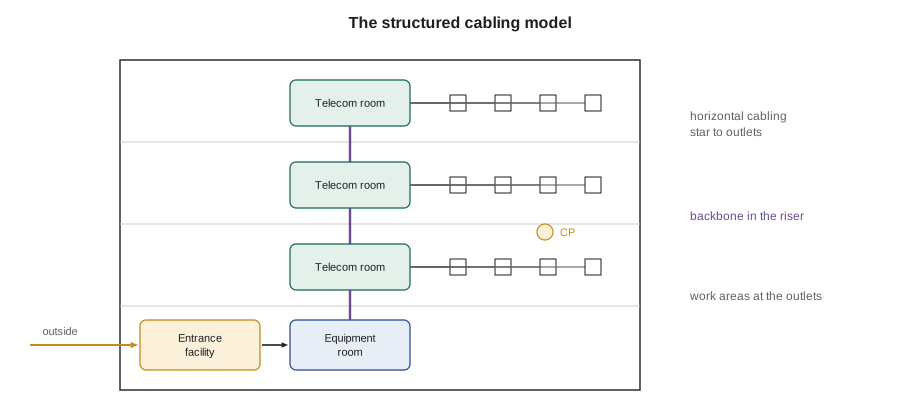
The model has a fixed set of parts, and the exam uses their names exactly.
- Entrance facility: where outside cables enter the building and change to inside cable, with primary protectors for copper.
- Equipment room: a central space for equipment that serves the building, often combined with the main cross-connect.
- Telecommunications room: the floor-serving space with the horizontal cross-connect; the term enclosure is used for small cabinets serving small areas.
- Backbone cabling: between the entrance facility, equipment room and telecommunications rooms, and between buildings on a campus.
- Horizontal cabling: from the horizontal cross-connect in the telecommunications room to the outlet in the work area, in a star topology.
- Work area: where users connect, from the outlet to the equipment.
Topology is a star at every level: each telecommunications room connects back to the main cross-connect, and each outlet connects back to its room. The standard allows no more than two levels of backbone cross-connects between the main cross-connect and a horizontal cross-connect.
The limits that are always examined
LVT-120 lesson 5 and lesson 11 covered the distances. These are the numbers to know cold.
| Item | Limit |
|---|---|
| Horizontal cable, twisted-pair | 90 m |
| Channel, including cords | 100 m |
| Equipment and patch cords, total | 10 m (with 5 m as a common guide at each end) |
| Consolidation point | At least 15 m from the telecommunications room |
| Multi-user outlet (MUTOA) | Serves no more than 12 work areas |
| Outlets per work area (minimum) | Two, under the commercial standard's recommendations |
| Conduit between pull points | No more than 30 m (100 ft) and two 90-degree bends |
The 90 and 100 metre limits are written in metres in the standards everywhere, including in the US, because they are the standard's numbers. Exam questions sometimes give a horizontal run in feet; 90 m is about 295 ft.
Exam trap: the 90 m limit applies to the horizontal cable, not to the distance between the room and the outlet along the floor. A cable that rises from the room to the ceiling, runs along a zigzag tray route and drops to a desk can be well over the straight-line distance.
Worked problem
Checking a MUTOA work area cord
An open office uses a multi-user outlet assembly. The horizontal cable to the MUTOA is 72 m. The patch and equipment cords at the room end total 5 m. The cords are 24 AWG with a derating factor of 0.2. What is the longest work area cord allowed?
Show solution
- The standard's formula for total cord length is C = (102 − H) / (1 + D).
- C = (102 − 72) / 1.2 = 25 m of cord in total.
- The work area cord is W = C − T, where T is the cord length in the room: W = 25 − 5 = 20 m.
- The standard also caps the work area cord at 22 m for 24 AWG cords; 20 m is within that.
Answer: The longest work area cord is 20 m. The trap is applying the simple 10 m cord rule, which would wrongly limit the cord to 5 m, or forgetting the derating.
# Check horizontal channels against the cabling limits, including MUTOA work area cords
D = 0.2          # derating for 24 AWG patch cords
CAP_W = 22.0     # maximum work area cord, metres, for 24 AWG

def mutoa_max_cord(h, t):
    c = (102 - h) / (1 + D)
    return min(c - t, CAP_W)

links = [  # (identifier, horizontal m, room cords m, work area cord m, MUTOA?)
    ("6A.B12", 61.0, 4.0, 3.0, False),
    ("6A.C03", 88.5, 4.5, 6.5, False),
    ("6A.D17", 92.0, 3.0, 3.0, False),
    ("6A.M04", 72.0, 5.0, 18.0, True),
    ("6A.M09", 80.0, 5.0, 16.0, True),
]
for ident, h, t, w, mutoa in links:
    probs = []
    if h > 90:
        probs.append("horizontal over 90 m")
    if mutoa:
        wmax = mutoa_max_cord(h, t)
        if w > wmax:
            probs.append(f"work area cord {w} m over {wmax:.1f} m")
    elif t + w > 10:
        probs.append(f"cords {t + w} m over 10 m")
    total = h + t + w
print(f"{ident}: channel {total:5.1f} m " + ("OK" if not probs else "; ".join(probs)))6A.B12: channel 68.0 m OK 6A.C03: channel 99.5 m cords 11.0 m over 10 m 6A.D17: channel 98.0 m horizontal over 90 m 6A.M04: channel 95.0 m OK 6A.M09: channel 101.0 m work area cord 16.0 m over 13.3 m
The code checks five links from a practice floor plan against those limits, the way Maya would on a review question with several options. Three results are worth reading closely. Link C03 is under 100 m overall but fails because its cords total 11 m; a channel can be short enough and still break the cord rule. Link D17 fails on the horizontal cable alone, even though the whole channel is under 100 m, because the 90 m limit applies to the fixed cable. And MUTOA link M09, with an 80 m horizontal run, allows only about 13.3 m of work area cord, so the 16 m cord the furniture installer supplied is too long. A candidate who checks only the 100 m total would pass all five links and miss three faults.
Categories
LVT-120 lesson 6 covered performance. Category 5e is specified to 100 MHz, Category 6 to 250 MHz, Category 6A to 500 MHz and Category 8 to 2,000 MHz over a short channel of up to 30 m with two connectors, intended for data centre switch-to-server links. Category 6A is the usual choice for new horizontal cabling, because it supports 10GBASE-T over the full 100 m channel and handles high-power PoE better than smaller cables. Category 6 supports 10GBASE-T only over shorter distances that depend on the installation's alien crosstalk. Backward compatibility means a higher category works in a lower-category application, but a channel performs only to its lowest-rated component: one Category 6 jack in a Category 6A channel makes it a Category 6 channel.
Exam trap: categories describe frequency and transmission performance, not data rate directly. A question that asks which category supports 10 Gb/s over 100 m is asking for Category 6A, but one that asks which category is specified to 250 MHz is asking for Category 6.
Pathways and spaces
TIA-569, covered in LVT-120 lesson 9, sets the pathway rules. Conduit is sized so that its fill stays within the allowed percentage, commonly 40 percent of the internal area for three or more cables; a run should have no more than two 90-degree bends, or the equivalent, between pull points, and no more than about 30 m (100 ft) between pull points. Bend radius for conduit carrying twisted-pair cable is at least six times the conduit's internal diameter for conduit up to 50 mm (2 in), and ten times for larger. Cable tray fill is also limited by the tray's capacity and the standard's percentage, and J-hooks are spaced at no more than 1.5 m (5 ft). A telecommunications room is sized to the area it serves, with at least one room per floor and more where the floor is large or horizontal runs would exceed 90 m.
Exam trap: a pull box is not a place to make a bend. Cable enters and leaves a pull box in a straight line, and the box is used to split a long or bendy run into legal segments.
Administration and labelling
TIA-606, covered in LVT-120 lesson 10, defines identifiers for spaces, cables, connectors and pathways, and four classes of administration from Class 1, for a single equipment room, to Class 4, for a campus with several buildings. A horizontal link identifier takes the form fs.an, where fs is the floor and space and an is the patch panel and port, so 3A.B12 means floor 3, room A, panel B, port 12. Labels are machine-printed, durable and placed at both ends, and the records tie each identifier to its test result.
Exam trap: identifiers name the location of the termination, not the user or the department. A label reading Accounting desk 4 may be useful to the client, but it is not a TIA-606 identifier and will be wrong after the next move.
Worked problem
Reading an identifier
A test report lists a link with identifier 2B.C07. Where are its ends?
Show solution
- fs = 2B: floor 2, telecommunications room B.
- an = C07: patch panel C, port 07.
- The other end is the outlet whose label carries the same link identifier.
Answer: One end is panel C, port 7, in room 2B; the other is the outlet labelled 2B.C07. The trap is reading C07 as a cable count.
Backbone and campus distances
Backbone cabling has its own distance limits, which depend on the medium and the application. For twisted-pair backbone used for data, the limit is the same 90 m of cable plus cords, because the same Ethernet applications run over it. For voice and low-speed applications, twisted-pair backbone can be longer, up to the limits the standard gives for those applications. Optical fibre backbone distances depend on the fibre type and the application, from a few hundred metres for multimode at high speeds to kilometres for singlemode. The standard sets maximum distances between the main cross-connect and the horizontal cross-connects, with intermediate cross-connects counted as part of the path.
Exam trap: the 90 m figure is often offered as the answer to a fibre backbone question. Fibre backbone limits are set by the application and the fibre type, not by the twisted-pair horizontal rule.
Telecommunications room sizing
The pathway standard gives guidance on room size. The common rule is at least one telecommunications room per floor, with additional rooms when the floor area served is large or when horizontal runs would exceed 90 m. Recommended room sizes grow with the area served, and rooms must have their own lighting, dedicated power, environmental control where active equipment is installed, and a bonding busbar. Rooms are not shared with electrical equipment, plumbing or storage where that can be avoided, and they are stacked vertically in multistorey buildings so that backbone cables can run straight up through sleeves.
Exam trap: a question may describe a room that is too small for the floor it serves and ask for the best solution. Adding a second room, so that no run exceeds 90 m and each room serves a reasonable area, is usually the right answer; using a longer cable is never one.
Work area and outlet practice
Each work area has at least the outlets the commercial standard calls for, with each outlet terminated on its own four-pair cable and labelled at the faceplate. Outlets are mounted at the heights the accessibility rules allow, and spare capacity is left in the faceplate and in the pathway for future cables. Equipment cords in the work area count toward the 10 m of cords in the channel, so a desk far from its outlet is solved with a closer outlet, not a long cord. Consolidation points and MUTOAs are the standard's tools for open offices that change often, and their extra rules are the reason MUTOA calculations appear on exams.
Common mistakes
MistakeCalling a telecommunications room a closet or a hub room.
InsteadUse the standard's names; exams use them exactly.
MistakeApplying the 90 m limit to the straight-line distance.
InsteadMeasure the cable's actual route.
MistakeAssuming Category 8 is for office horizontal cabling.
InsteadIt is specified for short data centre links up to 30 m.
MistakeTreating a pull box as a corner.
InsteadCable passes straight through a pull box.
MistakeLabelling outlets by user or department.
InsteadUse location-based identifiers from TIA-606.
Summary and key terms
- Know which standard covers what: 568 for cabling, 569 for pathways and spaces, 606 for administration, 607 for bonding.
- The model: entrance facility, equipment room, telecommunications rooms, backbone, horizontal and work area, in a star.
- Limits: 90 m horizontal, 100 m channel, 10 m of cords, consolidation point at least 15 m from the room, MUTOA up to 12 work areas.
- Categories: 5e at 100 MHz, 6 at 250 MHz, 6A at 500 MHz, 8 at 2,000 MHz over up to 30 m.
- Conduit: fill limits, no more than two 90-degree bends and about 30 m (100 ft) between pull points.
- Identifiers name locations, such as fs.an for a horizontal link.
- Channel
- The end-to-end transmission path, including cords, up to 100 m.
- Permanent link
- The fixed horizontal cabling from the patch panel to the outlet, up to 90 m.
- Consolidation point
- An interconnection in the horizontal cabling, at least 15 m from the room.
- MUTOA
- A multi-user telecommunications outlet assembly serving up to 12 work areas.
- Horizontal cross-connect
- The connection point in a telecommunications room where horizontal cabling terminates.
Practice problems
Work each problem on paper first, then reveal the answer to check.
What is the maximum length of the horizontal cable in a twisted-pair channel?
Show answer
90 m.
How many work areas may one MUTOA serve?
Show answer
No more than 12.
To what frequency is Category 6A specified?
Show answer
500 MHz.
What does the identifier 4C.A21 mean?
Show answer
Floor 4, room C, panel A, port 21.
Lesson quiz · 5 questions
Score 60% or more to complete this lesson.
Create a free account to save your progress, take quizzes and earn a certificate.