
LVT-340 · Lesson 1 of 12 · 20 min
Certification paths for low-voltage technicians
Maya Okonkwo started at Cobalt Line Systems as a first-term apprentice who had never terminated a jack. Nine terms later she has pulled cable through a school, certified a floor of Category 6A, spliced a campus backbone, commissioned PoE devices, set up access control, tuned a gym sound system, surveyed a hospital wing for coverage and walked a building with an inspector. This last course is about turning that experience into credentials: the certificates and licences that show an employer, a client or an inspector what she can do, and the career that can be built on them.
A credential is not the same as competence. Maya was competent at many tasks long before she held a certificate for them, and some people with certificates are not yet competent. But credentials matter in this trade for three practical reasons. Some work legally requires them. Many specifications require that the installers or the supervisor on the job hold a named certificate. And a credential is portable: it goes with the technician from one employer to the next and tells a stranger something reliable about what she knows.
Three kinds of credential
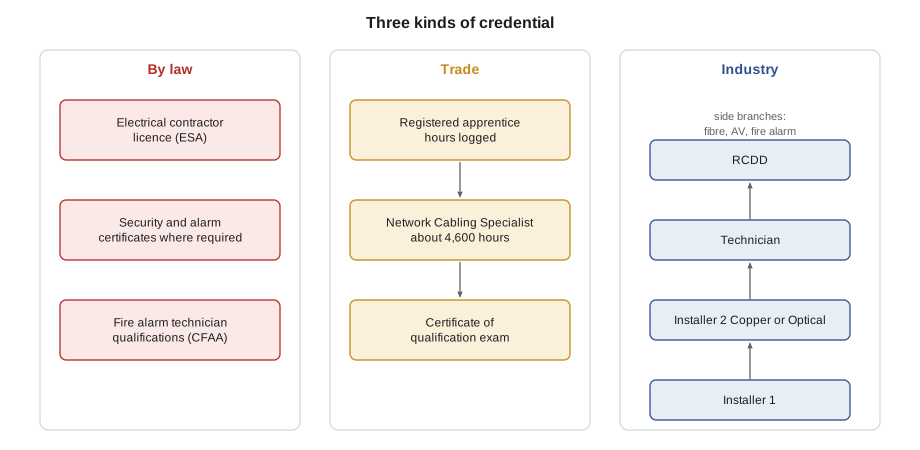
Low-voltage credentials fall into three groups, and it helps to keep them apart because they are earned, renewed and used differently.
- Licences and registrations required by law. These are issued by a government body or a regulator, and doing certain work without them is an offence. They vary by province or state and by the kind of work: alarm systems, fire alarm, electrical work above a voltage limit, or work in a licensed trade.
- Trade certificates. These are issued by the province's or state's apprenticeship authority after an apprenticeship and an exam. Some trades are compulsory, so only certified workers and registered apprentices may do the work; others are voluntary, so the certificate is proof of skill but not a legal requirement.
- Industry certifications. These are issued by associations and manufacturers: BICSI, the Electronics Technicians Association (ETA), the Fiber Optic Association, NICET for fire alarm and life safety, AVIXA for audio-visual work, and the manufacturers' own installer programs that back cabling system warranties. They are voluntary in law but often required by contract.
What the law requires
In Ontario, LVT-110 lesson 11 showed that the rules depend on the work. Electrical work is regulated by the Electrical Safety Authority, and a contractor doing electrical work needs an electrical contractor licence; work on Class 2 circuits and communication cabling is treated differently from power wiring, and ESA's guidance decides which installations need a licensed contractor and a notification. Fire alarm work is governed by the fire code and the CAN/ULC standards, and building owners and authorities expect technicians with recognized fire alarm qualifications such as CFAA registration. Security installers deal with privacy law and, for some services, the province's private security licensing. Other provinces differ: British Columbia, for example, issues a security alarm field safety representative certificate that covers Class 2 circuits up to 100 VA through Technical Safety BC.
The practical rule for a technician is to know which parts of her own work need a licence, and never to assume that because cabling is low voltage it is unregulated. When Cobalt Line bids work in a new jurisdiction, Colette Brennan checks the licensing rules before the estimate goes out, because a contract that requires licensed staff the company does not have is a contract it cannot perform.
Trade certificates
Ontario recognizes Network Cabling Specialist as a trade with an apprenticeship of about 4,600 hours, about 4,000 of them on the job and about 600 in school over two levels. The trade is voluntary: it is not compulsory, so uncertified workers may do the work, and the certificate does not need renewal. An apprentice who completes the program and passes the provincial certificate of qualification exam receives a certificate from Skilled Trades Ontario. Maya registered as an apprentice in her first term, and her hours log, signed each term by Dev Malhotra, is the record that lets her write the exam. A voluntary certificate still carries weight: it is the government's statement that she has completed a full apprenticeship and passed a standardized exam.
Industry certifications
BICSI, an international association for information and communications technology, runs the best-known installer program. Its ladder starts with Installer 1, an entry-level credential with no experience requirement, and continues to Installer 2 Copper and Installer 2 Optical Fiber, which require field experience, then Technician, which requires broader experience or both Installer 2 credentials, and on to the Registered Communications Distribution Designer (RCDD) for designers. Lesson 2 covers how those exams work. Other industry credentials Maya's colleagues hold include:
- Hollis Tran: Installer 2 Optical Fiber, plus the ETA Fiber Optics Installer certification, which tests fibre theory and practical skills.
- Frank Delisle: in-building wireless certifications from the equipment makers and a radio industry certificate for public safety systems.
- Wendell Price: AVIXA's Certified Technology Specialist (CTS), the general audio-visual credential.
- Sanjay Iyer: the RCDD, which the company needs on design-build projects.
- Most of the crew: manufacturer installer certifications, which let Cobalt Line issue the manufacturer's extended warranty on a cabling system, as in LVT-130 lesson 12.
Manufacturer programs deserve a word. A cabling manufacturer's 25-year system warranty, the kind Brightwater received on the Kellerman sixth floor, requires that the installing company be a certified installer with a set number of trained staff on the job. Losing those trained staff, or letting their training lapse, can stop a company from offering the warranty, which can stop it from winning the work. For a technician, manufacturer training is usually paid for by the employer and is often the first certificate she earns.
Choosing a path
There is no single right order. Maya's own path, set out with Dev at the start of her apprenticeship and adjusted along the way, looks like this:
| Stage | Credential | Why at that point |
|---|---|---|
| Term 2 | BICSI Installer 1 | No experience needed; proves the basics early |
| Term 4 | Manufacturer certified installer | Needed for warranty jobs like Kellerman |
| Term 10 | BICSI Installer 2 Copper | Six months of field work after Installer 1 makes her eligible |
| Term 10 | Network Cabling Specialist certificate | Hours and school complete |
| Next | Installer 2 Optical Fiber, then Technician | Fibre work with Hollis; leading crews |
| Later | RCDD or a specialist path | Design, project management or a specialty |
Teo Barros, a second-year apprentice, is at the start of the same path. He will sit Installer 1 this term, and Maya, who wrote it two years ago, is helping him prepare. Much of this course follows the two of them: Maya preparing for a harder exam and a career decision, Teo preparing for his first.
What employers and clients look for
Certifications appear in specifications in a few standard forms. A specification may require that the installing contractor be a certified installer for the cabling system being supplied, that a named number of the installers on site hold a manufacturer certificate, that the job supervisor or lead technician hold a BICSI Technician or Installer 2 credential, or that the design be stamped by an RCDD. Public agencies and hospitals are the most demanding. St. Brendan's specification for the east wing, for example, required an RCDD on the design, a BICSI Technician as site lead and certificates for every person terminating cable. The project manager has to be able to show those certificates on request, so Cobalt Line keeps a credential register with every employee's certificates, numbers and expiry dates.
# Credential register check before a bid: who is qualified, and what expires during the job
from datetime import date

JOB_START, JOB_END = date(2027, 1, 11), date(2027, 6, 25)
staff = [  # (name, credential, expires or None)
    ("Dev Malhotra", "BICSI Technician", date(2028, 3, 31)),
    ("Maya Okonkwo", "BICSI Installer 1", None),
    ("Maya Okonkwo", "Manufacturer installer", date(2027, 9, 30)),
    ("Teo Barros", "Manufacturer installer", date(2027, 2, 28)),
    ("Hollis Tran", "BICSI Installer 2 Optical Fiber", date(2027, 6, 30)),
    ("Hollis Tran", "Manufacturer installer", date(2026, 12, 31)),
    ("Sanjay Iyer", "BICSI RCDD", date(2028, 1, 31)),
    ("Frank Delisle", "Manufacturer installer", date(2028, 5, 31)),
]
need = {"Manufacturer installer": 3, "BICSI Technician": 1, "BICSI RCDD": 1}

for cred, n in need.items():
    ok = [p for p, c, exp in staff if c == cred and (exp is None or exp >= JOB_END)]
    lapse = [p for p, c, exp in staff if c == cred and exp is not None and JOB_START <= exp < JOB_END]
    status = "OK" if len(ok) >= n else "SHORT"
    print(f"{cred:24s} need {n}  valid all job {len(ok)}  {status}")
    gone = [p for p, c, exp in staff if c == cred and exp is not None and exp < JOB_START]
    for p in lapse:
        print(f"    {p}: expires during the job, renew before {JOB_START}")
    for p in gone:
print(f" {p}: expired before the job starts, renew now")Manufacturer installer need 3 valid all job 2 SHORT
Teo Barros: expires during the job, renew before 2027-01-11
Hollis Tran: expired before the job starts, renew now
BICSI Technician need 1 valid all job 1 OK
BICSI RCDD need 1 valid all job 1 OKThe code runs a short extract of the register, eight entries for a crew Colette is considering for a spring job, against three requirements. It reports the crew one manufacturer certificate short: Teo's certificate runs out partway through the job and Hollis's has already lapsed. Neither problem is serious if it is caught at bid time, because a refresher course takes a day; both are serious if they are caught by the client's inspector in month three. This is the kind of report Colette runs before every bid, and for Maya it is a reminder that a credential is something to maintain, not just to earn.
Renewal and continuing education
Most industry credentials expire unless they are renewed. BICSI credentials above Installer 1 run on a three-year cycle and are renewed by earning continuing education credits (CECs) and completing an ethics course. Installer 1 is a certificate that does not need renewal. Fire alarm and alarm licences have their own renewal periods and continuing education hours. Manufacturer certifications usually need a refresher course every few years. Lesson 12 builds Maya's renewal tracker; for now the point is that every credential comes with a date to watch.
Continuing education is not a formality. The standards change: TIA-568 has moved through several editions during Maya's apprenticeship, the electrical codes change every three years, PoE power has increased, and Wi-Fi has gained a new band. A technician who renews by attending courses on what has changed is a better technician, and the renewal rules are designed to make that happen.
Worked problem
Matching people to a specification
Colette is bidding a library renovation. The specification requires: the contractor to be a certified installer for the proposed cabling system; at least half of the installers on site to hold that manufacturer's installer certificate; a site lead holding BICSI Technician or Installer 2 Copper; and an RCDD to review the shop drawings. Cobalt Line plans a crew of six for the job.
Show solution
- Company certification: Cobalt Line is current with the manufacturer; check that it stays current for the job's length.
- Installers: at least 3 of the 6 must hold the manufacturer certificate; the register shows 9 people who do, so pick 3 or more of them for the crew.
- Site lead: Dev holds Technician; Maya will hold Installer 2 Copper if she passes this term, which would give a second qualified lead.
- Design review: Sanjay's RCDD covers it; confirm his renewal date falls after the review dates.
Answer: The bid can name a qualified crew, and Maya's exam result this term affects whether she can be named as an alternate site lead.
Credentials and honesty
One more point about credentials belongs in a first lesson. A certificate is a statement made on the technician's behalf to people who will rely on it, so it carries an obligation. Listing a credential that has lapsed, claiming one that was never earned, or signing a test report for work someone else did are all forms of misrepresentation, and the certifying bodies treat them seriously: BICSI's ethics course, required at each renewal, exists for exactly this reason. Cobalt Line's register is checked against the certifying bodies' online verification tools before a bid names anyone, and Colette has removed people from bids when a certificate could not be confirmed. Maya learned early that a credential's value comes from the fact that people can trust it, and that trust is the technician's to keep or lose.
Common mistakes
MistakeAssuming low-voltage work needs no licence anywhere.
InsteadCheck the jurisdiction's rules for alarm, fire alarm, access control and electrical work.
MistakeTreating a voluntary trade certificate as worthless.
InsteadIt is the government's record of a completed apprenticeship and a standardized exam.
MistakeLetting a credential lapse because the work does not require it today.
InsteadSpecifications on the next job may; track renewal dates.
MistakeCollecting certificates without the experience behind them.
InsteadCredentials are most valuable when they match real work the technician can show.
MistakeForgetting that manufacturer warranties depend on trained staff.
InsteadKeep manufacturer training current so the company can offer the warranty.
Summary and key terms
- Credentials fall into three groups: licences required by law, trade certificates and industry certifications.
- Ontario's Network Cabling Specialist is a voluntary trade of about 4,600 hours with a certificate of qualification exam; electrical, fire alarm and security work have their own rules.
- BICSI's ladder runs from Installer 1 through Installer 2 Copper and Optical Fiber to Technician and the RCDD.
- Specifications often require manufacturer certification, certified installers on site and named BICSI credentials.
- Most credentials expire and are renewed with continuing education; keep a register of dates.
- Licence
- Permission from a government body to do regulated work.
- Trade certificate
- A certificate issued after an apprenticeship and an exam by the apprenticeship authority.
- Industry certification
- A credential issued by an association or manufacturer to show knowledge and skill.
- Certified installer program
- A manufacturer's program that trains installers so the company can offer the system warranty.
- Continuing education credit
- A unit of approved training used to renew a credential.
Practice problems
Work each problem on paper first, then reveal the answer to check.
Name the three groups of credentials.
Show answer
Licences required by law, trade certificates and industry certifications.
Which BICSI credential has no experience requirement?
Show answer
Installer 1.
Why does a manufacturer warranty depend on staff training?
Show answer
The manufacturer requires certified, trained installers before it will warrant the system.
What should a company do before bidding in a new jurisdiction?
Show answer
Check the licensing rules for the kinds of work in the contract.
Lesson quiz · 5 questions
Score 60% or more to complete this lesson.
Create a free account to save your progress, take quizzes and earn a certificate.