
LVT-340 · Lesson 11 of 12 · 19 min
Hands-on skills checklist and practical assessments
The practical part of an installer exam is short, timed and unforgiving. Each task takes about as long as a coffee break, an evaluator watches and fills in a checklist, and one critical error fails the task no matter how good the rest is. Candidates with years of field experience sometimes fail practical tasks they do every day, because the exam measures doing the task exactly to the reference, cleanly and in time, under observation. This lesson builds the checklists Cobalt Line uses to prepare apprentices for practical assessments and describes how Maya and Teo practised with them.
What practical tasks look like
The certifying bodies publish the general content of their practical exams but not the exact tasks or scoring sheets. Across the installer programs and the employer assessments Maya has seen, the tasks fall into a few families:
- Copper termination: terminate a jack or a patch panel port to a named wiring scheme, keeping twists and jacket position within limits, then test it.
- Copper testing: set up a field tester with the right limit, adapters, NVP and reference, test a link, save the result under the right name and interpret a fault.
- Fibre termination and splicing: prepare a cable, cleave and fusion splice, or install a connector, then inspect and test.
- Fibre testing: set a reference by the specified method and measure loss at the right wavelengths; or read an OTDR trace.
- Pathways and support: install supports, dress a bundle, mount hardware, firestop a penetration from a listing.
- Administration: label to an identifier scheme and complete a record.
Installer 1 tasks are basic and mostly copper; Installer 2 Copper adds testing and troubleshooting; Technician adds more tasks and a wider spread of skills. Each task has a time limit and a checklist with critical items, which fail the task, and workmanship items, which add up to a score.
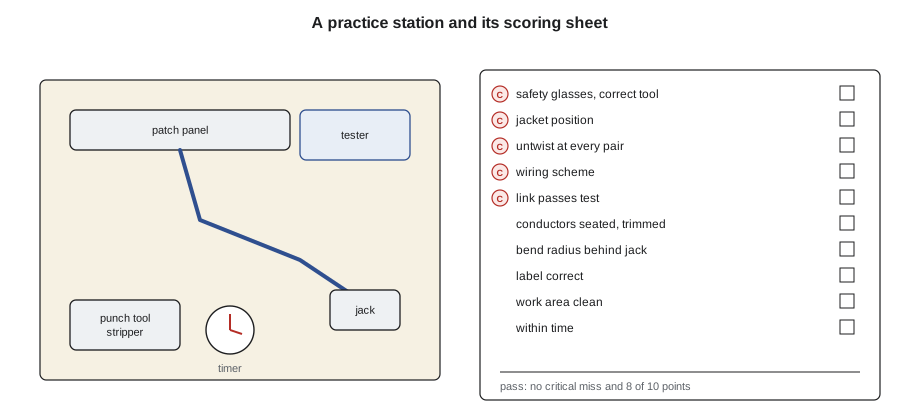
Building a checklist
A good checklist describes observable results, not intentions. Try to keep twists is not checkable; untwist no more than 13 mm (0.5 in) at each pair, measured with a rule is. Dev writes each checklist from the reference and the manufacturer's instructions, marks the items that would make the work unacceptable as critical, and gives the rest a point value. The checklist for terminating a Category 6A jack is typical.
| Item | Type | Check |
|---|---|---|
| Safety glasses and correct tool used | Critical | Observed |
| Jacket ends within the connector maker's limit of the termination | Critical | Measured |
| Untwist within the maker's limit at every pair | Critical | Measured |
| Wiring scheme correct at both ends | Critical | Wiremap test |
| Link passes the test set by the evaluator | Critical | Tester result |
| Conductors seated fully, trimmed flush | 2 points | Visual |
| Bend radius kept behind the jack | 2 points | Visual |
| Cap or strain relief fitted as designed | 1 point | Visual |
| Label applied, legible and correct | 2 points | Visual |
| Work area clean, offcuts collected | 1 point | Visual |
| Finished within the time limit | 2 points | Clock |
The pass rule Dev uses for practice is: no critical item missed, and at least 8 of the 10 workmanship points. That is stricter than many real exams, by design. An apprentice who passes Dev's checklist consistently will pass the exam's version, which may score differently but rewards the same things.
# Score a practical attempt against a checklist: any missed critical item fails the task
CHECKLIST = [  # (item, critical?, points)
    ("safety glasses and correct tool", True, 0),
    ("jacket within maker's limit", True, 0),
    ("untwist within maker's limit", True, 0),
    ("wiring scheme correct", True, 0),
    ("link passes test", True, 0),
    ("conductors seated and trimmed", False, 2),
    ("bend radius behind jack", False, 2),
    ("cap or strain relief fitted", False, 1),
    ("label correct and legible", False, 2),
    ("work area clean", False, 1),
    ("within time limit", False, 2),
]
NEED_POINTS = 8

def score(name, missed):
    crit = [i for i, c, _ in CHECKLIST if c and i in missed]
    pts = sum(p for i, c, p in CHECKLIST if not c and i not in missed)
    result = "PASS" if not crit and pts >= NEED_POINTS else "FAIL"
    why = ("critical: " + ", ".join(crit)) if crit else f"{pts} of 10 points"
    print(f"{name:16s} {result}  ({why})")

score("Teo attempt 1", {"untwist within maker's limit", "label correct and legible", "within time limit"})
score("Teo attempt 2", {"untwist within maker's limit"})
score("Teo attempt 3", {"work area clean"})
score("Maya attempt 1", {"cap or strain relief fitted", "within time limit", "work area clean"})
score("Maya attempt 2", set())Teo attempt 1 FAIL (critical: untwist within maker's limit) Teo attempt 2 FAIL (critical: untwist within maker's limit) Teo attempt 3 PASS (9 of 10 points) Maya attempt 1 FAIL (6 of 10 points) Maya attempt 2 PASS (10 of 10 points)
The scorer is the same logic the evaluator applies on paper. Teo's second attempt shows the pattern Dev sees in most apprentices: good workmanship, one critical miss. In Teo's case it was untwist on the blue pair, measured at 11 mm (7/16 in) against the 6 mm (1/4 in) the jack maker specifies. It would have passed the general 13 mm (0.5 in) limit, and it failed this task, because the task card names the jack and the jack's own limit governs.
How to practise
Practice for a practical exam follows the same principles as study for a written one: repetition spaced over days, under conditions like the exam, with feedback against a standard.
- Use the real materials and tools. Practise on the jack and panel types the exam is likely to use, with a good punch-down tool and a quality stripper. Unfamiliar hardware on exam day costs minutes.
- Time every attempt. Start with no clock to learn the steps, then add the clock and keep a log of times. Aim to finish with a quarter of the time to spare, because the exam bench will be unfamiliar.
- Check against the checklist after every attempt. A partner or mentor scores some attempts; self-scoring is fine for others, if done honestly with a rule and a tester.
- Build a fixed layout. Put tools in the same places every time: stripper, punch tool, scissors, rule, labels, tester. Under pressure, hands find tools by habit.
- Rehearse recovery. Practise what to do after an error, such as re-terminating a jack quickly and cleanly. On the exam, recognizing and fixing a mistake before calling the evaluator is part of the skill.
Maya's practice for Installer 2 Copper concentrated on the testing and troubleshooting tasks, which she does less often than termination. Dev set up a practice board with eight links, each with a seeded fault: a split pair, a reversed pair, an open, a short, a kinked section, an over-untwisted termination, a bad patch cord and a link 3 m over length. Maya's job was to test each one, name the fault and say where it was, within a time limit. Her first attempt found six of eight in time; by the fourth she found all eight with time to spare.
Common practical errors
| Error | Why it happens | Prevention |
|---|---|---|
| Too much untwist | Untwisting to make lacing easier | Lace from the jacket outward and trim last |
| Jacket pulled back too far | Stripping too much at the start | Strip only what the connector needs; measure |
| Wrong wiring scheme | Habit from the last job | Read the task card; check the colour code on the jack |
| Dirty fibre end face | Skipping inspection to save time | Inspect before every connection |
| Wrong tester setup | Leaving the last job's limit or NVP selected | Use a setup checklist before every test |
| Missing safety glasses for fibre | Forgetting under time pressure | Put them on before opening the fibre kit |
| Labels wrong or missing | Labelling left to the end and rushed | Label as part of the task, not after it |
On the day
A few habits help on practical exam day. Read the task card fully before touching anything; it states the wiring scheme, the labels, the test limit and any special instructions, and candidates who skim it lose points for following their habit instead. Ask the evaluator about anything unclear before starting, because questions are usually allowed then and not during the task. Lay out the tools in the practised order. Work steadily, not fast. Before calling the evaluator, run through the critical items on your own mental checklist: scheme, untwist, jacket, test, label. If something is wrong and there is time, fix it.
Evaluators are not trying to fail candidates; they score what they see. Clean, deliberate work in the right order is easy to score. Work that is correct but chaotic, with offcuts everywhere and a label applied in the last ten seconds, invites lost points.
Worked problem
Planning a 20-minute task
A practice task asks Teo to terminate both ends of a 3 m (10 ft) link, one end to a jack and one to a patch panel, test it and label both ends, in 20 minutes.
Show solution
- Read the task card and set out tools: 1 minute.
- Prepare and terminate the jack: 5 minutes.
- Prepare and terminate the panel port: 5 minutes.
- Test with the specified setup: 2 minutes.
- Label both ends: 2 minutes.
- Self-check against the critical items and clean up: 2 minutes, leaving 3 minutes in reserve.
Answer: A plan of 17 minutes in a 20-minute task. Teo's first timed attempts took 24 minutes; the time was lost in stripping and lacing, which he then practised separately until each termination took under 5 minutes.
Beyond the exam
Checklists are not just exam tools. Cobalt Line uses the same lists for quality checks on real jobs, where Greta Lindqvist samples a share of each crew's terminations against the checklist every week. The lists also make onboarding faster: a new hire who can pass the practice checklists is ready to work unsupervised on those tasks. For Maya, now writing checklists herself for the apprentices she will train, the discipline of turning good practice into observable, checkable steps is the start of being a lead hand.
Practical tasks for fibre and other skills
Fibre practical tasks have their own critical items, and they are mostly about safety and cleanliness. Safety glasses are on before the fibre kit opens, every fibre offcut goes into the marked container, and no food or drink is on the bench. The end face of every connector is inspected before it is mated, and an evaluator who sees a connector mated without inspection may fail the task even if the loss is good. Splicing tasks usually require the splice to be protected with a sleeve and placed in the tray correctly, with the fibre routed within its bend radius, and the splicer's loss estimate recorded. Loss testing tasks require the reference to be set by the specified method and the test done at the specified wavelengths. A candidate who practises the order of operations, safety, cleave or polish, inspect, connect, test, record, until it is automatic will rarely miss a critical item.
Other practical tasks, such as installing a firestop system or bonding a rack, are scored on whether the work matches the listing or the standard: the right materials, the right depth of sealant, the label, the bonding conductor size, the connection method and the absence of paint or coating at the bonding point. Reading the listing or the drawing first is the step most candidates skip.
Feedback that helps
When Dev scores a practice attempt, he follows a fixed pattern: one thing that was done well, the critical items first if any were missed, then the one workmanship item that would add the most points. He does not list every small fault, because a long list is hard to act on. Maya now uses the same pattern with Teo, and has found that it works as well for her own self-scoring: name the critical problem, fix it, then work on the next most valuable improvement.
Practising under pressure
Two weeks before his exam, Teo practised a full mock practical with a stranger as evaluator: Wendell, from the AV crew, whom Teo had barely spoken to. The point was the pressure of being watched by someone unfamiliar, which is the condition that makes careful people rush. Teo's first two tasks were slower than his usual times; by the third he had settled. Maya recommends the same exercise to every apprentice: the first time being watched should not be the exam.
Common mistakes
MistakeSkimming the task card.
InsteadRead it fully; it states the scheme, labels and limits.
MistakePractising without a clock.
InsteadTime attempts and log the times.
MistakePractising only strong tasks.
InsteadSpend practice on the tasks done least often in the field.
MistakeCalling the evaluator without a final self-check.
InsteadRun through the critical items first.
MistakeLabelling at the last moment.
InsteadLabel as part of the task.
Summary and key terms
- Practical tasks cover termination, testing, fibre work, pathways and administration, each timed and scored.
- Checklists have critical items that fail the task and workmanship items that add points.
- Write checklist items as observable, measurable results.
- Practise with real materials, a clock, a fixed tool layout and feedback after every attempt.
- Seeded-fault boards build testing and troubleshooting skill.
- On the day: read the task card, ask questions first, work steadily, self-check before calling the evaluator.
- Practical exam
- An assessment in which the candidate performs tasks while an evaluator scores them.
- Task card
- The written instructions for a practical task, with its requirements and limits.
- Critical item
- A checklist item that fails the task if missed.
- Workmanship item
- A checklist item that adds to or subtracts from the score.
- Seeded fault
- A deliberate fault built into a practice link for troubleshooting practice.
Practice problems
Work each problem on paper first, then reveal the answer to check.
What makes a checklist item useful?
Show answer
It describes an observable, measurable result.
What should a candidate do before touching anything at a practical station?
Show answer
Read the task card fully.
Why use a fixed tool layout?
Show answer
So hands find tools by habit under time pressure.
What fails a practical task regardless of other scores?
Show answer
A missed critical item.
Lesson quiz · 5 questions
Score 60% or more to complete this lesson.
Create a free account to save your progress, take quizzes and earn a certificate.