
LVT-340 · Lesson 12 of 12 · 19 min
Capstone: a full practice exam and a career plan
Four weeks before her Installer 2 Copper exam, Maya sat a full practice exam under exam conditions: 100 questions, two hours, a basic calculator, no notes, in the quiet training room at Cobalt Line's office with Dev as invigilator. Teo sat a 75-question practice exam for Installer 1 the same morning. This capstone follows the practice exams, the analysis that came after them, the last weeks of preparation and the real exams, and then turns to the bigger question every apprentice faces at the end of an apprenticeship: what next.
The practice exam
Dev assembled Maya's practice exam from the study group's question bank, which the crew has built over several years. All of its questions are original, written by Cobalt Line's own staff to the blueprint's domains and checked against the reference; none are copied from a real exam, which would break the certifying body's rules and teach nothing about the reference. He weighted the domains as in lesson 3 and mixed easy recall questions with calculations and scenario questions, as a real exam does.
Maya used the three-pass method from lesson 2. On her first pass, she answered 71 questions and flagged 29 in 58 minutes. On the second pass she worked the flagged questions, which took 41 minutes. The third pass, reviewing flagged and uncertain answers, used the last 21 minutes; she changed four answers, three of them correctly.
# Score a practice exam by domain against a 70 percent line
results = {  # domain: (correct, questions)
    "Safety": (8, 10),
    "Standards and codes": (14, 20),
    "Pathways and installation": (17, 20),
    "Termination": (19, 20),
    "Testing": (13, 20),
    "Fibre, bonding, other": (7, 10),
}
LINE = 0.70
right = sum(c for c, n in results.values()); total = sum(n for c, n in results.values())
print(f"Overall {right}/{total} = {right / total:.0%}")
for d, (c, n) in sorted(results.items(), key=lambda kv: kv[1][0] / kv[1][1]):
    pct = c / n
    flag = "  <- at or below the line" if pct <= LINE else ""
print(f" {d:26s} {c:2d}/{n:2d} {pct:4.0%} " + "#" * round(pct * 20) + flag)Overall 78/100 = 78% Testing 13/20 65% ############# <- at or below the line Standards and codes 14/20 70% ############## <- at or below the line Fibre, bonding, other 7/10 70% ############## <- at or below the line Safety 8/10 80% ################ Pathways and installation 17/20 85% ################# Termination 19/20 95% ###################
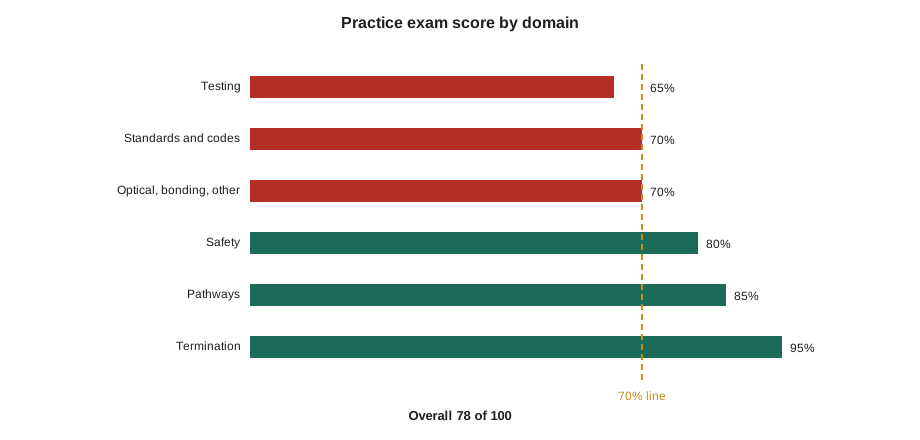
Her overall score, 78 percent, was above the pass mark the study group uses for practice, but the domain breakdown told the real story. Testing and standards, the two domains her plan had targeted, were still the lowest. They had improved from her week-one scores, but not enough to be safe: a bad day in those two domains on the real exam could pull her below the line.
Analysing the misses
Maya logged all 22 misses in her mistake log, with a cause for each, as in lesson 3.
| Cause | Count | Examples | Action |
|---|---|---|---|
| Did not know | 8 | Delay skew limit; accuracy level names; a TIA-606 class | Flashcards and the reference sections |
| Misread | 6 | Two except questions; a maximum read as minimum | Slow down on the stem; mark key words |
| Calculation | 4 | MUTOA cord without derating; bits and bytes | Redo with every unit written |
| Confused rules | 3 | Permanent link and channel adapters; CMR and CMP substitution | Comparison cards |
| Changed a right answer | 1 | Bend radius during pulling | Change only for a clear reason |
The pattern was encouraging. Only eight misses were gaps in knowledge, and most of those were narrow facts that flashcards fix quickly. The six misreadings and four calculation errors were technique, and technique improves fast with deliberate practice. Dev and Maya recalculated her plan with the practice scores replacing the self-ratings, and the code from lesson 3 sent most of her remaining 20 hours to testing and standards, with short sessions on calculations and a daily ten-minute drill on reading stems.
Teo's practice exam told a different story. He scored 64 percent, below the line, with misses spread across every domain. His causes were mostly did not know, which meant his study had been too shallow and too short. He moved his exam date back three weeks, which the testing provider allowed for a small fee, and doubled his weekday sessions. That is not a failure; it is exactly what a practice exam is for.
The last weeks
Maya's final three weeks followed the plan: weekday sessions on the target domains, flashcards at lunch, a mixed 50-question practice set each Saturday with full review, and, twice a week, half an hour on Dev's seeded-fault board for the practical tasks. Her Saturday scores rose from 78 to 84 to 88 percent, and the testing domain rose from 65 to 85. In the last three days she learned nothing new, did a light review of her comparison cards and her mistake log, and slept normally.
On the day she arrived at the testing centre forty minutes early with her identification, did the practical tasks in the morning, and sat the written part in the afternoon. The testing and troubleshooting station gave her a link with a fault she had not seen on Dev's board: a good termination but a damaged section of cable at 17 m (56 ft), where a cable tie had been pulled so tight that it deformed the jacket. The time-domain plot showed the reflection at the distance, she named the cause and location, and the evaluator ticked the box.
Three weeks later, the result arrived: pass. Teo passed Installer 1 on his rescheduled date, with a written score well above the line and every practical task passed on the first attempt.
Keeping the credential
A credential above Installer 1 starts a renewal clock the day it is issued. Maya's Installer 2 Copper runs on BICSI's three-year cycle: before it ends she must earn the required continuing education credits, complete the ethics course and pay the renewal fee. Recent BICSI material lists 15 credits per cycle for the Installer 2 credentials and 18 for Technician; the current handbook is the authority. Credits come from BICSI courses and conferences, manufacturer training, college courses and other approved activities, each worth a set number of credits.
# Continuing education tracker for one three-year renewal cycle
from datetime import date

CYCLE_START, CYCLE_END = date(2027, 3, 1), date(2030, 2, 28)
REQUIRED, ETHICS_DONE = 15, False
earned = [  # (date, activity, credits)
    (date(2027, 5, 12), "Manufacturer installer refresher", 3),
    (date(2027, 10, 4), "Fibre splicing course", 4),
    (date(2028, 2, 20), "Regional conference sessions", 2),
]
today = date(2028, 3, 1)
total = sum(c for _, _, c in earned)
elapsed = (today - CYCLE_START).days / (CYCLE_END - CYCLE_START).days
print(f"Credits {total} of {REQUIRED} after {elapsed:.0%} of the cycle")
print(f"On pace: {total / REQUIRED >= elapsed}; still needed: {max(0, REQUIRED - total)}")
print("Ethics course done:", ETHICS_DONE)
print(f"Renew before {CYCLE_END}")Credits 9 of 15 after 33% of the cycle On pace: True; still needed: 6 Ethics course done: False Renew before 2030-02-28
The tracker shows Maya on course after her first year, with most of her credits already from training courses the company pays for. The habit that matters is recording each course as it happens, with its certificate, rather than reconstructing three years of training a month before the deadline.
Her Network Cabling Specialist certificate of qualification does not need renewal, because the trade is voluntary, but she keeps her hours log and certificate with her other records, because employers and clients ask for them.
Career paths
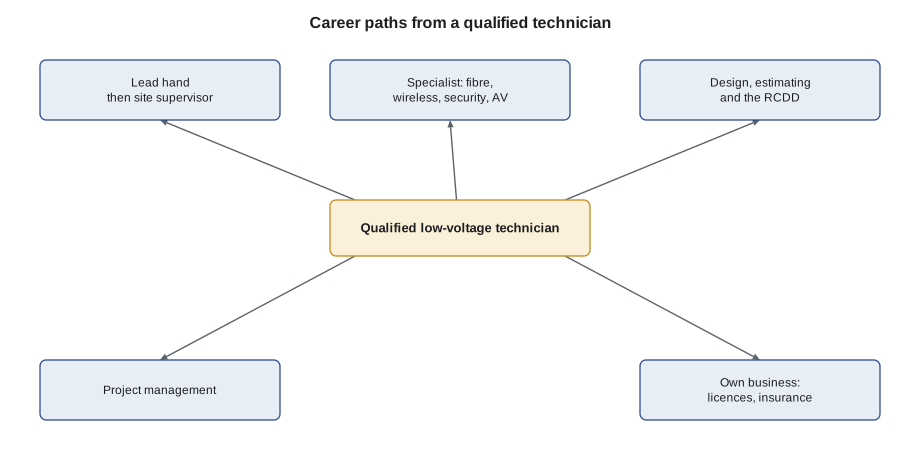
With her apprenticeship finished, Maya sat down with Dev and Colette to talk about the next five years. The paths open to a qualified low-voltage technician are wider than most people outside the trade realize.
- Lead hand and site supervisor: running a crew, planning the work, managing quality and safety and dealing with the general contractor. The credential that supports it is BICSI Technician, and the skills are planning, communication and the ability to teach.
- Specialist: fibre and outside plant with Hollis, in-building wireless with Frank, security and access control, or audio-visual with Wendell. Specialists are scarce, and each specialty has its own credentials: Installer 2 Optical Fiber and fibre certifications, wireless and public safety radio certifications, security certifications, or AVIXA's CTS.
- Design and estimating: working with Sanjay on layouts, quantities, specifications and bids, with the RCDD as the long-term goal. Design needs field experience; the best designers have pulled cable.
- Project management: scheduling, budgets, contracts and clients, as Colette does, often with a project management credential.
- Own business: some technicians start their own contracting companies. That brings licensing, insurance, bonding, estimating and the responsibility for other people's paycheques, and most who succeed spend years as supervisors first.
Pay generally rises with responsibility and scarcity. As a reference point, the US Bureau of Labor Statistics reported a median of about 66,200 US dollars a year for telecommunications equipment installers and repairers in May 2025; supervisors, specialists and designers usually earn more, and pay varies widely by region and employer. In Canada, government labour market information publishes wage ranges by occupation and region for cabling technicians and related trades. The numbers in the code below are illustrative only, to show how a comparison might be set out.
# Comparing career paths over five years (illustrative figures only, not wage data)
paths = {  # path: (starting pay index, yearly growth, extra training hours, years to the next credential)
    "Lead hand": (1.10, 0.04, 80, 2),
    "Fibre specialist": (1.08, 0.05, 120, 2),
    "Wireless specialist": (1.10, 0.05, 160, 3),
    "Design and estimating": (1.00, 0.06, 300, 4),
    "Project management": (1.05, 0.05, 200, 3),
}
for name, (start, growth, hours, years) in paths.items():
    five = start * (1 + growth) ** 5
print(f"{name:22s} index now {start:.2f}, in 5 years {five:.2f}; about {hours} h of training, next credential in {years} years")Lead hand index now 1.10, in 5 years 1.34; about 80 h of training, next credential in 2 years Fibre specialist index now 1.08, in 5 years 1.38; about 120 h of training, next credential in 2 years Wireless specialist index now 1.10, in 5 years 1.40; about 160 h of training, next credential in 3 years Design and estimating index now 1.00, in 5 years 1.34; about 300 h of training, next credential in 4 years Project management index now 1.05, in 5 years 1.34; about 200 h of training, next credential in 3 years
Maya chose the fibre specialist route for the next two years, working with Hollis toward Installer 2 Optical Fiber, and then Technician, with an eye on a lead hand role. The comparison helped less with the numbers than with the questions it raised: which path she would enjoy, which skills she would need, and what training the company would support. Colette agreed to put her on the next campus fibre job and pay for the fibre course; Maya agreed to mentor Teo through his next two terms.
Looking back over the program
Maya's apprenticeship ran through the whole of the Low-Voltage Technician program: the safe first install of LVT-110, the Kellerman floor designed in LVT-120 and certified in LVT-130, the campus backbone of LVT-210, the PoE floor of LVT-220, Juniper Point's security systems in LVT-230, Riverside's gym in LVT-310, St. Brendan's coverage in LVT-320 and the code inspection of LVT-330. Each capstone was a real job with a real problem, and each problem was found and fixed by someone who knew the standard, checked the work and kept records. That is the trade in one sentence, and it is what the exams try, imperfectly, to measure.
Worked problem
A credential plan for Teo
Teo has just passed Installer 1 in his second year. He wants to work toward Installer 2 Copper and later a specialty. Using the routes in lesson 2, when is he eligible, and what should he do now?
Show solution
- Installer 2 Copper eligibility by the first route: Installer 1 plus about six months of structured cabling experience.
- Teo already has more than six months of copper work, so he is eligible now, but his practice score shows he needs depth first.
- Plan: one more year of varied copper work, including testing and troubleshooting, then sit Installer 2 Copper.
- Meanwhile: manufacturer installer training, a mistake log from every job's test failures, and a first look at fibre with Hollis.
Answer: Teo will sit Installer 2 Copper in about a year, with the experience behind it. Eligibility is the earliest date, not the best one.
Common mistakes
MistakeTreating a passing practice score as proof of readiness.
InsteadRead the domain breakdown; weak domains can fail an exam.
MistakeSkipping the review of a practice exam.
InsteadLog and classify every miss, then change the plan.
MistakeSitting an exam on the eligibility date regardless of readiness.
InsteadReschedule when practice scores say so.
MistakeReconstructing continuing education at the last minute.
InsteadRecord each course and certificate as it happens.
MistakeChoosing a career path by pay alone.
InsteadConsider the work, the skills, the training and the people.
Summary and key terms
- A full practice exam under exam conditions shows overall readiness and, more usefully, readiness by domain.
- Classify every miss; knowledge gaps need study, misreadings and calculation errors need technique.
- Reschedule if practice says so; that is what practice exams are for.
- Above Installer 1, BICSI credentials renew on a three-year cycle with credits and an ethics course; track credits as they are earned.
- Career paths include lead hand, specialist, design and estimating, project management and contracting.
- Choose a path by the work and the skills, then plan the credentials that support it.
- Practice exam
- A full-length, timed exam taken under exam conditions to measure readiness.
- Renewal cycle
- The period within which a credential must be renewed with continuing education.
- Ethics course
- A course on professional conduct required for BICSI renewal.
- Lead hand
- A senior technician who runs a crew on site.
- Specialist
- A technician who concentrates on one kind of system, such as fibre or wireless.
Practice problems
Work each problem on paper first, then reveal the answer to check.
What does the domain breakdown of a practice exam show that the total does not?
Show answer
Which domains could pull the score below the pass mark.
Teo scored 64 percent on a practice exam with misses in every domain. What should he do?
Show answer
Study more deeply, reschedule if needed and take another practice exam.
How long is a BICSI renewal cycle?
Show answer
Three years.
Why record continuing education as it happens?
Show answer
So the evidence is complete when renewal is due.
Lesson quiz · 5 questions
Score 60% or more to complete this lesson.
Create a free account to save your progress, take quizzes and earn a certificate.