
LSAT-111 · Lesson 9 of 12 · 25 min
Weaken questions
▶ Video coming soon A video version of this lesson is on the way.
For the second half of November 10, Harriet flipped the slide from the strengthen session around. 'Same argument, same gap,' she said. 'Now your job is to make the author nervous.' Dani said this was the part she had been waiting for. In six years at an immigration firm, she had read hundreds of government decisions and had learned to spot the one fact that undid a refusal. 'That is a weaken question,' Harriet said. 'One new fact that makes the conclusion less likely.'
Weaken questions are among the most common in Logical Reasoning. This lesson explains how they work, the main ways answers weaken, the method, and the traps that catch even strong test takers.
What a weaken question asks
Weaken stems ask which choice, if true, most undermines the argument.
- "Which one of the following, if true, most seriously weakens the argument?"
- "Which one of the following, if true, most calls into question the argument's conclusion?"
- "Which one of the following, if true, casts the most doubt on the reasoning?"
As with strengthen questions, accept every choice as true and look for the one that does the most damage. A weakener need not show the conclusion is false. It needs to make the conclusion less likely, or show that the evidence does not support it as well as the author thinks.
Three ways to weaken
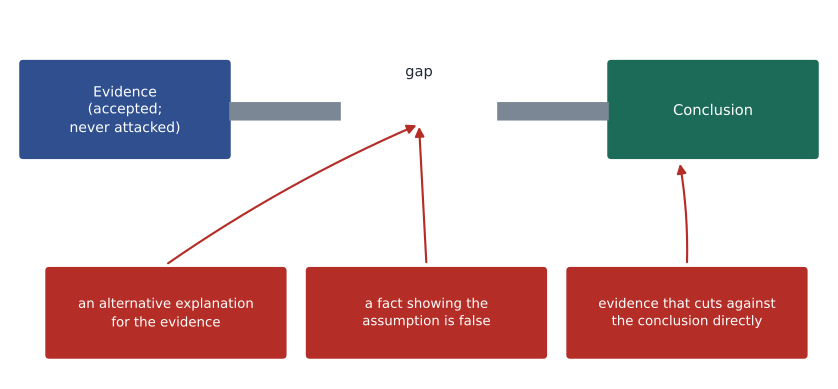
- Offer an alternative explanation. The evidence is real, but something other than the author's explanation accounts for it. This is the most common weakener for causal arguments. "The school's test scores rose after it hired new teachers. But that year, the school also introduced a selective admissions policy."
- Deny the assumption. Show that the unstated premise the argument needs is false or doubtful. In a sampling argument: "The survey was conducted only at the library." In an analogy: "Unlike Victoria, Saint John has no ferry terminal in its downtown."
- Cut against the conclusion directly. Provide new evidence that points the other way. "Several other studies found no such effect." This kind of weakener is less common and often less powerful than one that attacks the gap, but it can be correct when nothing else hurts the argument.
The method
- Step 1: Find the conclusion and the evidence. Classify the conclusion.
- Step 2: Identify the gap. What does the author assume?
- Step 3: Predict how to attack: an alternative explanation, a fact that undermines the assumption, or contrary evidence.
- Step 4: Test each choice. If this is true, does the conclusion become less likely? Watch the direction; disguised strengtheners appear in weaken questions just as disguised weakeners appear in strengthen questions.
Worked problem
Sample question (written for this course)
Stimulus: "After the town of Tarnwick lowered its speed limit on residential streets from 50 to 40 kilometres per hour, the number of pedestrian injuries on those streets fell by a third over the following year. The lower speed limit, therefore, made the streets safer for pedestrians." Stem: "Which one of the following, if true, most seriously weakens the argument?" (A) Some drivers in Tarnwick exceed the new speed limit. (B) Lower speed limits have been adopted in many other towns. (C) Pedestrian injuries are less severe at lower speeds. (D) Residents supported the change in a public survey. (E) Pedestrian injuries also fell by about a third that year on Tarnwick's main roads, where the speed limit did not change.
Show solution
- Conclusion: the lower limit made residential streets safer (causal). Evidence: injuries fell after the change.
- Gap: something else might explain the drop. Prediction: an alternative cause, or a drop where the limit did not change.
- (A) Some speeding does not show the limit had no effect; most drivers may have slowed.
- (E) Injuries fell just as much where nothing changed. That suggests a town-wide cause (weather, a campaign, fewer pedestrians), not the new limit. This weakens.
- (B) Popularity elsewhere is irrelevant. (C) supports the idea that lower speeds help. (D) Residents' opinions are irrelevant to whether injuries fell because of the limit.
Answer: (E). The effect appeared without the cause, pointing to an alternative explanation.
Common wrong answers
- Contradicting a premise. "The number of injuries did not actually fall." You must accept the premises; this choice is almost never right.
- Out of scope. A choice that discusses a related topic but not the argument's reasoning. "Drivers in Tarnwick pay high insurance premiums."
- The disguised strengthener. A choice that seems relevant but actually supports the argument, like the choice about injury severity in the example above.
- Too weak. "Some drivers exceed the limit." Words like "some" and "a few" rarely do enough damage when another choice attacks the gap directly.
- The opposite of a strengthener that is not a weakener. Students sometimes reason, "If X would strengthen, then not-X must weaken." Not always. If the argument does not depend on X, its absence may change nothing.
| Choice type | Example (Tarnwick) | Effect |
|---|---|---|
| Alternative explanation | A safety campaign for pedestrians ran the same year | Weakens |
| Effect without cause | Injuries fell as much on streets with no change | Weakens |
| Cause without effect | Neighbouring towns that cut limits saw no drop | Weakens |
| Contradicts a premise | Injuries did not actually fall | Not allowed (premises are true) |
| Too weak | Some drivers speed | Little or no effect |
| Disguised strengthener | Injuries are less severe at lower speeds | Strengthens |
Weakening different kinds of argument
- Causal: alternative causes, reversed causation, cause without effect, effect without cause, unreliable data.
- Sampling: the sample differs from the population in a relevant way.
- Analogy: the two things differ in a relevant way.
- Plan or recommendation: the plan will not achieve its goal, or it has a drawback that outweighs its benefit. "The new bus route passes through areas where few commuters live."
- Statistical: the total changed; a rate rather than a count matters; the average hides the spread.
- Prediction: something will prevent the predicted outcome. "The factory's main buyer is closing next year."
How strong must a weakener be?
Students often reject the correct answer because it does not destroy the argument. That is too high a bar. "Most seriously weakens" asks for the most damage among the choices, and frequently only one choice does any damage at all. A choice that raises a real doubt about the central assumption is enough.
On the other hand, if two choices both seem to weaken, compare them. The better one usually attacks the central gap, the one the whole argument depends on, rather than a side issue. In the Tarnwick example, a choice that showed some injuries were misreported would weaken a little; a choice showing injuries fell everywhere weakens much more.
Weaken questions with plans and predictions
Plan arguments deserve special attention. When an author recommends a course of action to reach a goal, the argument assumes the plan will work and that nothing makes it a bad idea. Weakeners show that the plan will fail, will be overwhelmed by a side effect, or targets the wrong cause. "To reduce litter in the park, the city should add more garbage bins. But most park litter is blown in from the neighbouring highway." The plan addresses the wrong source.
Élodie liked this kind of question because it felt like real policy analysis. Harriet agreed that plan arguments often read like the briefings Élodie had studied in political science.
Weaken EXCEPT
Sometimes the stem reads, "Each of the following, if true, weakens the argument EXCEPT:" Four choices weaken and one does not. The correct answer may strengthen the argument or simply be irrelevant. Lesson 11 covers EXCEPT questions in detail. For now, remember to look for the odd one out, not for a strengthener specifically.
Results and review
The group finished November 10 with eight weaken questions in eleven minutes (Ji-won sixteen and a half). Dani scored 7, her best on any question type so far. Thomas scored 6, losing one to a premise-contradiction answer he said "felt like attacking." Harriet asked him to read that choice again with the rule in mind: premises are true. He saw it immediately. Élodie and Ji-won each scored 7, and Marcus 8. Marcus left with a promise to email the group after his test.
Practice: weakening a sampling argument and a prediction
Worked problem
Sample question (written for this course)
Stimulus: "In a survey of members of the Glenmore Hiking Association, eighty percent said the province should spend more on trail maintenance. Clearly, most of the province's residents want more spending on trails." Stem: "Which one of the following, if true, most seriously weakens the argument?" (A) The survey had a high response rate. (B) The province's trails are popular with tourists. (C) The survey was conducted in the spring. (D) Members of hiking associations use trails far more often than most residents. (E) Trail maintenance costs have risen.
Show solution
- Sampling argument: hikers' views generalized to all residents.
- (A) A high response rate makes the sample a better picture of members, but members are still not residents in general; if anything it slightly strengthens. (B), (C) and (E) do not bear on whether members represent residents.
- (D) shows the sample differs from the population in exactly the respect that matters.
Answer: (D). It confirms the sample is unrepresentative in a relevant way.
Worked problem
Sample question (written for this course)
Stimulus: "Sales of electric scooters in Dunmore have doubled in each of the past three years. So scooter sales will double again next year." Stem: "Which one of the following, if true, most seriously weakens the argument?" (A) Dunmore will ban scooters from its sidewalks and most bike lanes starting next spring. (B) Scooters are popular with students. (C) Scooter prices have fallen. (D) Scooters are made in several countries. (E) Many residents own bicycles.
Show solution
- Prediction from a trend. Gap: the conditions behind the trend may change.
- (B) and (C) support continued growth. (D) and (E) are irrelevant.
- (A) introduces a change that would likely stop the trend.
Answer: (A). Predictions are weakened by facts that break the pattern.
Weakening without disproving
Thomas asked whether a weakener ever needs to prove the author wrong. Harriet drew a simple line on the whiteboard: if the argument stood at "fairly likely" before, a good weakener moves it to "uncertain." That is usually all the test asks. Arguments on the LSAT are rarely destroyed by one fact; they are made doubtful.
How weakeners relate to assumptions
Just as strengtheners support an argument's assumption, weakeners usually attack it. Find the assumption, then imagine it is false: the situation you picture is what the correct weakener describes. In the Tarnwick speed limit argument, the assumption is that nothing else caused the drop in injuries. Imagine that assumption false, and you picture some other cause or a town-wide drop, which is exactly what the credited answer supplied. This link between assumptions and weakeners is why Harriet spent six weeks of Thursday sessions on assumptions before starting the Tuesday series.
Thomas, whose assumption accuracy had risen from about 41 percent in September to about 70 percent by early November, said this was the moment the two blocks connected for him. 'I was finding the assumption anyway,' he said. 'Now I just ask what would make it false.'
Practice: weakening a plan
Worked problem
Sample question (written for this course)
Stimulus: "To reduce the number of late library returns, the Corriston Public Library plans to double its late fees. Since people dislike paying fees, the higher fees will lead more people to return items on time." Stem: "Which one of the following, if true, most seriously weakens the argument?" (A) The library's late fees are lower than those of nearby libraries. (B) The library recently extended its opening hours. (C) Most late returns at the library come from patrons who have already stopped paying their fees and whose accounts are blocked. (D) Many patrons borrow e-books, which are returned automatically. (E) Library staff spend time processing late fees.
Show solution
- Plan: higher fees will cut late returns. Gap: the people who return items late must be the kind who would respond to higher fees.
- (A) suggests room to raise fees, if anything supporting the plan. (B) Longer hours might reduce late returns but do not bear on whether the fee plan works. (D) E-books are not the problem the plan targets. (E) Processing time is a side issue.
- (C) shows the late returners are people who no longer pay fees at all, so raising the fee will not change their behaviour.
Answer: (C). The plan targets people who will not respond to it.
Common mistakes
MistakeChoosing an answer that contradicts a premise.
InsteadPremises are accepted as true; weaken the link between evidence and conclusion.
MistakeRejecting an answer because it does not disprove the conclusion.
InsteadA weakener only needs to make the conclusion less likely.
MistakeAssuming the opposite of a strengthener must weaken.
InsteadCheck whether the argument actually depends on the point.
MistakeMissing a disguised strengthener.
InsteadConfirm which direction each choice pushes the conclusion.
Summary and key terms
- Weaken questions ask which new fact, if true, most undermines the argument.
- Correct answers offer an alternative explanation, undermine the assumption or cut against the conclusion.
- Never attack a premise; accept it and show it does not support the conclusion.
- A weakener need not disprove the conclusion, only damage it more than the other choices.
- The type of argument tells you what kind of weakener to expect.
- For plans, look for reasons the plan will fail or has a serious drawback.
- Weakener
- A new fact that makes an argument's conclusion less likely or shows the evidence supports it less well.
- Alternative explanation
- Another account of the evidence that competes with the author's.
- Plan argument
- An argument recommending a course of action to achieve a goal.
- Out of scope
- Concerning a topic related to the argument but irrelevant to its reasoning.
Practice problems
Work each problem on paper first, then reveal the answer to check.
Weaken: "Since the café added outdoor seating, its revenue has risen, so outdoor seating increased revenue."
Show answer
Example: "The café also raised its prices and extended its hours at the same time."
Why is "The café's revenue did not actually rise" a poor weaken answer?
Show answer
It contradicts a premise, which must be accepted as true.
Weaken the plan: "To cut energy costs, the school should install solar panels on its roof."
Show answer
Example: "The school's roof is shaded by taller buildings for most of the day."
Lesson quiz · 5 questions
Score 60% or more to complete this lesson.
Create a free account to save your progress, take quizzes and earn a certificate.