
LSAT-111 · Lesson 3 of 12 · 21 min
Causal reasoning and its flaws
▶ Video coming soon A video version of this lesson is on the way.
On Tuesday, October 20, Harriet began with a headline she had invented for the occasion: "Students Who Eat Breakfast Score Higher on Exams." She asked the group what the newspaper wanted readers to conclude. Everyone agreed: eat breakfast, get better grades. Then she asked what else could explain the finding. Within two minutes the group had a list. Students from more stable homes might be more likely both to eat breakfast and to have time to study. Students who sleep well might be more likely to wake early enough for breakfast and to think clearly in exams. Students who are already doing well might feel calmer and have an appetite.
'That list is the whole lesson,' Harriet said. 'Causal conclusions are everywhere on the LSAT, and almost every one of them can be attacked or defended by thinking about what else could explain the evidence.'
This lesson explains how causal arguments work, the main ways they go wrong, and the standard moves that strengthen or weaken them. Causal reasoning is so common in Logical Reasoning that this lesson is one of the most useful in the course.
Recognizing a causal conclusion
A causal conclusion claims that one thing produces, leads to, results in, contributes to or explains another. The words vary, but the claim is the same: change the cause and the effect would change.
- Explicit causal words: causes, leads to, results in, produces, is responsible for, is due to, because of.
- Softer causal words: contributes to, promotes, helps, reduces, increases, makes more likely.
- Explanations: "The reason for the decline is…", "This is explained by…"
The evidence for a causal conclusion is usually one of two things: a correlation (two things tend to occur together) or a sequence (one thing happened, then the other). Neither, by itself, proves causation.
Correlation is not causation
When two things are correlated, there are several possibilities besides "A causes B." The test writers rely on each of them.
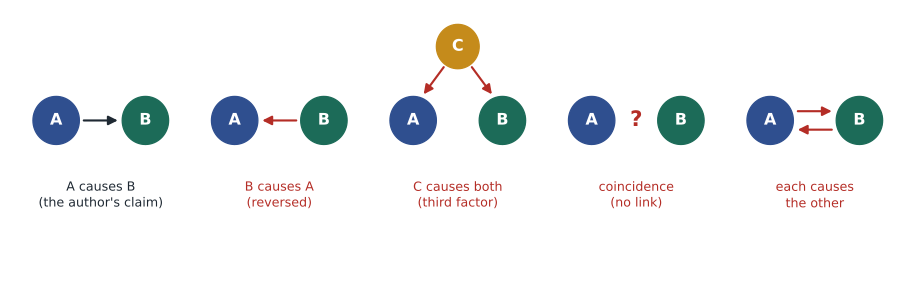
- Reversed causation: B causes A. "Children who read more have larger vocabularies, so reading builds vocabulary." Perhaps children with larger vocabularies enjoy reading more and so read more.
- A third factor causes both. "Neighbourhoods with more trees have fewer hospital visits." Perhaps wealthier neighbourhoods have both more trees and better health.
- Coincidence. With enough data, some correlations appear by chance, especially in small samples.
- Two-way causation. A and B may reinforce each other. Exercise may improve mood, and good mood may encourage exercise.
A causal argument based on a correlation assumes that none of these alternatives applies. The flaw is the failure to rule them out.
Sequence is not causation either
A related pattern relies on timing: B followed A, so A caused B. This is sometimes called the post hoc flaw, from the Latin phrase for "after this, therefore because of this." "The town banned leaf blowers in May, and complaints about noise fell by June, so the ban reduced noise." Perhaps complaints always fall in summer, or construction on a nearby highway ended in May.
Timing does matter: a cause must come before its effect. If B happened before A, A cannot have caused B. Some weaken answers work exactly that way, showing that the supposed effect began before the supposed cause. But a cause coming first is necessary, not sufficient, for causation.
The standard ways to weaken a causal argument
Because causal arguments rely on the same assumptions, they are weakened in the same few ways. Learn these and you will recognize most causal weaken answers on sight.
- Offer an alternative cause. Show that something else could explain the effect. "During the same months, the town also installed sound barriers along the highway."
- Show reversed causation. Show that the supposed effect could have produced the supposed cause.
- Show the cause without the effect. Find cases where the cause was present but the effect did not follow. "Towns that banned leaf blowers in earlier years saw no change in complaints."
- Show the effect without the cause. Find cases where the effect occurred without the cause. "Complaints fell by a similar amount in neighbouring towns that had no ban."
- Undermine the data. Show that the correlation itself is unreliable, for example because the measurement changed. "In May the town also stopped accepting noise complaints by email."
The standard ways to strengthen a causal argument
Strengthening a causal argument means ruling out the alternatives, or adding positive evidence of the link.
- Rule out an alternative cause. "No other changes affecting noise occurred in the town during the period."
- Rule out reversed causation. Show that the cause clearly came first or could not have been produced by the effect.
- Show the effect does not occur without the cause. "Comparable towns without a ban saw no drop in complaints."
- Show a dose-response pattern. More of the cause leads to more of the effect. "Neighbourhoods that enforced the ban most strictly saw the largest drops."
- Show a mechanism. Explain how the cause produces the effect. Mechanism answers are helpful but often weaker than answers that rule out an alternative, because a plausible mechanism does not show that it actually operated.
| Move | Weakens by showing… | Strengthens by showing… |
|---|---|---|
| Alternative cause | Another factor could explain the effect | No other factor changed or applies |
| Direction | The effect could have caused the cause | The cause came first and was independent |
| Cause without effect | The cause occurred elsewhere with no effect | Where the cause occurred, the effect followed |
| Effect without cause | The effect occurred without the cause | Without the cause, the effect did not occur |
| Data quality | The measured change is unreliable | The data were collected consistently |
Controlled comparisons and studies
Many LSAT stimuli describe studies. The strongest support for causation comes from comparing two groups that differ only in the suspected cause. When groups are assigned randomly, as in a well-designed experiment, other differences tend to even out, so a difference in results points to the cause being tested.
Observational studies, where researchers simply record what people already do, are more vulnerable. People who choose to take vitamins may differ from those who do not in diet, income or attention to health. Arguments based on observational studies therefore invite weaken answers that point to a difference between the groups other than the one the author cares about.
Harriet asked Marcus, the engineer, how his old firm tested whether a new material caused fewer cracks in concrete. 'Same mix, same pour, same curing, two batches, one with the additive,' he said. 'And we would not trust a single pair.' Harriet said that was the logic the LSAT rewards: hold everything else constant, then look for the difference.
Worked problem
Sample question (written for this course)
Stimulus: "Employees at Halvorsen Insurance who used the company's new standing desks reported fewer back problems over the past year than employees who kept traditional desks. Standing desks, therefore, reduce back problems." Stem: "Which one of the following, if true, most seriously weakens the argument?" (A) Employees could choose which kind of desk to use, and those who already had back problems were advised by their doctors to avoid standing for long periods. (B) Standing desks cost more than traditional desks. (C) Some employees who used standing desks reported mild foot pain. (D) Back problems are among the most common reasons for missed work. (E) Halvorsen plans to replace all its desks with standing desks next year.
Show solution
- Conclusion: standing desks reduce back problems (causal). Evidence: standing-desk users reported fewer back problems.
- Gap: the two groups may differ in ways other than the desk. Prediction: something that shows the groups differed to begin with.
- (B) cost is irrelevant to whether the desks reduce back problems.
- (A) shows the groups differed before the desks: people with back problems were steered away from standing desks. The difference in reported problems could reflect who chose each desk, not the desk itself. This weakens the argument.
- (C) foot pain is a different problem. (D) explains why back problems matter, not whether desks reduce them. (E) is a future plan and says nothing about the evidence.
Answer: (A). It introduces a pre-existing difference between the groups, which is the classic weakness of an observational comparison.
Causal arguments with only one case
Sometimes a causal argument relies on a single event: "The bridge collapsed the day after the heavy rain, so the rain caused the collapse." With one case, the alternatives multiply. Was the bridge already damaged? Was there an unusually heavy load? Strengthening answers for single-case arguments often show that other likely causes were absent; weakening answers often supply one that was present.
Explanations and causal conclusions in disguise
Not every causal conclusion announces itself. "The best explanation for the falling birth rate is the rising cost of housing" is a causal claim. So is "The new manager must be the reason morale improved." Watch for words like explanation, reason, account for, due to and responsible, and treat the conclusion as causal even when the word cause never appears.
Dani pointed out that her firm's managing partner made causal claims in nearly every staff meeting. "We changed the intake form and our approval rate went up" was her favourite example. Harriet asked what else had changed that quarter. Dani thought about it and said that the government had also cleared a backlog of applications. 'That is an alternative cause,' Harriet said, 'and on the test, it would be choice B.'
A note on "contributes to"
Some conclusions are modest: "Lack of sleep contributes to poor concentration." A contributing cause does not need to be the only cause, or even the main one. Weaken answers that merely show other causes exist may not hurt a "contributes to" conclusion much. The stronger the causal claim ("is the main cause," "is the only explanation"), the more an alternative cause damages it. As always, match the strength of the conclusion.
Ji-won summarized the session in her error log in one line: 'Every time I see "so it causes," list the other stories before I read the choices.' Harriet asked if she could borrow the line for future groups.
Practice: strengthening a causal claim
Worked problem
Sample question (written for this course)
Stimulus: "Over the past five years, residents of Lowell Heights who live within a short walk of the new greenway have reported exercising more often than residents who live farther away. Building greenways, therefore, encourages people to exercise." Stem: "Which one of the following, if true, most strengthens the argument?" (A) The greenway is popular with cyclists. (B) Greenways are expensive to maintain. (C) Residents who live near the greenway did not exercise more often than other residents before it was built. (D) Many cities are building greenways. (E) People who enjoy exercise often choose homes near parks and trails.
Show solution
- Conclusion: greenways encourage exercise (causal). Evidence: nearby residents exercise more.
- Gap: nearby residents may have exercised more all along, or active people may have chosen to live near the trail.
- (A) Popularity with cyclists does not show the greenway changed anyone's habits. (B) Cost is irrelevant to the causal claim. (D) What other cities do says nothing about this effect.
- (E) suggests reversed causation or self-selection, which weakens the argument.
- (C) rules out the pre-existing difference: before the greenway, nearby residents were no more active. That makes the greenway a more likely cause.
Answer: (C). It closes the gap by ruling out the main alternative explanation. (E) is the disguised weakener.
Marcus pointed out that the credited choice used a before-and-after comparison, the same logic as testing two batches of concrete. Harriet said that a before-and-after check on the same group is one of the most common strengtheners on the test, because it rules out the possibility that the groups differed from the start.
Thomas added a line to his error log after this session: "Causal conclusion? List three other stories before reading the choices." He said the list took less than fifteen seconds once he got used to it, and it meant the credited answer was usually one of his three stories.
Common mistakes
MistakeAccepting that a correlation proves causation.
InsteadList the alternatives: reversed cause, a third factor, coincidence.
MistakeTreating "B happened after A" as proof that A caused B.
InsteadTiming is necessary for causation but never enough on its own.
MistakeChoosing a mechanism answer when an answer rules out an alternative cause.
InsteadRuling out an alternative usually strengthens more than a plausible mechanism.
MistakeOverlooking causal conclusions phrased as explanations.
InsteadTreat "the reason for," "explains" and "is responsible for" as causal claims.
Summary and key terms
- Causal conclusions claim that one thing produces or explains another; the evidence is usually a correlation or a sequence.
- Correlations can reflect reversed causation, a third factor, coincidence or two-way influence.
- Weaken causal arguments with an alternative cause, reversed causation, cause without effect, effect without cause, or unreliable data.
- Strengthen them by ruling out alternatives, confirming direction, showing the effect does not occur without the cause, or showing dose and response.
- Controlled comparisons support causation better than observational studies, where groups may differ in other ways.
- Modest causal claims ("contributes to") are harder to weaken than sweeping ones ("is the only cause").
- Causal claim
- A claim that one thing produces, leads to or explains another.
- Third factor
- Something that causes both of two correlated things, creating a correlation without a direct link.
- Reversed causation
- The possibility that the supposed effect is actually the cause.
- Post hoc reasoning
- Concluding that A caused B simply because B followed A.
- Observational study
- A study that records what people already do rather than assigning them to groups.
- Dose-response
- A pattern in which more of a cause produces more of an effect.
Practice problems
Work each problem on paper first, then reveal the answer to check.
Give an alternative explanation: "People who own dogs live longer, so owning a dog extends life."
Show answer
Healthier, more active people may be more likely to own dogs (a third factor or reversed causation).
Write a strengthener for: "Since the library extended its hours, more students have passed the bar exam, so the longer hours helped."
Show answer
Example: "Among students, those who used the library during the new hours showed the largest improvement" (dose-response), or "No other change to bar preparation occurred."
Why does showing that the effect began before the supposed cause weaken a causal argument?
Show answer
A cause must come before its effect; if the effect came first, the supposed cause cannot have produced it.
Lesson quiz · 5 questions
Score 60% or more to complete this lesson.
Create a free account to save your progress, take quizzes and earn a certificate.