
LSAT-111 · Lesson 6 of 12 · 21 min
Attacks, circles and shifting words
▶ Video coming soon A video version of this lesson is on the way.
On Tuesday, November 3, Harriet began by reading two short letters to the editor she had written for the session. The first said a proposed bike lane was a bad idea because the councillor proposing it had once been fined for speeding. The second said a new tax was fair because everything about it was just. 'These are the flaws you have been arguing with your whole life,' she said. 'At dinner tables, in comment sections, in meetings. The LSAT just writes them more politely.'
This lesson covers the last family on the map: flaws in which something other than real evidence stands in for support. They include attacks on the source, circular reasoning, shifting words, false choices, inappropriate appeals to authority or popularity, and a few related patterns. Because these flaws are familiar from ordinary life, students sometimes underrate them. The test makes them subtle enough that they still catch people.
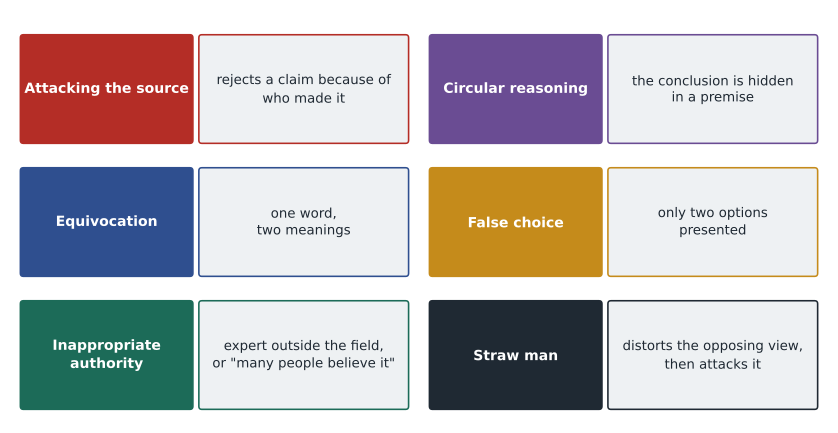
Attacking the source
An ad hominem argument rejects a claim because of something about the person making it: their character, motives, circumstances or past behaviour. "The scientist's warning about the pesticide can be dismissed, since she works for a company that makes a competing product." The scientist's motive may give a reason to check her evidence carefully, but it does not show her warning is false.
The LSAT tests several versions.
- Attacking character: "He was once fired for lying, so his testimony is false."
- Attacking motive: "She only supports the park because it would raise her property value."
- Pointing to inconsistency: "The minister says we should drive less, but she drives an SUV." Hypocrisy does not make the advice wrong.
- Pointing to circumstances: "Of course he opposes the minimum wage; he owns a restaurant."
Answer choices describe this flaw as "attacks the person making the argument rather than the argument itself," "rejects a claim on the basis of the motives of those who advance it," or "takes the character of a proponent to be relevant to the truth of the proposal."
One caution: questioning a source is not always a flaw. If the question is whether a witness actually saw something, evidence that she was across town is relevant. The flaw is rejecting a claim, especially a claim that rests on reasons or evidence, solely because of who made it.
Circular reasoning
A circular argument assumes what it sets out to prove. The conclusion appears, usually reworded, among the premises. "The policy is unjust because it is unfair to the people it affects." Unjust and unfair amount to the same thing here; no independent reason has been given.
Circular arguments on the LSAT are rarely as obvious as that. They tend to spread the circle over two or three sentences. "We can trust the newspaper's reporting on the scandal. After all, the newspaper is a reliable source of information, and reliable sources report accurately." The premises restate the conclusion's claim about trustworthiness in different words.
Answer choices: "presupposes the truth of what it seeks to establish," "takes for granted the very claim it is trying to prove," or "the conclusion is merely a restatement of one of the premises."
Harriet's test for circularity: cover the conclusion and ask whether you could guess it from the premises because they say the same thing, rather than because they support it. If the premises and conclusion are equivalent, the argument is circular.
Shifting words: equivocation
Equivocation uses a key term in two different senses. The argument looks valid because the same word appears in premise and conclusion, but the meaning has changed.
"The museum's new exhibit is a work of fiction. Fiction is not true. So the exhibit contains false information." The exhibit may be about fiction (a display of novels) while containing accurate information about them.
"Economic theory says that rational people maximize their interest. Since many people put their savings in low-interest accounts, they are not rational." Interest in the first sentence means self-interest; in the second, the rate a bank pays.
To spot equivocation, underline any word that appears in both a premise and the conclusion, and ask whether it means exactly the same thing each time. Common shifting words on the test include natural, theory, interest, free, right, significant, popular and successful.
Élodie said that working in two languages helped her here. 'When I translate a sentence, I have to choose one meaning, so I notice when a word is doing two jobs,' she said. Harriet suggested everyone try paraphrasing the key term in each sentence; if the paraphrases differ, the word has shifted.
False choice
A false choice (also called a false dilemma) presents two options as the only ones when others exist. "Either we expand the highway or traffic will keep getting worse. We cannot let traffic get worse, so we must expand the highway." Options left out: better public transit, flexible work hours, congestion pricing.
The flaw is easier to see in the abstract than in a stimulus. Look for "either… or…" and for arguments that reject one option and conclude the other, as if nothing else were possible. Answer choices: "presents two alternatives as if they were the only ones," "fails to consider other options," or "treats a set of possibilities as exhaustive when it is not."
A closely related pattern is treating opposites as contradictories. "The proposal is not a success, so it is a failure." There may be a middle ground: partial success, too early to tell. "Not good" does not mean "bad."
Inappropriate appeals to authority and popularity
Relying on experts is not a flaw. Most of what anyone knows comes from trusted sources. The flaw is relying on an authority whose expertise is not relevant, or treating popularity as proof.
- Expertise outside the field: "A Nobel laureate in physics says this diet is healthy, so it must be." Physics expertise does not extend to nutrition.
- Unnamed or vague authorities: "Experts agree that…" with no indication of who or why.
- Popularity: "Millions of people use this remedy, so it works." Many people can be wrong.
- Tradition: "We have always done it this way, so it is the right way."
Answer choices: "relies on the testimony of a person who is not shown to have expertise in the relevant area," "treats the popularity of a belief as evidence of its truth," or "appeals to tradition rather than to evidence."
Straw man and distorting the opposing view
In a straw man argument, the author misrepresents an opponent's position, usually making it more extreme, and then attacks the distorted version. "My opponent wants to reduce the police budget. Clearly, she wants to abolish law enforcement and let crime run wild." Refuting the exaggerated position does nothing to the actual one.
Straw man flaws often appear in dialogue stimuli, where one speaker responds to another. Read the first speaker carefully; then check whether the second speaker responds to what was actually said. Answer choices: "distorts the position it is criticizing," "responds to a claim the opponent did not make," or "attacks a weaker version of the opposing view."
Other substitutes for evidence
A few more patterns appear less often but are worth recognizing.
- Appeal to emotion or consequences: "This theory cannot be true, because if it were, life would be meaningless." How we would feel if something were true does not show it is false.
- Two wrongs: "Our company dumped waste in the river, but so did our competitors." Others doing wrong does not make an action right.
- Moving from "is" to "ought" without a principle: "Most people eat meat, so people should eat meat." A description of what happens does not, alone, show what should happen.
- Self-contradiction: an argument whose premises cannot all be true together.
| Flaw | Telltale sign | Typical answer wording |
|---|---|---|
| Attacking the source | Discusses the person rather than the claim | "attacks the proponent rather than the proposal" |
| Circular reasoning | Premise and conclusion say the same thing | "presupposes what it sets out to prove" |
| Equivocation | A repeated key word changes meaning | "uses a term in two different senses" |
| False choice | "Either… or…" with one option rejected | "treats two options as the only ones available" |
| Inappropriate authority | Expert outside the field, or popularity | "relies on an authority whose expertise is not relevant" |
| Straw man | Opponent's view restated in extreme form | "distorts the view it criticizes" |
Worked problem
Sample question (written for this course)
Stimulus: "Councillor Veer argues that the city should adopt a four-day work week for municipal employees, citing studies showing productivity gains. But Veer is a municipal employee herself and would benefit from the change. Her argument should therefore be rejected." Stem: "The reasoning in the argument is flawed because the argument…" (A) rejects a proposal on the basis of the proponent's interest in it rather than the evidence offered for it. (B) relies on studies that may not apply to the city. (C) presents two options as the only ones available. (D) uses the term "productivity" in two different senses. (E) assumes that what benefits employees benefits the city.
Show solution
- Conclusion: Veer's argument should be rejected. Evidence: she would benefit from the change.
- Gap: her interest says nothing about whether the studies support the proposal. This is an attack on the source.
- (B) is a reasonable worry about the studies, but the argument never discusses them; the author does not reason from the studies at all.
- (C), (D) and (E) describe flaws that do not occur in this argument.
Answer: (A). The author dismisses the argument because of the person making it.
Why these flaws still matter
Dani said that after a week of causal and sampling flaws, these felt like a holiday. Harriet warned her that the test writers know that too. On harder questions, these flaws are paired with tempting wrong answers that describe a different flaw from the same family, for example a circular-reasoning choice next to a correct equivocation choice. The fix is precision: name the exact substitute for evidence the author used before looking at the choices.
Marcus, who was five days from his test, asked whether he should spend his last week on these. Harriet said no: he should do mixed sets and trust the map. 'You have seen every family now,' she said. 'From here, it is recognition under time pressure.'
Practice: telling similar flaws apart
Worked problem
Sample question (written for this course)
Stimulus: "Dr. Osei claims that the new reading program improves literacy, citing her study of 400 students. But Dr. Osei designed the program and stands to earn royalties from it. So her claim is false." Stem: "The argument is most vulnerable to criticism on the grounds that it…" (A) presupposes that the program improves literacy. (B) relies on a sample that is too small to support a conclusion. (C) uses the word "improves" in two senses. (D) treats a possible motive for bias as proof that the claim is false. (E) overlooks the possibility that the study was not published.
Show solution
- Conclusion: Osei's claim is false. Evidence: she has a financial interest.
- A financial interest is a reason to examine the study carefully, but it does not show the claim is false. The flaw: attacking the source.
- (A) The argument concludes the opposite of this. (B) The argument never questions the sample; 400 students is not obviously too few, and in any case the author does not reason from it. (C) "Improves" is used once. (E) Publication status is irrelevant to the reasoning.
- (D) describes the move exactly: treating a motive as proof of falsehood.
Answer: (D). Note that "reason to be cautious" and "proof the claim is false" are different; the flaw lives in the gap between them.
Thomas asked whether the conclusion would still be flawed if the author had said "so we should check her study carefully." Harriet said no: that more modest conclusion is reasonable. 'Same evidence, smaller conclusion, no flaw,' she said. 'That pattern comes up on every question type.'
Ji-won added that equivocation was the flaw she most often missed in timed practice, because the shifted word looked so ordinary. Her fix was to read the conclusion first and underline its key noun, then check every use of that noun in the premises. On the next practice set, she caught both equivocation questions.
Harriet closed the discussion with a reminder that these flaws are often combined with the causal and statistical flaws from earlier lessons. A stimulus can attack a source and also generalize from a weak sample. When that happens, the stem and the answer choices tell you which defect the question is about.
Common mistakes
MistakeTreating any comment about a source as an ad hominem flaw.
InsteadThe flaw is rejecting a claim solely because of who made it; relevant facts about a witness's knowledge are fair game.
MistakeMissing a circle spread over several sentences.
InsteadCover the conclusion and ask whether a premise already says the same thing.
MistakeOverlooking a key word that changes meaning.
InsteadParaphrase each repeated key term; different paraphrases signal equivocation.
MistakeCalling every appeal to an expert a flaw.
InsteadRelying on relevant expertise is reasonable; the flaw is irrelevant expertise or popularity.
Summary and key terms
- Ad hominem flaws reject a claim because of the person making it, not the evidence.
- Circular reasoning assumes the conclusion in the premises, often reworded.
- Equivocation uses a key term in two senses; paraphrase repeated terms to catch it.
- False choices present two options as the only ones; opposites are not always contradictories.
- Appeals to authority are flawed when the expertise is irrelevant; popularity and tradition are not evidence.
- A straw man distorts the opposing view and attacks the distortion.
- Ad hominem
- Attacking the person who makes a claim instead of the claim itself.
- Straw man
- Misrepresenting an opponent's view in order to refute it more easily.
- False dilemma
- Presenting two options as exhaustive when others exist.
- Appeal to popularity
- Treating a belief as true because many people hold it.
- Appeal to authority
- Relying on someone's claim because of their status; flawed when their expertise is not relevant.
- Is-ought gap
- Concluding what should be done solely from facts about what is done.
Practice problems
Work each problem on paper first, then reveal the answer to check.
Name the flaw: "This medicine is effective because it works well on the illness it treats."
Show answer
Circular reasoning: "effective" and "works well" say the same thing.
Name the flaw: "Either we ban phones in class or students will never learn. Students must learn, so we must ban phones."
Show answer
False choice: other options, such as limiting phone use, are ignored.
Is this a flaw? "The witness claims she saw the theft, but she was at a concert across town at that time."
Show answer
No. Her location bears directly on whether she could have seen the theft; this is relevant evidence, not an attack on her character.
Lesson quiz · 5 questions
Score 60% or more to complete this lesson.
Create a free account to save your progress, take quizzes and earn a certificate.