
LSAT-111 · Lesson 5 of 12 · 21 min
Conditional and part-whole flaws
▶ Video coming soon A video version of this lesson is on the way.
The Tuesday, October 27 workshop started with a callback. Harriet put on the screen a slide from the Thursday conditionals session two weeks earlier, the one with arrows and contrapositives that Dani had once described as "algebra with words." Dani groaned theatrically. Harriet promised that tonight the arrows would earn their keep. 'In LSAT-110 you learned to translate conditionals,' she said. 'Tonight you learn what happens when the author translates them wrong.'
This lesson covers two families of structural flaws. The first involves conditional statements: arguments that treat a sufficient condition as necessary, or a necessary condition as sufficient. The second involves parts and wholes: arguments that move a property from members to a group, or from a group to its members, without justification.
A quick review of conditionals
A conditional statement links a sufficient condition to a necessary condition. "If you live in Halifax, you live in Nova Scotia" can be written Halifax → Nova Scotia. Living in Halifax is sufficient for living in Nova Scotia; living in Nova Scotia is necessary for living in Halifax.
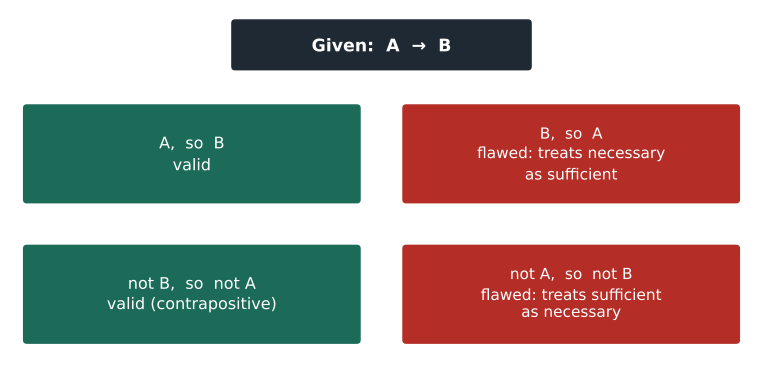
From a conditional, two inferences are valid:
- Affirming the sufficient condition: Halifax, so Nova Scotia. If the sufficient condition holds, the necessary one must.
- Denying the necessary condition (the contrapositive): not Nova Scotia, so not Halifax. If the necessary condition fails, the sufficient one must too.
Two other inferences look similar but are invalid:
- Affirming the necessary condition: Nova Scotia, so Halifax. (Someone in Nova Scotia might live in Truro.)
- Denying the sufficient condition: not Halifax, so not Nova Scotia. (Someone not in Halifax might still live in Nova Scotia.)
Treating a necessary condition as sufficient
The first conditional flaw reasons from the necessary condition to the sufficient one. It assumes that because something required is present, the outcome must follow.
"To win the election, a candidate must raise at least a million dollars in donations. Hartley has raised well over a million dollars. So Hartley will win." Raising the money is necessary (in this argument's terms) but not sufficient. Many candidates may raise that much; only one wins.
Answer choices describe this flaw in several ways: "takes a condition that is necessary for an outcome to be sufficient for it," "concludes that because a requirement has been met, the result will occur," or "mistakes something required for something that guarantees."
Treating a sufficient condition as necessary
The second conditional flaw reasons from the absence of the sufficient condition to the absence of the necessary one. It assumes that the only route to an outcome is the route named.
"If a student completes the honours thesis, she graduates with distinction. Priya did not complete an honours thesis, so she will not graduate with distinction." The thesis is one way to earn distinction; there may be others, such as a high average.
Answer choices: "treats a condition that is sufficient as if it were necessary," "overlooks the possibility that the outcome could occur in some other way," or "presumes that the only way to achieve the result is the one mentioned."
Conditional flaws in disguise
The test rarely uses "if" and "then" in flawed arguments. It disguises the conditional in ordinary language.
- "Only" and "only if": "Only experienced pilots fly the new route. Okafor is an experienced pilot, so he flies the new route." (Necessary treated as sufficient.)
- "All" and "every": "All the successful applicants submitted references. Jordan submitted references, so Jordan was successful." (Necessary treated as sufficient: submitting references is required for success, not a guarantee.)
- "Requires" and "depends on": "A healthy garden requires regular watering. Ming waters her garden every day, so it must be healthy."
- "Unless": "The shipment will arrive on time unless the port is closed. The port is closed, so the shipment will be late." Here "unless" means "if not closed, then on time." Knowing the port is closed tells you nothing about whether the shipment is late; it might still arrive on time another way. (Sufficient treated as necessary in reverse form.)
Ji-won found the "unless" version the hardest. She asked Harriet to slow down, and together they translated it: not Closed → On time. The argument says Closed, so not On time. That denies the sufficient condition. The flaw is the same as the honours thesis example, dressed differently.
Worked problem
Sample question (written for this course)
Stimulus: "Any restaurant that earns a top hygiene rating has passed three unannounced inspections in a row. The Lantern Café has passed three unannounced inspections in a row. Therefore, the Lantern Café will earn a top hygiene rating." Stem: "The flawed pattern of reasoning in which one of the following is most similar to that in the argument above?" Consider just this choice: "Every certified electrician has completed an apprenticeship. Dana has completed an apprenticeship. So Dana is a certified electrician."
Show solution
- Translate the stimulus: Top rating → Passed three. The argument says Passed three, so Top rating. That affirms the necessary condition (necessary treated as sufficient).
- Translate the choice: Certified → Apprenticeship. The choice says Apprenticeship, so Certified. Same pattern.
- Both arguments conclude that something has a property because it meets a requirement for that property.
Answer: The choice matches: both treat a necessary condition as sufficient. Parallel flaw questions, covered more fully in LSAT-112, reward this kind of translation.
Part-whole flaws
The second family is about groups and their members.
- Composition: what is true of each part is assumed true of the whole. "Every brick in this wall is light, so the wall is light." "Each musician in the orchestra is brilliant, so the orchestra is brilliant." A whole can lack a property its parts have, and gain properties its parts lack.
- Division: what is true of the whole is assumed true of each part. "The company is very profitable, so each of its divisions is profitable." "The committee made a reckless decision, so each member is reckless."
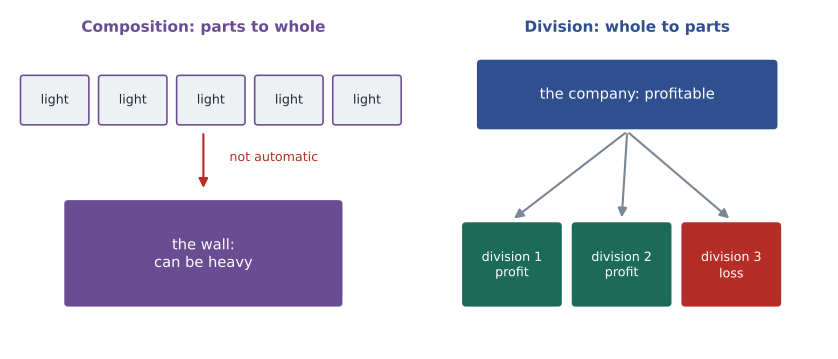
Some properties do transfer. If every page of a book is printed in blue ink, the book is printed in blue ink. The question is always whether the property is the kind that transfers. Size, weight, cost, quality and behaviour often do not. "Each of these sweaters is cheap, so the whole collection is cheap" is false if there are hundreds of sweaters.
Groups, members and averages
Part-whole flaws overlap with the statistical flaws of lesson 4. "The average student at the college is from out of province, so Lin, a student there, is probably from out of province" moves from a group description to an individual. "Most members of the club are retired" does not tell you that any particular member is retired. When an argument moves from what is generally true of a group to a conclusion about one member, check whether the move is justified.
Mixing conditionals with quantity words
A last group of structural flaws involves "some," "most" and "all."
- "Most" does not chain. "Most lawyers read the news. Most news readers distrust politicians. So most lawyers distrust politicians." The two majorities may barely overlap.
- "Some" is weak. "Some athletes are vegetarian. Some vegetarians are doctors. So some athletes are doctors." Nothing connects the two groups.
- "All" reversed. "All violinists in the orchestra practise daily. So all who practise daily are violinists." This is necessary treated as sufficient again.
Harriet told the group not to worry about formal rules for quantities yet; LSAT-112 covers inference with "most" and "some" in detail. For flaw questions, the warning is simpler: when an argument links two "most" or "some" statements, suspect a flaw.
| Flaw | Pattern | Example |
|---|---|---|
| Necessary as sufficient | A → B; B, so A | Only residents vote; Sam is a resident, so Sam votes. |
| Sufficient as necessary | A → B; not A, so not B | If you finish the course you get a badge; Ana did not finish, so no badge. |
| Composition | Each part X, so whole X | Every chapter is short, so the book is short. |
| Division | Whole X, so each part X | The team is the best, so each player is the best. |
| Chaining "most" | Most A are B; most B are C; so most A are C | Most nurses are tired; most tired people are irritable; so most nurses are irritable. |
Strengthening and weakening structural arguments
Structural flaws can also appear in strengthen and weaken questions. To strengthen an argument that treats a necessary condition as sufficient, you can supply the missing sufficiency: "Every candidate who raises over a million dollars in this district wins." To weaken it, show the condition is not enough: "Several candidates who raised over a million dollars lost." The same logic applies to part-whole arguments: strengthen by showing the property transfers in this case, weaken by showing it does not.
Marcus noticed that these answers often looked like the sufficient assumption answers from LSAT-110. Harriet agreed: a strengthener that closes a structural gap completely is a sufficient assumption in another form.
Thomas finds the pattern
Thomas had struggled with assumption questions in September. By late October, he said, conditional flaws had become his favourite because they were mechanical. 'I just draw the arrow and check which way the author went,' he said. On the end-of-session drill of eight structural flaw questions, he got seven right, the most he had ever scored on a set of formal logic questions. Harriet reminded him that most flaw questions are not formal, and that the hard work of causal and sampling flaws was still ahead in the timed drills.
Practice: a conditional flaw question
Worked problem
Sample question (written for this course)
Stimulus: "A film can win the festival's top prize only if it premieres at the festival. The documentary Northern Rivers premiered at the festival this year. Therefore, Northern Rivers will win the top prize." Stem: "The reasoning in the argument is flawed because the argument…" (A) treats one way of winning the prize as if it were the only way. (B) assumes that what is true of the festival is true of each film. (C) treats a requirement for winning the prize as if it guaranteed the prize. (D) relies on the opinion of the festival's judges. (E) infers a cause from a correlation.
Show solution
- Translate: Win → Premiere. The argument reasons Premiere, so Win.
- That affirms the necessary condition: necessary treated as sufficient.
- (A) describes the opposite error (sufficient treated as necessary), which would conclude a film cannot win because it did not do something. A classic trap.
- (B) describes division; nothing about the festival as a whole is applied to the film. (D) No judges' opinions appear. (E) No causal claim is made.
- (C) matches the translation exactly.
Answer: (C). On conditional flaw questions, expect one choice for each direction of error; the translation tells you which is right.
Spotting conditionals in everyday words
Harriet gave the group a list of phrases to translate at home: "requires," "is essential for," "cannot happen without," "guarantees," "is enough to," "whenever," and "no one who… unless…". Each one hides a conditional. Words like "requires," "essential" and "cannot… without" introduce necessary conditions; words like "guarantees," "is enough to" and "whenever" introduce sufficient ones. Once translated, the flaw is a matter of checking which way the author moved along the arrow.
Dani said the arrows had finally stopped feeling like algebra. She now drew every conditional in the margin before reading the choices, and she noticed that the two wrong conditional answers on most questions described the same arrow pointing the wrong way. 'Once I see the arrow, the trap is obvious,' she said.
Élodie noted that the parallel flaw example earlier in the lesson was the first time she had translated both a stimulus and an answer choice into arrows and compared them. It took her almost three minutes on the first try and under a minute by the end of the session.
Common mistakes
MistakeConcluding that an outcome will happen because a required condition is met.
InsteadA necessary condition is required, not sufficient; other conditions may also be needed.
MistakeConcluding that an outcome will not happen because one route to it is absent.
InsteadA sufficient condition is one route; there may be others.
MistakeAssuming any property of the parts belongs to the whole.
InsteadAsk whether the property transfers; size, cost and quality often do not.
MistakeChaining two "most" statements into a "most" conclusion.
InsteadTwo majorities need not overlap enough to support the conclusion.
Summary and key terms
- From A → B, you may infer B from A and not A from not B; the reverse moves are flaws.
- Treating a necessary condition as sufficient assumes that meeting a requirement guarantees the outcome.
- Treating a sufficient condition as necessary assumes the only route to an outcome is the one named.
- Conditional flaws are often hidden in "only," "all," "requires" and "unless."
- Composition moves a property from parts to the whole; division moves it from the whole to the parts.
- "Most" and "some" statements usually cannot be chained into a firm conclusion.
- Sufficient condition
- A condition that guarantees another; in A → B, A is sufficient for B.
- Necessary condition
- A condition required for another; in A → B, B is necessary for A.
- Contrapositive
- The valid reversed form of a conditional: from A → B, not B → not A.
- Affirming the consequent
- The invalid inference from A → B and B to A (necessary treated as sufficient).
- Denying the antecedent
- The invalid inference from A → B and not A to not B (sufficient treated as necessary).
Practice problems
Work each problem on paper first, then reveal the answer to check.
Identify the flaw: "Only students with a 3.5 average can join the honour society. Mei has a 3.8 average, so she is in the honour society."
Show answer
Necessary treated as sufficient: the average is required, not a guarantee of membership.
Identify the flaw: "If the bridge is closed, traffic downtown is heavy. The bridge is open today, so traffic downtown will be light."
Show answer
Sufficient treated as necessary: the bridge closure is one cause of heavy traffic, not the only one.
Does the property transfer? "Each tile in the floor is waterproof, so the floor is waterproof."
Show answer
Not necessarily: water may get through the gaps between tiles. Composition is suspect here.
Lesson quiz · 5 questions
Score 60% or more to complete this lesson.
Create a free account to save your progress, take quizzes and earn a certificate.