
LSAT-111 · Lesson 8 of 12 · 23 min
Strengthen questions
▶ Video coming soon A video version of this lesson is on the way.
The November 10 workshop was the last one before Marcus's test. He joined for the first half, said he wanted a light session, and stayed for all of it anyway. Harriet began with a question for the group: 'If I asked you to help a friend win an argument, what would you do?' Thomas said he would find more evidence. Dani said she would answer the other side's best objection. Élodie said she would fill in whatever the friend forgot to say. 'All three are strengthening,' Harriet said. 'And all three show up in strengthen answers.'
This lesson covers strengthen questions: what they ask, how much a correct answer needs to do, the main ways answers strengthen arguments, and the traps that catch test takers. Weaken questions, the mirror image, follow in lesson 9.
What a strengthen question asks
Strengthen stems ask which answer choice, if true, most supports the argument. Typical forms:
- "Which one of the following, if true, most strengthens the argument?"
- "Which one of the following, if true, provides the most support for the argument's conclusion?"
- "Which one of the following, if true, most helps to justify the reasoning above?"
Three features of these stems matter.
- "If true": accept every answer choice as a fact, however unlikely it seems.
- "Most": the correct answer need not prove the conclusion; it must help more than the others. Often only one choice helps at all.
- "The argument": you strengthen the reasoning from these premises to this conclusion. A choice that supports the conclusion in a way unrelated to the argument can still be correct, but the best answers usually work on the gap.
How much is enough?
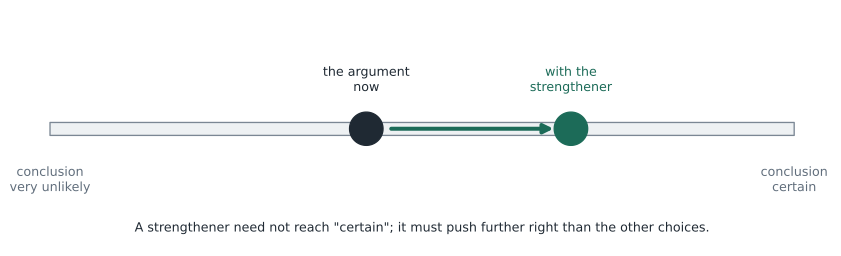
Students sometimes look for an answer that proves the conclusion. Strengthen answers rarely do that. They make the conclusion more likely, often by a little. A choice that addresses the gap even partly will beat a choice that sounds impressive but does not touch it.
Contrast strengthen questions with sufficient assumption questions from LSAT-110. A sufficient assumption must make the conclusion follow with certainty. A strengthener need only add some support. Some strengthen answers are in fact sufficient assumptions (they close the gap completely), but many are partial.
Three ways to strengthen
Almost every correct strengthen answer does one of three things.
- Closes the gap. It supplies, fully or partly, the assumption the argument needs. In a sampling argument: "The survey respondents were chosen at random from all customers." In a causal argument: "No other change that could affect the result occurred during the period."
- Rules out an objection. It eliminates an alternative explanation or a weakness someone might raise. "The cyclists in the study were no younger or fitter than the general population." This is especially common for causal and comparison arguments.
- Adds supporting evidence. It provides another piece of evidence pointing the same way. "Cities that later adopted the same policy saw similar results." This is common when the argument relies on a single case or a single study.
In practice the first two often overlap. Ruling out an alternative cause is a way of closing the gap in a causal argument, because the argument assumed there was no alternative cause.
The method
- Step 1: Find the conclusion and the evidence. Classify the conclusion.
- Step 2: Find the gap. What does the author assume? What objection would you raise?
- Step 3: Predict the kind of fact that would help: one that confirms the assumption or defeats the objection.
- Step 4: Test each choice. Ask: if this is true, does the conclusion become more likely? Eliminate choices that are irrelevant, that weaken, or that support something other than the conclusion.
Harriet emphasized that predictions for strengthen questions are often general ("something that rules out another cause") rather than specific. That is fine. The test writers can rule out an alternative cause in a hundred ways; you only need to recognize the move.
Worked problem
Sample question (written for this course)
Stimulus: "In a study, office workers who were given plants for their desks reported higher job satisfaction six months later than workers who were not given plants. Therefore, having plants at one's desk increases job satisfaction." Stem: "Which one of the following, if true, most strengthens the argument?" (A) Some workers who were given plants did not water them. (B) Job satisfaction is difficult to measure precisely. (C) Plants improve indoor air quality. (D) The workers who received plants were chosen at random from all the workers in the study. (E) Workers who are satisfied with their jobs are more likely to bring personal items to work.
Show solution
- Conclusion: desk plants increase job satisfaction (causal). Evidence: workers given plants reported higher satisfaction.
- Gap: the two groups may have differed in other ways. Prediction: something showing the groups were alike apart from the plants.
- (A) slightly weakens or is irrelevant. (B) weakens confidence in the data. (C) offers a possible mechanism but does not show the effect in this study came from plants rather than group differences. (E) suggests reversed causation, which weakens, although here the plants were given, so it is mostly irrelevant.
- (D) random assignment makes it much less likely the groups differed in other ways. It rules out the main objection.
Answer: (D). Random assignment closes the gap that observational comparisons leave open. (C) is the tempting mechanism answer; it helps a little but less than (D).
Common wrong answers
- Irrelevant information. A choice is on topic but does not affect the link between evidence and conclusion. "Plants are inexpensive." True or not, it does not make the causal claim more likely.
- The weakener in disguise. A choice that actually weakens the argument, often because it introduces an alternative explanation. Read carefully: test takers who are hurrying sometimes pick the answer that is most relevant without noticing which direction it pushes.
- Supporting the wrong conclusion. A choice supports a nearby claim, not the one the argument makes. If the conclusion is that plants increase satisfaction, "Satisfied workers are more productive" supports a claim about productivity, not satisfaction.
- Strengthening a premise instead of the reasoning. Since premises are accepted as true, a choice that merely confirms a premise usually adds little. "The study's survey was administered as described" is not a strengthener; you already accepted that.
- Too weak to matter compared with another choice. Remember "most." If two choices help, pick the one that addresses the central gap.
| Choice type | Example (plant study) | Effect |
|---|---|---|
| Closes the gap | Workers were randomly assigned to receive plants | Strengthens |
| Rules out an alternative | The plant group had no other changes, such as new desks or window seats | Strengthens |
| Adds supporting evidence | A second study in a different city found the same result | Strengthens |
| Mechanism only | Plants improve air quality | Helps a little at most |
| Irrelevant | Plants are cheap | No effect |
| Weakener | The plant group also got a raise during the study | Weakens |
Strengthening different kinds of argument
Because strengthen answers work on the gap, the family of the argument tells you what kind of answer to expect.
- Causal: rule out alternative causes, confirm direction, show that without the cause the effect does not occur, or show a dose-response pattern.
- Sampling: show that the sample was representative in the relevant respect.
- Analogy: show that the two things compared are alike in the relevant ways. "Like Halifax, Corriston has a compact downtown and similar weather."
- Plan or recommendation: show the plan will work and has no major drawback. "The new route avoids the construction zone and does not add to travel time."
- Conditional or principle: supply the missing link. If the argument moves from "Qualified" to "Should be hired," a strengthener might say, "Every qualified applicant should be hired."
Strengthen with principle stems
A variation asks, "Which one of the following principles, if valid, most helps to justify the reasoning?" These are strengthen questions in which every choice is a general rule. The correct principle connects the premises to the conclusion: its sufficient condition matches the facts in the premises, and its necessary condition matches the conclusion. Lesson 11 covers principle questions in more detail.
Marcus's last lesson before the test
Near the end of the session, the group did six strengthen questions in eight and a half minutes (Ji-won had a little under thirteen). Marcus got all six. He said the hardest part was resisting mechanism answers, which appealed to his engineering instincts. 'In my old job, a mechanism was the most convincing thing you could show,' he said. Harriet explained why the LSAT treats them differently: a mechanism shows how a cause could work, but the argument's problem is usually whether it did work, as opposed to some other cause. She wished him luck for Thursday. Everyone else did too.
Practice: strengthening a plan and an analogy
Worked problem
Sample question (written for this course)
Stimulus: "To reduce waiting times in its emergency department, Riverside Hospital plans to open an urgent care clinic next door for minor injuries and illnesses. Since many emergency patients have minor complaints, the clinic will shorten emergency waits." Stem: "Which one of the following, if true, most strengthens the argument?" (A) Urgent care clinics are common in large cities. (B) The clinic will be open only on weekdays. (C) Patients with minor complaints account for a large share of the time emergency staff spend on new arrivals, and most such patients say they would use a nearby clinic. (D) The hospital's emergency department was renovated recently. (E) Some emergency patients arrive by ambulance.
Show solution
- Plan argument: open a clinic to cut emergency waits. Gap: whether diverting minor cases will actually free up emergency capacity.
- (A) Commonness elsewhere does not show this plan will work. (B) Limited hours weaken the plan. (D) Renovation is irrelevant. (E) Ambulance arrivals are not the patients the clinic targets.
- (C) shows that minor cases consume significant staff time and that those patients would use the clinic, so the plan can work.
Answer: (C). Plan strengtheners show the plan reaches its goal.
Worked problem
Sample question (written for this course)
Stimulus: "When the city of Hartwell switched its streetlights to dimmable LED fixtures, its streetlight energy costs fell by almost half. Our city should make the same switch to cut its energy costs." Stem: "Which one of the following, if true, most strengthens the argument?" (A) LED fixtures last longer than older bulbs. (B) Our city's streetlights currently use the same type of older bulbs that Hartwell replaced, and electricity prices in the two cities are similar. (C) Hartwell's population is growing. (D) Some residents find LED light too bright. (E) Hartwell's mayor supported the switch.
Show solution
- Analogy: what worked in Hartwell will work here. Gap: the cities may differ in relevant ways.
- (A) A general benefit of LEDs, not evidence that the cost result will transfer. (C) and (E) are irrelevant. (D) A drawback, if anything weakening.
- (B) shows the two cities are alike in the respects that drive the savings: the bulbs being replaced and electricity prices.
Answer: (B). Analogy strengtheners show the compared cases match where it matters.
How strengtheners relate to assumptions
Strengthen questions and assumption questions use the same raw material. A necessary assumption is something the argument needs; stating that it is true almost always strengthens the argument a little. A sufficient assumption closes the gap completely; it is the strongest possible strengthener. Most strengthen answers fall between the two: they make the assumption more likely without guaranteeing the conclusion. If you can find the assumption in an argument, you already know what a strengthener will look like. It will make that assumption more believable, or remove a reason to doubt it.
Élodie said this made strengthen questions feel less like a separate topic and more like the assumption lessons from the Thursday block with the dial turned down. Harriet liked the image.
Dani noticed that her paralegal work had trained her to look for supporting evidence, which made strengthen questions feel natural. Her risk, Harriet told her, was the opposite of Thomas's: she was so good at imagining supporting facts that she sometimes chose an answer that supported the conclusion in her imagination but not on the page. The fix was to test each choice against the exact words of the argument.
Common mistakes
MistakeLooking for an answer that proves the conclusion.
InsteadA strengthener only needs to make the conclusion more likely than the other choices do.
MistakeChoosing the most relevant-sounding answer without checking its direction.
InsteadAsk whether the choice pushes the conclusion up or down.
MistakePicking a choice that confirms a premise.
InsteadPremises are already accepted; strengthen the link to the conclusion.
MistakePreferring a mechanism over an answer that rules out an alternative.
InsteadRuling out the main objection usually helps more than explaining how the cause might work.
Summary and key terms
- Strengthen questions ask which new fact, if true, most supports the argument.
- A strengthener need not prove the conclusion; it must help more than the other choices.
- Correct answers close the gap, rule out an objection or add supporting evidence.
- Predict the kind of fact that would help before reading the choices.
- Watch for irrelevant choices, disguised weakeners, support for the wrong conclusion and choices that only confirm a premise.
- The type of argument (causal, sampling, analogy, plan, principle) tells you what kind of strengthener to expect.
- Strengthener
- A new fact that makes an argument's conclusion more likely.
- Random assignment
- Placing subjects into groups by chance so that other differences tend to even out.
- Mechanism
- An explanation of how a cause produces its effect.
- Analogy
- An argument that because two things are alike in some ways, they are alike in another.
Practice problems
Work each problem on paper first, then reveal the answer to check.
Write a strengthener: "Our town's recycling rate rose after we introduced larger bins, so the larger bins increased recycling."
Show answer
Example: "No other change to recycling rules, collection schedules or public campaigns occurred during the period."
Does this strengthen? Argument: "This year's graduates found jobs faster because of the new career centre." Choice: "The career centre was expensive to build."
Show answer
No. Cost is irrelevant to whether the centre caused faster job placement.
Strengthen the analogy: "The ferry service worked in Victoria, so it will work in Saint John."
Show answer
Example: "Saint John and Victoria have similar commuter populations, distances and weather."
Lesson quiz · 5 questions
Score 60% or more to complete this lesson.
Create a free account to save your progress, take quizzes and earn a certificate.