
LSAT-111 · Lesson 7 of 12 · 23 min
Flaw questions
▶ Video coming soon A video version of this lesson is on the way.
After a short break on November 3, Harriet turned from the flaws themselves to the questions that ask about them. 'You now know what can go wrong in an argument,' she said. 'Flaw questions test whether you can see it in ninety seconds and recognize it in the strange language of the answer choices.' She estimated that flaw questions were among the most common single question types across a Logical Reasoning section, often several per section, and that the method in tonight's session would carry over to parallel flaw questions in LSAT-112.
This lesson sets out a step-by-step method for flaw questions, explains how to decode the abstract wording of answer choices, and shows the traps test writers set.
Recognizing a flaw question
Flaw stems come in a few standard forms.
- "The reasoning in the argument is flawed because the argument…"
- "The argument is most vulnerable to criticism on the grounds that it…"
- "Which one of the following most accurately describes a flaw in the argument's reasoning?"
- "The argument commits which one of the following errors of reasoning?"
In each case, the stimulus is flawed. You are not asked whether there is a flaw; you are told there is one and asked to describe it. Every answer choice describes something the argument does, or might do. Your job is to find the one that both happens in the argument and is a genuine error.
The four-step method
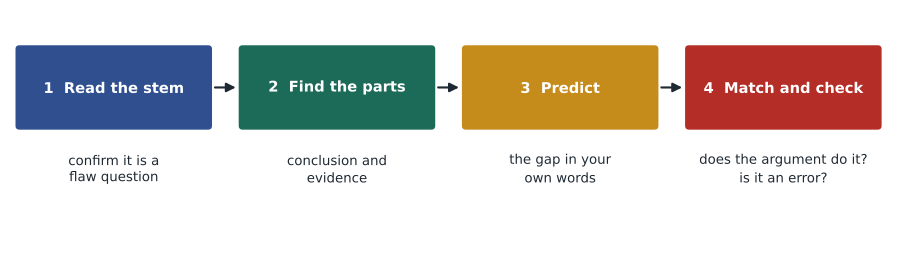
- Step 1: Read the stem. Confirm it is a flaw question. This tells you the stimulus is an argument with a defect.
- Step 2: Find the conclusion and the evidence. Use indicator words and the "why" test from LSAT-110. Classify the conclusion: causal, generalization, conditional, recommendation, claim about a view.
- Step 3: Predict the gap. Using the family map, put the flaw in your own words. "It assumes the survey respondents represent all customers." "It ignores other reasons sales might have risen."
- Step 4: Match and check. Find the choice that matches your prediction. Then check two things: does the argument actually do what the choice says, and is that thing actually an error?
The two checks in step 4 eliminate most wrong answers. Many wrong choices describe errors that the argument does not commit. Others describe things the argument does that are not errors.
Decoding the language of answer choices
Flaw answers are written abstractly so that the same choice could fit arguments on any subject. Learning to translate them back into the concrete terms of the argument is the core skill.
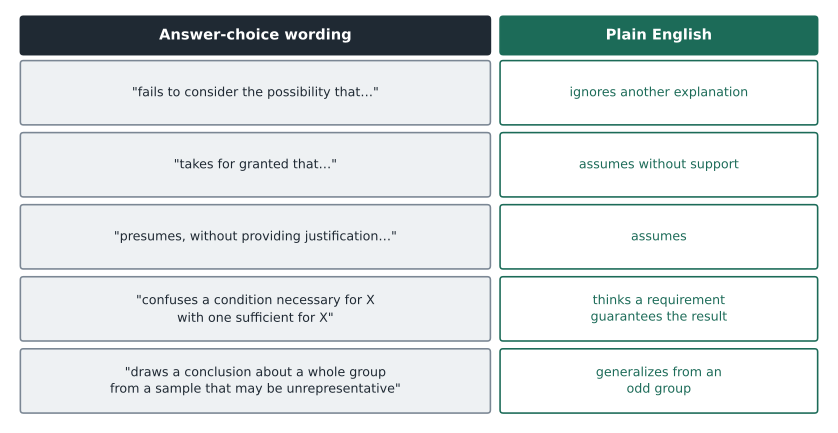
A few phrases deserve special attention.
- "Fails to consider the possibility that…" or "overlooks the possibility that…": the rest of the sentence names something the author should have ruled out. To check, ask whether that possibility would really damage the argument if true. If it would not, the choice is wrong even though the author did fail to consider it.
- "Takes for granted that…" or "presumes, without providing justification, that…": the rest names an assumption. Check that the argument really needs it.
- "Treats X as Y": the argument confuses two things, such as a correlation with a cause, or a necessary condition with a sufficient one. Check that both X and Y appear in the argument in the way described.
- "Relies on" or "draws a conclusion on the basis of": names the evidence. Check that the argument uses that evidence and that the use is the problem.
Ji-won made a translation card that night with ten common phrases on the front and plain-English meanings on the back. By the following Tuesday she said she no longer needed to look at it.
Common wrong answers
Flaw questions have predictable wrong answers.
- The wrong flaw. A choice describes a real flaw, but not one this argument commits. A causal argument paired with a choice about circular reasoning. These are easy to eliminate if you predicted.
- The accurate non-flaw. A choice describes something the argument really does, but which is not an error. "The argument relies on evidence from a survey" may be true, but relying on a survey is not wrong in itself. The question is whether the survey supports the conclusion.
- The extreme description. A choice exaggerates what the argument does. "The argument presumes that no other factor could have any effect" when the argument only assumes that no other factor explains this particular change.
- The irrelevant possibility. "Fails to consider the possibility that…" followed by something that would not hurt the argument. "Fails to consider that some customers did not like the new store layout" does not weaken an argument that sales rose because of the layout.
- The half-right choice. The first half matches the argument; the second half does not. Read every choice to the end.
| Wrong-answer type | How to recognize it | Check |
|---|---|---|
| Wrong flaw | Describes an error from a different family | Does the argument actually do this? |
| Accurate non-flaw | Describes something the argument does that is fine | Is this actually an error? |
| Extreme description | Uses "all", "never", "only", "certainly" not found in the argument | Does the argument go that far? |
| Irrelevant possibility | Names something the author ignored that would not matter | Would this possibility weaken the argument? |
| Half-right | One part matches, another does not | Does every part of the choice fit? |
Worked problem
Sample question (written for this course)
Stimulus: "Over the past decade, the number of people in Corriston who cycle to work has tripled, and over the same period the number of cycling injuries treated at the city's hospital has nearly tripled. Cycling in Corriston, therefore, has become much more dangerous." Stem: "The reasoning in the argument is most vulnerable to criticism on the grounds that the argument…" (A) presumes that cyclists are always responsible for their own injuries. (B) relies on hospital data rather than police data. (C) concludes that cycling caused the injuries. (D) treats the opinions of cyclists as evidence of danger. (E) fails to consider that the rate of injury per cyclist may not have changed.
Show solution
- Conclusion: cycling has become much more dangerous. Evidence: commuters and injuries both roughly tripled.
- Prediction: injuries rose in line with the number of cyclists; the risk per cyclist may be the same. A rate-versus-count flaw.
- (E) matches: if injuries per cyclist are unchanged, cycling is not more dangerous.
- (A) the argument says nothing about who is responsible. (B) is an accurate description of the evidence, but using hospital data is not itself the error. (C) injuries treated as cycling injuries were caused by cycling; that is not a flaw. (D) no opinions are cited.
Answer: (E). The near-tripling of injuries is what you would expect if risk per cyclist stayed the same, so the evidence does not show increased danger.
When your prediction does not appear
Sometimes no choice matches your prediction. This usually means the argument has more than one gap and the test chose a different one, or that the choice describes your gap in unexpected words. In that case, go through the choices one at a time, applying the two checks: does the argument do this, and is it an error? Usually only one choice survives both.
Harriet warned against a common reaction: picking a choice because it sounds sophisticated. 'The credited answer is often the plainest description of the problem,' she said. 'Fancy words in a wrong answer are still wrong.'
Flaw questions with two speakers
Some stimuli present a dialogue, and the stem asks about a flaw in the second speaker's response. "Lee's response is most vulnerable to criticism on the grounds that it…" Here the flaw is often a straw man (Lee misrepresents what the first speaker said) or a response that misses the point (Lee answers a different question). Read the first speaker's claim precisely before evaluating the reply.
Timing on flaw questions
Flaw questions reward preparation. If you predict well, you can often answer in under a minute because the correct choice jumps out. If you have not predicted, the abstract choices can eat two or three minutes. Harriet's rule: if you cannot predict after thirty seconds, read the choices actively, eliminate with the two checks, make your best choice, flag the question and move on. You can return if time allows.
The group's first mixed set
At the end of the November 3 session, the group did a set of eight flaw questions in eleven minutes (Ji-won had sixteen and a half under her accommodation). Results: Élodie and Ji-won 7, Marcus and Thomas 6, Dani 5. In review, Dani found that two of her misses were accurate non-flaws: she had picked choices that correctly described what the argument did without asking whether it was an error. Harriet told her that recognizing that pattern was worth more than the two points. Marcus, nine days from his test, said he was pleased to see flaw questions now felt routine.
Practice: two more flaw questions
Worked problem
Sample question (written for this course)
Stimulus: "Nearly every successful technology company was founded by people who dropped out of university. So dropping out of university increases one's chances of founding a successful company." Stem: "The reasoning is flawed because the argument…" (A) relies on an inappropriate authority. (B) fails to consider how many people who dropped out of university did not found successful companies. (C) uses the term "successful" in two senses. (D) attacks people who stay in university. (E) presents two options as exhaustive.
Show solution
- Conclusion: dropping out increases the chances of success (causal and statistical). Evidence: successful founders mostly dropped out.
- Gap: the evidence looks only at successes. Without knowing how many dropouts failed, nothing follows about chances. (The premise is also doubtful in reality, but that does not matter on the LSAT.)
- (A) No authority is cited. (C) "Successful" is used consistently. (D) No one is attacked. (E) No either-or appears.
- (B) names the missing comparison.
Answer: (B). Arguments that look only at the winners are a classic statistical gap.
Worked problem
Sample question (written for this course)
Stimulus: Amara: "The city should reduce bus fares to increase ridership." Ben: "Amara wants the transit system to run at a permanent loss and rely on endless subsidies. That is irresponsible, so fares should stay where they are." Stem: "Ben's reasoning is most vulnerable to criticism on the grounds that it…" (A) responds to a position Amara did not take. (B) relies on a sample of riders that may be unrepresentative. (C) confuses a cause with an effect. (D) treats a sufficient condition as necessary. (E) presupposes that ridership is increasing.
Show solution
- Amara proposes lower fares to raise ridership. Ben attacks a plan for permanent losses and endless subsidies, which Amara never proposed.
- (B), (C), (D) and (E) describe moves absent from Ben's reply.
- (A) names the straw man.
Answer: (A). In dialogue questions, check that the reply addresses what was actually said.
Building a personal flaw glossary
Harriet asked each student to start a personal glossary: one page with a column for the abstract phrase used in answer choices and a column for an example from the student's own practice. Élodie filled hers in both English and French. Dani organized hers by family, using the map from lesson 2. Thomas wrote his on index cards so that he could shuffle them. The format mattered less than the habit, Harriet said: after a few weeks, the phrases in answer choices would read like plain English, and the time saved on each flaw question would add up over a section.
She also suggested a quick drill for the glossary: cover the plain-English column, read the abstract phrase aloud, and say what it means in your own words in under five seconds. If a phrase takes longer, it goes back on the list for the next day.
Flaw questions and parallel flaw questions
A related question type, parallel flaw, asks you to find an answer choice whose argument contains the same flaw as the stimulus. The method begins the same way: predict the flaw in the stimulus. Then, instead of matching the prediction to an abstract description, you match it to a second argument on a different topic. LSAT-112 covers parallel questions in detail, but the flaw-recognition skills from this course do most of the work. If you can name the flaw in the stimulus, you can usually eliminate three or four choices quickly because their arguments are either valid or flawed in a different way.
Common mistakes
MistakeChoosing an answer because it accurately describes the argument.
InsteadThe choice must describe something the argument does that is also an error.
MistakeAccepting any "fails to consider" choice.
InsteadCheck that the overlooked possibility would actually weaken the argument.
MistakePicking the choice with the most sophisticated wording.
InsteadThe credited answer is often the plainest description of the gap.
MistakeStopping halfway through a choice.
InsteadRead to the end; half-right choices are common traps.
Summary and key terms
- Flaw stems tell you the argument is defective and ask you to describe the defect.
- Use four steps: read the stem, find conclusion and evidence, predict the gap, match and check.
- Every correct answer passes two checks: the argument does it, and it is an error.
- Translate abstract phrases such as "fails to consider" and "takes for granted" into the concrete terms of the argument.
- Common wrong answers: wrong flaw, accurate non-flaw, extreme description, irrelevant possibility, half-right.
- In dialogue stimuli, check whether the second speaker responds to what the first actually said.
- Flaw question
- A question asking you to identify the error in an argument's reasoning.
- Accurate non-flaw
- A wrong answer that correctly describes something the argument does that is not an error.
- Irrelevant possibility
- A possibility the author ignored that would not weaken the argument if true.
- Prediction
- Your own statement of the gap, formed before reading the answer choices.
Practice problems
Work each problem on paper first, then reveal the answer to check.
Translate: "The argument takes for granted that a correlation between two phenomena shows that one causes the other."
Show answer
The argument assumes that because two things go together, one causes the other.
Why is "The argument relies on expert testimony" usually a wrong answer by itself?
Show answer
Relying on experts is not an error unless the expertise is irrelevant or the testimony does not support the conclusion.
Is this a good flaw answer for a sampling argument about voters? "Fails to consider that some voters do not own phones."
Show answer
Only if the survey was conducted by phone and phone owners differ from other voters; otherwise it is an irrelevant possibility.
Lesson quiz · 5 questions
Score 60% or more to complete this lesson.
Create a free account to save your progress, take quizzes and earn a certificate.