
LSAT-111 · Lesson 1 of 12 · 19 min
What makes reasoning flawed
▶ Video coming soon A video version of this lesson is on the way.
On Tuesday, October 13, 2026, Harriet opened a new evening series for the Thursday Circle. The Thursday sessions had spent six weeks on the anatomy of arguments: premises, conclusions, conditionals and assumptions. The Tuesday workshop, she explained, would use all of that to answer a different kind of question. 'Last block, you learned to see the gap in an argument,' she said. 'This block, you learn what to do about it. Some questions ask you to name the gap. Some ask you to close it. Some ask you to pry it open. And some ask what you would need to know to tell how big it is.'
She put a single argument on the shared screen: "Every one of the twelve restaurants that opened on Garnet Street last year is still in business. Clearly, Garnet Street is an easy place to run a restaurant." Thomas said it sounded reasonable. Dani said it sounded like something her boss would say right before signing a bad lease. Harriet asked Dani to say why. 'Because twelve restaurants surviving one year does not tell you much,' Dani said. 'Maybe they all have rich owners. Maybe a year is not long enough. Maybe the rent goes up in year two.' Harriet nodded. 'That is a flaw. Not a false premise, not a conclusion you dislike, but a gap between what was shown and what was claimed.'
This lesson explains what the LSAT means by flawed reasoning, why the test cares so much about it, and how the questions in this course (flaw, strengthen, weaken and evaluate) all grow out of the same idea. The lessons that follow work through the most common flaws one family at a time, then turn to each question type.
Flawed does not mean false
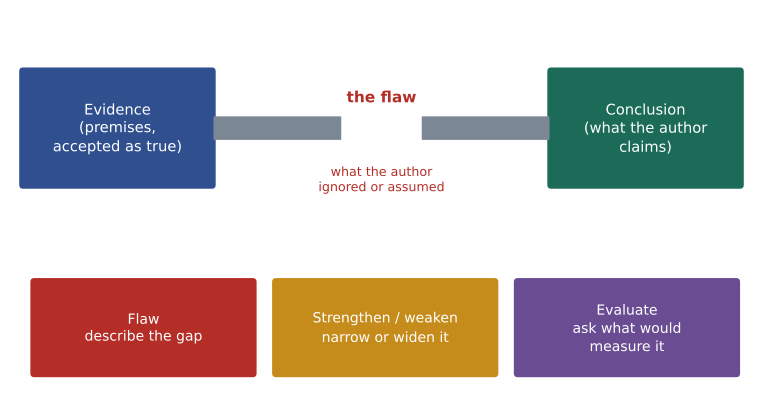
The single most important idea in this course is that an argument can have true premises and a true conclusion and still be flawed. A flaw is a defect in the connection. It is a reason the premises, taken as true, fail to establish the conclusion as strongly as the author claims.
Consider: "My neighbour owns a red car. Therefore the sky is blue." The premise is true (suppose), and the conclusion is true. But the argument is terrible, because the premise gives no support at all to the conclusion. Nobody would believe the sky is blue because of the neighbour's car.
Now consider the reverse: "All birds can fly. Penguins are birds. So penguins can fly." The conclusion is false, and so is the first premise, but the structure is perfectly valid: if the premises were true, the conclusion would have to be true. On the LSAT, that argument is not flawed in the test's sense. You accept the premises and judge the reasoning, and this reasoning is airtight.
Where flaws come from
Most flaws on the LSAT are the visible side of an assumption. In LSAT-110, you learned that most arguments rely on something unstated to connect premises to conclusion. When that unstated thing is doubtful, and the author proceeds as if it were certain, the argument is flawed. The Garnet Street argument assumes that one year of survival indicates that running a restaurant there is easy. Stated plainly, that assumption is shaky, and the flaw is that the author takes it for granted.
This gives you two ways to look at any flawed argument.
- From the assumption side: what must the author believe for this argument to work? (The restaurants' survival reflects the street, not something else.)
- From the flaw side: what possibility has the author failed to consider? (The survival could reflect something other than the street, such as wealthy owners or a short time frame.)
These are the same gap described from two directions. Flaw answer choices tend to use the second description: "fails to consider the possibility that…", "takes for granted that…", "overlooks…". Assumption answer choices use the first. When you can switch fluently between them, flaw questions and assumption questions become one skill.
| Argument | Assumption (what the author must believe) | Flaw (what the author overlooks) |
|---|---|---|
| Twelve new restaurants survived a year, so the street is easy for restaurants. | Their survival reflects conditions on the street. | Survival might reflect other factors, or a year may be too short to tell. |
| Students who use the tutoring centre earn higher grades, so the centre raises grades. | Students who use the centre are not already stronger students. | Stronger, more motivated students may be the ones who use the centre. |
| The senator's plan is wrong; she once supported the opposite. | A change of position shows the current position is wrong. | A person's past views do not show whether a claim is true. |
Strength of support: not all gaps are fatal
Real arguments rarely prove their conclusions. Most give reasons that make a conclusion more or less likely. The LSAT does not call an argument flawed just because it falls short of proof. It calls an argument flawed when the author claims more than the evidence supports, or relies on a connection the evidence cannot bear.
Watch the conclusion's strength. "Garnet Street may be a good place to open a restaurant" asks much less of the evidence than "Garnet Street is an easy place to run a restaurant." A modest conclusion can survive evidence that would sink a sweeping one. Many flawed arguments go wrong in exactly this way: the evidence supports "some" or "possibly," and the conclusion says "all" or "certainly."
Élodie raised a fair objection during the session. 'Every argument has some gap. How do I know which one the question wants?' Harriet's answer: 'The test writers build each stimulus around one gap, and usually it is the biggest one. If you find yourself listing five small worries, step back and ask which single thing, if false, would destroy the argument.' That thing is almost always what the credited answer is about.
The four question types in this course
Every question in this course starts with the same reading task: find the conclusion, find the evidence, and find the gap. What changes is what the stem asks you to do next.
| Question type | Typical stem | Your job |
|---|---|---|
| Flaw | "The reasoning in the argument is flawed because the argument…" or "…is most vulnerable to criticism on the grounds that it…" | Describe the gap in the abstract wording of the answer choices. |
| Strengthen | "Which one of the following, if true, most strengthens the argument?" | Find new information that makes the conclusion more likely, usually by closing the gap. |
| Weaken | "Which one of the following, if true, most seriously weakens the argument?" | Find new information that makes the conclusion less likely, usually by exploiting the gap. |
| Evaluate | "Which one of the following would it be most useful to know in order to evaluate the argument?" | Find the question whose answer would either strengthen or weaken the argument, depending on how it comes out. |
The words "if true" in strengthen and weaken stems matter. They tell you to accept each answer choice as a fact, however surprising, and judge its effect. Flaw questions do not say "if true," because the answer choices describe the reasoning; they do not add new facts. Evaluate questions ask about information you would want, not information you have.
How flawed arguments are disguised
If flaws were obvious, the questions would be easy. The test makes them harder in predictable ways.
- The conclusion sounds sensible. Many flawed arguments reach conclusions you might agree with. That makes the gap harder to see, because your mind supplies the missing support. Harriet calls this "agreeing your way past the flaw."
- The evidence is impressive. Precise numbers, studies and experts make an argument feel rigorous even when they do not bear on the conclusion.
- Words shift meaning. A term used one way in the premises and another way in the conclusion can hide a gap in plain sight.
- The scope changes. Evidence about one group, place or time is applied to another.
Each disguise maps to a family of flaws you will study: causal flaws, sampling and statistical flaws, conditional and part-whole flaws, and attacks, circles and shifting words. Once you know the families, you start to see the same few patterns behind very different topics.
A first look at the families
Prep books give these patterns many names, and the LSAT itself publishes no official list. What matters is recognizing the pattern, not memorizing a label. Here is a working map for this course.
- Causal flaws: concluding that one thing causes another from a correlation or a sequence in time, without ruling out other explanations (lesson 3).
- Sampling and statistical flaws: generalizing from an unrepresentative group, confusing percentages with amounts, or treating an average as true of every member (lesson 4).
- Conditional and part-whole flaws: confusing necessary with sufficient conditions, or assuming that what is true of the parts is true of the whole, or the reverse (lesson 5).
- Attacks, circles and shifting words: attacking the person instead of the argument, assuming the conclusion, using a term in two senses, presenting a false choice, or relying on an inappropriate authority (lesson 6).
Lesson 2 surveys all of these briefly so you have the whole map in view before the detailed lessons.
Worked problem
Finding the gap in a short argument
Stimulus: "Since the city installed speed cameras on Ridley Avenue in March, the number of collisions there has fallen by half. The cameras are therefore responsible for making the avenue safer." Find the conclusion, the evidence and the gap.
Show solution
- Conclusion: the cameras are responsible for making the avenue safer. "Therefore" introduces it.
- Evidence: collisions fell by half after the cameras were installed.
- Gap: the author assumes nothing else changed at the same time. Perhaps the avenue was also repaved, a nearby school closed, or a new traffic light went in.
- Described as a flaw: the argument fails to consider other possible explanations for the drop in collisions.
Answer: The argument infers a cause from a change that followed it, without ruling out alternative causes. That gap is what flaw, strengthen and weaken questions about this stimulus would focus on.
Reading for the gap before you look at the choices
Harriet asked everyone to adopt one rule for the whole block: predict before you read the choices. On a flaw question, put the gap into your own words. On a strengthen question, picture the kind of fact that would close it. On a weaken question, picture the kind of fact that would widen it. The choices are written to tempt people who arrive without a prediction, and the most tempting wrong answers often describe something that is in the stimulus but is not the problem.
Ji-won asked what to do when no prediction comes. Harriet suggested a fallback: say the conclusion out loud, then say "but what if…" and finish the sentence. Whatever completes it is usually close to the flaw. "The cameras made the avenue safer, but what if something else also changed in March?" That is the gap.
Dani found the habit natural. Six years as a paralegal had taught her to ask what the other side would say. Thomas found it harder; he tended to accept arguments whose conclusions he liked. Harriet suggested he deliberately try to disagree with every conclusion for the first two weeks, just as practice. 'You do not have to win the argument,' she said. 'You just have to find the place where you would push.'
The story of this course
The Tuesday workshop ran six weeks, from October 13 to November 17, with a timed capstone drill on Saturday, November 21. Marcus attended the first five Tuesdays before his November 12 test date and joined the November 17 review afterwards; his score was not yet released. Ji-won worked under her approved extended timing in every timed set. Each lesson in this course follows one part of that series, so you will see how five different learners handled the same material.
Common mistakes
MistakeCalling an argument flawed because a premise seems false.
InsteadAccept the premises; a flaw is a defect in how they support the conclusion.
MistakeTreating any argument that falls short of proof as flawed.
InsteadA flaw is a gap the author ignores while claiming more than the evidence supports.
MistakeListing every small worry about an argument.
InsteadFind the single biggest gap; the credited answer is almost always about it.
MistakeReading the answer choices before predicting.
InsteadPut the gap in your own words first, then look for a match.
Summary and key terms
- A flaw is a defect in the connection between premises and conclusion, not a false premise.
- Most flaws are doubtful assumptions the author takes for granted; the flaw and the assumption describe the same gap from two sides.
- The strength of the conclusion matters: sweeping conclusions need much stronger evidence than modest ones.
- Flaw questions describe the gap; strengthen and weaken questions add facts that close or widen it; evaluate questions ask what would measure it.
- Flawed arguments are disguised by sensible conclusions, impressive evidence, shifting words and changes of scope.
- Predict the gap in your own words before reading the answer choices.
- Flaw
- A defect in reasoning: a reason the premises, taken as true, fail to support the conclusion as strongly as claimed.
- Valid argument
- An argument whose conclusion must be true if its premises are true.
- Gap
- The distance between what the evidence shows and what the conclusion claims.
- Scope shift
- Applying evidence about one group, place, time or idea to a different one.
- Credited response
- The answer choice the test scores as correct.
Practice problems
Work each problem on paper first, then reveal the answer to check.
Is this argument flawed in the LSAT sense? "All squares have four sides. This shape is a square. So it has four sides."
Show answer
No. If the premises are true, the conclusion must be true. It is valid.
Describe the gap: "Most visitors who filled out our comment card loved the exhibit, so the exhibit is popular with the public."
Show answer
People who fill out comment cards may not represent all visitors, let alone the public.
Restate this assumption as a flaw: "The argument assumes that the new policy is the only reason sales rose."
Show answer
The argument fails to consider that something other than the new policy may have caused sales to rise.
Lesson quiz · 5 questions
Score 60% or more to complete this lesson.
Create a free account to save your progress, take quizzes and earn a certificate.