
LES-214 · Lesson 9 of 12 · 20 min
Public order: protests, demonstrations and the right to assemble
▶ Video coming soon A video version of this lesson is on the way.
On Saturday, September 26, 2026, about six hundred people marched from Harbour Park to Port Ardent City Hall to protest the planned closure of the maternity unit at Port Ardent General Hospital. The march took forty minutes, filled two lanes of Front Street, and ended with an hour of speeches on the City Hall steps. About forty counter-demonstrators, who supported the hospital board's plan to move the unit to a regional centre, gathered across the street. There were shouted arguments, one shoving match that two officers broke up in under a minute, and a man who climbed the flagpole and refused to come down for an hour. There were no arrests, no injuries and no damage.
Desjardins shows the class the operational plan the police service wrote for the day. It is twelve pages long, and the first heading is not 'threats' or 'tactics' but 'objectives'. The first objective reads: 'Facilitate the lawful exercise of the rights of peaceful assembly and expression by all participants.' The second: 'Maintain public safety and keep traffic moving around the march route.' The third: 'Respond to any criminal offence proportionately and in a way that does not escalate the event.' 'That order is deliberate,' Desjardins says. 'Most protests are lawful. The job is to make them safe, not to stop them.'
The right to protest
The Canadian Charter of Rights and Freedoms protects freedom of thought, belief, opinion and expression, including freedom of the press, in section 2(b), and freedom of peaceful assembly in section 2(c). Protest is one of the oldest forms of political expression, and it is protected even when the message is unpopular, offensive to some, or critical of the police or government. The protection is not unlimited. Violence is not protected expression, and governments may impose reasonable limits that are prescribed by law and justified in a free and democratic society under section 1, such as rules about blocking traffic or using amplified sound.
In practice, this means that police may manage how and where a protest happens, for example by directing a march along a route that keeps an emergency lane open, but may not stop a protest because they or others disagree with its message. Municipal permits for marches and amplified sound are common, but a protest without a permit is not automatically unlawful, and police should think carefully before treating it as if it were.
How thinking about protest policing has changed
Desjardins gives a brief history. For much of the twentieth century, protest policing in North America often relied on a show of force and on dispersing crowds that seemed disorderly. Events such as the shooting of students at Kent State University in Ohio in May 1970, when National Guard soldiers killed four people during a protest, led to reviews and to a gradual shift toward negotiated management: police meeting organizers in advance, agreeing on routes and arrangements, and tolerating some disruption as part of the right to protest.
Research on crowds since the 1990s, particularly the work of social psychologists in the United Kingdom, has added a further insight. A crowd is not a mass of identical people; it is made up of groups with different intentions, and most people in most crowds are peaceful. When police treat the whole crowd as a threat, for example by using force against everyone in an area because of the actions of a few, peaceful participants come to see the police as hostile and may begin to side with the few. When police distinguish between groups, communicate openly and respond to specific behaviour rather than to the crowd as a whole, the peaceful majority tends to isolate those who want trouble. This idea, sometimes summarized as the elaborated social identity model of crowd behaviour, has shaped modern training in many countries.
Canadian inquiries have reinforced the same lessons. The Ipperwash Inquiry, which reported in 2007 on the police shooting of Dudley George during an Indigenous occupation of a provincial park in 1995, recommended an approach to Indigenous protests based on communication, patience and respect for treaty and Aboriginal rights. Reviews of policing during the 2010 G20 summit in Toronto, including the 2012 report of Ontario's Office of the Independent Police Review Director, were strongly critical of mass arrests, the detention of peaceful people and the practice of containing crowds for hours. The Public Order Emergency Commission in 2023 criticized intelligence and planning failures in the response to the 2022 convoy protests.
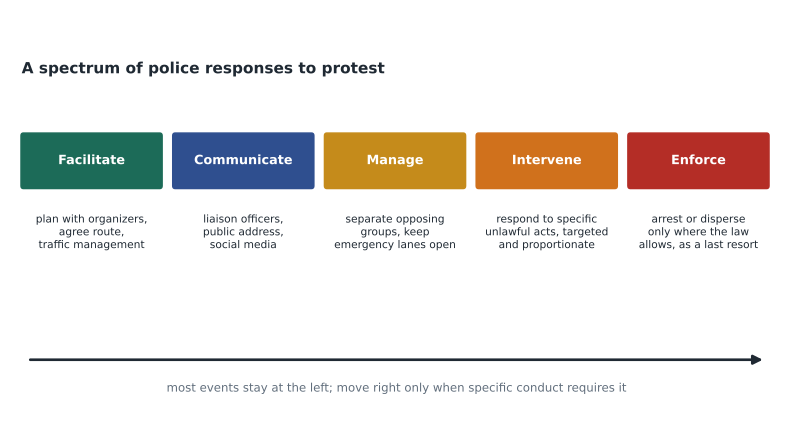
Planning for a demonstration
Planning for the September march began when the organizers, a coalition of parents and health workers, applied for a march permit three weeks in advance. A police liaison officer, Constable Grace Ferreira, the Eastgate neighbourhood officer, met the organizers twice, walked the route with them, and agreed on arrangements: the march would use the two eastbound lanes of Front Street with the westbound lanes kept open for emergency vehicles and buses; organizers would provide marshals in visible vests; amplified sound would end at 15:00; and the organizers would have a direct phone line to Ferreira during the event. Ferreira also contacted the counter-demonstrators, who had announced their plans on social media, and agreed on a location for them across the street with a clear space between the groups.
The operational plan assigned officers to traffic points along the route, to a small group walking with the march, to the area between the two groups at City Hall, and to a reserve out of sight. It named a commander and a deputy, set out radio channels, and included a communications plan: the police service would post route and road closure information in advance, and liaison officers would explain any police action to organizers as it happened. Officers were briefed that the march was lawful and that their role was to facilitate it.
# Estimating crowd size from area and density (a common rough method)
areas = {
    # name: (length in m, width in m, estimated people per m2)
    "City Hall steps and plaza":   (40, 15, 0.8),
    "Front Street in front":       (30, 7, 0.4),
    "Counter-demonstration area":  (12, 6, 0.55),
}
total = 0
for name, (length, width, density) in areas.items():
    people = round(length * width * density)
    total += people
    print(f"{name:28} about {people} people")
print("total estimate:", total)City Hall steps and plaza about 480 people Front Street in front about 84 people Counter-demonstration area about 40 people total estimate: 604
The method is simple: estimate the area each part of the crowd occupies and multiply by a typical density. A loose crowd standing and listening might have one person per square metre or fewer; a tightly packed crowd might have three or more. The estimate is rough, and different methods give different answers, which is one reason crowd sizes at protests are often disputed. Police estimates should be made carefully and described as estimates, because organizers and opponents will quote them.
On the day
The march stepped off from Harbour Park at 13:05. Traffic officers held cross streets as it passed, and the bus route was diverted for forty minutes. At City Hall, the speeches began at 13:50. At about 14:20, a man from the counter-demonstration crossed the space between the groups and began arguing face to face with marchers. One marcher pushed him; he pushed back. Two officers from the group between the crowds stepped in, separated the men, spoke to each of them, and walked the counter-demonstrator back across the street. Neither man wanted to make a complaint. The officers recorded the names and the details in their notes. The whole thing lasted less than a minute.
The man on the flagpole was harder. He was not part of either group, he was shouting about an unrelated grievance, and he was about six metres up. Officers cleared the area beneath him and spoke to him calmly, a crisis negotiator who happened to be on the reserve team talked with him for forty minutes, and he climbed down at 15:20 and was taken to hospital for assessment under mental health legislation, on the advice of the negotiator and a paramedic. The march organizers asked their crowd to give the officers space, and most of the crowd never noticed.
When protest becomes unlawful
Protests sometimes involve criminal offences: assault, mischief or damage to property, blocking roads in a way that endangers people, threats, or, rarely, riot. Officers should respond to specific offences by specific people, in a targeted and proportionate way that does not turn a peaceful crowd against the police. Arresting someone in the middle of a dense crowd may be lawful but unwise; it can often be done later, away from the crowd, using video and identification. Every use of force must be necessary, proportionate and reasonable in the circumstances, and must be reported.
The Criminal Code defines an unlawful assembly as three or more people who, with intent to carry out a common purpose, assemble or conduct themselves in a way that causes people in the neighbourhood to fear, on reasonable grounds, that they will disturb the peace tumultuously or provoke others to do so. A riot is an unlawful assembly that has begun to disturb the peace tumultuously. Sections 67 and 68 provide for a justice, mayor or sheriff to read a proclamation commanding rioters to disperse, after which remaining is a serious offence. These provisions are rarely used. Most protest-related offences are charged as specific offences such as assault or mischief.
Large-scale public order operations, such as dealing with a riot, involve specialized units with their own training, equipment and command arrangements, and are beyond the scope of this course. What every officer needs to know is that such operations are a last resort, that they require clear legal authority and senior command, and that the work done earlier, in planning, liaison and communication, is what usually keeps an event from ever reaching that point.
Officer conduct at protests
Individual officers shape how a protest goes far more than they may realize. Protesters notice whether officers are relaxed or tense, whether they answer questions or ignore them, and whether they treat people with the same courtesy regardless of the cause. Desjardins gives the class the guidance the Port Ardent service gave its officers before the September march. Be visible, approachable and calm. Answer questions about routes and closures. Do not express opinions about the cause, in person or online. Do not take or keep photographs of lawful protesters except as the service's policy allows for a specific operational purpose. Expect to be filmed, and do not interfere with filming. Wear your name or number visibly. If someone is rude or provocative, do not respond in kind; the aim is to keep the temperature down.
Ontario's policing legislation and police codes of conduct require officers to act with neutrality and professionalism, and complaints about officer conduct at protests can be made to the province's independent oversight bodies. Desjardins tells the students that body-worn camera video from protests is among the most frequently requested police recordings, by journalists, lawyers and members of the public, and that officers should assume that anything they say or do at a protest may be seen by many people later.
Protests that last for days
Some protests are not marches but occupations or encampments that last for days or weeks, such as camps in parks or the long blockades of 2022. These raise harder questions: how much disruption must a community tolerate, and for how long? The answers depend on the law, on the effect on others, and on the willingness of the participants to talk. Police leaders, municipal officials and sometimes the courts, through injunctions, share the decisions. For officers, the same principles apply: communicate, act on specific behaviour, respond proportionately, and record what happens.
Worked problem
Responding to a road blockade
During an otherwise peaceful climate protest, about thirty people sit down across both lanes of a busy downtown street at rush hour. They say they will stay for one hour. Traffic is backing up, and an ambulance is approaching from two blocks away. What should police do?
Show solution
- Recognize that the protest is expressive activity but that blocking a road entirely, especially an emergency route, can be lawfully limited.
- Use the liaison officer to talk with the participants immediately: explain that an ambulance is coming and ask them to open a lane.
- Divert traffic around the block and give the ambulance a clear alternate route if one exists.
- If the participants refuse and the blockade continues to endanger people, a commander decides on next steps, which may include warnings, a clear direction to move with time to comply, and, as a last resort, arrests for specific offences.
- Record everything, including warnings given and the time allowed to comply.
Answer: Prioritize the emergency vehicle and public safety through communication and diversion first, and move to enforcement only as a last resort, with clear warnings and records.
Common mistakes
MistakeA protest without a permit is unlawful.
InsteadNot automatically; the right to peaceful assembly does not depend on a permit, although permits and reasonable limits are common.
MistakeCrowds become violent because of crowd psychology.
InsteadMost crowds are peaceful; treating the whole crowd as hostile can turn peaceful people against police.
MistakeOfficers should arrest offenders immediately, wherever they are in the crowd.
InsteadTargeted arrests can often be made later, away from the crowd, using video and identification.
MistakePolice should keep opposing groups apart by any means.
InsteadSeparation is managed through planning, location agreements and a buffer space, not force.
Summary and key terms
- Sections 2(b) and 2(c) of the Charter protect expression and peaceful assembly, subject to reasonable limits under section 1.
- The main police objective at most protests is to facilitate lawful protest safely.
- Modern practice emphasizes negotiated management, liaison and distinguishing between groups in a crowd.
- The Ipperwash Inquiry, reviews of the 2010 G20 summit and the Public Order Emergency Commission all reinforced the value of planning and communication.
- Respond to specific offences by specific people, proportionately; arrests can often be made later.
- Unlawful assembly and riot are defined in the Criminal Code but rarely charged; specialized public order operations are a last resort.
- Unlawful assembly
- Under the Criminal Code, an assembly causing reasonable fear of a tumultuous breach of the peace.
- Ipperwash Inquiry
- The Ontario inquiry that reported in 2007 on the 1995 death of Dudley George.
- Negotiated management
- An approach in which police and organizers agree on arrangements for a protest in advance.
- Liaison officer
- An officer who communicates with organizers and participants before and during an event.
- Proportionality
- Using no more force or restriction than the situation requires.
- Counter-demonstration
- A demonstration opposing another demonstration at the same time and place.
Practice problems
Work each problem on paper first, then reveal the answer to check.
What was the first objective in the police plan for the September march?
Show answer
To facilitate the lawful exercise of the rights of peaceful assembly and expression.
In the code example, about how many people were estimated in total?
Show answer
About 600.
How long did the shoving match last, and how was it resolved?
Show answer
Less than a minute; two officers separated the men and walked the counter-demonstrator back.
Why can an arrest in the middle of a dense crowd be unwise?
Show answer
It can escalate the event and turn the peaceful crowd against police.
Lesson quiz · 5 questions
Score 60% or more to complete this lesson.
Create a free account to save your progress, take quizzes and earn a certificate.