
LES-214 · Lesson 6 of 12 · 22 min
Evacuation, shelter-in-place and reception centres
▶ Video coming soon A video version of this lesson is on the way.
The bus carrying the first twenty-two residents of Riverside Seniors Residence pulled away from the front door at 00:58 on June 23, escorted by a patrol car. Marco DiSanto, one of the students, knows the residence well; his grandmother lived there until last year. He asks Kowal how the city decided to move a building full of frail older people in the middle of the night, in the rain, when the water had not yet reached the building. 'Because by the time the water reaches the building, it's too late,' Kowal says. 'The residence is at the lowest point on Riverside Drive. Moving sixty-four people, eleven of them in wheelchairs and two on oxygen, takes two hours on a good day. Our flood plan said that if the creek forecast passed a certain level, the residence moves first. It passed that level at 23:45.'
Evacuation is one of the most common and most consequential actions in an emergency. Done well, it saves lives at modest cost. Done badly, or too late, it can put people in more danger than staying put, cause injuries during the move, separate families and destroy trust in the next warning. This lesson covers how evacuation decisions are made, how evacuations are carried out, the alternative of sheltering in place, and the reception centres and shelters that receive people who leave.
Evacuate or shelter in place?
The first decision is whether moving people is safer than keeping them where they are. For a flood, a wildfire or a building collapse, leaving is usually safer, as long as there is time and a safe route. For a short-lived release of a toxic gas, staying indoors with windows and doors closed and ventilation off is often safer than going outside into the cloud. For a severe storm or tornado, people should take shelter where they are, in a basement or interior room, rather than trying to drive away.
Decision-makers weigh several factors: the nature of the hazard and how fast it is moving; how long it will last; whether there are safe routes and enough time to use them; the number and needs of the people affected; the weather and time of day; and what the experts at the scene advise. The decision is often made by the incident commander for the immediate area, with the head of council or other officials ordering larger evacuations under emergency powers. Police seldom make the decision alone, but officers are often the first to recognize that people need to move, and the first officer on scene may have to order an immediate evacuation of a few buildings before anyone more senior arrives.
| Hazard | Usual protective action | Why |
|---|---|---|
| Rising floodwater | Evacuate early, before routes flood | Water rises faster than people expect and cuts off roads |
| Wildfire | Evacuate early | Fire can move faster than traffic, and smoke reduces visibility |
| Short toxic gas release | Shelter in place | Going outside may mean walking into the cloud |
| Tornado or severe wind | Take shelter in place | Vehicles offer little protection |
| Gas leak in a building | Evacuate the building and the immediate area | Risk of explosion inside |
| Extended power failure in cold weather | Shelter in place or go to a warming centre | Depends on heating and individual needs |
Kinds of evacuation
Evacuations are often described by how urgent and how compulsory they are. A precautionary evacuation is recommended before the hazard arrives, when it is likely but not certain; it gives people more time and makes the later work easier. An ordered or mandatory evacuation is directed by an official with legal authority. In practice, the difference between the two is often less than the words suggest. Even under an order, police rarely remove adults from their homes by force, as the previous lessons discussed, and some people leave after a recommendation who would not leave after an order. What matters most is that the message is clear about the danger and about what will happen if people stay, for example that rescue may not be possible.
Evacuations also differ in scale: a single building, a block, a neighbourhood, a whole town. Ontario has evacuated entire communities several times in recent years, most often First Nations in the north threatened by wildfire smoke or spring flooding, sometimes moving thousands of people by air to host communities in the south.
Phases of an evacuation
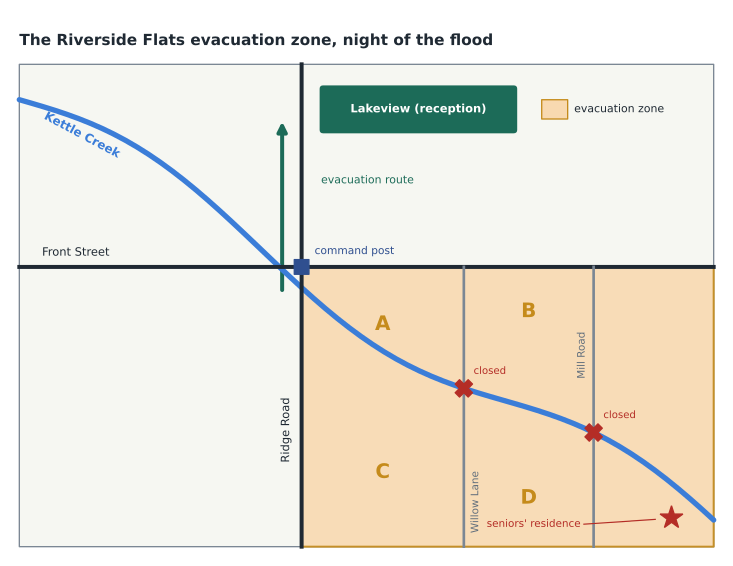
Most evacuations move through the same phases: the decision; alerting and notification; movement; reception and shelter; and, eventually, return. Each phase has police tasks.
In the warning phase, police help notify residents, as the last lesson described. In the movement phase, police control traffic on evacuation routes, keep routes open for emergency vehicles, escort buses, direct drivers away from hazards and deal with breakdowns and collisions. In the reception phase, police provide security at reception centres and shelters and help with inquiries about missing people. And while the area is empty, police patrol it to prevent theft and keep people out of danger. On return, police manage access, often checking identification so that only residents and authorized workers enter.
The evacuation of Riverside Flats used four teams of officers and firefighters working through four divisions, each with a leader reporting to the evacuation group supervisor. Before the teams started, the planning section printed a list of every address in the zone. Each team recorded the result at each door. The group supervisor reported totals to the command post every thirty minutes.
Worked problem
Estimating door-to-door evacuation time
Riverside Flats has 430 households. Twenty-four officers and twelve firefighters work in 18 pairs, and each door takes about 6 minutes on average, including waiting, explaining and recording. If the teams start at 23:55, when should they finish?
Show solution
- Share the doors among the pairs, rounding up because the last round still takes a full visit.
- \[\lceil 430 \div 18 \rceil = \lceil 23.9 \rceil = 24 \text{ doors per pair}\]
- \[24 \times 6 = 144 \text{ minutes} = 2 \text{ hours } 24 \text{ minutes}\]
- Add the time to the start: 23:55 plus 2 hours 24 minutes is 02:19.
Answer: About 144 minutes, finishing at about 02:19.
The estimate of about two and a half hours matched what happened: the teams reported every address checked at 02:31. Kowal notes that six minutes a door is an average. Some doors took thirty seconds because nobody was home and the house was dark; one took twenty-five minutes because an older couple needed help finding medication and packing a bag for their cat. Planners use averages, but supervisors should expect wide variation.
People who need help to leave
The people most at risk in an evacuation are often those least able to leave on their own: older adults, people with disabilities or serious illnesses, people without cars, children in schools and daycares, people in hospitals, care homes and correctional facilities, people experiencing homelessness, and visitors who do not know the area. Good plans identify them in advance. Port Ardent's plan lists every care facility in each flood zone, its number of residents, their mobility needs and its own evacuation plan, and contains agreements with the regional transit service and two school bus companies to provide vehicles.
Animals matter too. Many people refuse to evacuate if they cannot take their pets, and some have died returning for them. Many Ontario municipalities now plan for pets at reception centres, often with local humane societies. Service animals must always be allowed to stay with their handlers.
Reception centres and shelters
A reception centre is where evacuees go first. It registers them, provides immediate needs such as food, water, warmth, information and first aid, and helps them find somewhere to stay, which may be with family, in a hotel or in a shelter. In Ontario this work is usually organized as emergency social services by the municipality, often with the Canadian Red Cross. Lakeview Community Centre registered 211 people on the night of the flood. Fifty-eight stayed overnight on cots in the gymnasium; the rest went to family, friends or hotels.
Registration is important for two reasons. It lets officials know who is safe, which allows police to stop searching for people who have already left. And it supports family reunification: when relatives call asking whether someone is safe, the registration and inquiry service can tell them, with the evacuee's consent. Officers who receive missing-person calls during an emergency should check the registration list before starting a search.
Police tasks at reception centres usually include security, traffic and parking, helping identify people who may need police services, and supporting inquiries about missing people. Officers should be visible and approachable. Desjardins reminds the class that many evacuees are frightened, tired and grieving, and some have reasons to be wary of police. 'You are there to help them feel safe,' he says. 'This is not the place to run warrant checks on everyone who walks in.' Port Ardent's policy, like that of many services, is that officers at reception centres do not check evacuees for outstanding warrants unless there is a specific safety concern.
Protecting the evacuated area
People who evacuate worry about their homes, and fear of looting is one of the most common reasons people give for refusing to leave. Research on disasters has repeatedly found that widespread looting is much rarer than media coverage and popular belief suggest, and that most people in disasters behave cooperatively and help one another. Theft from evacuated areas does happen, however, and visible police patrols reassure residents. During the flood, officers patrolled the dry edges of Riverside Flats on foot and by car; a property crime unit followed up three reports of thefts from sheds in the following week.
Shelter in place in practice
Sheltering in place is simple to describe and harder to do well. People should go indoors, close all windows and doors, turn off heating, ventilation and air-conditioning systems that draw in outside air, close fireplace dampers, move to an interior room above ground level if the hazard is a heavier-than-air gas, and listen to the radio or watch their phones for updates. They should not leave to pick up children from school, because schools have their own plans. When the hazard has passed, officials will tell them to open windows and go outside to air the building out, because indoor air slowly becomes contaminated during a long release.
Police may be asked to tell people to shelter in place, to keep traffic out of the affected area, and to enforce the instruction at the edges of the zone. Officers should not drive into an area where people are being told to shelter in place, because their own vehicles draw in outside air and offer little protection. Lesson 11 returns to this when it covers the gasoline tanker rollover in September.
Recording and tracking evacuees
Accounting for people is one of the hardest parts of an evacuation. During the flood, the planning section kept three lists that had to be reconciled: the addresses checked by the door-to-door teams, the people registered at Lakeview, and the people reported missing by relatives. At 04:00 the three lists left nine people unaccounted for. By 06:00 seven had been found registered with family or at hotels, one was the man with the dogs who was later rescued by boat, and one was a woman who had been in hospital the whole time. Kowal says that the reconciliation took four people two hours, and that the next version of the plan will use a shared electronic list instead of paper.
Worked problem
Planning the return home
Two days after the flood, the water has receded from Riverside Flats. Public works says the streets are passable, but the electric utility has not finished checking which homes are safe to reconnect, and public health is concerned about contaminated water in basements. Residents are gathering at the closure on Ridge Road and want to go home. What should police do?
Show solution
- Recognize that the decision to allow return belongs to the operations centre and incident command, based on advice from the utility, public health and building officials.
- Explain to residents clearly why they cannot enter yet, what is being checked and when the next update will be given.
- Suggest a supervised short visit to collect medication and essentials, if command approves, with officers checking identification and recording who enters.
- Pass residents' concerns and questions to the operations centre so the public information team can address them.
- When return is approved, manage access in phases, starting with the streets declared safe, and provide information on cleanup safety.
Answer: Keep the area closed until the responsible agencies say it is safe, communicate clearly and often, and manage a phased, recorded return.
Common mistakes
MistakeEvacuation is always safer than staying put.
InsteadFor short toxic gas releases and tornadoes, sheltering in place is often safer.
MistakeMandatory evacuation means police will remove everyone by force.
InsteadPersuasion is used in almost all cases; refusals are recorded and reported.
MistakeLooting is widespread after disasters.
InsteadResearch shows it is much rarer than commonly believed, though patrols reassure residents.
MistakeOfficers should check everyone at a reception centre for warrants.
InsteadMany services forbid it unless there is a specific safety concern, because it deters people from seeking help.
Summary and key terms
- The first decision is whether to evacuate or shelter in place, based on the hazard, time, routes and the people affected.
- Evacuations can be precautionary or ordered, and range from one building to whole communities.
- Evacuations move through decision, warning, movement, reception and return, with police tasks in each phase.
- People who cannot leave on their own, and their animals, need to be identified and planned for in advance.
- Reception centres register evacuees, meet immediate needs and support family reunification; police provide security and help with inquiries.
- Evacuated areas need patrols and controlled return, based on advice from the agencies responsible for safety.
- Emergency social services
- Municipal services for evacuees, such as reception, lodging, food and clothing.
- Shelter in place
- Staying indoors, with windows and ventilation closed, to avoid an outdoor hazard.
- Precautionary evacuation
- An evacuation recommended before a hazard arrives.
- Ordered evacuation
- An evacuation directed by an official with legal authority.
- Reception centre
- The first stop for evacuees, providing registration and immediate needs.
- Family reunification
- Helping separated family members find each other.
Practice problems
Work each problem on paper first, then reveal the answer to check.
Why did the seniors' residence move before the water reached it?
Show answer
Moving 64 frail residents takes about two hours, and the plan said it moves first once the creek passed a set level.
In the lesson's example, how many minutes was the evacuation estimated to take?
Show answer
144 minutes, finishing at about 02:19.
How many people registered at Lakeview, and how many stayed overnight?
Show answer
211 registered and 58 stayed overnight.
Why should officers check the registration list before searching for a missing evacuee?
Show answer
The person may already be registered as safe.
Lesson quiz · 5 questions
Score 60% or more to complete this lesson.
Create a free account to save your progress, take quizzes and earn a certificate.