
LES-214 · Lesson 11 of 12 · 21 min
Hazardous materials awareness and mass-casualty incidents
▶ Video coming soon A video version of this lesson is on the way.
At 14:20 on Wednesday, September 9, 2026, a tank truck carrying about thirty thousand litres of gasoline took the curve on the Highway 12 off-ramp at Industrial Road too fast and rolled onto its side. The driver climbed out through the windshield with cuts to his hands. Constable Priya Sandhu's field training officer, Constable Marcus Hale, was the first to arrive, about four minutes later. He stopped his cruiser on the overpass, a little over a hundred metres away and uphill, upwind of the truck, and looked through binoculars. He could smell gasoline. Fuel was running from the tank into the ditch and toward a storm drain. He could read the placard on the side of the tank: a red diamond with the number 1203.
Desjardins asks Sandhu, who had been riding along that day as part of her program, what Hale did next. 'He didn't go any closer,' she says. 'He got on the radio, gave the location, said tanker rollover, gasoline, product 1203, leaking into a ditch and a storm drain, driver out and walking toward us. He asked for fire with hazmat, paramedics and a supervisor, and for traffic to be stopped on the ramp and Industrial Road. Then he opened the orange book in the glovebox and read me the page.' This lesson covers the awareness-level knowledge every officer needs for hazardous materials incidents, and the basics of responding when an incident produces more casualties than the first responders can treat at once.
Recognizing hazardous materials
Hazardous materials, called dangerous goods in Canadian law, are substances that can harm people, property or the environment if released: flammable liquids and gases, toxic gases, corrosive liquids, explosives, radioactive materials, oxidizers and others. They are moved every day by road, rail, pipeline, water and air, and stored in factories, farms, warehouses, pools and stores. Most releases are small. A few are catastrophic. In July 2013, a runaway train carrying crude oil derailed and exploded in the centre of Lac-Mégantic, Quebec, killing forty-seven people.
The first responder's challenge is to recognize that a hazardous material may be involved before becoming exposed to it. Clues include:
- Placards on vehicles, rail cars and containers: diamond-shaped signs with a colour, a symbol, a hazard class number and often a four-digit product identification number
- Labels on packages, and markings and shipping papers, which the driver or train crew should have
- The shape of containers: pressurized tank trucks and rail cars, drums, cylinders, intermediate bulk containers
- Locations: factories, farms, pool supply stores, laboratories, water treatment plants, rail yards
- Senses at a distance: unusual smells, clouds or vapours, fires that behave strangely, hissing sounds
- People or animals showing symptoms: coughing, collapsing, vomiting, eye irritation, dead birds or fish
Officers should never use their senses deliberately to identify a substance, for example by approaching to sniff or touch. If an officer smells something, they are already exposed. The safe way to identify a product is from a distance, with binoculars, using placards, papers and information from the driver, the facility or dispatch.
The Emergency Response Guidebook and CANUTEC
The Emergency Response Guidebook, produced jointly by Transport Canada, the United States Department of Transportation and partners in Mexico and Argentina, is the standard reference for first responders in the first minutes of a dangerous goods incident. The current edition was published in 2024, and Transport Canada distributes it free to emergency services. Transport Canada also runs CANUTEC, a national emergency response centre staffed around the clock by chemists, which responders can call for advice on the product, the hazards and the protective actions.
The guidebook is colour-coded. The yellow pages list materials by identification number; the blue pages list them by name. Each entry gives a guide number, which leads to an orange page describing the potential hazards, public safety measures and emergency response actions for that group of materials. The green pages give initial isolation and protective action distances for materials that are toxic by inhalation, which can affect people far from the spill. Officers should know where the guidebook is in their vehicle, and should practise looking things up before they need to.
Hale looked up 1203 in the yellow pages: gasoline, guide 128. The orange page for guide 128 describes flammable liquids that are not miscible with water. Among other things, it advises isolating the spill or leak area for at least 50 metres in all directions as an immediate precaution, considering an initial downwind evacuation for at least 300 metres for a large spill, and much larger distances if a tank is involved in a fire. It also warns that vapours may travel to a source of ignition and flash back, and that runoff to sewers may create a fire or explosion hazard. Officers should always use the current edition of the guidebook for distances.
The awareness-level role
Most police officers are trained to the awareness level for hazardous materials. Their job is not to stop the release, enter the hazard area or rescue people from it, which require specialized training and protective equipment. Their job is to recognize the hazard, protect themselves, isolate the area, deny entry, notify the right people and help protect the public. These steps are often summarized as recognize, isolate, deny entry and notify.
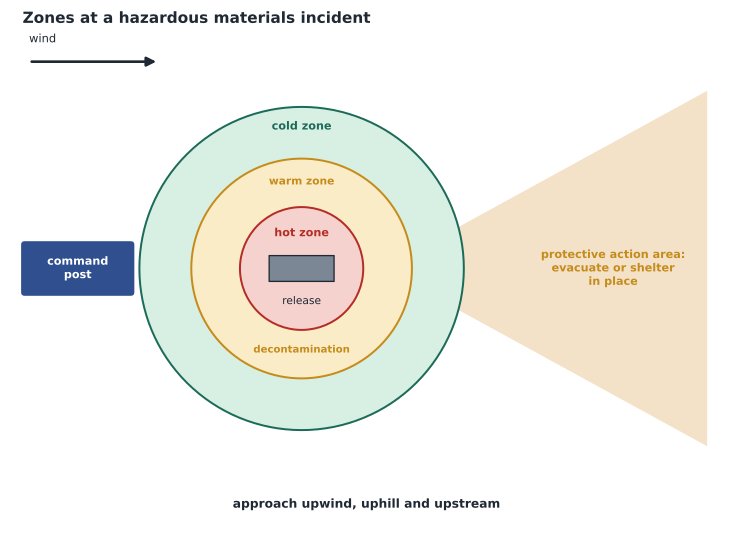
Approach upwind, uphill and upstream, so that vapours, liquids and runoff move away from you. Stop at a safe distance, using the guidebook as a starting point. Keep people out of the area and move people already inside it toward safety, upwind, without becoming exposed yourself. Report the product, quantity if known, container, conditions, wind direction and casualties. Ask for fire and hazardous materials teams. Stop traffic and close roads into the area. Eliminate ignition sources where possible without approaching: for a flammable product, that can mean asking people to shut off nearby vehicle engines and keeping ignition sources away. Officers should never light road flares near a spill of a flammable product. Once the fire service arrives, it typically takes charge of the hazard area and establishes the zones.
The fire service divides the scene into zones. The hot zone surrounds the release and can be entered only by trained responders in appropriate protective equipment. The warm zone surrounds the hot zone and contains the decontamination corridor, through which people and equipment leave the hot zone. The cold zone is outside both and holds the command post, staging and medical treatment. Police usually control the outer perimeter and traffic and keep the public and media in safe locations.
At Industrial Road, the fire service established a hot zone of about 50 metres around the truck and used foam to cover the spilled gasoline. Public works blocked the storm drain downstream. Police closed the ramp and Industrial Road between Ridge Road and the rail crossing, and because the wind was carrying vapours toward a small business park, officers evacuated four businesses and a daycare within about 300 metres downwind. The daycare's twenty-two children walked to a church on the next street with their staff, escorted by two officers. The road reopened at 21:40 after the load had been transferred to another truck.
Mass-casualty incidents
A mass-casualty incident is one in which the number of injured people exceeds the resources immediately available to care for them. What counts as mass casualty depends on the place: ten injured people may overwhelm a rural area with two ambulances, while a large city can treat that many with routine resources. The defining feature is a shift in how care is given. Instead of doing everything possible for each patient in turn, responders try to do the most good for the most people, which means sorting patients by urgency so that the limited resources go first to those who will benefit most.
This sorting is called triage. Paramedic and fire services use standard triage systems, and one widely taught system in North America is START, simple triage and rapid treatment. It sorts patients in about a minute each, using a few simple checks, into four categories, usually marked by coloured tags: immediate (red), delayed (yellow), minor (green), and expectant or deceased (black).
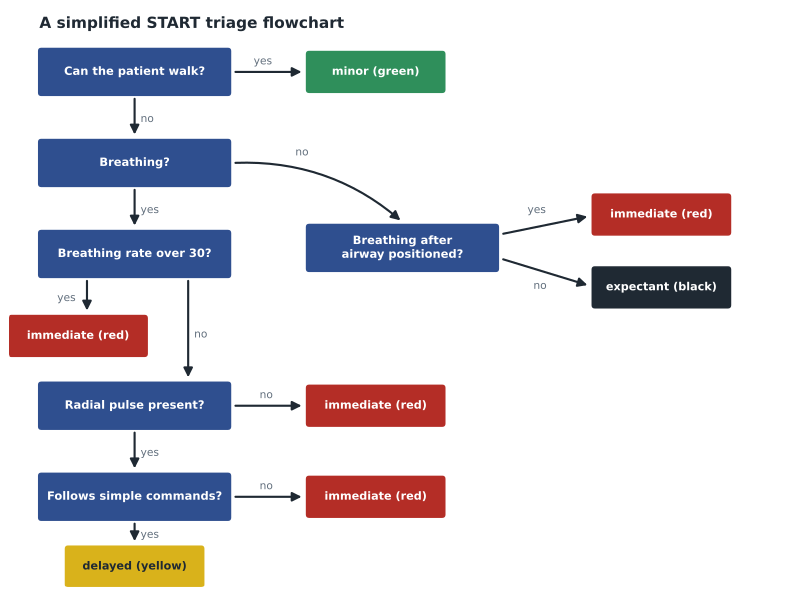
# A simplified START triage sort (for teaching; real triage is done by trained medical staff)
def start_triage(walks, breathing, breathing_after_airway, rate, radial_pulse, follows_commands):
    if walks:
        return "minor (green)"
    if not breathing:
        return "immediate (red)" if breathing_after_airway else "expectant or deceased (black)"
    if rate > 30:
        return "immediate (red)"
    if not radial_pulse:
        return "immediate (red)"
    if not follows_commands:
        return "immediate (red)"
    return "delayed (yellow)"

patients = [
    ("student A", True,  True,  True,  18, True,  True),
    ("student B", False, True,  True,  34, True,  True),
    ("student C", False, True,  True,  22, True,  True),
    ("driver",    False, True,  True,  20, False, True),
    ("student D", False, True,  True,  16, True,  False),
]
for name, *signs in patients:
print(f"{name:10} {start_triage(*signs)}")student A minor (green) student B immediate (red) student C delayed (yellow) driver immediate (red) student D immediate (red)
Police do not usually triage patients; paramedics and firefighters do. But police officers are often first on scene and may need to do some of the first steps, such as directing everyone who can walk to a safe collection point, which quickly separates the minor injuries from the rest. Officers trained in first aid can control severe bleeding, which is one of the most common preventable causes of death after injury, using direct pressure or a tourniquet. Most of all, police make the medical response possible: securing the scene, keeping access and exit routes open for ambulances, controlling traffic, managing bystanders, and keeping track of where patients are taken.
At 15:05 on Tuesday, October 6, 2026, a pickup truck ran a stop sign at Ridge Road and Concession 4 and struck the side of a school bus carrying twenty-three students home from a middle school. The first police officer arrived three minutes later, saw students climbing out of the bus, and radioed for a mass-casualty response. He told every student who could walk to go to the grass beside the church across the road and sit down, and asked a teacher who had been driving behind the bus to stay with them and count them. Sixteen students walked to the church. Paramedics triaged the rest: two immediate, five delayed. The bus driver and the pickup driver were also hurt. All twenty-five patients were taken to two hospitals within seventy minutes. Nobody died.
The hardest part for police, Desjardins says, came afterward: dozens of parents arriving at the scene and at the school, frantic for news. The police plan for the incident set up a family information point at the school, away from the crash, where officers and school staff could tell parents which hospital each child had been taken to, as soon as that was confirmed. Keeping accurate lists of who went where, and checking them before telling any parent anything, is a police task in almost every mass-casualty incident.
Contamination and secondary hazards
People who have been exposed to a hazardous material can carry it on their skin and clothing and contaminate others, including responders, vehicles and hospitals. That is why the fire service sets up decontamination in the warm zone, and why officers should not put a possibly contaminated person in a patrol car or take them to hospital without checking with fire and paramedics. Simple steps, such as removing outer clothing, which removes most contamination, and rinsing with water, are often done first; specialized decontamination follows if needed. Officers who think they may have been exposed should report it at once and follow the advice of the hazardous materials team.
Responders should also be alert to secondary hazards: a second release from a damaged container, a fire that starts after the first responders arrive, vapours collecting in low places such as ditches, basements and storm drains, and unstable vehicles or loads. At Industrial Road, the hazardous materials team monitored the air in the storm drain system for two hours after the foam was applied, because gasoline vapour in a sewer can travel a long way and ignite far from the spill.
Worked problem
Arriving first at a possible hazardous materials incident
You are sent to a report of a person collapsed in the parking lot of a pool supply store. As you approach, you see two employees outside the loading door, one coughing badly, and a faint yellowish-green haze near the door. You notice a sharp, irritating smell from your open window. What should you do?
Show solution
- Recognize the clues: a pool supply store, a coloured haze, people with breathing symptoms and an irritating smell suggest a toxic gas such as chlorine.
- Close your window, turn off your vehicle's outside air, stop immediately and back away to a position upwind and uphill at a distance.
- Report a possible toxic gas release with casualties, request fire with hazardous materials capability and paramedics, and give the wind direction.
- Use the loudspeaker to tell the employees to move upwind toward you, away from the haze, without entering the area yourself.
- Stop traffic and pedestrians from entering, and consider with your supervisor whether nearby buildings need to shelter in place.
Answer: Recognize the clues, back away upwind and uphill, report and request the right resources, and help people move to safety without entering the hazard.
Common mistakes
MistakeOfficers should get close enough to identify the substance.
InsteadIdentify from a distance using placards, papers and binoculars; if you smell it, you are already exposed.
MistakeThe first officer should rescue people from the hazard area.
InsteadEntry requires trained responders in protective equipment; help people move out toward you.
MistakeTriage means treating the worst injured first, whatever their chances.
InsteadIt means sorting to do the most good for the most people with limited resources.
MistakePolice have no role in a mass-casualty incident.
InsteadPolice secure the scene, keep routes open, track patients and support families.
Summary and key terms
- Hazardous materials can be recognized by placards, labels, papers, containers, locations, signs at a distance and symptoms.
- The Emergency Response Guidebook, current edition 2024, gives initial actions and distances; CANUTEC provides expert advice by phone.
- Awareness-level responders recognize, isolate, deny entry and notify, approaching upwind, uphill and upstream.
- Scenes are divided into hot, warm and cold zones; police usually control the outer perimeter and traffic.
- A mass-casualty incident overwhelms available resources; triage sorts patients to do the most good for the most people.
- Police make the medical response possible and keep accurate records of where patients go, supporting families.
- Dangerous goods
- The term used in Canadian law for hazardous materials in transport.
- CANUTEC
- Transport Canada's national emergency response centre for dangerous goods.
- Placard
- A diamond-shaped sign showing the hazard class and often the product identification number.
- Hot zone
- The area around a release that only trained responders in protective equipment may enter.
- Decontamination
- Removing or neutralizing hazardous materials from people and equipment.
- Triage
- Sorting patients by urgency when resources are limited.
- START
- Simple triage and rapid treatment, a widely used triage system.
Practice problems
Work each problem on paper first, then reveal the answer to check.
What clues did Hale use to identify the product?
Show answer
The placard number 1203, the smell of gasoline from a distance and the type of vehicle.
In the code example, what category did the driver receive, and why?
Show answer
Immediate (red), because his radial pulse was absent.
Why were the daycare children moved?
Show answer
The wind was carrying gasoline vapours toward the business park.
What did the first officer do at the bus collision?
Show answer
Called for a mass-casualty response and directed everyone who could walk to the church grounds.
Lesson quiz · 5 questions
Score 60% or more to complete this lesson.
Create a free account to save your progress, take quizzes and earn a certificate.