
LES-214 · Lesson 10 of 12 · 20 min
Severe weather, floods and wildfires
▶ Video coming soon A video version of this lesson is on the way.
The rain that flooded Kettle Creek on June 22 did not come as a surprise. At 06:00 that morning the national weather service had forecast thunderstorms with locally heavy rain for the region. At 14:30 it issued a severe thunderstorm watch, and at 16:00 a rainfall warning for Port Ardent and the surrounding counties, calling for 50 to 80 millimetres of rain by morning, with higher amounts in thunderstorms. At 17:15 the conservation authority issued a flood watch for low-lying areas along the creek. The forecast was, if anything, a little low.
Desjardins asks the class how many of them had heard any of those messages at the time. Two of the twenty students had. 'That's typical,' Kowal says. 'Weather information is better than it has ever been, and most people still don't hear it until it's on top of them. Part of our job, and part of yours, is to turn the forecast into action early.' This lesson covers the weather and natural hazards that police deal with most often, the alerts that warn of them, and the police role before, during and after.
Understanding weather alerts
Environment and Climate Change Canada issues public weather alerts in several tiers. A special weather statement is the least urgent and describes unusual weather that could cause concern. A watch means conditions are favourable for severe weather that could threaten safety; people should be prepared. A warning means severe weather is occurring or imminent; people should act. Environment Canada issues warnings for thunderstorms, tornadoes, rainfall, snowfall, freezing rain, wind, extreme cold, heat and other hazards, each with its own criteria, which vary by region. The most dangerous, such as tornado warnings, are also broadcast through Alert Ready.
Flood messages in Ontario are issued separately by conservation authorities, or by the Ministry of Natural Resources in areas without one. They include watershed conditions statements about water safety or a flood outlook, flood watches when flooding is possible in specific areas, and flood warnings when flooding is imminent or occurring. Municipalities and police use these messages to decide when to close roads, warn residents and prepare to evacuate. Port Ardent's flood plan ties each level of the creek gauge to specific actions, such as closing Mill Road, warning Riverside Flats, and moving the seniors' residence.
| Hazard | Main dangers | Typical police role |
|---|---|---|
| Thunderstorms and tornadoes | Wind, lightning, flying debris, downed lines and trees | Road closures, welfare checks, traffic at dark signals, security of damaged areas |
| Floods | Drowning, especially in vehicles; contamination; collapse | Close flooded roads, warn and evacuate, keep people out of water |
| Winter storms and ice | Collisions, power failures, cold exposure, carbon monoxide | Collisions, stranded motorists, checks on vulnerable people |
| Extreme heat | Heat illness and death, especially among isolated older people | Welfare checks, cooling centre support, awareness during patrol |
| Wildfire and smoke | Fire spread, evacuation, smoke exposure | Evacuation routes, perimeters, traffic, security |
Floods
Floods kill more people in North America than most other weather hazards, and a large share of flood deaths happen in vehicles. Drivers underestimate the depth and speed of water over a road, and they do not realize how little water it takes to move a car. Moving water exerts force on everything in its path, and a vehicle partly submerged also becomes buoyant. Roads under water may also have been washed out beneath the surface. The public safety message is short: turn around, don't drown.
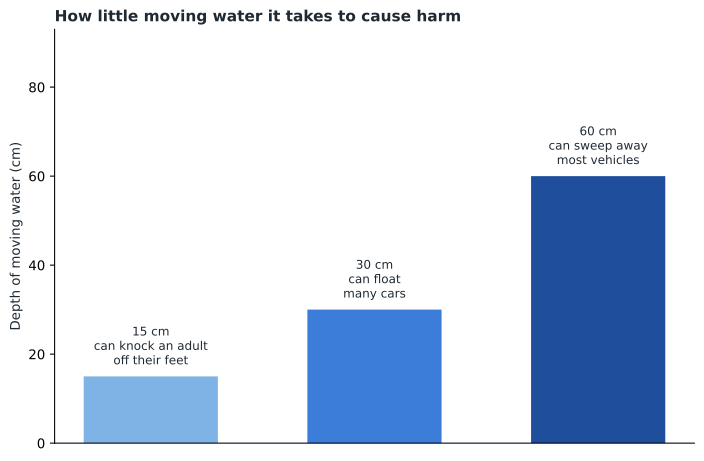
Widely used public safety guidance puts it this way: about 15 centimetres of moving water can knock an adult off their feet, about 30 centimetres can float many cars, and about 60 centimetres can sweep away most vehicles. The exact figures depend on speed, the vehicle and the road, but the point is that no depth of moving water over a road is safe to drive through. That is why closures of flooded roads must be physical and, where the danger is serious, staffed.
# Force of moving water on a standing person or a car (rough illustration)
# drag force = 0.5 * density * speed^2 * drag coefficient * area facing the flow
density = 1000.0           # kilograms per cubic metre
def force_newtons(speed_ms, depth_m, width_m, cd=1.0):
    area = depth_m * width_m
    return 0.5 * density * speed_ms ** 2 * cd * area
for speed in (1.0, 2.0, 3.0):          # metres per second
    legs = force_newtons(speed, 0.15, 0.3)   # two legs, 15 cm deep
    car = force_newtons(speed, 0.30, 1.8)    # side of a small car, 30 cm deep
    print(f"{speed} m/s: legs about {round(legs)} N, car about {round(car)} N")
print("Doubling the speed multiplies the force by", round(2.0 ** 2))1.0 m/s: legs about 22 N, car about 270 N 2.0 m/s: legs about 90 N, car about 1080 N 3.0 m/s: legs about 202 N, car about 2430 N Doubling the speed multiplies the force by 4
The example is a rough physical model, not a design calculation, but it shows the key point: force grows with the square of the speed, so water that looks only a little faster can push much harder. A car that has been floated even slightly loses its grip on the road and can then be carried by forces that would not have moved it when its tires were firmly on the ground.
Officers face the same dangers. Rescuing people from moving water is a job for trained and equipped swiftwater rescue teams, usually from the fire service. Officers who wade into floodwater to help someone risk becoming victims themselves. The best help an officer can usually give is to call for rescue, keep the person in sight, talk to them, keep others out of the water and, if trained and equipped, throw a line or flotation device from a safe position on land.
Thunderstorms, tornadoes and wind
Severe thunderstorms bring wind, hail, lightning and heavy rain, and sometimes tornadoes. On May 21, 2022, a derecho, a long-lived line of severe thunderstorms with damaging straight-line winds, crossed southern Ontario and Quebec, killing about a dozen people, mostly from falling trees, and leaving hundreds of thousands of homes without power, some for more than a week. After a storm, police deal with downed trees and power lines, dark traffic signals, damaged buildings, and calls from people without power who need help.
Downed power lines are a serious danger to officers and the public. Officers should treat every downed line as energized, keep themselves and others well back, at least 10 metres, and wait for the utility to make it safe. Lines can re-energize without warning, and the ground around a line can carry current. If a line falls on a vehicle, the occupants should usually stay inside until the utility arrives unless the vehicle is on fire.
After storms and during power failures, carbon monoxide poisoning is a hidden danger. People run generators in garages or basements, or use barbecues and heaters indoors. Officers doing welfare checks should be alert to the smell of exhaust, headaches or confusion in a household, and should get people outside and call for help if they suspect carbon monoxide.
Extreme heat
Extreme heat is one of the deadliest weather hazards, although it rarely looks like an emergency. Its victims are often older people living alone, people with chronic illnesses, people who use certain medications, people experiencing homelessness, and outdoor workers. In late June 2021, an extreme heat event in British Columbia led to more than six hundred deaths, most of them older people found alone in hot homes; a coroners' death review panel found that most had died alone at home and recommended better ways of checking on people at risk. Police support heat response by checking on people when relatives or neighbours are worried, by knowing where cooling centres are, by noticing people in distress during patrol, and by recognizing the signs of heat stroke, which include confusion, hot skin and collapse, and is a medical emergency.
Wildfires and smoke
Wildfire is a growing hazard in many parts of North America. The 2023 wildfire season in Canada was the most destructive on record, with well over fifteen million hectares burned and more than two hundred thousand people evacuated across the country, including many First Nations communities. Even communities far from forests feel the effects of smoke, which causes respiratory illness and reduces visibility on roads.
Wildfire evacuations differ from floods in that fire can move faster than expected, change direction with the wind, and close evacuation routes with smoke and flames. Police roles include managing evacuation routes and traffic, keeping people out of fire areas, security of evacuated communities and, as in floods, supporting reception centres. Decisions about evacuation are made with fire officials who understand fire behaviour. Officers working near wildfires must never drive into smoke they cannot see through, and must keep an escape route open.
Winter storms and ice
Winter brings its own hazards: heavy snow, blowing snow that reduces visibility to almost nothing, freezing rain that coats roads, trees and power lines with ice, and extreme cold. The ice storm of January 1998, which left millions of people in eastern Ontario and southern Quebec without power, some for weeks, remains one of the most costly natural disasters in Canadian history and led to the largest peacetime deployment of the Canadian Armed Forces up to that time. For police, winter storms mean collisions, stranded motorists, highway closures and welfare checks on people without heat. Officers should carry winter survival equipment in their vehicles, know where warming centres are, and remember that people in cold, dark homes may be using unsafe heat sources.
Highway closures in severe winter weather are usually decided by the road authority and the police together, and they work only if drivers are kept off the closed road from the start. Officers at closure points may face long lines of frustrated drivers and should know the detour, the expected reopening time if any, and where stranded travellers can wait in safety.
Before the storm
Most of what police can do about weather happens before it arrives. When a watch or warning is issued, supervisors can adjust staffing, make sure vehicles are fuelled and equipped, check that officers know the plan for their area, and pass the alert to officers on patrol so they can watch for early signs of trouble. Kowal notes that on June 22 the duty inspector kept two officers on after the evening shift, which put two more cars on the road at 23:15 when the first calls came in. 'That cost the city some overtime,' she says. 'It also meant that the first barricades went up at the creek crossings half an hour earlier than they otherwise would have. I don't know who drove into the water that night who would otherwise have drowned. Neither do you. That's what prevention looks like.'
Officers can also share safety messages with the public during ordinary contacts before severe weather: reminding drivers not to drive through flooded roads, telling residents where cooling or warming centres are, and encouraging people to check on older neighbours. These small actions add up across a whole shift and a whole service.
Worked problem
Responding to a call during a storm
During a severe thunderstorm warning at night, you are sent to a report of a tree down on a residential street. When you arrive, you find a large tree across the road with power lines tangled in its branches, sparks visible near the base, and a car stopped just short of it with a driver inside. Rain is heavy. What should you do?
Show solution
- Stop well back; treat the lines as energized and the ground around them as dangerous.
- Tell the driver by loudspeaker or from a safe distance to stay in the vehicle if it is not touching the lines and is not on fire, and not to get out near the lines.
- Report the downed lines and request the utility and fire immediately, giving the exact location.
- Close the street at both ends with your vehicle and cones, keeping everyone well back from the lines.
- Wait for the utility to make the lines safe before anyone approaches, and keep monitoring the driver.
Answer: Keep everyone, including yourself, well back from the lines, keep the driver in the car unless it becomes unsafe, close the street and get the utility and fire on the way.
Common mistakes
MistakeA few inches of water over a road is safe to drive through.
InsteadNo depth of moving water over a road is safe; small depths can move people and vehicles.
MistakeA watch means severe weather is happening.
InsteadA watch means conditions are favourable; a warning means it is occurring or imminent.
MistakeA downed line that is not sparking is safe.
InsteadTreat every downed line as energized until the utility says otherwise.
MistakeHeat is a nuisance, not an emergency.
InsteadExtreme heat kills, especially isolated older people; welfare checks save lives.
Summary and key terms
- Environment and Climate Change Canada issues special weather statements, watches and warnings; conservation authorities issue flood messages in Ontario.
- A watch means be prepared; a warning means act.
- Many flood deaths happen in vehicles; small depths of moving water can move people and cars because force grows with the square of speed.
- After storms, treat downed lines as energized and watch for carbon monoxide.
- Extreme heat kills mainly isolated and vulnerable people; welfare checks and cooling centres are key.
- Wildfire evacuations can be fast-changing; work with fire officials and keep escape routes open.
- Special weather statement
- The least urgent tier of Environment and Climate Change Canada alerts.
- Conservation authority
- An Ontario watershed agency that monitors water levels and issues flood messages.
- Watch
- An alert meaning conditions are favourable for a hazard; be prepared.
- Weather warning
- An alert meaning a hazard is occurring or imminent; take action.
- Derecho
- A long-lived line of severe thunderstorms with damaging straight-line winds.
- Swiftwater rescue
- Rescue from moving water by trained and equipped teams.
- Heat stroke
- A life-threatening condition in which the body cannot cool itself.
Practice problems
Work each problem on paper first, then reveal the answer to check.
What alerts were issued on June 22 before the flood?
Show answer
A severe thunderstorm watch, a rainfall warning and a conservation authority flood watch.
In the code example, what happens to the force when the speed doubles?
Show answer
It is multiplied by four.
How far back should officers keep from a downed power line?
Show answer
At least 10 metres.
What should an officer do if someone is trapped in moving water?
Show answer
Call for rescue, keep them in sight, keep others out, and throw a line or flotation device from land if trained and equipped.
Lesson quiz · 5 questions
Score 60% or more to complete this lesson.
Create a free account to save your progress, take quizzes and earn a certificate.