
LES-214 · Lesson 2 of 12 · 21 min
Emergency management law in Ontario and Canada
▶ Video coming soon A video version of this lesson is on the way.
Kowal arrives for the second class carrying a binder with a red spine. 'This is the Port Ardent emergency plan,' she says. 'Every page in it exists because a law says it has to, or because a law gives someone a power they need to use it. When the mayor signed the emergency declaration at a quarter past midnight on June 23, she was not making it up as she went. She was using a power the law gave her, in a way the plan said she would.'
Desjardins explains why officers need to know emergency law. Emergencies are when governments use unusual powers: closing roads to everyone, ordering people out of their homes, taking over buildings, spending money without the usual approvals. Officers are often the people who carry out those powers on the street. An officer who tells a resident 'you have to leave' should know whether that is an order backed by law or a strong request, and what the officer may do if the resident refuses. Getting that wrong can expose people to danger, expose the officer and the city to liability, or violate someone's rights.
Who is responsible
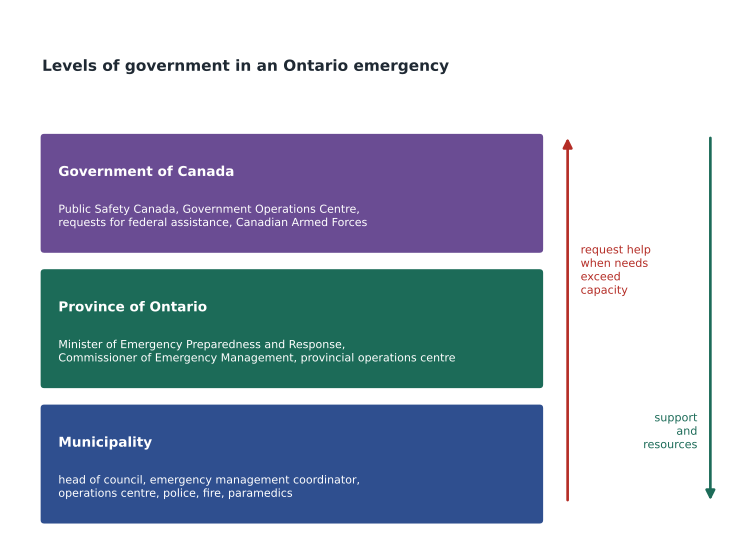
In Canada, emergency management is a shared responsibility, but the constitution leaves most of it with the provinces. Provinces regulate property, municipal institutions and local matters, so the first and most important level of response is the municipality, backed by the province. The federal government supports provinces when they ask, leads in areas of federal jurisdiction such as national defence, border security and federal lands, and has its own law for national emergencies. The usual description is that an emergency is handled at the lowest level able to deal with it, and each higher level steps in only when the lower one asks or is overwhelmed.
Ontario's Emergency Management and Civil Protection Act
The main Ontario statute is the Emergency Management and Civil Protection Act. It requires every municipality to develop and implement an emergency management program and an emergency plan, and it sets the rules for declaring emergencies at both the municipal and provincial levels. A regulation under the Act sets standards for municipal programs. Among other things, municipalities must designate a community emergency management coordinator, have an emergency management program committee, identify their hazards and risks, set up an emergency operations centre, designate an emergency information officer, train the people with roles in the plan, run an annual exercise, and educate the public.
The Act was significantly amended by the Emergency Management Modernization Act, 2025, which received royal assent on December 3, 2025. The amendments renamed emergency plans as emergency management plans, made the Minister of Emergency Preparedness and Response responsible for leading emergency management in the province, required a provincial emergency management strategy and a provincial planning framework that municipal plans must follow, and gave the Minister power to direct changes to a plan or program that does not comply. Some provisions come into force on dates set later, and the municipal standards in the regulation are being updated to match, so officers and coordinators should check the current version of the law rather than relying on older training materials.
| Requirement | Ontario municipalities | Why it matters to police |
|---|---|---|
| Coordinator | Community emergency management coordinator | The person police work with on planning and in the operations centre |
| Plan | Emergency management plan following the provincial framework | Sets out the police role and who is in charge |
| Exercise | Annual exercise | Officers should take part and learn their role |
| Operations centre | Emergency operations centre | Police send a representative |
| Public information | Emergency information officer | Police messages should be coordinated through this role |
Declaring an emergency
Under the Act, the head of council of a municipality may declare that an emergency exists in all or part of the municipality and may take such action and make such orders as he or she considers necessary, as long as they are not contrary to law, to implement the emergency plan and protect property and the health, safety and welfare of residents. Since the 2025 amendments, the head of council must consult the municipal emergency management plan and be satisfied that action is needed without risk of serious delay before declaring, must notify the Minister, and must report to council regularly while the declaration lasts. The head of council, the council or the Premier may terminate a municipal declaration.
A municipal declaration does not create sweeping new police powers. What it does is give the head of council authority to make orders to implement the plan, signal to residents and partners that the situation is serious, and allow access to some kinds of support. In Port Ardent, the mayor's order on June 23 directed the evacuation of Riverside Flats, authorized the use of Lakeview Community Centre as a reception centre, and closed Mill Road and parts of Willow Lane to all but emergency vehicles. Officers enforcing those closures were acting under a lawful order.
At the provincial level, the Premier or the Lieutenant Governor in Council may declare a provincial emergency in all or part of Ontario. During a declared provincial emergency, the government may make emergency orders in specified areas, such as regulating travel, evacuating people, establishing facilities and closing places, but only if the orders are reasonably necessary, the harm would be worse without them, and other measures would not be enough. Orders must be limited in duration and geography and are subject to reporting and legislative oversight. Ontario's experience during the COVID-19 pandemic and the 2022 Ambassador Bridge blockade led to close public scrutiny of these powers.
Federal law: the Emergency Management Act and the Emergencies Act
Federally, the Emergency Management Act sets out the responsibilities of federal ministers to prepare for and respond to emergencies in their areas, and Public Safety Canada coordinates the federal response through the Government Operations Centre. When a province needs help it cannot provide itself, it makes a request for federal assistance. Federal help can include specialized equipment, expertise and, as a last resort, the Canadian Armed Forces, which have been deployed many times for floods, wildfires and storms. After a disaster, federal financial assistance to provinces has been provided through cost-sharing arrangements; these programs have been under review, so current terms should be checked.
The Emergencies Act is a separate and exceptional law. It allows the federal government to declare a public welfare emergency, a public order emergency, an international emergency or a war emergency, but only for a national emergency that cannot be effectively dealt with under any other law of Canada. It replaced the War Measures Act in 1988, and it requires consultation with the provinces, parliamentary review, time limits and an inquiry after any declaration.
The Act was used for the first time in February 2022, when the federal government declared a public order emergency in response to the protests and blockades in Ottawa and at border crossings. The Public Order Emergency Commission, led by Justice Paul Rouleau, reported in February 2023 that the very high threshold for using the Act had been met, while criticizing police planning and intelligence failures. In January 2024 the Federal Court reached a different conclusion, finding that the invocation was unreasonable and that parts of the emergency measures violated the Charter. On January 16, 2026, the Federal Court of Appeal upheld that ruling, finding that the government did not have reasonable grounds to believe a national emergency existed, and that the regulations infringed freedom of expression and the protection against unreasonable search and seizure. The lesson for police is that extraordinary powers are subject to close review, and that ordinary police powers, well planned and well used, are expected to be enough in almost every case.
Mutual aid
Within Ontario, municipalities and police services often help each other under mutual aid agreements. Police services can also request assistance from the Ontario Provincial Police or other services, and the Community Safety and Policing Act provides for police services to provide assistance across boundaries. Fire services have a provincial mutual aid plan. Officers working in another jurisdiction under mutual aid should know whose direction they are under and what authority they have.
Powers and limits on the street
Desjardins returns to the practical question. When an officer tells a resident in an evacuation zone to leave, what is the legal basis? The answer depends on the situation and the local law. Where a lawful order directs evacuation, officers can enforce it, but most plans and most police leaders prefer persuasion. In Port Ardent in June, three residents of Riverside Flats refused to leave. Officers did not drag anyone out. They explained the danger, made sure the residents had a way to call for help, recorded the addresses, and passed them to the operations centre so that fire crews could check on them later. Two left voluntarily by morning. The third, a man who wanted to stay with his dogs, was taken out by boat at 06:30 when the water reached his porch; he and the dogs went to the reception centre together.
Officers should also remember that the Charter continues to apply in an emergency. Section 7 protects life, liberty and security of the person; section 8 protects against unreasonable search and seizure; section 9 protects against arbitrary detention. Section 1 allows reasonable limits, and courts give governments some latitude in genuine emergencies, but they still require that limits be authorized by law and proportionate. An officer entering a home to check for trapped residents during a flood is acting under the common law duty to protect life, which courts recognize, but should go no further than that purpose requires.
What the plan must say about police
The emergency plan is where the law becomes practical. Kowal opens the red binder at the section on police and reads the headings: notification and call-out of police personnel; the police representative at the operations centre; perimeter and access control; traffic control and evacuation routes; door-to-door notification; security of reception centres and evacuated areas; missing persons and inquiries; fatalities and the coroner; and investigations. Each heading has a page or two describing who does what, how they are contacted and what equipment they need. 'Every officer in this city should have read these ten pages,' she says. 'Most haven't. The ones who have are the ones I want on the street on a night like June 22.'
Desjardins adds that officers should also know the limits of what the plan can require. A plan cannot give police powers the law does not give them. If the plan says officers will close a road, the authority to do so must come from somewhere, such as the Highway Traffic Act, a municipal by-law, the common law duty to protect life, or an order made under an emergency declaration. Good plans cite the authority for each power they describe, so officers are not left guessing when a resident or a lawyer asks.
Liability and protection
Officers and emergency workers sometimes worry about being sued for decisions made under pressure. Ontario's Act provides that no action or other proceeding lies against a member of council, an employee of a municipality, a provincial employee or any other person acting under the authority of the Act for an act done in good faith in the exercise or performance of a power or duty under it, or for neglect or default in good faith. The protection does not cover acts done in bad faith, and it does not relieve the municipality of liability it would otherwise have. Officers who act reasonably, in good faith and within the plan are generally protected. Officers who ignore the plan, act recklessly or use emergency powers for unrelated purposes are not.
Reviews and inquiries
Major emergencies are often followed by formal reviews, coroner's inquests or public inquiries, and police conduct during the emergency may be examined closely. The Public Order Emergency Commission's review of the 2022 convoy protests, discussed above, is one example. Others include reviews of floods, wildfires and storms that examined how warnings were issued and how evacuations were carried out. Officers should expect that their notes, radio transmissions and body-worn camera recordings from an emergency will be read and watched by people who were not there. That is one more reason to keep good notes and to follow the plan.
Worked problem
Is this order enforceable?
During the June flood, a resident of Riverside Flats tells an officer that she will not leave and that the officer has no right to make her. The mayor has declared an emergency and ordered the evacuation of Riverside Flats. The water is ankle-deep in her street and rising. What should the officer do?
Show solution
- The evacuation order is a lawful order made under the emergency declaration, so the officer is acting with authority.
- Even so, the plan and police policy prefer persuasion: explain the danger clearly, including that rescue may be impossible later.
- Find out why she wants to stay; pets, medication and fear of looting are common reasons with practical solutions.
- If she still refuses, record the address, the number of people and any special needs, and pass the information to the operations centre.
- Leave her with a way to call for help, and do not use force unless a supervisor directs it under the order and the situation requires it.
Answer: Treat the order as lawful authority but rely on persuasion, solve the practical problem if possible, and record and report any refusal so the person can be checked later.
Common mistakes
MistakeA municipal emergency declaration gives police unlimited powers.
InsteadIt activates the plan and specific authorities; officers still need a lawful basis for what they do.
MistakeThe federal government takes over when an emergency is declared.
InsteadHigher levels of government support; the local response remains in local hands.
MistakeConstitutional rights are suspended in an emergency.
InsteadThey continue to apply, although courts allow reasonable, proportionate limits authorized by law.
MistakeOfficers should force people to evacuate.
InsteadPersuasion is preferred; refusals should be recorded and reported so people can be checked later.
Summary and key terms
- Ontario's Emergency Management and Civil Protection Act requires municipal emergency programs and plans and sets the rules for municipal and provincial declarations; it was significantly amended in 2025.
- A head of council may declare a municipal emergency and make orders to implement the plan.
- Federal help comes through requests for federal assistance; the Emergencies Act is reserved for national emergencies that no other law can handle.
- The 2022 invocation of the Emergencies Act was found unreasonable by the Federal Court in 2024 and the Federal Court of Appeal in 2026.
- Mutual aid lets police and other agencies help across boundaries; officers should know whose direction they work under.
- Officers should know the legal basis of emergency orders and prefer persuasion when enforcing them.
- EMCPA
- Ontario's Emergency Management and Civil Protection Act.
- Emergencies Act
- The federal law for national emergencies that cannot be handled under any other law.
- Request for federal assistance
- A province's formal request for federal resources, including the Canadian Armed Forces.
- Declaration of emergency
- A formal statement by an authorized official that an emergency exists, activating special authority.
- Mutual aid
- An agreement under which agencies or jurisdictions help each other in emergencies.
- Request for assistance
- A formal request from one level of government to a higher one for resources.
Practice problems
Work each problem on paper first, then reveal the answer to check.
What happened to the resident who wanted to stay with his dogs?
Show answer
He was taken out by boat at 06:30 and went to the reception centre with his dogs.
Who may terminate a municipal emergency declaration in Ontario?
Show answer
The head of council, the council or the Premier.
What did the Federal Court of Appeal decide in January 2026?
Show answer
That the 2022 invocation of the Emergencies Act was unreasonable and parts of the measures violated the Charter.
Why should officers record refusals to evacuate?
Show answer
So the operations centre can arrange checks or rescue later.
Lesson quiz · 5 questions
Score 60% or more to complete this lesson.
Create a free account to save your progress, take quizzes and earn a certificate.