
LES-214 · Lesson 1 of 12 · 22 min
Emergency management: hazards, risk and the police role
▶ Video coming soon A video version of this lesson is on the way.
Professor Desjardins begins the course with a photograph the students recognize. It shows Mill Road in Port Ardent at about one in the morning on Tuesday, June 23, 2026, or rather what was left of it: brown water running fast across the low crossing where Kettle Creek passes under the road, a police cruiser parked sideways with its light bar on, and, at the edge of the frame, the roof of a small car that had tried to drive through. 'Ninety-two millimetres of rain fell on this city in a little over three hours that night,' he says. 'By midnight the creek was over its banks. By two o'clock we had evacuated most of Riverside Flats, four hundred and thirty homes and a seniors' residence. Nobody died. Some of that was luck. Most of it was planning, and a lot of the planning was done by people who will never be thanked for it.'
He tells the class that the course will follow Port Ardent through a year of emergencies: the Kettle Creek flood in June, the Harbourfest weekend in August when thirty-eight thousand people packed the waterfront in dangerous heat, a gasoline tanker rollover on the Highway 12 ramp in September, a large demonstration at City Hall, and a school bus collision on Ridge Road in October. None of these were crimes in the usual sense. Each one still put police officers at the centre of the response, because police are often first on scene, they are on duty around the clock, they control roads and perimeters, and the public expects to see them.
Desjardins introduces the guest who will join the class throughout the course: Maggie Kowal, Port Ardent's Community Emergency Management Coordinator. Kowal spent fourteen years as a paramedic before moving into emergency management, and she has run the city's emergency operations centre through every activation since 2019. 'Most people think emergency management is about the big night,' she says. 'It is really about the three hundred and sixty-four days before it. If we do that work, the big night is hard but manageable. If we don't, no amount of heroics on the night will fix it.'
What emergency management is
An emergency, in the ordinary sense, is a situation that threatens life, health, property or the environment and needs urgent action. Police deal with emergencies every shift: a crash, a fire, a person in crisis. Emergency management is concerned with a different scale of event, one that overwhelms or threatens to overwhelm the normal resources and routines of the agencies that respond. A single house fire is an emergency for the family and a routine call for the fire service. A flood that forces hundreds of people from their homes, closes roads, cuts power and fills a shelter is an emergency for the whole community, and it needs many agencies working together in a way they do not on an ordinary day.
Emergency management is the organized effort to reduce the risk of such events and to deal with them when they happen. It covers the whole life of a hazard, not just the response. A useful way to describe it is as a set of activities that run before, during and after an event, carried out by governments, emergency services, private organizations, volunteers and individuals. Police are one partner among many. In most communities the police are not in charge of emergency management overall; that role belongs to the elected government and the emergency management program it sets up. But police have essential duties within it, and an officer who understands the whole system will do those duties better.
The pillars of emergency management
Canadian emergency management describes four interdependent components, often called pillars: prevention and mitigation, preparedness, response, and recovery. The national Emergency Management Framework for Canada uses these four components, and Ontario's emergency management programs are built around a similar set of activities. Many Canadian plans list prevention and mitigation separately, giving five. Whatever the exact labels, the idea is the same. The activities form a cycle. Recovery from one event should include work to reduce the risk of the next, and lessons from response should change the plans used in preparedness.
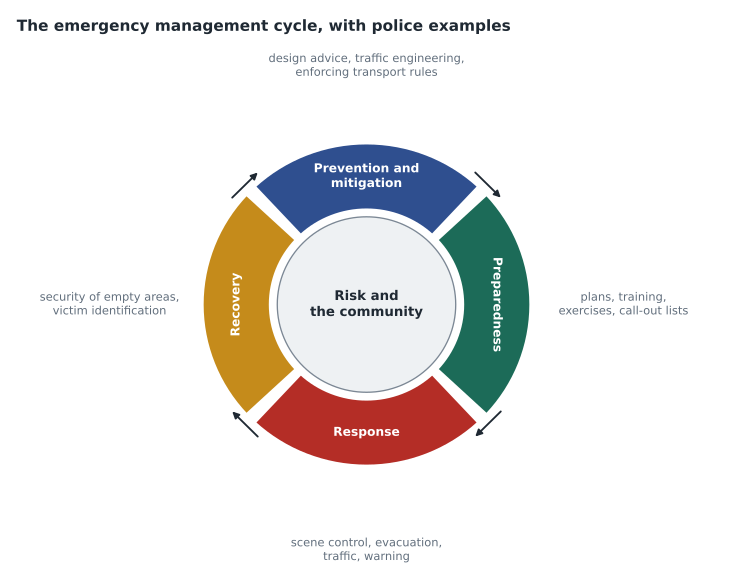
Prevention and mitigation are actions that stop a hazard from becoming an emergency or reduce its impact if it does. Building a berm along a creek, banning new homes in a floodplain, installing larger culverts, requiring sprinklers in seniors' residences and burying power lines are all mitigation. Police contribute less here than other agencies, but they still have a role: traffic engineering advice, crime prevention through environmental design, and enforcement of laws that reduce risk, such as rules on the transport of dangerous goods.
Preparedness is everything done in advance to be ready to respond: writing plans, training staff, running exercises, stocking supplies, building warning systems and educating the public. For a police service, preparedness includes knowing its part in the community emergency plan, training officers in incident command, keeping call-out lists current, and practising with fire, paramedics, public works and the other partners it will work with on the day.
Response is the action taken during and immediately after the event to save lives, protect property and meet basic needs. This is where police are most visible: closing roads, setting perimeters, warning residents, helping evacuate, controlling traffic, protecting evacuated areas and supporting other agencies.
Recovery is the longer process of restoring the community: repairing infrastructure, helping people return home, supporting those who lost property or loved ones, and restoring the local economy. It can take months or years. Police remain involved in recovery longer than many people expect, protecting evacuated areas from theft, supporting identification of victims after a fatal event, managing traffic around reconstruction and handling the investigations that sometimes follow.
Hazards, vulnerability and risk
Emergency managers distinguish between a hazard and a risk. A hazard is something that can cause harm: a flood, a tornado, an ice storm, a chemical spill, a pandemic, a large crowd, a power failure. Risk combines the likelihood that a hazard will cause an emergency with the consequences if it does. A hazard that is very likely but has small consequences, such as a short power cut, may carry less risk than one that is rare but catastrophic, such as a major chemical release in a residential area.
Consequences depend on vulnerability: how exposed and how able to cope the people and places affected are. The same flood is more dangerous in a neighbourhood with many older residents, people with disabilities, people without cars, or people who do not speak the language of the warning messages. Vulnerability is not fixed; it can be reduced by planning. Port Ardent's emergency plan, for example, includes a list of facilities with residents who cannot evacuate themselves, such as the Riverside Seniors Residence, and an arrangement with the regional transit service to provide accessible buses.
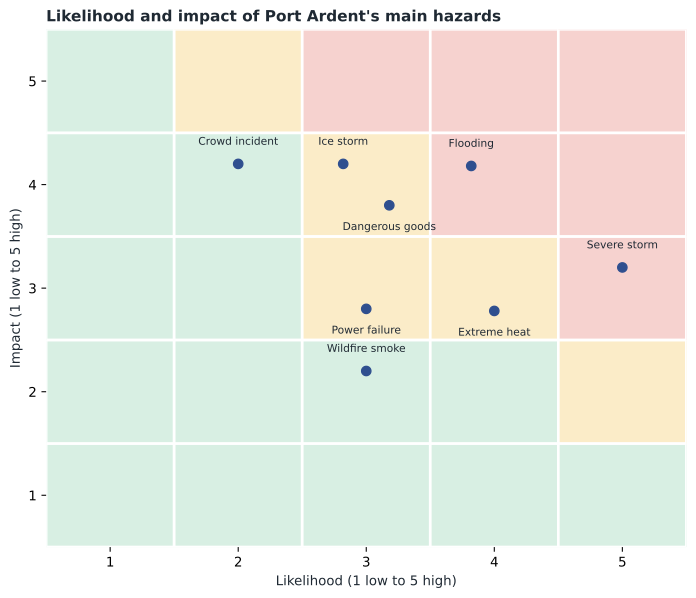
Ontario municipalities assess their risks through a hazard identification and risk assessment, commonly called a HIRA. Provincial standards require each municipality to identify and assess the hazards and risks to public safety in its area and to keep that assessment current, and the community emergency plan is built on it. A common method is to rate each hazard for likelihood and impact on simple scales, multiply the ratings, and rank the results. The method is crude, but it forces a community to think systematically about what could happen and where to put limited resources.
# A simple hazard ranking: likelihood and impact each rated 1 (low) to 5 (high)
hazards = {
    "Riverine and flash flooding":    (4, 4),
    "Severe thunderstorm and wind":   (5, 3),
    "Extreme heat":                    (4, 3),
    "Ice storm":                       (3, 4),
    "Dangerous goods road incident":   (3, 4),
    "Large crowd incident":            (2, 4),
    "Extended power failure":          (3, 3),
    "Wildfire smoke":                  (3, 2),
}
ranked = sorted(hazards.items(), key=lambda kv: kv[1][0] * kv[1][1], reverse=True)
for name, (likelihood, impact) in ranked:
    score = likelihood * impact
    level = "high" if score >= 15 else "moderate" if score >= 9 else "low"
print(f"{name:32} L={likelihood} I={impact} score={score:2} {level}")Riverine and flash flooding L=4 I=4 score=16 high Severe thunderstorm and wind L=5 I=3 score=15 high Extreme heat L=4 I=3 score=12 moderate Ice storm L=3 I=4 score=12 moderate Dangerous goods road incident L=3 I=4 score=12 moderate Extended power failure L=3 I=3 score= 9 moderate Large crowd incident L=2 I=4 score= 8 low Wildfire smoke L=3 I=2 score= 6 low
The scores come from Port Ardent's most recent assessment, simplified for the class. Kowal points out that flooding scored high before June 2026, not after it. 'We did not guess,' she says. 'The creek had flooded Riverside Flats in 1986 and come close in 2011. The conservation authority's maps showed which streets were in the floodplain. The risk was on paper for years. The flood plan existed because of it.'
Why police matter in emergencies
Police bring several things to an emergency that no other agency has in the same combination. They are on duty everywhere, all the time, and they are often the first emergency workers to arrive. They have radios, vehicles and a dispatch centre that can reach every patrol unit at once. They have legal authority to direct traffic, close roads, keep people out of dangerous areas and, in some situations, require people to leave. They are trained to take charge of scenes. And the public recognizes the uniform, which makes officers natural messengers in a crisis.
Desjardins lists the duties police commonly hold in community emergency plans. Not every plan assigns all of them to police, and officers should know the plan in their own community, but the list is typical:
- Initial scene assessment and reporting, often as the first unit to arrive
- Establishing and maintaining perimeters, and controlling access to dangerous or evacuated areas
- Traffic control, road closures, detours and escort of emergency vehicles
- Alerting residents and helping with evacuation, including door-to-door notification
- Security of evacuated areas, reception centres and critical facilities
- Supporting search for missing persons and reunification of families
- Investigating deaths, supporting victim identification and notifying next of kin
- Investigating any criminal conduct connected to the event
- Providing a representative to the emergency operations centre
There are also things police usually do not do. They do not usually decide whether to declare an emergency; that belongs to the head of council. They do not run the shelter, which is usually a social services function. They do not decide technical questions such as whether a chemical release is safe to approach; that belongs to the fire service and hazardous materials specialists. A good officer knows where the police role ends and is quick to bring in the agency whose job it is.
| Agency | Typical lead roles in an emergency | What police can expect from them |
|---|---|---|
| Fire service | Fire, rescue, hazardous materials, technical rescue | Scene safety advice, hot zone control, rescues |
| Paramedic service | Patient care, triage, transport | Medical assessment of casualties, mass-casualty coordination |
| Public works and roads | Road closures, barricades, debris, drainage | Barriers, signs, heavy equipment |
| Social services | Reception centres, shelters, food, emotional support | Running the centre while police provide security |
| Public health | Health advice, water and food safety, disease control | Health risk advice and public messaging |
| Utilities | Power, gas and water shutoffs and repairs | Making downed lines and gas leaks safe |
| Emergency management | Plan, emergency operations centre, coordination | Overall coordination and resource requests |
The first officer on scene
Most large emergencies begin as an ordinary call. On Monday, June 22, the first call about Kettle Creek came at 23:12 from a resident on Willow Lane who said water was coming up her driveway. Constable Femi Okeke was sent, and what he did in the next ten minutes shaped the response. He drove to the lowest street he knew, saw water flowing across Mill Road, stopped well short of it, and radioed a description: water over the road at the Mill Road crossing, flowing fast, depth unknown but over the curb, and rising along Willow Lane. He asked for public works to close Mill Road, for fire to be notified, and for a supervisor to attend. Then he positioned his cruiser to block the crossing and began turning traffic back.
Kowal calls this a model first report. It was early, it was specific, and it was honest about what Okeke did not know. Many emergencies are made worse because the first report is late, vague or overconfident. An officer who arrives first at a developing emergency has four jobs before anything else: protect themselves, assess what is happening, report it clearly, and begin to make the scene safer. Rushing in to help, however natural, often adds a victim. Two of the people rescued from cars that night had driven around barricades; one of the rescuers, a firefighter, was briefly swept off his feet. 'Your first duty,' Desjardins tells the class, 'is not to become part of the problem.'
Worked problem
Writing a first report from the scene
You are the first officer at a factory where a neighbour has reported a strong chemical smell. You see a white cloud drifting from a loading dock toward a parking lot, several workers standing outside coughing, and a placard on a tanker trailer that you cannot read from where you are. What should your first radio report contain, and what should you do next?
Show solution
- Stop upwind and at a distance; do not drive into the cloud or approach the trailer.
- Report your exact location, what you can see (a white vapour cloud from a loading dock moving toward a lot), the wind direction, the number of people affected and their symptoms.
- Say what you do not know: the product, the placard number and the source of the release.
- Request fire with hazardous materials capability, paramedics and a supervisor, and ask for traffic to be kept away from the area.
- Move people uphill and upwind, away from the cloud, and keep others from entering. Try to read the placard only with binoculars from a safe distance.
Answer: A clear, early report of location, observations, wind, casualties and unknowns, a request for the right resources, and immediate steps to keep yourself and others out of danger.
Common mistakes
MistakeEmergency management is mostly about the response.
InsteadIt covers prevention, mitigation, preparedness, response and recovery; most of the work happens before the event.
MistakePolice are in charge of community emergencies.
InsteadPolice have key duties, but overall direction usually belongs to the elected government through its emergency program.
MistakeThe first officer should go in and help immediately.
InsteadThe first officer should protect themselves, assess, report and make the scene safer before taking risks.
MistakeA hazard and a risk are the same thing.
InsteadA hazard is something that can cause harm; risk combines how likely it is to cause an emergency with the consequences.
Summary and key terms
- Emergency management is the organized effort to reduce the risk of large events and deal with them when they occur.
- Canadian practice organizes it into four pillars: prevention and mitigation, preparedness, response and recovery.
- Risk combines likelihood with consequences, and consequences depend on vulnerability.
- Communities assess their hazards systematically and build their plans on that assessment.
- Police are one partner among many, with key duties in scene control, traffic, warning, evacuation and security.
- The first officer on scene should protect themselves, assess, report clearly and begin to make the scene safer.
- HIRA
- Hazard identification and risk assessment, required of Ontario municipalities.
- CEMC
- Community Emergency Management Coordinator, who runs a municipal emergency program.
- Hazard
- Something that can cause harm, such as a flood, storm or chemical release.
- Risk
- The combination of the likelihood of an emergency and its consequences.
- Vulnerability
- How exposed people and places are, and how well they can cope.
- Mitigation
- Action that reduces the impact of a hazard before it happens.
- Preparedness
- Plans, training, exercises and supplies prepared in advance.
Practice problems
Work each problem on paper first, then reveal the answer to check.
What did Okeke do before trying to help anyone on Mill Road?
Show answer
He stopped short of the water, assessed it, reported it clearly and blocked the crossing.
In the code example, which hazard ranked highest, and with what score?
Show answer
Riverine and flash flooding, with a score of 16.
Why can the same flood be more dangerous in one neighbourhood than another?
Show answer
Because vulnerability differs, for example the number of residents who cannot evacuate themselves.
Who usually runs a reception centre?
Show answer
Social services, with police providing security.
Lesson quiz · 5 questions
Score 60% or more to complete this lesson.
Create a free account to save your progress, take quizzes and earn a certificate.