
LES-214 · Lesson 7 of 12 · 20 min
Traffic, perimeter and scene control
▶ Video coming soon A video version of this lesson is on the way.
At 00:47 on June 23, a pickup truck drove around the barricade at Mill Road and Front Street, past Constable Femi Okeke, who was waving a flashlight at it, and into the water at the low crossing. It stalled about fifteen metres in. The driver climbed onto the roof and was taken off twelve minutes later by a fire rescue team on a tethered line. Desjardins shows the class the video from Okeke's in-car camera: the truck's headlights swinging around the barricade, Okeke stepping back as it passes within an arm's length of him, the brake lights disappearing into the dark water.
'Two lessons,' Desjardins says. 'First, a barricade is only a suggestion to some drivers. Second, the most dangerous thing at most emergency scenes, for an officer, is traffic.' This lesson covers how police control roads, perimeters and access at emergency scenes, how to do it legally and safely, and how to keep the emergency routes open that everyone else depends on.
Why traffic and perimeters matter
Almost every emergency needs some area kept clear: to protect the public from a hazard, to protect responders while they work, to keep routes open for emergency vehicles, to preserve evidence, or to keep evacuated areas secure. Police are usually responsible for this, because they have the legal authority, the vehicles and the radios to do it. It is often the least glamorous job at an emergency and one of the most important. A perimeter that leaks lets people into danger and blocks the response; a traffic jam on an evacuation route can trap the very people the evacuation was meant to protect.
The legal basis
In Ontario, section 134 of the Highway Traffic Act allows a police officer to direct traffic where the officer considers it reasonably necessary to ensure orderly movement, to prevent injury or damage, or to permit proper action in an emergency, and allows an officer to close a highway temporarily for those purposes. Drivers must obey the officer's directions. Municipal by-laws and orders made under an emergency declaration may provide further authority. Beyond the roadway, the common law recognizes a police duty to protect life and property, and courts have accepted that officers may keep people out of a dangerous area or an active scene where that is reasonably necessary to carry out the duty. The authority is real but not unlimited. A perimeter must be reasonably necessary, no larger or longer than it needs to be, and enforced in a way that respects people's rights.
Inner and outer perimeters
Emergency scenes are usually controlled with two perimeters. The inner perimeter surrounds the hazard and the working area. Only responders with an assigned task enter it, and their entry is controlled and recorded. At a hazardous materials incident, the inner perimeter is the hot zone and the area around it, which the fire service controls. The outer perimeter keeps the public, traffic and media far enough away to be safe and to give responders room. Police usually staff the outer perimeter, with traffic control points where roads cross it and access control points where authorized people enter.
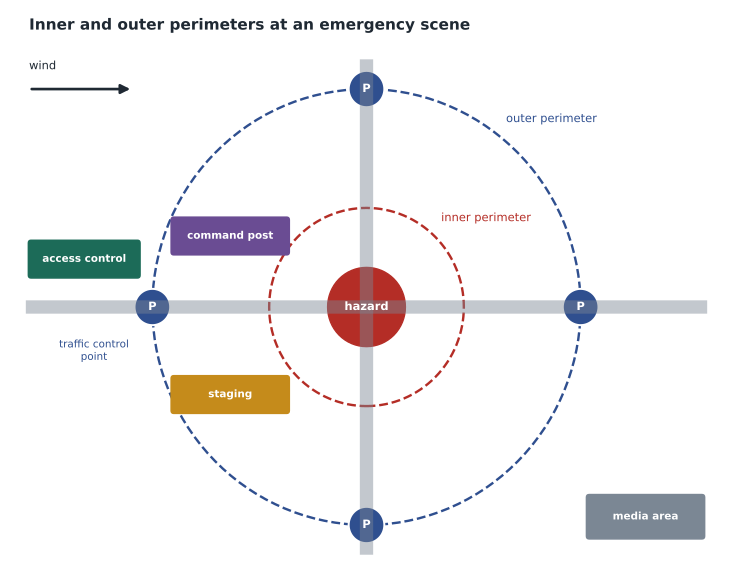
Setting a perimeter is a balance. Too small, and people are exposed to danger or responders are crowded; too large, and too many officers are tied up, residents and businesses are needlessly disrupted, and people lose patience and start ignoring it. A good rule is to start large, because it is much easier to shrink a perimeter than to expand one, and then tighten it as the hazard becomes clearer. Perimeters should use natural boundaries where possible, such as intersections, rivers and fences, so that fewer points need to be staffed.
Traffic control points
A traffic control point is where an officer or barricade stops or diverts traffic. Each point should have a clear purpose: road closed to all traffic, closed except to residents, or closed except to emergency vehicles. Officers at the point need to know the purpose, the detour, where to send people with questions, and what to do about exceptions. During the flood, the nine closures were staffed by eleven officers, four from the neighbouring Bay Township service under mutual aid, and public works crews with barricades and signs. Each closure had a laminated card with its location, its purpose, the detour and the radio channel.
Officers at traffic points face serious danger from passing traffic, especially at night, in rain or smoke, and on high-speed roads. Struck-by incidents are among the leading causes of on-duty deaths and injuries for police and other roadside workers. Officers should wear high-visibility garments, use their vehicles as a protective barrier with emergency lights on, place cones or flares well in advance of the point so drivers have time to slow, stand where they have an escape route, and never turn their back to oncoming traffic. Ontario's Highway Traffic Act requires drivers approaching a stopped emergency vehicle with its lights flashing to slow down and, on multi-lane roads, move over if it is safe to do so. Many drivers do not.
Advance warning gives drivers time to see the hazard and stop. The distance a vehicle needs to stop depends heavily on speed, because braking distance grows with the square of speed, and on the road surface. The example below estimates stopping distance as the distance travelled during the driver's reaction time plus the braking distance.
# Rough stopping distance: reaction distance plus braking distance (metric)
g = 9.81             # metres per second squared
reaction_time = 1.5  # seconds, a typical planning value
for kmh in (50, 70, 90, 110):
    v = kmh / 3.6                                    # metres per second
    for surface, friction in (("dry", 0.7), ("wet", 0.4)):
        d = v * reaction_time + v * v / (2 * friction * g)
print(f"{kmh:3} km/h {surface}: about {round(d):3} m")50 km/h dry: about 35 m 50 km/h wet: about 45 m 70 km/h dry: about 57 m 70 km/h wet: about 77 m 90 km/h dry: about 83 m 90 km/h wet: about 117 m 110 km/h dry: about 114 m 110 km/h wet: about 165 m
The numbers show why a single cruiser with its lights on, parked at the top of a hill or just around a curve on a highway, gives too little warning. At 90 km/h on a wet road, a driver needs well over a hundred metres to stop. Ontario's traffic manual for temporary conditions gives standard distances for advance signs and tapers by speed; officers who set up longer-term closures should follow it or ask public works or the road authority to set up the signs.
Keeping emergency routes open
Large emergencies attract traffic: residents trying to get home, relatives trying to reach family, people curious to see, and media. At the same time, emergency vehicles need to get in and evacuees need to get out. Plans should designate emergency routes into and out of the area and keep them clear, with traffic points on side roads that feed into them. On the night of the flood, Ridge Road north of Front Street was kept as a one-way evacuation route to Lakeview, with all northbound lanes open and southbound traffic limited to emergency vehicles and buses. Officers at four side streets turned other drivers away.
Traffic signals often fail during emergencies because of power cuts. When the utility cut power to the east side at 02:15, two busy intersections went dark. Public works set up portable signals at one; at the other, an officer directed traffic by hand until 04:30. Desjardins reminds the class that the law generally treats a dark signal as a stop sign in all directions, but that many drivers do not know this, and that manual direction at a busy intersection is tiring and dangerous work that should be rotated every hour or so.
Access control
Access control points let authorized people into a controlled area while keeping others out. The plan should say who may enter and how they will be identified: responders with their agency identification, utility crews, residents with proof of address once return is allowed, and others with passes issued by the operations centre. Officers at access points should record who enters and leaves, at least at the inner perimeter, so the incident knows who is inside if conditions change.
Access control is where officers most often meet frustrated people. A resident who wants to check on a pet, a business owner who wants to move stock before the water arrives, a contractor sent by an insurance company, a relative who has not heard from someone: each has a legitimate concern, and each can become angry if refused without explanation. Officers should explain why the area is closed, what is being done, when it might reopen and where to get updates, and should pass requests they cannot grant to someone who can, such as a supervisor or the operations centre. Escorted short visits can sometimes meet the need safely.
Scene preservation
Some emergencies are also crime scenes or may become the subject of an investigation, a coroner's inquest or a lawsuit. Fires may be arson; collapses may involve negligence; a death during a flood must be investigated. Responders' first duty is to save lives, and evidence may be disturbed in doing so, but once lives are safe, the scene should be protected. Officers should note what they see on arrival, limit access, avoid moving things unnecessarily and record what was moved and by whom, and keep a log of everyone who enters the scene.
Directing traffic by hand
Directing traffic by hand looks simple and is surprisingly hard to do well. The officer must be seen, must be understood, and must stay safe. Desjardins summarizes the practice taught at most police academies. Stand where every approaching driver can see you, usually in the centre of the intersection or at a point where you control the lanes you need, wearing a high-visibility vest and, at night, carrying a lit wand or flashlight. Face the traffic you are stopping, with your side to the traffic you are moving. To stop traffic, point at the driver, then raise your hand with the palm toward them and hold it until they stop. To start traffic, turn so your side faces them, point at the driver and then swing your arm in the direction you want them to go. Use a whistle to get attention: one long blast to stop, two short blasts to go. Keep movements large, deliberate and consistent.
Officers should look drivers in the eye, make sure the driver has understood before releasing the next lane, and keep an escape route in mind. They should not stand in front of a vehicle they have just stopped, and they should watch for drivers who misunderstand or ignore signals. Pedestrians, cyclists and emergency vehicles need particular attention: an ambulance approaching with its siren on should be given a clear path by stopping cross traffic in all directions. An officer who needs to stop directing traffic, even briefly, should first stop all lanes or hand over to another officer, rather than simply walking away and leaving drivers unsure what to do.
At the dark intersection at Ridge and Front, Constable Rachel Boateng took over from the first officer at 03:20 after he had been directing for an hour. She says the hardest part was the drivers who were not paying attention. 'People expect the lights to work,' she says. 'Even with my vest and my wand, two drivers rolled right through before they realized someone was standing there. You have to assume they won't see you.'
Worked problem
Setting up a closure on a highway ramp
You are sent to close the on-ramp to a highway where a tanker truck has rolled over at the bottom of the ramp. The posted speed on the road approaching the ramp is 70 km/h, it is dusk, and traffic is moderate. How should you set up the closure?
Show solution
- Approach from upwind and stop well back from the tanker; the closure is to keep traffic away, not to get close.
- Position the cruiser at the top of the ramp entrance, angled to protect you, with emergency lights on, where approaching drivers can see it from a distance.
- Put on a high-visibility vest and place cones or flares well in advance of the ramp to taper traffic past it, giving drivers time to slow.
- Stand where you have an escape route and can see oncoming traffic; never stand between the cruiser and traffic.
- Report the closure, request public works or the road authority to bring proper signs and barriers for a longer closure, and ask for a detour to be broadcast.
Answer: Protect yourself with the cruiser and advance warning, close the ramp well back from the hazard, and get proper signs and a broadcast detour for a longer closure.
Common mistakes
MistakeA barricade will stop all drivers.
InsteadSome drivers go around barricades; staffed points and physical barriers are needed where the danger is serious.
MistakeA perimeter should be as small as possible.
InsteadStart large and tighten as the hazard becomes clear; expanding later is much harder.
MistakeOne cruiser with lights is enough warning at a highway closure.
InsteadStopping distances at speed need advance warning with cones, flares or signs.
MistakeAccess control means refusing everyone.
InsteadExplain, record and pass legitimate requests up; escorted short visits can sometimes meet the need.
Summary and key terms
- Section 134 of the Highway Traffic Act lets police direct traffic and close highways when reasonably necessary, including in an emergency.
- Perimeters must be reasonably necessary and no larger or longer than needed.
- Scenes are controlled with an inner perimeter around the hazard and an outer perimeter for the public, with traffic and access control points.
- Traffic is the greatest danger to officers at most scenes; use high-visibility clothing, vehicles as barriers, advance warning and escape routes.
- Emergency routes must be designated and kept clear, and dark signals need portable signals or manual direction.
- Access control points identify and record who enters, and scenes that may be investigated should be protected once lives are safe.
- Section 134
- The Highway Traffic Act provision allowing police to direct traffic and close highways.
- Inner perimeter
- The boundary around the hazard and working area, entered only by assigned responders.
- Outer perimeter
- The boundary that keeps the public and traffic at a safe distance.
- Traffic control point
- A location where traffic is stopped or diverted.
- Access control point
- A location where authorized people enter a controlled area.
- Struck-by incident
- An incident in which a roadside worker is hit by a vehicle.
Practice problems
Work each problem on paper first, then reveal the answer to check.
What did the pickup driver at Mill Road do, and what happened?
Show answer
He drove around the barricade into the water, stalled, and was rescued from the roof by a fire team.
In the code example, about how far does a car need to stop from 90 km/h on a wet road?
Show answer
About 117 metres.
Why should a perimeter start large?
Show answer
It is easier to shrink a perimeter than expand one.
How long did an officer direct traffic by hand at the dark intersection?
Show answer
From about 02:15 until 04:30.
Lesson quiz · 5 questions
Score 60% or more to complete this lesson.
Create a free account to save your progress, take quizzes and earn a certificate.