
LES-207 · Lesson 9 of 12 · 22 min
Judgment and decision-making under stress
▶ Video coming soon A video version of this lesson is on the way.
Ferris and Desjardins open the ninth class with a short video from a patrol car's dash camera, recorded at about 10:44 p.m. on Saturday, April 18, 2026. The picture shows a park pavilion lit by streetlights and the white beam of a spotlight. A young man stands near a picnic table holding something dark in his right hand. A voice, Constable Femi Okeke's, calls out from behind the car: 'Police! Put it on the ground! Put it down!' The young man freezes, then shouts something the microphone barely catches: 'It's fake! It's for a video!' Okeke tells him to bend down slowly and put it on the ground and step back. He does. The whole exchange takes about ninety seconds. Nobody fires.
The object was a replica pistol, a realistic copy of a real handgun, with the orange tip that marks it as a toy removed. The young man, Caleb Wren, nineteen, and two friends were filming a music video in Riverside Park. A woman walking her dog had seen Wren waving what looked like a handgun and called 911. 'This is the call that keeps me up at night,' Ferris tells the class. 'Not because anything went wrong. Because of how easily it could have.'
This lesson is about judgment: how officers decide whether to draw, point and fire, how stress affects those decisions, and what training and tactics can do to make good decisions more likely. It describes the general principles behind judgment training, not the scenarios or tactics themselves, which are taught by certified instructors in supervised settings.
What stress does to the body and mind
When a person perceives a threat to their life, their body responds within seconds. The heart rate and breathing rate rise sharply, stress hormones flood the bloodstream, blood flow shifts toward the large muscles, and the brain shifts toward fast, automatic responses. These changes evolved to help people survive physical danger, and they can help. But they also have costs that matter for anyone holding a firearm. Fine motor control, the precise finger movements needed for trigger control, gets worse. Attention narrows. Complex thinking and memory become harder.
Researchers have documented these effects in police officers who have been involved in shootings. In a widely cited 2002 article in the FBI Law Enforcement Bulletin, police psychologist Alexis Artwohl reported on a survey of 157 officers who had been involved in shootings, carried out between 1994 and 1999. Most reported at least one distortion of perception or memory. Eighty-four of every 100 reported that sounds seemed diminished, so that some did not hear their own shots. Sixty-two of every 100 reported that time seemed to slow down. Fifty-two of every 100 reported gaps in their memory for part of the event. Smaller numbers reported the opposite effects, such as sounds seeming louder or time seeming to speed up. Other studies and many officers' accounts describe tunnel vision, a narrowing of the visual field to the threat.
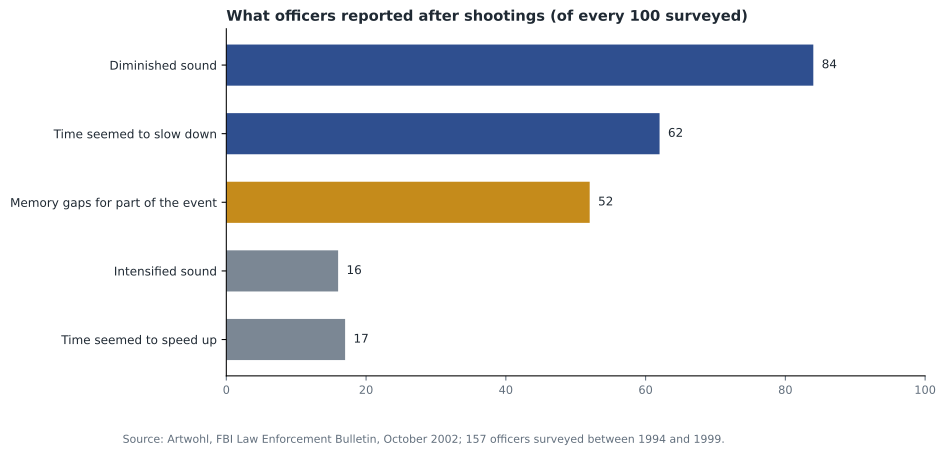
These findings matter in three ways. First, they explain why officers sometimes fire more rounds than they realize, miss more often than they expect, or do not notice a bystander. Second, they explain why an officer's honest account of a shooting may differ from the video or the physical evidence, which is not proof of dishonesty. Third, they show why training and tactics that reduce stress, by giving officers more time, more distance and more information, are among the most important safety measures there are.
Accuracy under stress
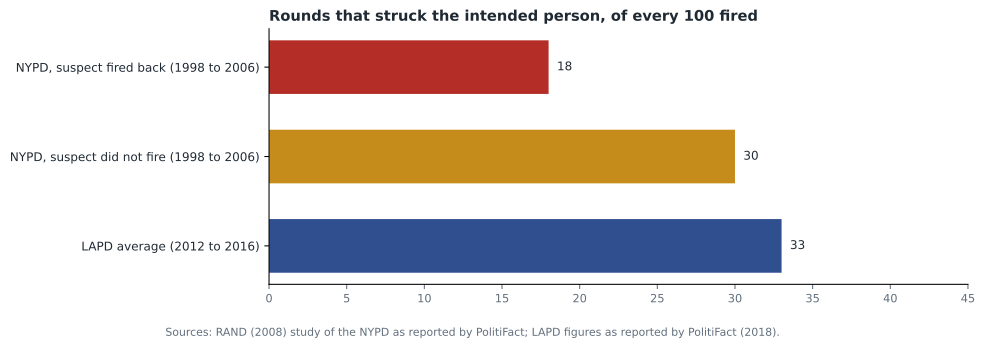
The effect of stress is clear in the data on how often police bullets strike their intended target. A 2008 study by the RAND Corporation of the New York City Police Department, which looked at incidents from 1998 to 2006, found that officers struck their intended target with about 18 of every 100 rounds when the suspect was firing at them, and about 30 of every 100 when the suspect did not fire. Figures published by the Los Angeles Police Department for 2012 to 2016 showed an average of about 33 of every 100 rounds striking the intended target. These numbers vary by city, year and how a hit is counted, and no national figure exists. But the pattern is consistent: officers who shoot very well on the range miss far more often in real incidents.
| Hit rate | 3 rounds fired | 10 rounds fired | 20 rounds fired |
|---|---|---|---|
| 18 of every 100 | 2.5 miss | 8.2 miss | 16.4 miss |
| 30 of every 100 | 2.1 miss | 7.0 miss | 14.0 miss |
| 33 of every 100 | 2.0 miss | 6.7 miss | 13.4 miss |
Worked problem
Expected misses
If an officer fires 10 rounds at a hit rate of 18 in every 100, how many rounds are expected to miss?
Show solution
- The miss rate is 100 − 18 = 82 in every 100.
- \[10\times\frac{82}{100}=8.2\]
Answer: About 8 of the 10 rounds are expected to miss and travel on past the target.
The calculation is simple, and that is the point. If ten rounds are fired at a typical real-incident hit rate, seven or eight of them miss and go somewhere else. That is why the fourth safety rule and the law's concern for bystanders matter so much, and why policies discourage firing when the background is unknown or crowded.
Identifying the threat
The hardest judgment an officer can face is deciding whether something in a person's hand is a weapon, and whether that person intends to use it. Phones, wallets, flashlights, tools and replica firearms have all been mistaken for guns, sometimes with fatal results. In November 2014, in Cleveland, Ohio, twelve-year-old Tamir Rice was shot and killed by a police officer within seconds of officers arriving at a park where he was holding a replica pistol. A grand jury declined to indict the officer, and the city later paid a 6 million dollar settlement to his family. The case is studied in police training in both countries because it shows how the speed and closeness of an approach can leave almost no time to identify what is happening.
At Riverside Park, Coutu and Okeke did several things that gave them time. They stopped their cars about 30 metres from the pavilion rather than driving up to it. They stayed behind the engine blocks of their cars, which offer much better protection than doors. They lit the scene with the spotlight, so that they could see Wren's hands and he could not see them clearly. Okeke gave clear, simple commands and repeated them, and he listened when Wren spoke. Coutu, the cover officer, watched Wren's two friends and the area around the pavilion. Both officers noticed what was behind Wren: a children's playground, then a row of houses with lights on. 'If he had swung that thing toward us, we would have had a decision to make,' Okeke told Ferris afterwards. 'But we had time and distance, and I knew a miss would go toward those houses.'
Desjardins asks the class to imagine the same call answered differently: officers driving up to the pavilion and getting out a few steps from Wren, with no cover, no light on his hands and no time. A startled nineteen-year-old turning toward them with a realistic replica in his hand could have been shot, and depending on the circumstances the shooting might even have been found legally reasonable, because the law judges what a reasonable officer would have perceived. 'The law asks whether your perception was reasonable,' Desjardins says. 'Good tactics are what keep you from having to perceive anything in a split second in the first place.'
Time, distance and cover
Police trainers often describe the officer's best friends in a potentially dangerous encounter as time, distance and cover. Distance gives an officer more time to see, think and act, and it makes the person's actions less immediately dangerous. Cover, meaning something that can stop a bullet, such as an engine block or a concrete wall, protects the officer and reduces the pressure to fire first. Time allows information to arrive, from dispatch, from other officers or from the person, and allows the person to calm down or comply. Together they turn many potential split-second decisions into situations where there is time to identify a threat accurately and to try communication first.
These ideas also appear in de-escalation training, which the less-lethal weapons course covered. Some policies call the use of distance and cover tactical repositioning, and many require officers to use de-escalation when it is safe and feasible. They are not always available. Some threats arrive with no warning and no time. But Ferris tells the class that, in her review of incidents, the officers who fired when they perhaps did not need to were usually officers who had lost time, distance or cover early in the encounter, often by approaching too quickly.
Decisions are continuous
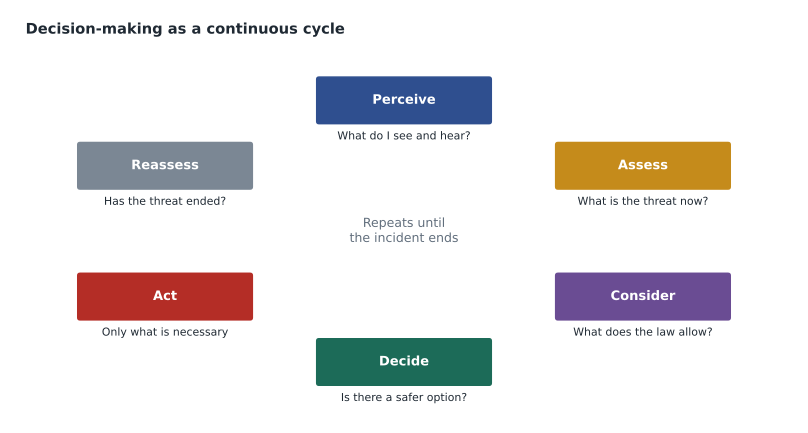
Officers are taught to treat decision-making as a cycle that repeats until the incident ends, not as a single moment. They perceive what is happening, assess the threat, consider what the law and policy allow, decide whether there is a safer option, act, and then reassess immediately. The cycle explains two things that the law requires. An officer who reasonably decides to fire must keep reassessing and stop firing when the threat ends. And an officer who has drawn and pointed a firearm must keep reassessing whether that is still necessary, and holster when it is not.
At Kettle Creek Road, Okeke's reassessment took about a second. After his third round, Vossberg fell and the rifle dropped onto the gravel, and Okeke stopped firing. He told Coutu to cover, called out to Vossberg to stay down and not reach for the rifle, and radioed that shots had been fired and that an ambulance was needed. The class will return to those minutes in Lesson 11.
Judgment training
Police services train judgment as well as marksmanship. Many use simulators that project filmed or computer-generated scenarios on a screen, in which the officer must decide whether to draw, communicate, use another option or fire, and the scenario changes depending on what the officer does. Others use live scenario training with role players and training replicas or marking cartridges. The best scenarios include situations where firing is not the right answer, such as a person holding a phone, a person in crisis threatening only themselves, or a person who complies at the last moment. Instructors debrief every scenario, asking what the officer saw, what they thought and why they acted.
The 2008 RAND study of the NYPD recommended more scenario-based training, remedial training for officers with poor technique even if they passed, and scenarios that teach officers that cues such as the sound of gunfire can be misleading. That last point addresses a known risk sometimes called contagious fire, in which officers fire because they hear other officers firing, without independently seeing a threat. Policies and training stress that each officer must have their own justification for every round they fire.
Research has also examined whether officers' decisions are affected by bias, for example whether a person's race affects how quickly an officer perceives a threat. Laboratory studies using simulated shoot or don't-shoot tasks have found evidence of such effects in some groups and settings, with trained officers often performing better than untrained participants. The research is complex and debated, but most services now include training on implicit bias and on slowing decisions down where possible, on the reasoning that time and accurate information reduce errors of every kind.
Worked problem
Building time into a call
Dispatch sends two officers to a report of a man with a knife sitting on a bench outside a closed shop at 2 a.m., talking to himself. Nobody else is nearby. What choices can the officers make before they arrive and when they arrive to keep time and distance on their side?
Show solution
- Agree on roles before arriving: one officer communicates, the other covers and watches the surroundings.
- Stop well back from the bench, with something solid between them and the man if possible.
- Ask dispatch for more information, such as whether the man is known, and request a crisis team if one is available.
- Light the scene so they can see his hands, and note what is behind him.
- Begin with communication and let the man respond; draw or point only if the law and policy justify it, and reassess constantly.
Answer: The officers cannot control what the man does, but they can control their approach. Distance, cover, light, information and communication give them time to make an accurate decision, and they make it much less likely that they will face a split-second choice.
Common mistakes
MistakeOfficers who shoot well on the range will be accurate in real incidents.
InsteadPublished data show officers strike their intended target far less often in real incidents, often fewer than one in three rounds.
MistakeAn officer whose account differs from the video must be lying.
InsteadStress commonly distorts perception and memory; differences can be honest.
MistakeIf other officers are firing, there must be a threat.
InsteadEach officer needs their own justification for every round; contagious fire is a known risk.
MistakeGood judgment means deciding quickly.
InsteadGood judgment usually means creating time, distance and cover so the decision does not have to be made in a split second.
Summary and key terms
- Stress raises heart rate, narrows attention and reduces fine motor control and memory.
- In one survey of 157 officers involved in shootings, 84 of every 100 reported diminished sound and 52 of every 100 reported memory gaps.
- Published data show officers hit their intended target with fewer than one in three rounds in many real incidents.
- Mistaking objects such as phones and replicas for guns is a major risk; time, distance, cover and light reduce it.
- Decision-making is a continuous cycle; officers must reassess and stop when the threat ends.
- Judgment training uses scenarios where firing is not the right answer and teaches each officer to justify every round.
- Tunnel vision
- A narrowing of the visual field to the threat under stress.
- Auditory exclusion
- A reduction in what a person hears under extreme stress.
- Cover
- An object that can stop a bullet, such as an engine block or concrete wall.
- Contagious fire
- Officers firing because others are firing, without seeing a threat themselves.
- Replica firearm
- An object made to look like a real firearm that cannot fire live ammunition.
- Scenario training
- Training in which officers make decisions in realistic, changing situations.
Practice problems
Work each problem on paper first, then reveal the answer to check.
Why might an officer honestly not remember how many rounds they fired?
Show answer
Stress commonly causes memory gaps and diminished hearing.
What three things did Coutu and Okeke use at Riverside Park to give themselves time?
Show answer
Distance, cover and light, along with clear communication.
What did the RAND study find about hit rates when suspects fired back?
Show answer
Officers struck their intended target with about 18 of every 100 rounds.
What is contagious fire?
Show answer
Firing because other officers are firing, without independently seeing a threat.
Lesson quiz · 5 questions
Score 60% or more to complete this lesson.
Create a free account to save your progress, take quizzes and earn a certificate.