
LES-207 · Lesson 2 of 12 · 23 min
The universal firearm safety rules
▶ Video coming soon A video version of this lesson is on the way.
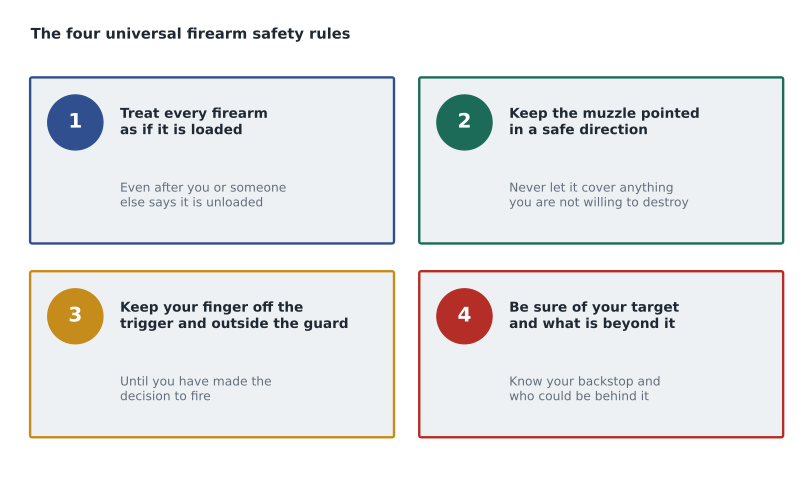
Ferris writes four short sentences on the whiteboard before the second class begins, and she leaves them there for the rest of the course. Treat every firearm as if it is loaded. Keep the muzzle pointed in a safe direction. Keep your finger off the trigger until you have decided to fire. Be sure of your target and what is beyond it. 'Hunters learn these,' she says. 'Sport shooters learn these. Soldiers learn these. Police officers learn these. The words change a little from one course to another, but the ideas are the same everywhere, because they work. If you follow all four, a mistake with a firearm is very unlikely to hurt anyone. If you break one, the others are there to catch you. If you break two at once, you are relying on luck.'
Amara Okafor asks why rules that simple need a whole lesson. Ferris says that the rules are simple to say and hard to follow every time, for years, when you are tired, distracted, rushed, frightened or bored. 'Nobody who has an unintended discharge thinks the rules are wrong,' she says. 'They just did not follow one of them, once, at the wrong moment.'
Rule 1: Treat every firearm as if it is loaded
The first rule is about attitude. A firearm should be handled as if it could fire at any moment, whether or not you believe it is loaded, whether or not someone has told you it is unloaded, and whether or not you checked it yourself a minute ago. The rule exists because the most common sentence in reports of unintended discharges is some version of 'I thought it was unloaded.' People are wrong about whether firearms are loaded far more often than they expect. A magazine was reinserted without anyone noticing. A round stayed in the chamber when the magazine was removed. Someone else handled the firearm in between. A firearm that is always treated as loaded cannot surprise anyone.
The rule does not mean that you never check. It means that checking does not change how you handle the firearm. Even after you have proven a firearm unloaded, which the next lesson describes, you still keep the muzzle in a safe direction and your finger off the trigger. 'The check tells you what you have,' Ferris says. 'The rule tells you how to behave. You need both.'
Rule 2: Keep the muzzle pointed in a safe direction
The muzzle is the open end of the barrel, where a bullet leaves. A safe direction is one where, if the firearm fired, the bullet would not hit anyone and would be stopped safely. On a range, that means toward the backstop, the earth berm or bullet trap behind the targets. At a station, it means into a clearing barrel or clearing station, a container filled with material designed to stop a bullet, built for exactly this purpose. Outdoors, it usually means toward the ground at a spot where nobody is standing and the bullet will not ricochet off rock or concrete.
Police training often states this rule more strongly: never let the muzzle cover anything you are not willing to destroy. 'Covering' means pointing at, even for an instant, even while moving, even with an unloaded firearm. The phrase 'willing to destroy' is deliberately blunt. It makes the shooter think about what is in front of the muzzle at every moment: their own hand, a partner's leg, the person in the next lane, a wall with an office behind it. In Canada, the national firearms safety course uses the same idea and teaches it as part of a short memory aid that also covers the other rules.
Muzzle discipline is the rule that most often turns an unintended discharge into a near miss rather than a tragedy. If a firearm fires unexpectedly while pointed at a backstop or clearing barrel, the result is a hole in something designed to take it, a report and some retraining. If it fires while pointed at a person, the result can be a death.
Rule 3: Keep your finger off the trigger
The third rule says that the trigger finger stays straight, alongside the frame of the firearm and outside the trigger guard, until the shooter has made the decision to fire. It does not go onto the trigger while drawing, while holding someone at gunpoint, while moving, while holstering, while loading or unloading or while talking. It goes onto the trigger only when the sights are on the target and the shooter has decided to fire, and it comes off the trigger again as soon as that decision ends.
This rule addresses a weakness in human bodies. When people are startled, lose their balance, or squeeze with one hand, the fingers of that hand tend to tighten together without the person deciding to. When one hand grips hard, the other can tighten too. A finger resting on a trigger can press it in any of these moments. Researchers and trainers call these involuntary muscle contractions, and they are one reason that the rule is taught as a habit, practised until the finger goes to the frame automatically, rather than as a choice made each time. Under stress, people do what they have practised.
Many modern handguns used by police have no external manual safety lever. Their safety comes largely from the design of the trigger and from the shooter's finger discipline. That is one more reason this rule is treated as absolute. Ferris says that she does not care how good a firearm's internal safeties are. 'The best safety on any firearm is a trigger finger that stays where it belongs,' she says.
Rule 4: Be sure of your target and what is beyond it
The fourth rule says that before firing, the shooter must positively identify what they are shooting at and must know what is behind it and around it. Bullets do not stop because a shooter wanted them to. They can miss, pass through the target, pass through walls, doors, vehicles and windows, and ricochet off hard surfaces. A shooter who fires at a target without knowing what is behind it may hit someone they never saw.
On a range, the rule is satisfied by the design of the range: the backstop stops every bullet and nobody is allowed downrange while firing is going on. On the street, nothing like that exists. The rule is part of the reason police policies restrict firing at moving vehicles, firing into buildings when people inside cannot be seen and firing in crowded places. It is also part of the reason the officers at Riverside Park in April 2026, which a later lesson studies, did not fire: behind the young man holding what looked like a handgun were a children's playground, a row of houses and the dark windows of a community centre.
Why the rules overlap
The four rules overlap on purpose. Each one would prevent most injuries on its own. Together, they mean that a single mistake is very unlikely to hurt anyone. Safety experts describe systems like this as layers of protection, each with holes in it, stacked so that the holes rarely line up. A firearm that someone wrongly believes is unloaded will not hurt anyone if the finger is off the trigger. A finger that slips onto the trigger will not hurt anyone if the muzzle is pointed at a clearing barrel. A shooter who misidentifies a target will not fire if they were never going to put a finger on the trigger without being sure.
| Layer | Lapse assumed | Chance of a lapse on one handling |
|---|---|---|
| Rule 1: firearm wrongly believed unloaded | 1 handling in 200 | 0.005 |
| Rule 3: finger on the trigger | 1 handling in 100 | 0.01 |
| Rule 2: muzzle covering a person | 1 handling in 50 | 0.02 |
Worked problem
When do the holes line up?
Assume the three lapses happen independently. An officer handles a firearm twice a shift, 250 shifts a year, for 25 years. How often do all three lapses happen on the same handling, and what changes if fatigue makes the trigger-finger lapse ten times more common?
Show solution
- Independent chances multiply, so the chance that all three line up on one handling is the product of the three.
- \[\frac{1}{200}\times\frac{1}{100}\times\frac{1}{50}=\frac{1}{1\,000\,000}\]
- A career contains 2 × 250 × 25 = 12,500 handlings.
- \[12\,500\times\frac{1}{1\,000\,000}=0.0125\]
- With a careless trigger finger the middle chance becomes 1 in 10, so the product becomes 1 in 100,000.
- \[12\,500\times\frac{1}{100\,000}=0.125\]
Answer: With every layer holding, about 1 in a million handlings, or roughly 0.013 dangerous moments in a whole career. With one layer broken by habit, 1 in 100,000, or about 0.125 in a career: nearly ten times the risk, carried by the two layers that remain.
The numbers in the model are invented for teaching, but the pattern is real. When every layer holds, a career of handling firearms can pass without a single dangerous moment. When one layer becomes a habit of breaking the rule, the risk multiplies, and the other layers are carrying the whole load. That is why instructors correct small lapses, even when nothing bad happened.
The clearing station incident
At about 7:05 a.m. on Thursday, March 13, 2025, Constable Brandon Pell, a four-year officer, was at the clearing station in the station's equipment room at the end of a shift that had run thirteen hours because of a serious collision on the highway. Service policy required officers to unload their duty pistols at the clearing station before putting them in their lockers. Pell was talking to another officer about the collision while he unloaded. His pistol fired one round into the clearing barrel. Nobody was hurt.
The review found that two rules had failed at once. Pell had removed the magazine but not yet cleared the round in the chamber, so the firearm was still loaded when he believed it was being made safe, which breaks the spirit of the first rule. And his finger was inside the trigger guard while he was handling the pistol, which breaks the third rule. The second rule held: the muzzle was pointed into the clearing barrel, exactly as the station design intended, and that is why the incident ended with a report instead of an injury. The fourth rule did not come into play, because he never intended to fire.
Pell reported the discharge to his sergeant at once and wrote a full account before he went home. Under the service's procedures, the chief was told the same morning, and because the discharge involved a failure to follow firearms safety procedures, it was reported to the police service board. Ferris led the review. 'He was exhausted, he was distracted, and he was doing something he had done two thousand times,' she tells the class. 'That is exactly when the rules matter most.' The outcome, and the changes the service made, are covered in the next lesson.
Unintended discharges: the words matter
Police services use several terms for a firearm that fires when the person holding it did not mean it to. 'Accidental discharge' was once common, but many trainers now avoid it because it suggests nobody was responsible. 'Negligent discharge' places responsibility on the shooter and is used when a safety rule was broken. 'Unintentional' or 'unintended discharge' is a neutral description used in many reports, because a firearm can very occasionally fire because of a mechanical defect with nobody at fault. Ferris says that, in her experience, a genuine mechanical failure is very rare. 'When a firearm fires when it should not, my first question is where the finger was,' she says. 'Nine times out of ten, that answers it.'
In Canada, the national firearms safety course teaches the same four ideas under a memory aid that starts with assuming every firearm is loaded, controlling the muzzle direction, keeping the trigger finger off the trigger and out of the trigger guard, and seeing that the firearm is unloaded by proving it safe. Police training adds discipline and repetition. Officers practise the rules until they no longer have to think about them, and instructors correct every lapse on the range, however small.
Worked problem
Which rules were broken?
During a vehicle search, an officer finds a revolver under a seat. She picks it up by the grip, turns to show her partner, and for a moment the muzzle points at his chest. Her finger is along the frame. Later it turns out the revolver was loaded. Which rules did she follow and which did she break?
Show solution
- Rule 1: by picking it up and turning casually, she handled it as if it might be unloaded, so she broke the first rule in spirit.
- Rule 2: the muzzle covered her partner, so she broke the second rule.
- Rule 3: her finger stayed along the frame, so she followed the third rule, and that is probably why nobody was hurt.
- Rule 4: she never intended to fire, so the fourth rule did not apply.
Answer: She broke rules 1 and 2 and followed rule 3. One rule held, and it was enough that day. A found firearm should be treated as loaded, the muzzle kept in a safe direction, and the firearm secured according to policy, ideally by someone trained to make it safe.
Common mistakes
MistakeA firearm you have just checked can be handled casually.
InsteadEven a firearm you have proven unloaded is still handled as if it were loaded: muzzle safe, finger off the trigger.
MistakeThe finger can rest on the trigger while you hold someone at gunpoint, so you are ready.
InsteadThe finger stays outside the trigger guard until you have decided to fire; startle and grip reflexes can press a resting finger.
MistakeModern police pistols are safe because of their internal safeties.
InsteadInternal safeties help, but the main safety is a trigger finger that stays off the trigger.
MistakeAn unintended discharge is always an accident nobody could prevent.
InsteadMost unintended discharges involve a broken safety rule; a true mechanical failure is rare.
Summary and key terms
- The four universal rules are taught in nearly the same words to hunters, sport shooters, soldiers and police.
- Rule 1: treat every firearm as loaded, even after checking it.
- Rule 2: never let the muzzle cover anything you are not willing to destroy.
- Rule 3: keep the finger off the trigger and outside the guard until you have decided to fire.
- Rule 4: be sure of the target and what is beyond it, because bullets miss and pass through.
- The rules overlap so that one mistake is unlikely to hurt anyone; breaking two at once relies on luck.
- ACTS
- The memory aid used in the Canadian Firearms Safety Course for the four safety ideas.
- Muzzle
- The open end of the barrel, where the bullet leaves the firearm.
- Muzzle discipline
- Keeping the muzzle pointed in a safe direction at all times.
- Trigger discipline
- Keeping the trigger finger straight and outside the trigger guard until the decision to fire.
- Backstop
- Material behind a target, such as an earth berm or bullet trap, that safely stops bullets.
- Clearing barrel
- A container at a station, filled with material that stops a bullet, used when loading and unloading.
- Negligent discharge
- A discharge caused by a broken safety rule.
Practice problems
Work each problem on paper first, then reveal the answer to check.
Why does rule 1 apply even after you have checked a firearm?
Show answer
Because people are often wrong about whether a firearm is loaded, and the rule governs how you handle it, not what you believe.
What does 'covering' mean in muzzle discipline?
Show answer
Pointing the muzzle at something, even briefly or while moving.
Why is trigger discipline taught as a habit?
Show answer
Because startle and grip reflexes can press a resting finger, and under stress people do what they have practised.
Which rule saved the day in the clearing station incident?
Show answer
Rule 2: the muzzle was pointed into the clearing barrel.
Lesson quiz · 5 questions
Score 60% or more to complete this lesson.
Create a free account to save your progress, take quizzes and earn a certificate.