
LES-207 · Lesson 11 of 12 · 19 min
After a police shooting: medical aid, investigation, oversight and wellness
▶ Video coming soon A video version of this lesson is on the way.
For the eleventh class, Desjardins invites two guests: paramedic Joan Ivey, who was the first paramedic to reach Dale Vossberg at the Kettle Creek Road boat launch, and Sergeant Lisa Haddad, who was the patrol supervisor that night. Constable Femi Okeke agreed to let the class study the incident but did not want to attend. 'He has told the story enough times,' Haddad says. 'To investigators, to a psychologist, to his family. He asked me to tell you one thing: the hardest part was not the shooting. It was the next six weeks.'
This lesson follows what happens after a police officer fires at a person: the first minutes, when the priority is to make the scene safe and save life; the hours that follow, when the scene becomes evidence; and the weeks and months of investigation, oversight and recovery. The same process applies whether the person is killed, injured or not struck at all.
The first minutes at Kettle Creek Road
The class works through the timeline from the radio recordings, the cameras and the reports. At 2:41 a.m. on Sunday, August 23, 2026, Carla Mott called 911 to report that her brother, Dale Vossberg, forty-six, had been drinking, had argued with her husband in their driveway and had pointed a hunting rifle at him before driving off in his pickup. At 2:58, Okeke, driving alone, found the pickup parked in the boat launch lot at the end of Kettle Creek Road. He stopped well back on the road, behind his engine block, and called for backup. At 3:06, Coutu arrived and parked beside him. For about five minutes, Okeke talked to Vossberg over the car's loudspeaker and then in his own voice, asking him to come out without the rifle. At about 3:09, Vossberg got out of the pickup holding the rifle and shouted at the officers to leave.
At 3:11:02, Vossberg raised the rifle and fired one round, which struck the front of Okeke's patrol car. Okeke fired three rounds in about two seconds. Vossberg was struck once in the upper leg, fell and dropped the rifle on the gravel. Okeke stopped firing. At 3:11:20 he radioed that shots had been fired, that a man was down and that an ambulance was needed. Coutu kept her eyes on Vossberg and the rifle, and both officers stayed behind cover and told him to stay down and not reach for it.
Sergeant Haddad and Constable Sofia Reyes arrived at 3:15. The four officers moved forward together as a team, Reyes secured the rifle and moved it well away, and Coutu began first aid. She applied a tourniquet from her trauma kit above the wound at 3:16, while Okeke pressed on the wound and talked to Vossberg to keep him calm. Paramedics, who had been asked to wait nearby until the scene was safe, reached Vossberg at 3:21. Ivey tells the class that the tourniquet was applied well and probably prevented serious blood loss. Vossberg was taken to Port Ardent General Hospital at 3:38, had surgery and survived.
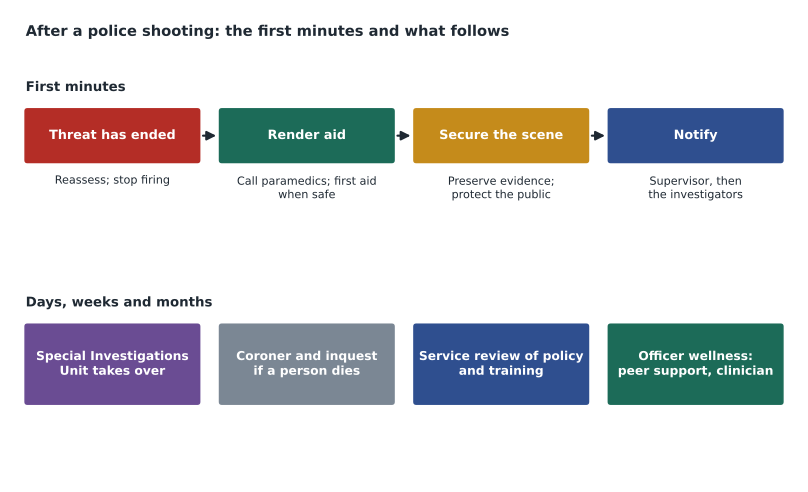
The duty to render aid
Once the threat has ended and it is safe to do so, officers must make sure that injured people get medical help as quickly as possible, including the person they shot. In Canada, this duty comes from the common law duties of police, from service policy and from provincial rules, and failing to provide or summon care can itself lead to discipline or, in serious cases, criminal liability. Many services now issue trauma kits with tourniquets and pressure dressings to every patrol officer and train them to use them, because the minutes before paramedics arrive can decide whether a person lives.
Ivey adds a paramedic's perspective. 'We need three things from police,' she says. 'Tell us early, make the scene safe enough for us to come in, and tell us what you have done. A tourniquet with the time written on it is the best handover I can get.' Coutu had written 3:16 on the tourniquet's tab with a marker.
Securing the scene and the evidence
As soon as the injured person is in the paramedics' care, the scene becomes the site of a serious investigation. Haddad's job as the supervisor was to protect the evidence until investigators arrived. She had the area taped off, posted an officer to keep a log of everyone who entered, made sure nothing was moved except as needed for first aid, and noted where the rifle had been before Reyes moved it. She made sure no officer handled or unloaded Okeke's pistol, which stayed in his holster until the investigators took custody of it, with the magazines, so that the remaining rounds could be counted. Spent cases, the rifle and the damaged patrol car were left for the forensic team.
Haddad also separated the officers. Okeke and Coutu were driven to the station in different cars and kept apart until investigators had spoken to them, so that each officer's memory would not be shaped by the other's. A peer support officer stayed with Okeke. Haddad tells the class that this separation is not a sign of suspicion. 'Your memory after something like that is fragile,' she says. 'Investigators need what you saw, not a version you built together in the car.'
Body-worn camera recordings were secured immediately. Coutu had started her camera when she was dispatched. Okeke's camera started about forty seconds after he stopped his car, so it missed his first radio call but captured everything from Vossberg's first appearance onward. The late activation became one of the review points in Lesson 12.
Who investigates
In Ontario, the Special Investigations Unit, a civilian agency independent of the police, investigates incidents in which a police officer's conduct may have resulted in death or serious injury, and incidents in which an officer discharges a firearm at a person, whether or not the person is struck. Police services must notify the unit immediately. The duty inspector called the unit at 3:35 a.m., the unit took over the investigation at 4:10, and its investigators and forensic team arrived at 5:20. Under the Special Investigations Unit Act, 2019, the officer whose conduct is being investigated, called the subject official, is not required to give an interview or hand over notes, which reflects the right against self-incrimination. Other officers, called witness officials, must cooperate. Okeke, on legal advice, declined an interview, as was his right. Coutu and Haddad were interviewed as witness officials.
The unit's director published a report on October 30, 2026. It found no reasonable grounds to believe that Okeke had committed a criminal offence and closed the file. The report summarized the evidence, including the cameras, the forensic findings and the witness accounts, and explained the legal analysis. Ontario then requires the chief of police to review the incident for any issues of policy, services or officer conduct, and that review is described in Lesson 12. If Vossberg had died, a coroner's inquest would have been mandatory.
| Time | Event | Minutes after the call |
|---|---|---|
| 02:41:00 | Call received | 0 |
| 02:58:00 | First officer on scene | 17 |
| 03:06:00 | Second officer on scene | 25 |
| 03:11:02 | Shots fired | 30 |
| 03:11:20 | Radio call for ambulance | 30 |
| 03:15:00 | Supervisor on scene | 34 |
| 03:16:00 | Tourniquet applied | 35 |
| 03:21:00 | Paramedics at patient | 40 |
| 03:38:00 | Leaves for hospital | 57 |
| Interval | Length |
|---|---|
| Shots to ambulance request | 18 seconds |
| Shots to tourniquet | about 4 minutes 58 seconds |
| Shots to paramedics at patient | about 9 minutes 58 seconds |
Reviewers read a timeline like this in two directions. Looking forward from the shots, they ask whether each step of medical aid followed as quickly as the scene allowed: the call for an ambulance came almost at once, and the tourniquet went on as soon as the officers judged it safe to approach. Looking back from the shots, they ask how long officers had to plan before the confrontation, which in this incident was about thirteen minutes from the first officer's arrival. Both directions matter, because a good outcome after the shots does not excuse a poor approach, and a careful approach does not excuse slow first aid.
The timeline shows that the ambulance was requested within twenty seconds of the shots, the tourniquet was applied within five minutes and paramedics reached Vossberg within ten. Reviewers look at intervals like these to see whether medical aid was summoned and given promptly, and whether anything delayed it.
The officer after a shooting
Haddad returns to Okeke's message about the next six weeks. Officers who have fired at a person commonly experience strong reactions in the days and weeks that follow, whether or not anyone was killed. These can include trouble sleeping, replaying the event, feeling numb or on edge, guilt, anger, fear about the investigation, and worry about how colleagues, family and the public see them. For most officers these reactions fade over weeks with support. For some they last longer, and some develop post-traumatic stress injuries, depression or problems with alcohol.
Police services now have procedures meant to support officers after a shooting. At Port Ardent, an officer who fires at a person is relieved of patrol duty for at least three days, which is not a punishment, and must meet a psychologist with experience in police trauma within seventy-two hours. The meeting is confidential and is not a fitness evaluation. A peer support officer, a colleague trained to listen and to connect officers to help, is assigned to the officer and their family. The officer returns to work gradually, usually starting with administrative duties and then range time with an instructor before going back on patrol. Okeke returned to patrol on September 21, after meeting the psychologist four times, and he still checks in with his peer support officer.
Ontario law presumes that post-traumatic stress disorder diagnosed in a first responder, including a police officer, is work-related, which makes it easier to receive workers' compensation. The presumption was introduced in 2016. Haddad says that the most important support often comes from colleagues and supervisors who check in, treat the officer normally and do not gossip. She also reminds the class that Coutu, who did not fire, and the other officers at the scene can be affected too. Anyone who is struggling can call or text 9-8-8 at any time.
Accountability and support together
Students sometimes see a tension between investigating an officer and supporting them. Desjardins says that, in a healthy system, the two go together. The public is entitled to a full, independent investigation of every police shooting, and officers are entitled to fair treatment, legal advice and care for their health while it happens. Services that rush to defend officers before the facts are known lose public trust. Services that abandon officers during an investigation lose their officers. 'Investigate fully and support fully,' Desjardins says. 'Those are not opposites.'
Worked problem
Ordering the first minutes
An officer has just fired at a man armed with a knife who was advancing on another officer. The man is on the ground and the knife has fallen beside him. What should the officers do, and in what order?
Show solution
- Stop firing and reassess: has the threat ended? Is anyone else in danger?
- Radio that shots have been fired, give the location and request paramedics and a supervisor.
- Approach as a team when it is safe, move the knife well away and keep the man under observation.
- Begin first aid within their training, such as controlling bleeding, and hand over to paramedics with a clear account.
- Protect the scene, keep officers separate, secure cameras and leave firearms in holsters for investigators.
Answer: The order follows the same logic as Kettle Creek Road: end the threat, call for help, make safe, save life, then protect the evidence and the people involved.
Common mistakes
MistakeOnce the person is down, the officers' job is over until investigators arrive.
InsteadOfficers must summon and give medical aid once it is safe, then protect the scene and evidence.
MistakeOfficers involved in a shooting should talk it over together to get their story straight.
InsteadThey are kept apart so that each officer's memory is their own and the investigation is fair.
MistakeThe officer who fired must give the Special Investigations Unit an interview.
InsteadThe subject official is not required to give an interview or notes; witness officials must cooperate.
MistakeTime off after a shooting means the officer is being punished.
InsteadRelief from duty and a meeting with a clinician are standard support, not discipline.
Summary and key terms
- After the threat ends, officers summon help, make the scene safe and give first aid within their training.
- Supervisors protect the scene, separate officers, secure firearms and cameras and keep a log.
- Ontario's Special Investigations Unit investigates every police discharge of a firearm at a person and decides whether to lay charges.
- Subject officials need not give interviews or notes; witness officials must cooperate.
- Officers commonly have strong reactions after a shooting; services provide time off, a clinician and peer support.
- Full investigation and full support for officers belong together.
- Special Investigations Unit
- Ontario's civilian agency that investigates police incidents involving death, serious injury or a firearm discharge at a person.
- Subject official
- The officer whose conduct the Special Investigations Unit is investigating.
- Witness official
- An officer who saw or was involved in the incident and must cooperate with the unit.
- Trauma kit
- A first aid kit with tourniquets and dressings for serious bleeding.
- Tourniquet
- A band tightened above a wound on a limb to stop severe bleeding.
- Scene log
- A record of everyone who enters and leaves a protected scene.
- Peer support officer
- A trained colleague who supports officers and families after critical incidents.
Practice problems
Work each problem on paper first, then reveal the answer to check.
How soon after the shots did Okeke request an ambulance?
Show answer
About eighteen seconds later, at 3:11:20.
Why was Okeke's pistol left in his holster?
Show answer
So investigators could take custody of it and count the remaining rounds.
What must Ontario police do when an officer fires at a person?
Show answer
Notify the Special Investigations Unit immediately.
Name three supports Port Ardent provides after a shooting.
Show answer
Relief from patrol duty, a meeting with a psychologist within seventy-two hours, a peer support officer and a gradual return.
Lesson quiz · 5 questions
Score 60% or more to complete this lesson.
Create a free account to save your progress, take quizzes and earn a certificate.