
LES-207 · Lesson 8 of 12 · 20 min
The law of lethal force
▶ Video coming soon A video version of this lesson is on the way.
Desjardins takes the lead for the eighth class, and Ferris sits at the side of the room. He writes one sentence on the board: 'A police officer may use force that is intended or likely to cause death or grievous bodily harm only when the officer believes, on reasonable grounds, that it is necessary to protect someone from death or grievous bodily harm.' 'Everything in this lesson is a way of unpacking that sentence,' he says. 'Learn it so well that you could say it in your sleep, and then learn what every word in it means.'
This lesson sets out the law that governs police use of lethal force with firearms, the policies that add to the law, and how investigators, Crown attorneys, courts and coroners' juries apply them. It does not replace the general law of force covered in earlier courses, but it focuses on the most serious decision an officer can make.
The Criminal Code framework
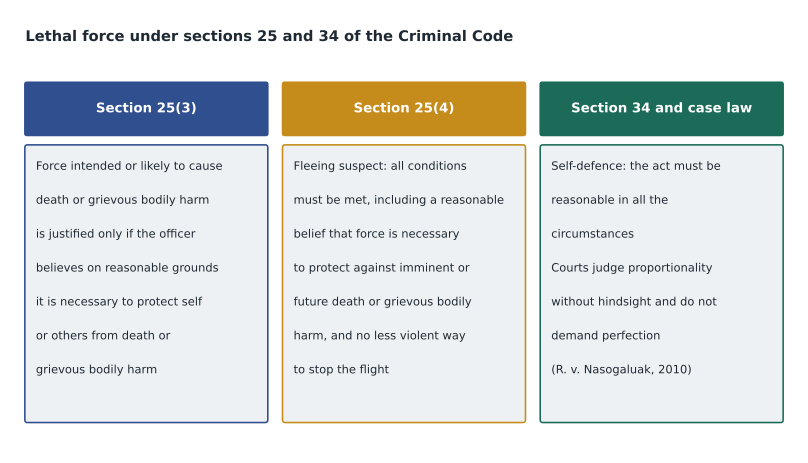
Section 25 of the Criminal Code is the main source of police authority to use force. Section 25(1) says that a person who is required or authorized by law to do something in the administration or enforcement of the law, acting on reasonable grounds, is justified in doing it and in using as much force as is necessary for that purpose. Section 25(3) then limits lethal force. It says that a person is not justified in using force that is intended or is likely to cause death or grievous bodily harm unless the person believes, on reasonable grounds, that it is necessary for the self-preservation of the person or the preservation of anyone under that person's protection from death or grievous bodily harm.
Section 25(4) deals with a person who flees to avoid arrest. A peace officer, and anyone lawfully helping the officer, is justified in using force intended or likely to cause death or grievous bodily harm against a person to be arrested only if all of the following are true: the officer is proceeding lawfully to arrest the person, with or without a warrant; the offence is one for which the person may be arrested without a warrant; the person takes flight to avoid arrest; the officer believes on reasonable grounds that the force is necessary to protect the officer or any other person from imminent or future death or grievous bodily harm; and the flight cannot be prevented by reasonable means in a less violent manner. The section was rewritten in 1994 after a court found the older rule unconstitutional, which allowed force to stop any fleeing suspect of a serious offence.
Section 34 of the Criminal Code, the general self-defence provision rewritten in 2013, also applies to officers. It requires that the person believes on reasonable grounds that force is being used or threatened against them or someone else, acts to defend or protect against it, and acts reasonably in the circumstances. The section lists factors a court considers, including the nature of the force or threat, how imminent it was, whether other means of responding were available, each person's role in the incident, whether any party used or threatened to use a weapon, and the size, age, gender and physical capabilities of the parties. Section 26 adds that anyone authorized to use force is criminally responsible for any excess.
What the words mean
Reasonable grounds has two parts. The officer must actually believe that lethal force is necessary, which is the subjective part, and that belief must be one a reasonable person in the officer's position, with the officer's training and experience, would share, which is the objective part. In R. v. Nasogaluak (2010), the Supreme Court of Canada said that police officers are not expected to measure the force they use with exactitude, that their actions should not be judged against a standard of perfection, and that allowance must be made for the dangerous and demanding circumstances in which they work. But the Court also said that force must be proportional, necessary and reasonable, and that section 25(3) sets a high bar for lethal force.
Several ideas run through both countries' law. The threat must be one of death or serious injury, not a lesser harm or a threat only to property. It must be imminent or immediate, not speculative. The force must be necessary, which means that a less dangerous option would not have worked in the circumstances. And the whole situation is considered, including what the officer knew, what the officer could see and hear, how much time there was and what other options were available. The law does not require officers to wait until they are shot at before firing, and it does not require them to retreat from someone threatening their lives. But it does require them to stop firing when the threat ends.
Policy adds to the law
Police policies usually go further than the minimum the law requires. In Ontario, service policies following the provincial rules allow an officer to draw a handgun, point a firearm at a person or discharge a firearm only when the officer believes on reasonable grounds that it is necessary to protect against loss of life or serious bodily harm. Policies typically forbid discharging a firearm for the sole purpose of stopping a fleeing motor vehicle, and most services prohibit or tightly restrict warning shots. The policies also require reports on every draw in the presence of the public, every point at a person and every discharge, and they require training before an officer may carry a firearm.
| Situation | General legal position | Common policy rule |
|---|---|---|
| Fleeing person who poses no threat of death or serious injury | Lethal force not justified under section 25(4) | Do not shoot to stop flight alone |
| Moving vehicle | Judged on all the circumstances; force must meet the legal test | Do not shoot solely to stop or disable a vehicle; move out of its path where possible |
| Firing warning shots | Any discharge must meet the legal test for force | Prohibited or tightly restricted |
| Person threatening only themselves | Lethal force requires a threat to someone's life | Use time, distance and crisis resources |
| Threat has ended | Further force is not necessary and may be a crime | Stop, reassess, render aid |
| Bystanders in the line of fire | Officer can be liable for reckless or negligent harm to others | Rule 4: know what is beyond the target |
Consequences when force is unlawful
A police officer who uses lethal force without legal justification can be charged with a criminal offence like anyone else, including murder, manslaughter, criminal negligence causing death or bodily harm, aggravated assault or careless use of a firearm. In Ontario, the Special Investigations Unit decides whether to lay charges when a police officer's conduct results in death or serious injury, or when an officer discharges a firearm at a person, and Lesson 11 describes its work. When the use of force by a police officer causes a person's death, Ontario law requires a coroner's inquest, at which a jury hears evidence and may make recommendations to prevent similar deaths. Officers can also face discipline under the Community Safety and Policing Act and civil lawsuits for damages.
Desjardins emphasizes the last point. Policy violations are judged by the agency against its own rules, which are often stricter than the law. An officer can be cleared of any crime and still be found to have violated policy, for example by firing at a moving vehicle when the policy forbids it, or by failing to activate a camera. Investigators and reviewers keep these questions separate: was the force lawful, was it within policy, and what can be learned?
Applying the law to Kettle Creek Road
At about 3:11 a.m. on Sunday, August 23, 2026, Constable Femi Okeke fired three rounds at Dale Vossberg at the Kettle Creek Road boat launch, a few seconds after Vossberg raised a hunting rifle and fired one round toward the patrol car behind which Okeke and Constable Nadine Coutu had taken cover. The round struck the front of the car. Vossberg was struck once, fell and dropped the rifle, and Okeke stopped firing. Lesson 9 examines the decisions leading up to that moment, Lesson 11 the medical aid and investigation that followed, and Lesson 12 the whole incident.
The Special Investigations Unit later found no reasonable grounds to believe that Okeke had committed a criminal offence. The director's report applied sections 25 and 34: Vossberg had just fired a rifle toward the officers, he was still holding it, and Okeke believed his life and Coutu's were in danger. That belief was reasonable, and the force was proportionate to a threat of death. The report also noted that Okeke stopped firing when Vossberg fell and dropped the rifle. Vossberg himself is charged with offences arising from the incident and is presumed innocent. His trial is scheduled for 2027.
Amara Okafor asks what would have changed the legal analysis. Desjardins gives three examples. If Vossberg had put the rifle down and turned to walk toward the water, the threat would have ended and firing would not have been necessary. If Okeke had kept firing after Vossberg fell and let go of the rifle, the later rounds would have been judged separately and might have been excessive. And if a camper had been sitting on the dock directly behind Vossberg, the fourth safety rule, and the law's concern for bystanders, would have made firing much harder to justify, even though Vossberg was a threat.
Drawing and pointing are decisions too
Students often think of the law of lethal force as being only about the decision to fire. But drawing a firearm and pointing it at a person are also decisions that the law and policy govern. Ontario services permit an officer to draw or point a firearm only when the officer believes on reasonable grounds that it is necessary to protect against loss of life or serious bodily harm, and every draw in the presence of the public and every point at a person must be reported. Pointing a firearm at someone is frightening and can escalate a situation, and a firearm that is pointed is a firearm that can be fired by mistake.
Desjardins asks the students to remember Riverside Park. Okeke drew and pointed his pistol because he reasonably believed that Wren might be holding a real handgun. As soon as Wren put the object down and stepped away, the reason for pointing the pistol ended, and Okeke lowered it and then holstered it once the replica was secured. His report explained each step. 'The same reasoning governs every stage,' Desjardins says. 'Draw only when the law allows it, point only when the law allows it, fire only when the law allows it, and stop each one when the reason ends.'
He adds that officers should expect every one of those decisions to be reviewed. Supervisors read the reports, compare them with camera footage and look for patterns. An officer who draws or points far more often than colleagues on similar calls will be asked why, and the answer may lead to coaching rather than discipline.
Worked problem
Applying the test
Officers stop a car whose driver is wanted on a warrant for fraud. The driver suddenly accelerates away, and an officer who is standing well to the side, out of the car's path, fires at the driver to stop him escaping. Analyse the decision.
Show solution
- The driver was wanted for a non-violent offence, and there is no information that he poses a threat of death or serious injury to anyone.
- The officer was out of the car's path, so the car was not a threat of death or serious injury to the officer at that moment.
- Section 25(4) requires a reasonable belief that force is necessary to protect someone from imminent or future death or grievous bodily harm; that condition is not met.
- Common policies also forbid shooting at a moving vehicle solely to stop it.
- Rule 4 is also engaged: shots at a moving car may strike passengers or others.
Answer: The discharge was not justified in law or policy. The officer should have let the car go, broadcast its description and pursued other ways of making the arrest later.
Common mistakes
MistakeOfficers may use lethal force to stop any person fleeing from a serious crime.
InsteadSection 25(4) requires a reasonable belief that force is necessary to protect someone from imminent or future death or grievous bodily harm, and that flight cannot be stopped less violently.
MistakeCourts look only at the moment the officer fired.
InsteadCourts consider all the circumstances, and section 34 lists many factors.
MistakeIf the force was lawful, the officer cannot be disciplined.
InsteadPolicies are often stricter than the law, and an officer can violate policy without committing a crime.
MistakeOnce lethal force is justified, an officer may keep firing until certain the person cannot get up.
InsteadForce must stop when the threat ends; later rounds are judged separately.
Summary and key terms
- Section 25(3) allows lethal force only on a reasonable belief that it is necessary to protect against death or grievous bodily harm.
- Section 25(4) sets strict conditions for lethal force against a fleeing person.
- R. v. Nasogaluak says officers are not held to perfection, but force must be proportional, necessary and reasonable.
- Policies usually add limits on warning shots, moving vehicles and reporting.
- Unlawful force can lead to criminal charges, civil liability and discipline, and policy violations are judged separately.
- Force must stop when the threat ends.
- Grievous bodily harm
- Serious hurt or injury that interferes in a grave way with a person's physical integrity or health.
- Reasonable grounds
- A belief that is actually held and that a reasonable person in the officer's position would share.
- Coroner's inquest
- A public hearing into a death, mandatory in Ontario when police use of force causes a death.
- Imminent
- About to happen; not speculative or in the distant future.
- Proportionality
- The requirement that force be in balance with the threat it responds to.
- Totality of the circumstances
- Everything the officer knew and faced, not just one moment.
Practice problems
Work each problem on paper first, then reveal the answer to check.
What two parts does 'reasonable grounds' have?
Show answer
A belief the officer actually holds and that a reasonable person in the officer's position would share.
Must an officer wait to be shot at before firing?
Show answer
No, but there must be a reasonable belief of an imminent threat of death or serious injury.
Name two common policy limits on firearms use.
Show answer
Any two of no shooting solely to stop a fleeing vehicle, no or restricted warning shots, reporting draws and points, and rendering aid.
Why did Okeke's decision to stop firing matter legally?
Show answer
Force must stop when the threat ends; continued firing would have been judged separately.
Lesson quiz · 5 questions
Score 60% or more to complete this lesson.
Create a free account to save your progress, take quizzes and earn a certificate.