
LES-207 · Lesson 1 of 12 · 21 min
Firearms in policing: responsibility, risk and the data
▶ Video coming soon A video version of this lesson is on the way.
Sergeant Martina Ferris opens the first class without a firearm in sight. She puts a single sheet of paper on the projector instead. It is a page from the range log at Port Ardent's indoor range, the one under police headquarters, and it lists every round issued, every round fired and every round returned on one Tuesday in January 2026. The columns balance to the last cartridge. 'This is what carrying a firearm looks like most days,' she says. 'Paperwork, counting, cleaning and checking. Most of you will go a whole career without firing at a person. All of you will spend that career being responsible for a weapon that can end a life in less than a second. That responsibility starts here, with the boring parts.'
Ferris has been a police officer in Port Ardent for sixteen years and has run the range for the last nine. She is the service's range master and senior firearms instructor, which means she writes the range rules, runs the annual requalification, supervises the instructors who help her and signs the records that say each officer is allowed to carry a firearm for another year. She teaches this course with Professor Ray Desjardins, who has taught the program's law and procedure courses. Sergeant Lisa Haddad, who taught the use-of-force material in the less-lethal weapons course, joins several classes.
This course is not range training. Nobody in this classroom will handle a live firearm as part of it. Firearms skills are taught only on a supervised range, by certified instructors, to people who are authorized to carry, and every police service sets its own course for that. What this course does is give students the knowledge that sits around those skills: the safety rules that every shooter in North America learns, how a professional range is run, what police firearms and equipment are and why they are controlled, the general principles of marksmanship, how firearms are maintained and stored, the law that governs lethal force, how stress affects judgment, how officers qualify each year, and what happens after a police shooting. These are the things that a recruit needs to understand before stepping onto a range, and that a supervisor, investigator or member of the public needs to understand to judge whether a firearm was carried and used responsibly.
Who may carry a firearm on duty
In Canada, police officers carry firearms because provincial law and their service's policies authorize them to, and because federal law exempts them from the firearms offences that would otherwise apply. Section 117.07 of the Criminal Code says that public officers, which include peace officers, do not commit the possession and transfer offences in Part III of the Code when they are acting in the course of their duties. The firearms they carry are owned by the police service, not by the officer. In Ontario, the regulation on use of force and weapons made under the Community Safety and Policing Act, which came into force in April 2024, sets out which weapons officers may carry, requires training before an officer carries a firearm, sets technical standards for handguns and requires reports when a firearm is drawn, pointed or discharged. Other provinces have similar rules.
In both countries, carrying a firearm is a condition of the job that can be taken away. An officer who fails a qualification, who is suspended, who is under certain kinds of investigation or whose health makes it unsafe can have their firearm withdrawn. Ferris tells the class that she has withdrawn firearms from officers on four occasions in nine years, three times for a failed qualification that was later fixed with retraining and once for a reason she will not discuss. 'It is not a punishment,' she says. 'It is the service saying that, for now, we cannot be sure this weapon is safe in your hands. Everyone in this room should want that check to exist.'
How often police use firearms
Firearms are among the most visible parts of police work and among the least used. Officers draw them far more often than they fire them, and they fire them at people very rarely. Port Ardent's annual report for 2025, which covered about 61,000 calls for service, shows the pattern. Officers reported drawing a handgun with members of the public present 74 times. They reported pointing a firearm at a person 38 times. They fired a firearm three times to end the suffering of a badly injured animal, usually a deer hit by a car. There was one unintended discharge, at the station's clearing station, which this course will study closely. No officer fired at a person in 2025.
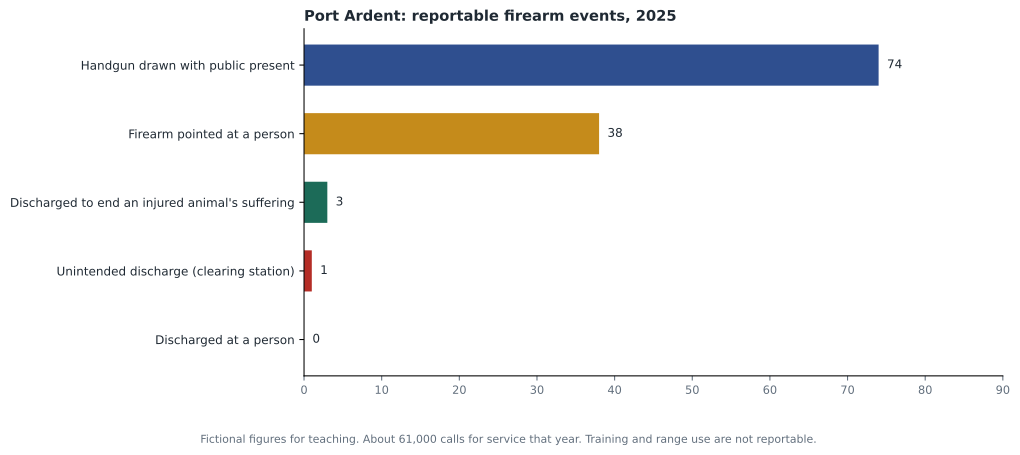
Those figures are reportable because Ontario's regulation requires a report when an officer draws a handgun in the presence of a member of the public, points a firearm at a person or discharges a firearm, apart from training, target practice and ordinary maintenance. Other provinces set similar reporting rules. Desjardins points out that the drawing and pointing figures are not a sign that something went wrong. Officers draw their firearms when they reasonably believe they may need them, such as when approaching someone reported to have a gun. The report exists so that supervisors can see the pattern, check that each draw was justified and spot officers or situations that need attention.
The national picture
Canada has no single official count of people killed or injured by police firearms. Researchers and journalists have filled the gap. The Tracking (In)Justice project, a research database led by academics, documented 745 deaths across Canada from 2000 to 2023 in which police used intentional force, and found a steady rise in such deaths over that period, particularly deaths from police shootings. Provincial oversight bodies, such as Ontario's Special Investigations Unit, publish reports on each case they investigate, which allows the public to see what happened in individual shootings.
Marco DiSanto asks why the numbers matter to a recruit who just wants to learn to shoot safely. Desjardins answers that every one of those deaths was investigated, many were reviewed by courts or inquests, and the lessons from them shape the policies the students will follow. 'The rules you will learn about drawing, pointing, warning shots, moving vehicles and medical aid were mostly written after something went wrong,' he says. 'Knowing the data is how you understand why the rules exist.'
A safety culture
Ferris describes the police range as a safety culture, a place where everyone is expected to follow the rules every time, to watch for mistakes in others, and to speak up without fear when they see one. The idea comes from fields such as aviation and medicine, where people learned that serious accidents usually come from small errors that line up. On the range, nobody is too senior to be told to keep their finger off the trigger. 'The chief gets corrected on my range,' Ferris says. 'He thanks me for it.'
A safety culture also means reporting mistakes, including your own. An officer who has an unintended discharge, who loses track of a magazine, or who notices a damaged holster is expected to report it immediately. A service that punishes every honest report soon stops getting reports. A service that never holds anyone accountable soon stops having rules. Ferris says that the balance is hard and that she will come back to it when the class studies the clearing station incident.
Three incidents this course follows
Three fictional incidents from Port Ardent run through the course. Each one teaches a different part of firearms responsibility, and each was reviewed by the service.
| Date | Incident | What it teaches |
|---|---|---|
| Thursday, March 13, 2025, about 7:05 a.m. | An officer at the end of a long night shift has an unintended discharge into the clearing barrel at the station. No one is hurt. | The safety rules, safe handling, fatigue and honest reporting |
| Saturday, April 18, 2026, about 10:40 p.m. | Officers respond to a report of a man with a gun at Riverside Park. It is a replica used to film a music video. No shots are fired. | Threat identification, cover, distance, time and knowing what is beyond the target |
| Sunday, August 23, 2026, about 3:10 a.m. | At the Kettle Creek Road boat launch, a man fires a rifle toward two officers. One officer fires three rounds and the man is struck once. He survives. | The law of lethal force, decisions under stress, medical aid, investigation, oversight and wellness |
The third incident is the most serious and is still before the courts. The man, Dale Vossberg, has been charged and has pleaded not guilty. His trial is scheduled for 2027, and he is presumed innocent until proven guilty. The course studies the officers' decisions, which have been reviewed by the oversight bodies and the service, not the merits of the charges against him.
Desjardins makes a final point about language. The course will use the phrase lethal force for force that is intended or likely to cause death or serious injury, which includes firing a firearm at a person. The Criminal Code uses the phrase 'force that is intended or is likely to cause death or grievous bodily harm.' Police training sometimes uses softer phrases, such as 'neutralizing a threat'. 'In your reports and in your heads,' Desjardins says, 'call it what it is. Firing your weapon at a person is using force that may kill them. Everything in this course follows from taking that seriously.'
| Event | Number | Per 10,000 calls |
|---|---|---|
| Handgun drawn with members of the public present | 74 | 12.13 |
| Firearm pointed at a person | 38 | 6.23 |
| Discharged to end an injured animal's suffering | 3 | 0.49 |
| Unintended discharge | 1 | 0.16 |
| Discharged at a person | 0 | 0.00 |
Worked problem
Turning counts into rates
Port Ardent answered 61,000 calls in 2025. Officers drew a handgun with the public present 74 times and pointed a firearm at a person 38 times. How often, per 10,000 calls, was a handgun drawn, and how many calls were there for every draw or point?
Show solution
- Divide the count by the number of calls and multiply by 10,000.
- \[\frac{74}{61\,000}\times 10\,000 \approx 12.13 \text{ per 10,000 calls}\]
- Add the draws and points together: 74 + 38 = 112.
- \[\frac{61\,000}{112}\approx 544.6\]
- Round to the nearest whole call.
Answer: About 12.13 draws per 10,000 calls, and one draw or point for roughly every 545 calls.
The table shows that, even counting every draw and point, an officer in Port Ardent drew or pointed a firearm about once for every 545 calls in 2025, and fired at a person in none of them. Rates like these let a service compare one year with another and its own patterns with those of services of different sizes.
Worked problem
Reading a firearms report
A neighbouring service of similar size reports 150 handgun draws, 90 points and 2 discharges at people in a year with 60,000 calls. A councillor says this proves its officers are trigger-happy. What questions should a supervisor ask before drawing any conclusion?
Show solution
- Check whether the two services define a reportable draw the same way; some count every draw, others only draws with the public present.
- Look at the types of calls behind the draws, such as weapons calls, high-risk vehicle stops and alarms at closed businesses.
- Review the two discharges individually: what was the threat, what did the oversight body find, and were there lessons?
- Look for patterns by officer, shift or area, which might point to a training or supervision issue.
Answer: Raw counts alone cannot show whether firearms were used appropriately. Definitions, call types and the review of each incident matter more than the totals.
Common mistakes
MistakePolice firearms are owned by the officer.
InsteadDuty firearms are issued and owned by the police service, which can withdraw them.
MistakeDrawing a firearm is a use of lethal force.
InsteadDrawing and pointing are reportable, but lethal force is force intended or likely to cause death or grievous bodily harm, such as firing at a person.
MistakeOfficial national statistics show exactly how many people police shoot each year.
InsteadNeither country has a complete official count; researchers and journalists maintain the main databases.
MistakeA safety culture means never disciplining anyone.
InsteadIt means encouraging honest reporting while still holding people accountable for serious or repeated failures.
Summary and key terms
- Officers carry firearms because law and their service authorize it, and the service can withdraw that authority.
- Section 117.07 of the Criminal Code exempts public officers from firearms possession offences when acting in their duties, and provincial rules govern training and reporting.
- Officers draw and point firearms far more often than they fire them, and they rarely fire at people.
- Canada has no complete official count of police shootings; research databases such as Tracking (In)Justice fill the gap.
- A professional range runs on a safety culture in which everyone follows the rules and reports mistakes.
- Firing at a person is a use of force that may kill, and every part of firearms training follows from that.
- Section 117.07
- The Criminal Code exemption that allows public officers to possess firearms in the course of their duties.
- Lethal force
- Force intended or likely to cause death or grievous bodily harm.
- Range master
- The officer responsible for the range, its rules, its instructors and the qualification records.
- Reportable firearm event
- A draw, point or discharge that policy or law requires an officer to report.
- Safety culture
- A workplace where everyone follows safety rules, corrects others and reports mistakes without fear.
Practice problems
Work each problem on paper first, then reveal the answer to check.
Who owns an officer's duty firearm?
Show answer
The police service, which issues it and can withdraw it.
How many times did Port Ardent officers fire at a person in 2025?
Show answer
None; they fired three times at badly injured animals and had one unintended discharge.
Why do services track draws and points as well as discharges?
Show answer
So supervisors can review each one, see patterns and identify training or supervision needs.
What is the main lesson of the Riverside Park call?
Show answer
Identifying the threat, using cover, distance and time, and knowing what is beyond the target.
Lesson quiz · 5 questions
Score 60% or more to complete this lesson.
Create a free account to save your progress, take quizzes and earn a certificate.