
LES-207 · Lesson 4 of 12 · 20 min
Range safety culture and the range officer's role
▶ Video coming soon A video version of this lesson is on the way.
The fourth class is held in the briefing room next to the indoor range, behind two heavy doors and a window of thick glass. Through the glass the students can see the firing line, a row of numbered booths, and about 15 metres beyond them the angled steel plates of the bullet trap. A green light above the door means the range is cold, which at Port Ardent means no firearm on the line is loaded and nobody is shooting. Ferris explains that the light turns red when the range goes hot, and that nobody opens the door to the range while the light is red without her permission. 'The range is the one place in police work where we deliberately fire live ammunition near other people,' she says. 'It is safe because it is run like a cockpit. Everyone knows the procedures, one person is in charge and everyone else can stop the flight.'
This lesson describes how a professional range is organized and why. Students who become officers will spend more time on a range than in any other kind of firearms situation, and the habits they form there are the habits they will carry onto the street. A range with a sloppy culture teaches sloppy habits. A range with a strong culture teaches officers to think about safety every time they touch a firearm.
The range officer is in charge
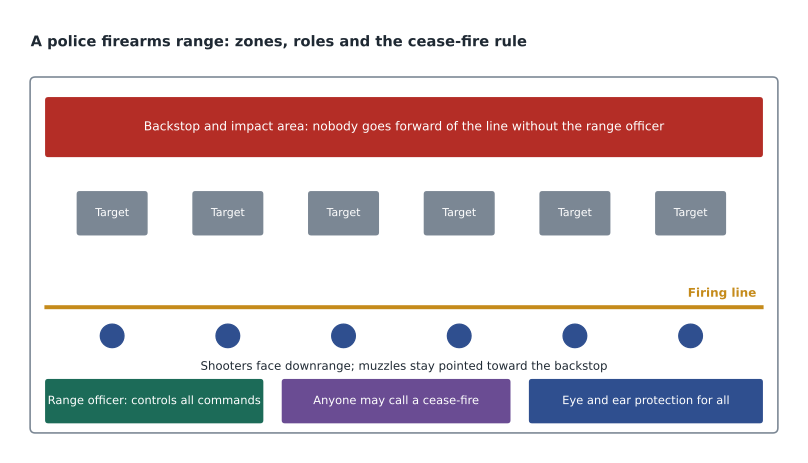
Every police range session has one person in charge, usually called the range officer or range safety officer, who controls everything that happens on the firing line. The range officer gives every command, decides when firearms may be loaded, when shooting may begin and when it must stop, and decides who may go forward of the firing line and when. On Ferris's range, the range officer is always a certified firearms instructor, and on busy days a second instructor watches the line while the first gives commands. Rank does not change the arrangement. A constable who is an instructor running the line gives orders to a superintendent who is qualifying, and the superintendent follows them.
The commands themselves vary between services, but they follow the same pattern. Shooters are told when to load and prepare, when to fire, when to stop, when to unload and show their firearms clear, and when the line is safe to go forward. Nothing happens on the line without a command, and shooters do not anticipate commands or act on what they think the range officer meant. Ferris says that the most dangerous person on a range is the experienced officer who decides they know what comes next. 'Wait for the command,' she says. 'Every time.'
Anyone can call a cease-fire
There is one exception to the range officer's control: anyone on the range can call a cease-fire. If any person sees something unsafe, such as a muzzle pointed in the wrong direction, a person forward of the line, a firearm behaving strangely, an injury or a stranger coming through a door, they call out a cease-fire loudly and clearly. Everyone stops shooting immediately, keeps their muzzle downrange, takes their finger off the trigger and waits for instructions. The range officer then finds out what happened and decides what to do next.
The rule exists because the range officer cannot see everything. A shooter at the end of the line may be the only one who notices a colleague's muzzle drifting toward the next booth. A shooter who feels something wrong with their own firearm may need everyone to stop so that it can be dealt with safely. Ferris tells the class that she has never criticized anyone for calling a cease-fire, even when it turned out to be unnecessary. 'I would rather stop the line a hundred times for nothing than miss the one time it mattered,' she says. Calling a cease-fire is the clearest expression of a safety culture: the newest recruit on the range has the authority to stop everyone.
Cold ranges and hot ranges
Ranges operate under one of two broad approaches. On a cold range, firearms are unloaded and holstered or cased everywhere except on the firing line, and they are loaded only on command. On a hot range, used in some advanced police and military training, shooters keep their firearms loaded and holstered throughout, as they would on duty, and the rules focus on never drawing or handling a firearm except on the line and on command. Port Ardent's range is run cold for recruits and for most qualification, and hot only for specific advanced courses with experienced officers and extra instructors.
Whichever approach a range uses, the rules about where firearms may be handled are strict. Behind the firing line, nobody draws, loads, unloads or handles a firearm except at a designated safe area, if one exists. Ammunition is kept in a separate area. Firearms that are being repaired, inspected or stored are kept with their actions open. Anyone entering the range is told, in a short safety briefing, what kind of range it is and what the rules are.
The safety briefing
Every range session at Port Ardent starts with a safety briefing, even when every shooter has heard it dozens of times. The briefing covers the four safety rules, the type of range, the commands that will be used, how to call a cease-fire, what to do if a firearm malfunctions, where the first aid kit, trauma kit and defibrillator are, who is trained in first aid, how to call for an ambulance and how to direct it to the range, and where everyone should go if there is a fire. The range officer also asks each shooter whether they are fit to shoot that day, which means not impaired by alcohol, drugs or medication, not ill, not injured in a way that affects their handling of the firearm and not so tired that they cannot concentrate.
Ferris explains why she never skips the briefing. 'The day I skip it is the day someone collapses and nobody remembers where the defibrillator is,' she says. She also uses the briefing to set the tone. An instructor who rushes through it tells shooters that safety is a formality. An instructor who takes it seriously tells them it matters.
Protecting eyes, ears and lungs
Firing a firearm produces noise loud enough to damage hearing permanently with a single unprotected exposure, especially indoors where sound reflects off walls. It throws out hot spent cases and small fragments, and it releases gases and particles, including lead, into the air. Ranges protect shooters in several ways.
| Hazard | Main protection | Notes |
|---|---|---|
| Noise | Hearing protection for everyone on the range; many ranges require earplugs and earmuffs together indoors | Hearing loss from gunfire is permanent and builds up over a career |
| Flying cases and fragments | Impact-rated eye protection for everyone, including instructors and visitors | A hot case can land behind glasses or inside a collar |
| Lead and other residue | Ventilation that draws air away from shooters, cleaning procedures and personal hygiene | No eating, drinking or smoking on the range; wash hands and face after shooting |
| Ricochet and splash | Proper backstops, minimum distances for steel targets and approved ammunition | Bullets and fragments can bounce off hard surfaces |
| Injury or medical emergency | First aid and trauma kits, a defibrillator, trained staff and an emergency plan | Know where the kit is and how the ambulance will find the range |
Lead deserves special attention because its effects are slow and invisible. Older ammunition and the bullets that strike a backstop release lead dust and fumes, which can be breathed in or swallowed when people touch their faces or eat without washing. Over time, lead exposure can affect the nervous system, kidneys and blood, and it can be carried home on clothing to children. In Ontario, lead is a designated substance under the province's occupational health and safety rules, and employers whose workers are exposed must assess the risk and put controls in place. Police ranges reduce exposure through ventilation, regular cleaning, lead-free primers and, in many services, lead-free training ammunition, and by testing the blood of instructors who spend many hours on the range.
Ferris says that the habits are simple and often ignored. Do not eat, drink or touch your face on the range. Wash your hands and face with cold water and soap before you eat or go home. Change out of range clothing before you hug your children. 'Your kids should not be paying for your qualification,' she says.
| Protection | Reduction assumed | About what reaches the ear |
|---|---|---|
| None | 0 dB | 160 dB |
| Earplugs only | 29 dB | 131 dB |
| Earmuffs only | 25 dB | 135 dB |
| Plugs and muffs together | 29 dB plus about 5 dB for the second layer | 126 dB |
The rule of thumb behind the last row is that a second layer adds only a few decibels to the better of the two ratings. It does not add the two ratings together, so plugs and muffs do not give 54 dB of reduction.
The figures are illustrative and real ratings depend on fit, but the lesson holds. No hearing protection makes indoor gunfire quiet, and wearing two layers helps less than people expect. That is why ranges also limit how long instructors spend on the line and why services test the hearing of officers who shoot often.
Accounting for ammunition and firearms
The range log that Ferris showed in the first class is part of the range's safety culture. Every round of ammunition issued is counted, every round fired is recorded and every round returned is checked back in. Every firearm brought onto the range is logged, inspected and logged out again. The counting serves several purposes. It prevents ammunition from going missing, it shows how much training each officer has had, and it creates a record if something goes wrong. If a firearm malfunctions or a round goes astray, the range officer can see exactly which firearm, which ammunition and which shooter were involved.
The range also keeps a record of incidents, including near misses that caused no harm, such as a muzzle sweeping across a neighbouring booth or a cease-fire called because a shooter stepped forward of the line. Ferris reviews the near miss record every quarter. Patterns, such as several muzzle errors on the left side of the line, which turned out to be caused by a booth partition that pushed shooters to turn awkwardly, lead to changes in the range or the training.
A culture you can see
Desjardins asks the students how a visitor could tell, within a few minutes, whether a range had a good safety culture. The students suggest several signs: everyone wearing eye and ear protection, including instructors; firearms left with actions open when not in use; nobody handling firearms behind the line; shooters waiting for commands rather than anticipating them; and the range officer correcting small lapses calmly every time, without embarrassing anyone. Priya Sandhu adds one more. 'People call cease-fires,' she says, 'and nobody rolls their eyes.' Ferris says that is the best answer she has heard from a class.
Ferris also points out that a range's culture is shaped by its worst day. Ranges in North America have had serious incidents, including instructors and shooters injured by unintended discharges, ricochets from steel targets set too close, and people walking downrange during firing. Each incident led to changes in range design, procedures or training across many services. 'Every rule I enforce has a story behind it,' Ferris says. 'Most of them are stories I would rather not tell.'
Worked problem
Running the line
During qualification, a shooter in booth 4 calls a cease-fire because the shooter in booth 5 has turned to speak to the instructor with his pistol still in his hand. The range officer stops the line. What should happen next?
Show solution
- Everyone stops firing, keeps muzzles downrange, takes fingers off triggers and waits.
- The range officer approaches booth 5, has the shooter face downrange and makes the firearm safe on command.
- The range officer explains the problem calmly and confirms booth 4 was right to call the cease-fire.
- The incident is recorded as a near miss, even though nobody was hurt.
- The range officer resumes firing only when the line is safe and everyone is ready.
Answer: The cease-fire worked as intended. The near miss is recorded and the shooter in booth 4 is thanked, which encourages others to speak up.
Common mistakes
MistakeOnly the range officer may stop the shooting.
InsteadAnyone on the range may call a cease-fire, and everyone must stop immediately.
MistakeSenior officers may disregard range commands.
InsteadRank does not change who is in charge on the line; the range officer controls everyone.
MistakeEarplugs and earmuffs together give protection equal to both ratings added.
InsteadWearing both adds only a few decibels of protection beyond the better one.
MistakeWashing up after shooting is a matter of personal preference.
InsteadLead residue can be swallowed or carried home; washing is part of range safety.
Summary and key terms
- One range officer controls every command on the firing line, regardless of rank.
- Anyone may call a cease-fire, and everyone must stop at once.
- Cold ranges keep firearms unloaded except on the line on command; hot ranges are used only in some advanced training.
- Every session starts with a safety briefing that includes the medical and emergency plan and a fitness check.
- Hearing, eye and lead hazards are controlled by protection, ventilation, procedures and hygiene.
- Ammunition, firearms and near misses are recorded so problems can be found and fixed.
- Designated substance
- A hazardous substance, such as lead, that Ontario employers must assess and control.
- Range officer
- The person who controls all commands and movement on the firing line.
- Cease-fire
- An immediate stop to all shooting, which anyone on the range may call.
- Cold range
- A range where firearms are unloaded except on the firing line on command.
- Hot range
- A range where shooters keep firearms loaded and holstered, used only in some advanced training.
- Bullet trap
- An angled steel or rubber structure that captures bullets safely.
- Near miss
- An unsafe event that caused no harm but is recorded so the cause can be fixed.
Practice problems
Work each problem on paper first, then reveal the answer to check.
Who controls the firing line?
Show answer
The range officer, regardless of the rank of the shooters.
What should every shooter do when a cease-fire is called?
Show answer
Stop firing, keep the muzzle downrange, take the finger off the trigger and wait for instructions.
Name three items in a range safety briefing.
Show answer
Any three of the safety rules, range type, commands, cease-fire, malfunctions, first aid and defibrillator location, emergency plan and fitness check.
Why should shooters wash their hands and faces after shooting?
Show answer
To avoid swallowing lead residue or carrying it home.
Lesson quiz · 5 questions
Score 60% or more to complete this lesson.
Create a free account to save your progress, take quizzes and earn a certificate.