
LES-207 · Lesson 7 of 12 · 20 min
Malfunctions, maintenance and safe storage
▶ Video coming soon A video version of this lesson is on the way.
The seventh class starts with a sound. Ferris plays a short recording from a range camera: a string of shots, then a quieter pop that sounds wrong, then silence as the shooter stops, lowers nothing, keeps the pistol pointed at the backstop and raises his other hand. The range officer's voice calls a cease-fire. 'That,' Ferris says, 'is the best thing I have on video. That officer heard a shot that sounded weak, and he stopped. If he had fired again, there was a good chance his pistol would have been badly damaged and he would have been hurt.' The armourer later found a bullet lodged in the barrel. A cartridge had been missing most of its powder, so the bullet had not been pushed all the way out.
This lesson covers three practical parts of firearms responsibility that rarely make the news: what to do when a firearm does not work as expected, how firearms are maintained so that they keep working, and how they are stored so that the wrong person cannot get them. All three are about preventing harm before anyone draws a firearm in a real situation.
When a firearm does not work as expected
A malfunction is any failure of a firearm to work as designed. Modern police firearms are very reliable, but malfunctions still happen, because of ammunition faults, dirt, worn or broken parts, a damaged magazine or the way the firearm is held. Common types include a firearm that does not fire when the trigger is pressed, a spent case that is not thrown clear, a new cartridge that does not feed properly into the chamber, and a weak or unusual shot. Each has different causes, and each is handled in a particular way that instructors teach on the range with the service's firearms.
Whatever the type, the safety principles are the same. Keep the muzzle pointed in a safe direction. Take the finger off the trigger. Do not look down the barrel or point the firearm at yourself or anyone else to see what is wrong. On the range, stop, signal the range officer and wait for instructions. On the street, officers are trained in a short procedure for the most common malfunctions, which they practise on the range until it is automatic, but even then the safety rules do not change.
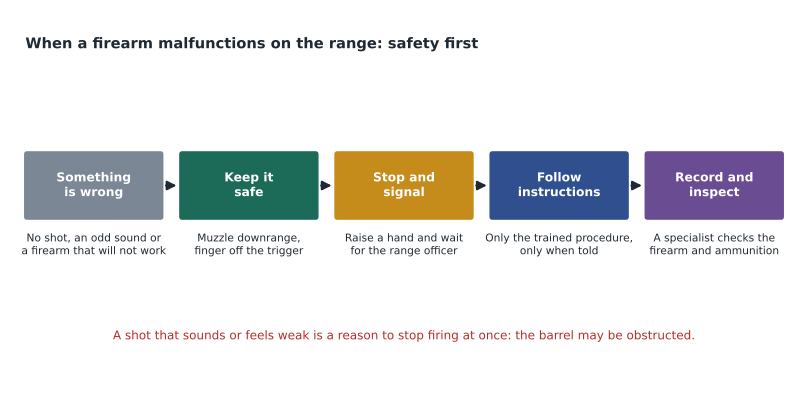
Two situations call for special caution. The first is a shot that sounds or feels weak, like the one in Ferris's recording. A weak shot can mean that a bullet has stuck in the barrel. If another round is fired behind it, the barrel can burst and the shooter and people nearby can be injured. The rule is to stop firing immediately and have the firearm inspected. The second is a cartridge that does not fire when the trigger is pressed. Very occasionally, a cartridge fires a moment late, which is called a hang fire. Firearms safety courses therefore teach shooters to keep the muzzle pointed in a safe direction for a period after a cartridge fails to fire before doing anything else. On the range, the range officer decides when it is safe to proceed.
Every malfunction on Ferris's range is recorded, along with the firearm's serial number and the ammunition lot. Patterns help find causes. In 2023, three similar malfunctions in a month led Ferris to a batch of magazines with weak springs, which the manufacturer replaced. 'Malfunctions are information,' she says. 'Write them down.'
Maintenance and inspection
Firearms need regular cleaning, lubrication and inspection to keep working reliably. Police services divide this work between officers and armourers. Officers are typically responsible for routine cleaning, following a set procedure, after range sessions and at regular intervals, and for reporting any damage or unusual behaviour at once. Certified armourers, who have been trained by the manufacturer or an equivalent program, inspect every firearm on a schedule, replace worn parts, test function and keep a service record for each firearm.
The safety rules for cleaning are strict, because cleaning is one of the most common moments for unintended discharges outside police work. The firearm is proven unloaded before cleaning starts, all ammunition is removed from the room, the muzzle stays in a safe direction throughout and the firearm is checked again before it is reassembled and reloaded. Many services require cleaning to be done at the station or the range, not at home. Ferris tells the class that she has investigated two cleaning discharges in her career, both by officers who were sure the firearm was empty.
| Task | Who does it | When |
|---|---|---|
| Routine cleaning and lubrication | The officer, following the service procedure | After every range session and at set intervals |
| Function check before duty | The officer, at the clearing station | Each shift or as policy requires |
| Detailed inspection and parts replacement | Certified armourer | On a schedule and after any malfunction or damage |
| Magazine inspection | Officer and armourer | Regularly, and whenever a feeding problem occurs |
| Ammunition rotation | Range staff | Duty ammunition is replaced on a schedule and used for training |
| Serial | Last inspected (day) | Due (day) | Status |
|---|---|---|---|
| CB-0207 | 130 | 310 | Due in 10 days |
| PA-1043 | 112 | 292 | Overdue by 8 days |
| PA-1044 | 40 | 220 | Overdue by 80 days |
| PA-1051 | 250 | 430 | Due in 130 days |
| PA-1060 | 95 | 275 | Overdue by 25 days |
Each due date is the last inspection day plus 180. Comparing it with today, day 300, gives the status: a due day earlier than 300 is overdue by the difference, and a later one is due in the difference.
In the invented records, two firearms have passed the six-month inspection interval and one is close to it. Many services use software that flags overdue inspections automatically, but someone still has to act on the flag.
Ammunition also needs care. Duty ammunition that is carried every day is exposed to heat, cold, moisture, oil from cleaning and handling. Services replace duty ammunition on a schedule, and often use the old ammunition for training, so that the rounds officers carry on duty are always in good condition.
Storage at the station and in transit
Police firearms that are not being carried are stored in ways that make them inaccessible to anyone not authorized. At the station, that means individual lockers or a vault, with keys or codes controlled by the service, and logs showing who took what and when. Long guns in patrol cars are kept in locked racks or cases. When firearms are moved, for example to an outside range or to an armourer, they are transported unloaded in locked cases, with the ammunition separate, and the transfer is recorded.
Storage at home
Most Canadian police services do not allow officers to take duty firearms home, so home storage usually concerns officers' personal firearms. Those are covered by the federal Storage, Display, Transportation and Handling of Firearms by Individuals Regulations, which do not apply to officers acting in the course of their duties but apply fully to their personal firearms. Under those regulations, a restricted firearm, such as most handguns, must be stored unloaded and either made inoperable with a secure locking device and kept in a securely locked container or room that is difficult to break into, or kept in a vault, safe or room built or modified for the purpose. Ammunition must be stored separately and securely unless it is in such a vault, safe or room. Non-restricted firearms have their own rules. Services where officers are authorized to take a firearm home set storage rules at least as strict.
Ferris tells the class about a case from Bay Township, the fictional neighbouring jurisdiction used elsewhere in the program. In 2024, a Bay Township officer travelling to a firearms course in another city left his service pistol in a locked case in his car overnight at a hotel, against his service's transport policy. The car was broken into and the pistol was stolen. It was recovered eight months later during a robbery investigation in another province. The officer was disciplined, and the service changed its rules so that officers travelling with firearms must store them in an approved safe at their destination. 'A police firearm in the wrong hands is one of the worst things that can come out of carelessness,' she says. 'Most of these thefts are from cars.'
Storage, families and suicide risk
Secure storage also protects the people officers live with, and officers themselves. Children and teenagers are curious and may not believe a firearm is real or dangerous, and a firearm that is stored unloaded and locked cannot be reached in a moment of curiosity, conflict or crisis. Research on suicide consistently finds that putting time and distance between a person in crisis and a firearm saves lives, because many suicidal crises are brief and firearms are especially lethal. Police officers face high stress, and like other emergency workers, some experience depression or suicidal thoughts. Secure storage, and the willingness of colleagues and families to ask an officer to let someone else hold their firearms for a while during a difficult time, is part of looking after each other.
If you or someone you know is thinking about suicide, you can call or text 9-8-8 at any time in Canada to reach the Suicide Crisis Helpline. Police services also offer peer support teams and confidential access to clinicians, which Lesson 11 describes.
Reporting losses and thefts
A lost or stolen police firearm must be reported immediately, both inside the service and to the national systems that track stolen firearms, so that the firearm can be identified if it is recovered. Police services enter lost and stolen firearms into the Canadian Police Information Centre, and the theft of a firearm is also reported to the provincial firearms officer as required. The officer responsible writes a detailed report, and the service investigates both the loss and whether policy was followed. Ferris says that the first hour matters most. 'Report it at once, even if you think it might just be misplaced,' she says. 'An embarrassing report is far better than a police pistol on the street with nobody looking for it.'
Storage in patrol cars and during calls
Storage rules also apply during a shift. Long guns stay locked in their racks unless an officer has a reason that meets policy to take them out, and they are returned and locked as soon as that reason ends. A firearm is never left unattended in a patrol car, even for a few minutes, unless it is locked in a rack or secure box designed for the purpose. Officers who go into a hospital, a courthouse or a custody area where firearms are not allowed use the lockboxes provided at the entrance, and they record that they have done so.
Ferris tells the class that the most common storage mistakes she sees are small ones made in a hurry: a rifle rack left unlocked after a call, a spare magazine left on a car seat, a lockbox key left in the lock. Each one is reported and corrected, and patterns lead to changes such as racks that lock automatically when closed. 'Most firearms that go missing go missing during ordinary days,' she says. 'Nobody plans to lose one.'
Desjardins adds that the same discipline applies when officers take temporary custody of other people's firearms, for example during a domestic dispute or a mental health call. Those firearms are made safe by a trained officer, documented, receipted to the owner and stored in the property room under the same controls as evidence until they are returned or a court decides otherwise.
Worked problem
Applying the storage rules
A recruit who will soon be sworn in asks how she should store a personal hunting rifle she owns in her apartment, where her teenage brother sometimes stays. What principles apply, whatever the exact law in her jurisdiction?
Show solution
- Store the rifle unloaded at all times.
- Lock it, using a locking device, a locked cabinet or a safe, so that nobody else can use it.
- Store ammunition separately and locked, unless both are in a proper safe.
- Keep the keys or combination where the brother cannot get them.
- Check the specific legal requirements that apply to her firearm and location, and any service policy on personal firearms.
Answer: Unloaded, locked, separated from ammunition and inaccessible to anyone else. These principles meet or exceed the legal requirements in most places and protect everyone in the home.
Common mistakes
MistakeIf a shot sounds weak, fire again to clear the barrel.
InsteadStop firing at once; a bullet may be stuck in the barrel, and another shot could burst it.
MistakeA cartridge that fails to fire can be removed immediately.
InsteadKeep the muzzle pointed safely for a period first, because a hang fire can fire late; on the range, wait for the range officer.
MistakeOfficers can do any repair they are comfortable with.
InsteadOfficers do routine cleaning; inspections, parts and repairs are done by certified armourers.
MistakeLeaving a firearm in a locked car is safe storage.
InsteadMany police firearm thefts are from cars; policies forbid leaving firearms in vehicles overnight.
Summary and key terms
- Whatever the malfunction, keep the muzzle safe, the finger off the trigger and, on the range, wait for the range officer.
- A weak-sounding shot means stop at once, because the barrel may be obstructed.
- Officers clean and check their firearms; certified armourers inspect, repair and keep service records.
- Firearms are stored in locked lockers, vaults, racks and cases, with logs of who has them.
- Personal firearms must meet federal storage regulations; restricted firearms must be unloaded and locked, with ammunition stored securely.
- Secure storage protects families and helps prevent suicide; losses and thefts are reported at once.
- Storage regulations
- The federal rules for storing, displaying, transporting and handling firearms by individuals.
- CPIC
- The Canadian Police Information Centre, the national police database that records stolen firearms.
- Malfunction
- Any failure of a firearm to work as designed.
- Hang fire
- A cartridge that fires a moment after the trigger is pressed.
- Obstructed barrel
- A barrel with a bullet or object stuck in it, which is dangerous to fire.
- Armourer
- A person certified to inspect, maintain and repair a service's firearms.
- Ammunition lot
- A batch of ammunition made together, recorded so problems can be traced.
Practice problems
Work each problem on paper first, then reveal the answer to check.
Why must a shooter stop after a weak-sounding shot?
Show answer
A bullet may be stuck in the barrel, and another shot could burst it.
Who replaces worn parts on a duty firearm?
Show answer
A certified armourer.
What are the core principles of home storage?
Show answer
Unloaded, locked, ammunition stored separately and inaccessible to others.
Why does secure storage help prevent suicide?
Show answer
It puts time and distance between a person in a brief crisis and a highly lethal means.
Lesson quiz · 5 questions
Score 60% or more to complete this lesson.
Create a free account to save your progress, take quizzes and earn a certificate.